How to Get Backlinks for a Business Website
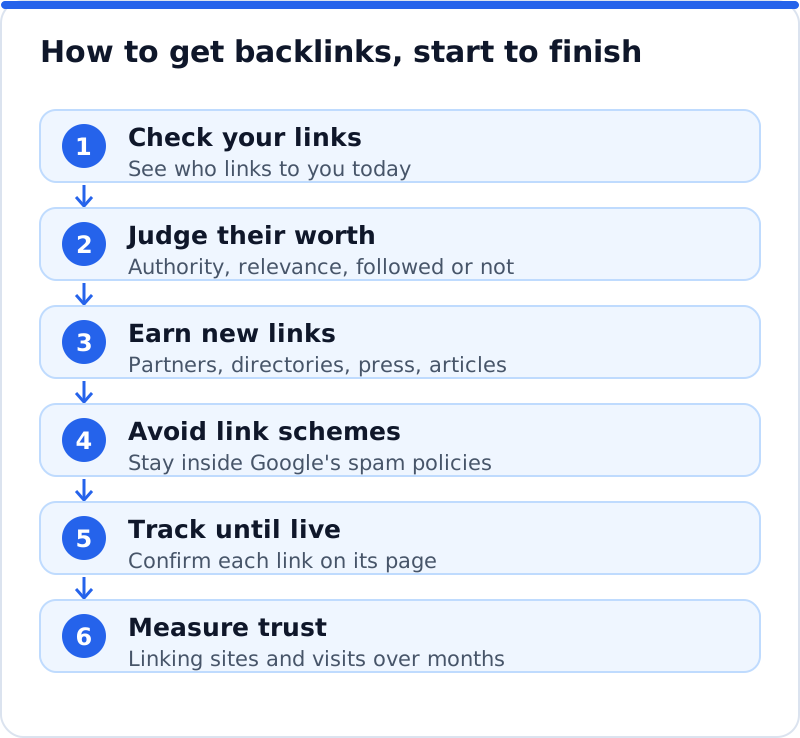
A backlink is a sentence on somebody else's website that sends its readers to yours, and search engines read it as a small, public vote of confidence. Most business owners know links matter, yet few have a plan for how to get backlinks that is honest and steady. The best links for a business rarely come from tricks: they come from suppliers, associations, local news, trade publications and people who already talk about you. You will see what makes one link worth more than another, how to find the links you have and every dependable way to earn new ones. You will also find Google's link spam policies in plain words, a way to track each link until it is live, a 90-day plan and a way to measure growing trust. It all starts with our ai website generator.
Every site that links to yours, its authority and relevance, the trust your backlinks earn and the links your competitors have.
Check your backlinks with the AI Backlink Checker →What backlinks are and why Google counts them
A backlink is a link from a page on another website to a page on yours. If a garden centre in Portland writes about native plants and links to a landscaping company's page on drought-tolerant lawns, that company has earned a backlink. Search engines use links to discover pages, because crawlers follow links from page to page, and as one of many signals about which pages deserve to rank. The idea goes back to Google's original PageRank system, which treated a link as a vote and gave more weight to votes from well-linked pages. Content that answers the search well remains the foundation, but links from respected, relevant websites still show that others vouch for a page.
For a business, links do more than help rankings. A link from a local news story or a trade association directory sends real visitors, and those visitors often arrive already trusting you because someone they trust pointed the way. Links also help new pages get found, since crawlers discover pages by following links from pages they already know. They support your reputation when a prospective client researches you and finds your name on respected sites. In short, learning how to get backlinks is partly SEO and partly ordinary marketing, and each supports the other.
What makes one link worth more than another
Links are not equal, and a business that understands why will spend its time far better. The first factor is the authority of the linking website, which third-party tools estimate with scores such as Open PageRank. The second is relevance: a link to a physiotherapy clinic in Bristol from a regional sports club makes more sense than one from a casino review site. The third is whether the link is followed, because rel="nofollow", rel="sponsored" and rel="ugc" ask Google not to pass ranking credit, and Google treats them as hints rather than strict commands. The fourth is placement, since a link inside the main text carries more weight than one buried in a footer or a long sidebar list.
Anchor text, the clickable words of the link, also matters. A link reading "Hartley Architecture" or "this Rotterdam practice" looks natural, while hundreds of links all reading "best architects Rotterdam" look arranged, and Google's policies name optimised anchor text in guest posts and press releases as a warning sign. The linking page's own quality counts too: a page with real content and real readers passes more value than a page listing two hundred unrelated links. Freshness plays a part, because a link on a page that is still maintained and visited is worth more than one on an abandoned page. Taken together, these factors explain why twenty relevant links from respected local and industry sites usually do more for a business than a thousand links from places nobody visits.
| Factor | A stronger link | A weaker link |
|---|---|---|
| Authority | Regional newspaper or national trade body | New site with no links of its own |
| Relevance | Industry association or local partner | Unrelated site in another sector |
| Follow status | Normal followed link in the text | Marked nofollow or sponsored |
| Placement | Inside the body of an article | Site-wide footer or long sidebar list |
| Anchor text | Business name or a natural phrase | The same exact keyword every time |
| Linking page | Read, updated, few outbound links | Page of hundreds of unrelated links |
See the links you already have
Before you ask anyone for a link, find out who already gives you one. Google Search Console includes a Links report that shows your top linked pages, the top linking sites and the most common linking text, grouped by root domain. It is a sample rather than a complete list, its tables stop at 1,000 rows, and it does not say whether a link is nofollow, but it costs nothing and comes straight from Google. Bing Webmaster Tools has its own backlinks report built from Bing's crawl, which often shows sites that Google's sample leaves out. Commercial link indexes and a backlink checker fill in the gaps by crawling the web themselves, and the better ones confirm that each link still exists on its page.
Reading your existing links tells you where to start. You may find that a supplier links to an old address that now shows "not found", which means the link is wasted until you redirect that page. You may see that your trade association lists you without a link at all, or that your strongest links all point to the home page while your service pages have none. You may also discover a competitor's links that are open to you too, such as a chamber of commerce directory or a local business awards page. A simple spreadsheet with the linking site, the page, the target page and whether the link is followed is enough to turn this into a working list.
How to get backlinks from people who already know you
The warmest links come from relationships you already have, and most businesses have more of them than they think. Suppliers and manufacturers often keep a "where to buy" or "stockists" page, and a wine shop in Bordeaux that sells a small producer's bottles has every reason to be listed there with a link. Partners do the same: a bookkeeper who works with a payroll provider, or an IT support company that installs a particular software, can each mention the other where it genuinely helps their clients. Clients sometimes publish case studies or thank-you posts, and a polite request to include a link costs them nothing. Even former staff who now run their own businesses may be happy to mention where they trained.
Associations and memberships are the second circle. Trade bodies, professional registers, chambers of commerce, business improvement districts and local networking groups usually publish a member directory, and many of those listings can carry a link to your website. These links tend to be relevant, trusted and stable. Check that every membership listing shows your current name, address, phone number and website. An HVAC contractor in Columbus who belongs to a state contractors' association, a chamber and a manufacturer's dealer programme may already be entitled to three good links before doing anything new.
Directories and citations worth having
Business directories still matter, though not in the way they did fifteen years ago. A citation is any listing of your business name, address and phone number, and the important ones help customers and search engines confirm that your details are consistent across the web. Google Business Profile, Bing Places and Apple Business (which replaced Apple Business Connect in April 2026) come first, because they feed maps and local results, even though their links are not the main point. After those come the major general directories in your country, the directories of your own industry and the local listings run by councils, chambers and newspapers. Each listing should use exactly the same business name, address and phone number, since inconsistencies make it harder for search engines to match the listings to you.
The directories to avoid matter just as much. A directory that accepts anyone who pays and exists only to sell links is what Google's policies call low-quality directory links. Warning signs include thousands of near-empty categories, no editorial checks and no sign of real visitors. A quick test is whether a customer looking for your kind of business would ever use it. If the honest answer is no, the listing will not help.
Press, local news and trade publications
Coverage in a newspaper, a local news website or a trade magazine is one of the most valuable links a business can earn, because those sites are trusted and read. The key is news, not advertising: a journalist needs a story their readers care about. A florist in Edinburgh that supplies flowers for a city festival, a bike repair shop in Copenhagen that starts a repair class for refugees, or an engineering firm that wins a regional contract each has a genuine angle. Data you hold can be news too, such as a seasonal trend you see in your bookings, provided you present it honestly. Short, clear pitches to the right reporter work better than long releases sent to everyone.
A press release sent through a paid wire service is a different thing. Those copies are often syndicated onto many sites with nofollow links, and Google's policies specifically mention press releases with optimised links as a form of link spam. That does not make press releases useless: a well-written release still helps journalists understand your story, and the coverage they write is what earns the link. When a journalist writes about you, it is reasonable to ask whether they can link to the relevant page, but accept their editorial decision gracefully. Coverage without a link still brings readers, brand searches and credibility.
Guest articles and expert contributions
Writing an article for another website can earn a link and, more importantly, put your expertise in front of a relevant audience. A kitchen fitter in Nottingham writing for a home renovation magazine, or a family law firm in Chicago contributing a piece on custody arrangements to a parenting website, gives that site's readers something genuinely useful. The author bio normally links back to your website, and sometimes the editor allows a link within the text where it truly helps the reader. The best hosts are publications your customers actually read, such as trade journals, regional business sites and the blogs of partner organisations. Pitch three specific ideas, write the piece to the host's standards and keep the link modest.
Google draws a clear line around guest posting. Its spam policies list paid articles whose links pass ranking credit, and guest posts with optimised anchor text, as link spam, and in 2017 it warned specifically about large-scale article campaigns, such as the same thin article sent to dozens of sites whose only interest is selling space. A sensible rule is to write fewer, better pieces for sites you would be proud to be seen on. If a site asks for payment to publish your article with a followed link, that is a paid link and should be marked sponsored or declined. One respected article a quarter will do more for a business than a monthly batch of cheap placements.
Unlinked mentions and resources people cite
Pages that mention your business without linking to it are the easiest links to ask for. Someone has already decided you are worth naming, so a short, friendly note asking whether they could add a link to your website is often welcome. Search for your business name in quotation marks, the names of your products and services, the names of your key people and common misspellings, and exclude your own website from the results. Set up alerts for your name so new mentions reach you while they are fresh. Contact the writer or editor rather than a general inbox, thank them for the mention and suggest the exact page that would help their readers.
Useful resources earn links on their own over time. A clear guide, a checklist, a local map, a calculator or a page of honest answers to common questions can become the page that bloggers, journalists and community groups cite. A mortgage broker in Glasgow might publish a plain-English guide to first-time buyer schemes, and a pest control company in Atlanta might keep a seasonal guide to termites in Georgia. These pages need to be better than what already exists, and they need to be kept accurate, because nobody cites a page that has gone stale. Once the page is live, tell the people who would find it useful, such as local reporters, community groups and partners.
Sponsorships, events and reviews
Local sponsorships and events create links naturally, because organisers usually thank their supporters on their websites. Sponsoring a youth football team, a charity run or a neighbourhood festival puts your name in front of the community and often earns a link from the club or event page. Hosting an event, a workshop or a meet-up can earn listings on event calendars and local news sites. Choose causes and events that fit your business and your customers, since relevance matters for both the link and the goodwill. If a sponsorship comes with a link that exists purely because you paid, it should be marked sponsored, and that is perfectly fine because the value is in the visibility.
Reviews of your business on respected sites can also bring links. Industry review platforms, local guides and consumer publications sometimes link to the businesses they feature, and a good review profile builds trust even when the link is nofollow. Encourage honest reviews, but never offer payment or discounts for positive ones, which breaks the rules of most review platforms. Awards and accreditations work in a similar way, since winners and members are usually listed. Each channel is slow alone, but together they build a varied set of links no shortcut can imitate.
| Link source | Effort | Typical value for a business |
|---|---|---|
| Suppliers, partners and clients | Low | High relevance, often followed |
| Associations and chambers | Low | Trusted and stable |
| Key directories and citations | Low to medium | Consistency, local trust |
| Unlinked mentions | Low | Warm, relevant, quick to win |
| Local news and trade press | Medium to high | High authority and real visitors |
| Guest articles | Medium | Relevant audience, expert reputation |
| Useful resources | High | Links that keep arriving over time |
What never to do, and Google's link spam policies
Google defines link spam as creating links to or from a website mainly to manipulate search rankings, and its spam policies give clear examples. Know these examples well enough to recognise them when a seller offers them under a friendlier name. The policies make an important distinction: buying links for advertising is normal, provided the links are marked with rel="nofollow" or rel="sponsored" so they pass no ranking credit. What breaks the rules is paying, swapping or automating links in order to rank. The main examples Google lists are these.
- Buying or selling links that pass ranking credit, including paying with money, goods or services, or sending products in exchange for a followed link.
- Excessive link exchanges ("link to me and I will link to you") and partner pages built only to swap links.
- Automated programs or services that create links to a website, and low-value content made mainly to manipulate links and rankings.
- Paid advertorials and text links that pass ranking credit, and articles, guest posts or press releases on other sites with optimised anchor text.
- Low-quality directory or bookmark links, widely distributed widget, footer or template links, and forum posts or signatures with optimised links.
Google enforces these policies with automated systems and, where needed, human review. A human reviewer can issue a manual action, which appears in the Manual actions report in Search Console, and Google says websites that violate its policies may rank lower or not appear at all. Private blog networks, which are groups of websites built or bought to link to a client, are a form of link scheme even when they look like real blogs. Offers of "100 high authority links" for a small fee, guaranteed placements on news sites and "permanent dofollow links" are almost always one of the examples above. If you inherit a website with questionable links, deal with it calmly and carefully, but do not add to the problem.
Tracking every link until it is live
A link that was promised is not a link until it appears on the page. Agreements slip, editors change their minds, pages get rebuilt, and a directory listing may wait weeks in a moderation queue. Keep one tracker for every link you pursue, with the site, the contact, the date you asked, the page you hoped they would link to, the status and the date you confirmed it live. Once a link appears, check that it points to the right page, that it works, and whether it is followed or marked nofollow or sponsored. Note the anchor text too, so you can watch your anchor mix.
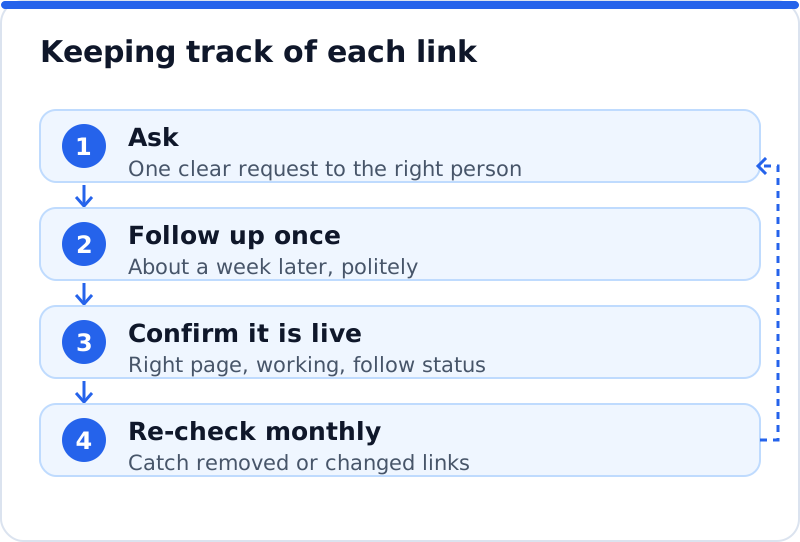
Links also disappear after they go live. A partner drops its stockists page, a news site moves its archive, or a directory closes. Re-checking your important links every month or two lets you ask for a fix while the contact still remembers you. Watch your own side too, because a link to a page you later deleted or moved is wasted. Keeping old addresses redirected protects links you earned years ago, and it is one of the simplest wins available.
A 90-day plan for business link building
Link building works best as a steady habit rather than a burst of activity. Two or three hours a week for three months is a realistic budget for one person alongside a normal job. The plan below starts with the quickest wins, the links you are already owed, before moving on to work that takes more effort. Adjust the order to suit your sector, but finish each stage before starting the next. After day 90, keep the tracker going and repeat the cycle each quarter with a new resource, a new story or a new partner.
| Weeks | Focus | What done looks like |
|---|---|---|
| 1 to 2 | Check existing links and fix broken targets | A tracker of current links, old pages redirected |
| 3 to 4 | Suppliers, partners, associations, memberships | Every relationship asked once, listings corrected |
| 5 to 6 | Key directories and unlinked mentions | Main citations consistent, mentions contacted |
| 7 to 9 | One useful resource and a local news pitch | Resource published, three journalists pitched |
| 10 to 12 | One guest article and a sponsorship or event | Article pitched or placed, event confirmed |
Measuring trust over time
Counting backlinks alone is misleading, because one website can link to you hundreds of times from a site-wide footer. The better measure is the number of distinct linking websites, often called referring domains, with their quality and relevance. Track it monthly, with the followed share and which of your pages receive links. Losing one strong linking site matters more than gaining several weak ones. Authority scores from third-party tools can show a trend, but they are estimates and should never become the goal.
The real test is in your search results and enquiries. In Search Console's Performance report, compare impressions and clicks for the pages that gained links with the same period before, allowing for seasonality, since links usually take weeks or months to show an effect. Look at referral visits in your analytics to see which links send people who stay, read and get in touch. A link from a local news story might send a burst of visitors, while a supplier's stockist page may send a few qualified buyers every week for years. Both count, and both tell you which kinds of links to pursue next.
How the AI Backlink Checker helps
The AI Backlink Checker brings these steps into one place. It finds the websites that link to yours using web search together with our own crawler, which visits each linking page to confirm the link is really there, and shows each site's authority, based on Open PageRank and shown on a scale of 0 to 100. It tells you whether each link is followed, flags spam signals, lists pages that mention your business without linking and gives your website a trust score. The full audit adds a judgement of how relevant each linking site is, your anchor text, toxic links with a disavow file and your link history over time. It also compares your links with a competitor's to show sites that link to them but not to you.
For building links, it supports three dependable channels: directory listings with a listing kit, a press release with suggested outlets, and guest posts with pitches you can adapt. Its link tracker confirms when each link you pursue is live on the page, so promised links do not quietly vanish. To see how links fit into the rest of your website's health, the AI SEO tools for business websites check on-site issues too, from titles to page structure. Together they show what to fix on your own pages and where your next links should come from. The decisions, the relationships and the writing remain yours, which is how good links are earned.
Questions business owners ask
How many backlinks does a business website need?
There is no fixed number, because what matters is how your links compare with the websites ranking for the searches you want. A plumber in a mid-sized town may compete with rivals who have a few dozen linking sites, while a national retailer competes with far stronger websites. Look at the businesses that rank above you and count their distinct linking websites rather than their total links. Then aim to match the quality and relevance of their best links, not their raw total. A handful of strong, relevant links often moves a local business further than a large number of weak ones.
How long do backlinks take to make a difference?
Google first has to find the linking page, crawl it and process the link, which can take days on a busy news site and much longer on a quiet one. After that, any effect on rankings tends to build gradually over weeks and months rather than overnight. Links also work alongside everything else on your page, so a strong link to a thin page may change little. Measure in quarters rather than weeks, and compare the pages that gained links with their own earlier results. Patience is part of the method, which is why a steady 90-day rhythm works better than a sudden push.
Is it fine to swap links with a partner business?
An occasional link between two businesses that genuinely work together is normal. What Google's spam policies name is excessive link exchanges, and partner pages that exist only for cross-linking. The test is whether each link would exist for the readers' sake if rankings did not matter. A florist linking to the wedding venue it supplies every weekend passes that test, while a page of fifty "partners" in unrelated trades does not. Keep reciprocal links few, relevant and written into pages where they help, and never agree to a swap simply because someone offered one.
Can a brand-new website get backlinks?
Yes, and the first ones usually come from the business rather than the website. A new company still has suppliers, an accountant, a bank, a trade body, a chamber of commerce and often a local paper that covers openings, and each is a reasonable first request. Complete the main directory listings in the first week, because they confirm the business exists and give search engines a route to the new pages. Do not buy a quick batch of links to look established, because that is exactly what Google's policies describe. Expect the first few months to be about foundations, with stronger coverage and articles following once there is a track record to talk about.
Your first week of link building
On day one, check who links to you using Search Console's Links report, Bing Webmaster Tools and a backlink checker, and put every linking site into one tracker. On day two, confirm that your strongest links point to working pages, and redirect any old addresses that now show "not found". On day three, list every supplier, partner, client, association and membership, and mark the ones that could reasonably link to you. On day four, send five friendly requests, each to a named person and each suggesting the page that would help their readers. On day five, search for unlinked mentions of your business and your key people, and add each to the tracker. By Friday you will know where you stand and have your first requests out, so open the tracker each Monday and keep the habit going.
All Backlinks guides
- How to Check the Backlinks of Any Website
- Unlinked Brand Mentions: The Easiest Links to Ask For
- Bing Webmaster Tools Backlinks: Seeing Every Link Bing Knows
- Competitor Backlink Analysis: Finding Links Your Rivals Have
- Backlink Quality: Authority, Relevance and the Links That Count
- Domain Authority Explained: What the Numbers Really Mean
- Anchor Text: How Links Describe Your Pages
- Nofollow vs Dofollow Links: Which Ones Count for SEO
- Link Building for Business: Directories, Press and Guest Posts
- Business Directory Listings: Which Ones Are Worth It
- Press Releases for SEO: Getting Coverage That Links Back
- Guest Posting for Businesses: Finding Sites and Pitching Well