Unlinked Brand Mentions: The Easiest Links to Ask For
How to find pages that already name your business without linking to it, choose the ones worth your time, write the request and track the result.
- Who links to you
- A trust score
- The competitor gap
Somewhere online, a page has already written your business name in full and then stopped one step short of a link. A food blogger praised your pastries, a supplier listed you as a stockist, a conference page named your managing director as a speaker, and none of them made the name clickable. These unlinked brand mentions are the warmest link opportunities a business will ever find, because the writer has already decided you deserve a place on the page. Turning a mention into a link usually takes one polite email to the right person, sent at the right moment. You will see how to find these mentions with a few careful searches, how to decide which ones are worth chasing, who to contact, what to write, what to do when someone says no and how to track every request until the link is live.
To see who links to your own website, try our check the backlinks to your website, part of our AI SEO Tools.
Try the AI backlink checker to find pages that mention your business without linking
What an unlinked brand mention is
An unlinked brand mention is any page on another website that names your business, your products or your people without linking to your website. It can be a sentence in a news story, a line in a "best of" round-up, an entry in a member list, a quote in a trade article or a caption under a photo. The mention already helps a little, because readers see your name and some will search for it. Without a link, though, nobody can click through, and search engines get a weaker connection between that page and your website. Adding the link turns an existing recommendation into a visible, followable one, with no new content needed from anyone.
Not every mention of a word that matches your name is a brand mention. A plumbing firm called "Summit" will find thousands of pages about mountains, and a café called "The Corner" will find every street corner on the web. The mentions worth your time are the ones that clearly refer to your business, usually because they include your town, your trade, your product names or the people who work for you. That is why searches for unlinked brand mentions need care, and why a quick manual check of each result matters. The goal is a short list of real mentions, not a long list of coincidences.
Why unlinked brand mentions are the warmest links
Most link building starts cold: you approach someone who has never heard of you and ask them to consider you. With an unlinked mention, the hardest part is already done, because the writer chose to name you without being asked. Your request is not "please recommend us" but "would you make it easier for your readers to find us", which is a much smaller and more helpful ask. Editors and bloggers also have a reason to agree, since a working link improves their page for readers who want to know more. That combination of existing goodwill and a small request is why unlinked mentions usually get warmer replies than cold outreach.
The links themselves are usually good ones. The page already talks about your business, so the link is relevant by definition, and the anchor is often your business name, which is exactly how natural links look. Many mentions come from local news, trade publications, associations and partners, which are the kinds of websites that carry trust. Asking for them also keeps you inside Google's link spam policies, since you are asking for an editorial link on a page that already exists, not paying for placement or arranging swaps. For a business with limited time, few activities offer such a reliable return.
Finding unlinked brand mentions
The simplest method uses ordinary web search with a few operators. Search for your business name in quotation marks and add -site: followed by your own domain, so your pages are excluded and every result is another website talking about you. Repeat the search for each product or service with a distinctive name, for each of your key people, and for common misspellings of your name, since writers often get it slightly wrong. Add your town or your trade to any name that is also an ordinary word, so the results stay on topic. Search engines show only a selection of matching pages, so run the searches in Google and Bing, and look past the first page of results.
| Search for | Example | What it tends to find |
|---|---|---|
| The business name | "Harbour Lane Gelato" -site:yourdomain | Reviews, round-ups, local news |
| Products and services | "Midnight Fig sorbet" Brighton | Food blogs, stockists, menus |
| Key people | "Elena Rossi" gelato Brighton | Interviews, speaker pages, quotes |
| Misspellings | "Harbor Lane Gelato" | Visitor posts and listings with typos |
| The bare address | "harbourlanegelato.co.uk" | Pages that print the address as plain text |
Searches find what already exists, but alerts catch new mentions while they are fresh. Google Alerts can email you when a new page matches your business name or a key person's name, and many social listening and backlink tools offer similar monitoring. A new mention is the best moment to ask, because the writer still remembers the piece and can edit it easily. Older mentions are still worth chasing, but expect slower replies and more pages that are no longer maintained. Keep a running list as you go, with the page address, the date you found it and a note of how your business is mentioned.
Qualifying each mention before you ask
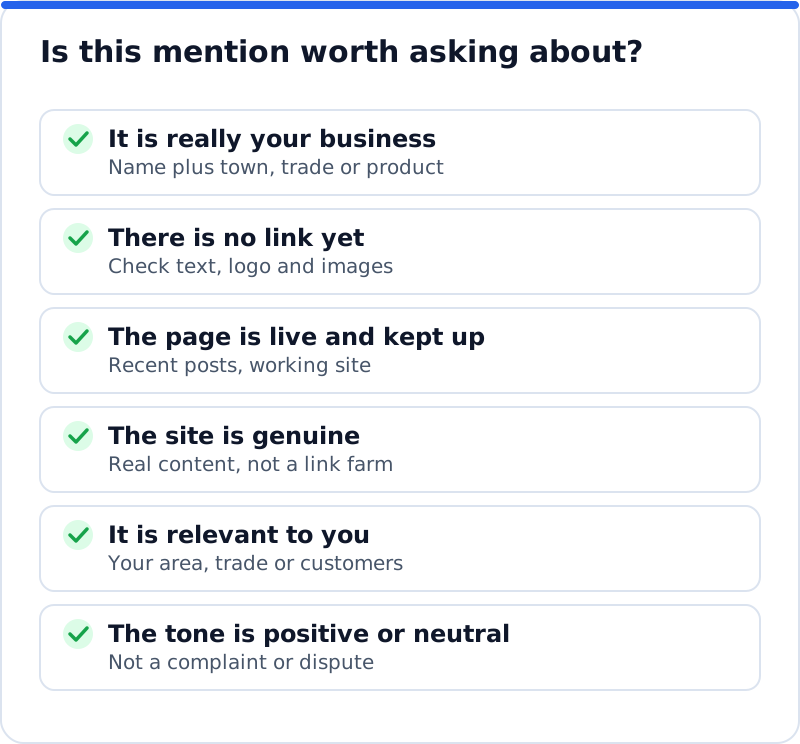
A list of mentions is not yet a list of prospects. Open each page and confirm that it really refers to your business and that there is no link to you already, including on a logo, an image or a nearby "website" button. Check that the page is public, still maintained and part of a genuine website with real content, since a request to a dead blog or a scraped copy is wasted time. Consider relevance too: a mention on a regional food guide is far more valuable to a gelato shop than one on an unrelated coupon site. Finally, check the tone, because a page that mentions you in a complaint is not the place to ask for a link.
Once you have a qualified list, put the best ones first. Mentions on local news websites, trade publications, associations and partners' websites usually come first, because they combine trust, relevance and real readers. Recent mentions come next, since the writer is easier to reach and more likely to remember you. Mentions on personal blogs and small community websites are still worth a request, but they can wait until the important ones are done. Working in that order means your first hour of outreach goes to the links that will matter most.
Finding the right person to contact
A request sent to a general inbox often disappears, while the same request sent to the person who wrote or manages the page usually gets read. For news stories and magazine articles, the author's name is normally on the piece, and many publications list reporters' email addresses or a contact form for corrections. For blogs, the writer is often the owner, and an about or contact page will tell you how to reach them. For association directories, member lists and event pages, the person who looks after membership or events is the right contact. When a partner or supplier mentions you, use the contact you already deal with, because a familiar name gets a much faster reply.
Be careful with how you reach out. Use a business email address, not a personal one, so the request is clearly from the business mentioned. If a website asks for corrections through a form, use the form rather than hunting for private addresses. Avoid social media direct messages for a first request unless that is genuinely how the person prefers to be contacted. A professional, easily verified approach makes it more likely that your message is trusted and answered.
Writing a request people say yes to
The best requests are short, specific and generous. Open with genuine thanks for the mention, naming the article or page so the person knows exactly what you mean, and add a sentence that shows you actually read it. Then make the request in one line: ask whether they would be willing to link your business name to your website, and give the exact address of the most useful page. For a review of your shop, that is usually the home page or the location page; for a mention of a specific product or service, it is that product's page. Close by thanking them again and offering something helpful if it fits, such as a photo, a correction to a detail they got wrong or an answer for a future piece.
As an example, an IT consultancy in Amsterdam mentioned in a trade article about cloud migration might write to the author along these lines. The subject line says "Thank you for mentioning Brightgate in your cloud migration piece", which tells the reader at once why the message is relevant. The first sentence thanks the writer for including the firm, and the second says which point in the article the team found useful. The third sentence asks whether the writer would be happy to link the name Brightgate to the firm's cloud services page, with the full address written out. The final sentence offers to share an anonymised client example if the writer ever returns to the topic, and the message ends with a name, a role and a phone number.
Notice what that request leaves out. It does not ask for specific anchor text stuffed with keywords, which would look manipulative and is the kind of optimised anchor Google's policies warn about. It does not offer payment or a link in return, both of which would turn an editorial link into a scheme. It does not lecture the writer about SEO or claim the link will help their rankings. It simply makes it easy to say yes, which is all a good request needs to do.
Following up and handling a no
If you hear nothing, send one follow-up about a week later. Keep it shorter than the first message, reply in the same thread so the context is there, and restate the request in a single sentence. After that, stop: two messages are polite, and a third begins to feel like pressure. Many people simply miss the first email, so the follow-up often brings the reply. Record the date of each message in your tracker, so you never accidentally contact the same person twice in one week.
Some people will say no, and that is fine. Many news websites have policies about outbound links, some writers cannot edit old articles, and some websites mark every outbound link as nofollow. Thank them anyway, because the mention still stands and the relationship is worth more than one link. If they offer a nofollow link, accept it gladly, since it still brings readers and helps people find you. A graceful reply also makes it more likely that the same writer will mention you again, and perhaps link to you without being asked next time.
Tracking every request until the link is live
A simple spreadsheet is enough to manage unlinked brand mentions. Give each mention a row with the page address, the website, the contact name, the date you asked, the date you followed up, the page you asked them to link to and the outcome. When someone agrees, do not mark the row as done until you have opened the page and seen the link yourself, because edits sometimes take days and occasionally never happen. Check whether the link points to the right page, whether it works and whether it is followed. Then add a reminder to check it again in a few months, since pages are redesigned and links can quietly vanish.
The tracker also teaches you what works. After a few months you will see which kinds of websites tend to say yes, which subject lines get replies and how long editors usually take. A craft brewery in Asheville might find that beer bloggers almost always add a link, while regional newspapers rarely edit old stories. That knowledge lets you spend your time where it pays. It also gives you a clean record of every link you earned, which is useful when you later check backlinks of a website and want to know where each one came from.
How the AI Backlink Checker helps
Searching for mentions by hand works, but it is slow and easy to forget. The AI Backlink Checker lists pages that mention your business without linking to it, alongside the websites that already link to you, so the opportunities appear in the same place as your existing links. Each linking site comes with its authority, based on Open PageRank and shown on a scale of 0 to 100, and whether the link is followed, which helps you judge which mentions are worth chasing first. Its link tracker confirms when a requested link is live on the page, so you do not have to keep reopening pages yourself. If you want a broader view of your website's search health, the AI SEO tools for business websites check your pages as well as your links.
Questions business owners ask
How many unlinked brand mentions turn into links?
There is no reliable figure, because it depends heavily on who mentioned you and why. Partners, suppliers, associations and bloggers who wrote kindly about you tend to say yes often, while large news websites with strict policies say yes less often. Recent mentions also convert better than old ones, since the writer remembers the piece and can edit it easily. Your own tracker will tell you your rate after a few months of steady requests. Treat every yes as a bonus on top of a mention that was already helping you.
What if the mention gets a detail wrong?
Ask for the correction and the link in the same short message, because both make the page more accurate for its readers. An old phone number, a previous address or a misspelt name is common in mentions that are a few years old. Lead with the correction, since editors are used to fixing facts and will often act on it quickly. Then add one line asking whether the name could link to your website, with the exact address. A page that ends up with the right details and a working link helps customers find you, which is the point of both requests.
Is it pushy to ask for a link at all?
Not when it is done politely and once. You are asking someone to make their own page more useful to their readers, and most writers understand that a link to the business they mentioned is helpful. The request becomes pushy only when it is repeated, demanding or paired with an offer of payment. One message and one follow-up, both friendly and short, respect the writer's time. Many people are glad to be told, because they simply forgot to add the link.
Your first hour with unlinked brand mentions
Set aside one hour this week and start with the searches: your business name, your two or three best-known products or services, your key people and the most likely misspelling, each with your own website excluded. Open each result, check that it really refers to you and has no link, and add the qualified ones to a simple tracker. Pick the five most valuable mentions, find the right person for each and send a short, thankful request that names the exact page you would like them to link to. Put a reminder in your calendar to follow up once in a week and to search for new mentions each month. When the first links appear, confirm each one on its page, and you will have turned goodwill you already earned into links that last.
Every site that links to yours, its authority and relevance, the trust your backlinks earn and the links your competitors have.
Check your backlinks with the AI Backlink Checker →