Domain Authority Explained: What the Numbers Really Mean
Where domain authority scores come from, why Moz, Ahrefs, Semrush and Open PageRank give different numbers, and how to use them for decisions without chasing them.
- Who links to you
- A trust score
- The competitor gap
A single number between 0 and 100 has become the shorthand many people use for how strong a website is, and it is quoted in sales emails, agency reports and link offers every day. That number is usually called domain authority, and the first thing to know is that Google does not make it, publish it or use it. Domain authority scores are estimates built by SEO companies from their own crawls of the web, mostly by looking at which websites link to which. Read sensibly, they help you compare websites and decide where to spend your time on links. Read badly, they lead businesses to buy worthless links, chase a number that customers never see and judge websites on the wrong evidence. You will learn where the idea came from, how the main scores are built, why they disagree, and how to use them for decisions without being misled.
To see who links to your own website, try our check the backlinks to your website, part of our AI SEO Tools.
Get an authority score for every site that links to you with the AI backlink checker
Domain authority is not a Google number
The phrase "domain authority" is used in two ways. As a generic idea, it means the overall strength a website has earned through the links pointing to it. As a product name, Domain Authority (often shortened to DA) is the score made by Moz, one of several companies that publish a number of this kind. Ahrefs calls its version Domain Rating, Semrush has Authority Score, and Open PageRank is an independent project that publishes a PageRank-style score built from open web data. None of these scores comes from Google, and Google has said many times that it does not use any of them.
This matters because the numbers are often presented as if they were official. An accountant in Dublin may receive an email offering "DA 60 guest posts" as though the score were a grade awarded by Google, when it is really one company's estimate of one website's link profile. Google does assess the links pointing at a site, through its own link analysis systems, but it keeps its measurements private. The third-party scores try to approximate the same idea from outside, using the links their crawlers can find. They are useful approximations, and like all approximations they can be wrong, out of date or deliberately inflated.
Where the idea came from
The story starts with PageRank, the link analysis method that Larry Page and Sergey Brin developed at Stanford in the late 1990s and built Google around. PageRank treats a link as a vote, and it gives more weight to votes from pages that have themselves received many votes. For years, Google showed a rough version of this to the public as a score from 0 to 10 in the Google Toolbar, a browser add-on. Website owners watched that little green bar closely, and a trade in links from "PR 6" and "PR 7" pages grew up around it. Google updated the public score less and less often, stopped updating it after 2013 and removed it entirely in 2016.
Google did not stop using PageRank when the toolbar score disappeared. Its own guide to ranking systems still lists PageRank among its link analysis systems, while making clear that it is one of many signals and has changed a great deal since the early days. What disappeared was the public window into it. SEO companies filled that gap by building their own link indexes and their own scores, which is why domain authority metrics became so popular after the toolbar went dark. Knowing this history helps you see the scores for what they are: an outside attempt to estimate something Google measures privately.
How the main scores are calculated
Each company keeps the exact formula to itself, but the broad method is public. A crawler visits billions of pages and records the links it finds, building a map of which websites link to which. The score is then worked out from that map, giving more credit to links from websites that are themselves well linked, and usually counting unique linking websites rather than raw numbers of links. Some scores add other signals, such as estimated search traffic or spam patterns, to make them harder to fake. Most publish the result on a range of 0 to 100 (1 to 100 for Moz, while Open PageRank uses 0 to 10) so that websites can be compared.
| Score | Made by | Range | Built mainly from |
|---|---|---|---|
| Domain Authority (DA) | Moz | 1 to 100 | Linking websites and other link data, modelled to predict ranking ability |
| Domain Rating (DR) | Ahrefs | 0 to 100 | Unique websites with followed links, weighted by their own rating |
| Authority Score (AS) | Semrush | 0 to 100 | Link strength, estimated organic traffic and spam signals |
| Open PageRank | DomCop's Open PageRank initiative | 0 to 10 | A PageRank-style calculation over open crawl data such as Common Crawl |
Most of these scores are not linear, which surprises many people. Moz and Ahrefs both describe their scales as working in a way where each step up is harder than the one before, so moving from 20 to 30 takes far less than moving from 70 to 80. A local business with a score in the teens or twenties is completely normal, and comparing it with a national newspaper in the nineties tells you nothing useful. The meaningful comparison is with websites like yours that compete for the same searches. Remember too that the scores are relative to the rest of the web, so a site's number can drift down even when nothing has changed on it, simply because the index has grown.
Why the same site scores differently in each tool
Look up one website in three tools and you will almost always get three different numbers. The biggest reason is that each company has its own crawler, which visits different pages, at different times, with different rules about what to keep. One index might have found two hundred websites linking to a ski rental shop in Innsbruck, another only a hundred and forty, and each score is built on what its own index knows. The formulas differ as well: a score that adds estimated traffic will rate a busy website higher than a score built only on links. Update schedules differ too, so a link earned last month may appear in one tool and not yet in another.
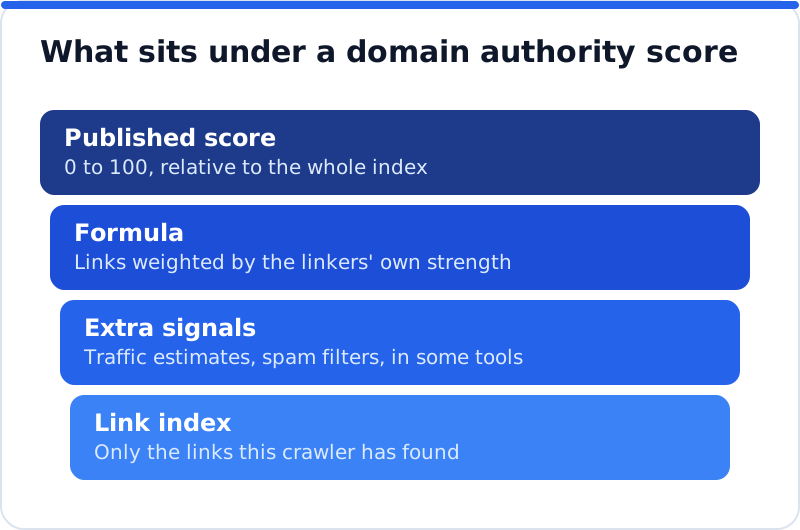
None of the tools is "right" in an absolute sense, because none of them sees the web as Google does. The practical rule is to pick one tool for comparisons and stick with it, rather than mixing a score from one with a score from another. If a seller quotes one company's metric, check it against a second before you trust it, and treat a large gap as a reason to look closer. A website that scores high in a links-only metric but low in one that considers traffic may have links that nobody follows to a site that nobody visits. Disagreement between tools is not a flaw to be fixed; it is information.
Using domain authority scores sensibly
The scores are good at one job: sorting and comparing. When you have a list of fifty websites that could link to you, an authority score helps you decide which ones to approach first, alongside relevance and how realistic the link is. When you compare your website with the competitors that rank above you, the gap in authority gives a rough sense of how much link building lies ahead. When you track your own score in one tool over a year, a rising trend suggests your link earning is working, even if the exact number means little. A pest control company in Atlanta that sees its score rise as it earns links from local associations and news sites has a simple sign that the effort is paying off.
Always pair the score with judgement about relevance and the page itself. A regional trade association with a modest score is often a better link for a business than a general website with a high one, because the association is relevant and trusted by customers. The linking page matters as much as the domain: a link from a well-visited article counts for more than a link from a forgotten archive page on the same site. Think of the score as one column in your spreadsheet, next to topic, place, followed or nofollow, and the reason the site would link to you. If you want the full picture of what makes a link worth having, read our guide to backlink quality, which covers each of those signals in turn.
How not to use them
The worst use of domain authority is treating it as the goal. Customers never see the number, and Google does not use it, so raising it for its own sake earns nothing. Businesses that chase the score often end up paying for links from websites built to look strong in one tool, with high numbers and no real readers. Those sites tend to link to anything for a fee, across every subject imaginable, which is exactly the pattern Google's link spam policies describe. Buying or selling links for ranking purposes is against those policies, whatever the score of the website selling them.
Scores can also be inflated on purpose. Because most metrics count links from strong websites, people who sell links sometimes build networks of sites that link to each other, or buy expired domains with old links, to push their numbers up. The score then looks impressive while the site has no audience and no relevance to anyone. Some tool makers add traffic and spam signals precisely to resist this, but no metric is immune. A recruitment agency in Birmingham offered a "DA 70" placement should ask who reads the site, whether its articles cover recruitment at all and whether the link would be marked as sponsored. If the honest answers are nobody, no and no, the score is irrelevant.
| Sensible use | Risky use |
|---|---|
| Sorting a list of link prospects | Paying more for a link because of a high score |
| Comparing your site with ranking rivals in one tool | Comparing scores taken from different tools |
| Watching your own trend over months | Treating a small monthly drop as a crisis |
| A rough check before outreach | A substitute for looking at the site |
Measuring your authority over time
If you want to track your own website, choose one score and check it once a quarter rather than every week. Small movements are normal, because the tool's index changes and other websites gain and lose links too. What you are looking for is a steady trend over several months, matched by real progress you can see: more relevant websites linking to you, more of those links followed and placed in content, and more visits from Google. Search Console's Links report shows the top websites linking to you, which is a useful check on what the tools report. If the score rises while your enquiries from search do not, look at relevance and the pages you are trying to rank, not at the number.
Our AI Backlink Checker shows the authority of each website that links to you, based on Open PageRank and shown on a scale of 0 to 100, alongside whether each link is followed and any spam signals it finds. Each link is confirmed on its page by our own crawler, so the list reflects links that exist today. The tool then sums your profile up in a trust score, which looks at the whole set of links rather than a single site. The full audit adds a relevance judgement for each linking site, so authority is never read on its own. The same backlink trust feeds into the website score in the wider AI SEO tools for business websites, where it sits alongside the on-site checks.
Questions business owners ask
What is a good domain authority score for a business?
There is no universal good score, because it depends entirely on your competitors and the tool you use. A local trade business may rank well with a modest score if its rivals are similar, while a national online shop faces websites with much higher numbers. The useful question is how your score compares with the websites ranking above you for your main searches, measured in the same tool. If they are well ahead, you know links are part of the gap. If you are level, your effort is better spent on your pages and content.
Why did my score drop when I did nothing wrong?
Scores move for reasons unrelated to your website. The tool may have updated its formula, cleaned spam out of its index or added billions of new pages, which shifts every website's position. A website that linked to you may have removed the link or closed down, which happens to everyone over time. Because the scales are relative, other websites growing faster can also nudge your number down. Look at the trend over several months and at your actual linking websites before worrying about any single change.
Can I raise my domain authority quickly?
Not in a way that helps your business. The fast methods, such as buying links from networks or high-score websites with no readers, raise a third-party number while breaking Google's link spam policies and doing nothing for your rankings or your customers. The lasting way is slower: earning links from relevant associations, partners, local media and industry publications. Those links lift the scores as a side effect, and more importantly they send visitors and build the trust Google actually measures. Expect real change over months, not days.
Reading the number for what it is
Domain authority scores are handy estimates from companies that crawl the web, built mainly from links and scaled so that websites can be compared. Use one tool consistently, compare yourself with the websites that rank above you, and use the score to sort link prospects alongside relevance and the page itself. Never pay for a link because of its number, and never mix scores from different tools. When the number and your common sense disagree, trust your judgement about who would genuinely recommend your business. Look up the authority of the websites already linking to you this week, and use what you find to choose the next five links worth earning.
Every site that links to yours, its authority and relevance, the trust your backlinks earn and the links your competitors have.
Check your backlinks with the AI Backlink Checker →