Competitor Backlink Analysis: Finding Links Your Rivals Have
How to pick the competitors worth studying, find the sites that link to several of them but not to you, and turn that gap into a short list of links you can actually earn.
- Who links to you
- A trust score
- The competitor gap
Every link a competitor has earned is a public clue about who in your industry is willing to recommend a business like yours. The websites that already link to two or three of your rivals have shown that they link out, that they care about your subject and, very often, that they would happily add one more name. A competitor backlink analysis turns those clues into a working list: named websites, the page where the link would go and a realistic reason for them to add you. The method is not about copying everything a rival has, because some of their links were bought, some came from history you cannot repeat and some are worth nothing. You will learn how to choose the competitors that matter in search, gather their links from more than one source, find the gap, qualify each prospect, decide which links are realistic to win and work the list until links go live.
To see who links to your own website, try our build quality backlinks for your business, part of our AI SEO Tools.
Run a competitor backlink analysis with the AI backlink checker and see your link gap
Who your search competitors really are
The businesses you compete with for customers are not always the websites you compete with on Google. A physiotherapy clinic in Manchester may think of the two clinics on the same street as its rivals, but the pages ranking above it for "sports massage Manchester" might be a national chain, a booking platform and a health magazine. For a competitor backlink analysis, the useful competitors are the ones that appear on the first page for the searches you want to win. Those are the websites whose links are helping them hold the positions you are aiming for. Studying a rival who ranks nowhere teaches you very little, however well you know them in the real world.
Start by writing down five to ten searches that bring in paying work, such as the main service plus your town, and look at who ranks for each one in a private browser window. Note the websites that appear again and again across those searches, and ignore the giant directories and marketplaces that rank for everything. Wikipedia, Yelp, Tripadvisor and national newspapers are not useful models, because nobody can copy the links of a site with millions of pages. Pick three to five competitors that are a similar kind of business, ideally with a similar size of website, that consistently rank above you. These are the businesses whose link profiles you can realistically match, and that is what makes the rest of the work worthwhile.
Gathering their links from more than one source
Google Search Console shows links only for websites you have verified, so it cannot show you a competitor's backlinks. Google also stopped supporting the old link: search operator years ago, so a simple search will not list them either. For a rival's links you need a link index, a database built by a company that crawls the web and records the links it finds. The large commercial SEO tools each keep their own index, Bing Webmaster Tools offers competitive backlink data to verified users, and backlink checkers that crawl the web themselves can do the same. No single index sees everything, because each crawler visits different pages at different times, so two sources together give a fuller picture than one.
Search operators still help at the edges of the job. A search for a competitor's business name in quotation marks, minus their own website with the -site: operator, finds pages that mention them, and many of those pages carry a link. Searching for their name alongside words like "sponsor", "member", "partner" or "stockist" often turns up the association pages and supplier lists that matter most to a local business. Once you have the lists, export them into one spreadsheet with a column for the linking website, the linking page, the competitor it links to and the date you found it. If you want a refresher on the general methods and their limits, see how to check backlinks of a website before you start. Keep the raw export, because you will come back to it when you plan the next round.
Finding the link gap
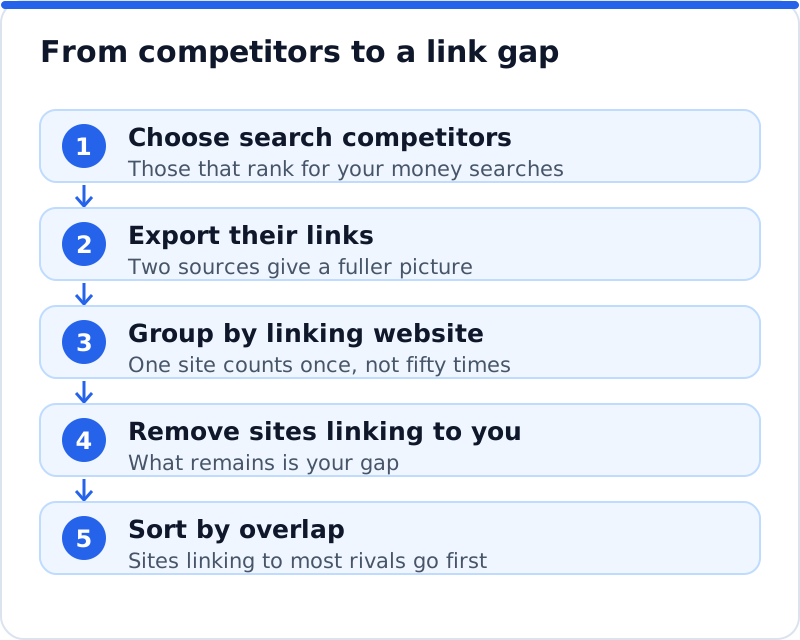
The link gap is the set of websites that link to two or more of your competitors but not to you. It is the most valuable part of a competitor backlink analysis because it filters out the accidental links and leaves the patterns. A single competitor might have a link because the owner's cousin runs a blog, but when a website links to three of your rivals it is telling you that it links to businesses of your type as a matter of habit. That habit might be a members' directory, a "where to buy" list, an annual roundup or a local news section that covers businesses like yours. Each of those is a door that is already open to you.
To find the gap by hand, sort your combined spreadsheet by linking website and count how many of your competitors each one links to. Remove any website that already links to you, then sort the rest so that those linking to the most competitors sit at the top. Most commercial link tools have a built-in report that does the same comparison, often called a link intersect or backlink gap report, and it saves an hour of sorting. Count by linking website rather than by individual link, because one site with fifty links to a rival in its footer is still only one relationship. The result is usually a much shorter list than the raw export, and that is exactly the point.
Qualifying each prospect
A website in the gap is a prospect, not a target, until you have checked it. Open the linking page and confirm that the link is still there, because link indexes keep records long after a link has been removed. Look at what the site is about and who reads it, since a relevant site in your industry or your area is worth far more than a general one with a high score. Check whether the link is followed or marked nofollow or sponsored, and remember that a nofollow link from a busy trade association page can still bring enquiries. Finally, ask how the competitor got the link, because the answer tells you whether you can get one too.
| What to check | Strong prospect | Weak prospect |
|---|---|---|
| Is the link live? | Present on the page today | Gone, or the page returns an error |
| Topic and place | Your industry, your town or region | Unrelated subject, another country |
| How the rival got it | Membership, coverage, a listing anyone can apply for | A one-off friendship or a paid placement |
| The page itself | Real content, visited, few other links | Hundreds of links, no readers, spun text |
| Contact | A named editor, secretary or form | No way to reach anyone |
| Authority estimate | Moderate to high for its niche | Very low, with spam signals |
Authority scores from SEO tools help you sort the list, but treat them as a tiebreaker rather than a verdict. They are estimates made by third parties from their own crawl data, not numbers Google uses or publishes. A county chamber of commerce with a modest score is often a better prospect than a high-scoring general blog, because the chamber's link is relevant, stable and earned. Give each prospect a simple rating of high, medium or low, write one line about how the competitor got the link, and drop anything you would be embarrassed to explain to a customer. That one line of notes is what makes the list usable a week later, when you have forgotten why each row was there.
Links you can realistically win
Most of the links in a competitor's profile fall into a handful of kinds, and each kind has its own way in. Membership links come from trade bodies, chambers of commerce and professional registers, and you win them by joining and asking for the profile page to link to your website. Supplier and partner links come from manufacturers' "find an installer" or "stockists" pages, and you win them by asking the brands you already buy from. Listing links come from industry and local directories, and you win them by completing a profile with accurate details. Coverage links come from local news, trade magazines and roundups, and you win them with a genuine story, a useful comment or an event. Article links come from industry blogs and publications that accept contributions, and you win them by offering expertise their readers want.
An HVAC company in Columbus that finds three rivals listed on a heat pump manufacturer's installer map, a state contractors' association directory and a local news feature on energy rebates has three different jobs to do. The installer map needs a certification or a call to the manufacturer's dealer team. The association needs a membership form and a few weeks. The news feature needs a fresh angle, such as what homeowners should check before winter, offered to the same reporter. Matching each prospect to the right approach is what turns a spreadsheet into links. Write the approach in a column next to each prospect so that whoever works the list knows exactly what to do.
What not to copy
Some of the links you find were never worth having, and copying them can cause harm. Google's spam policies treat buying or selling links for ranking purposes, excessive link exchanges, automated link building, low-quality directory and bookmark sites, and keyword-rich links hidden in widgets or footers as link spam. If a competitor has dozens of links from sites with names like "best-business-links-directory" or from articles that clearly exist only to carry links, leave them alone. Their ranking may be holding up for now, but Google has said its systems are designed to detect and neutralise unnatural links, and the money spent on them is often wasted. A business that follows a rival into a paid link network inherits all of its risk and none of its stability.
Other links are honest but impossible to repeat. A family law firm in Bristol might find that a competitor has a link from a university because a partner lectures there, or from a national newspaper because of a case that made headlines ten years ago. Those links reflect a history you cannot buy and should not try to fake. Links from a competitor's own other websites, such as a sister company, also belong in this group. Web design credits in the footer of client sites and links from old press releases on distribution services usually carry little weight either. Mark all of these as "not pursuing" in your list, so nobody wastes time on them later.
Building and working the prospect list
A prospect list only produces links if someone works it every week. Keep it in a spreadsheet or a simple project board with columns for the website, the page, the kind of link, the approach, the contact, the date of the first message, the follow-up date and the status. Work in small batches of five to ten prospects a week, starting with the high-rated ones that link to the most competitors. Write each message for its recipient, mentioning the page where your business would fit and why its readers would care, and keep it short enough to read on a phone. Follow up once after a week or two, then move on, because a polite single reminder is welcome and a third email is not.
When a link goes live, open the page, check the link points to the right address and note whether it is followed. Some links disappear when a page is redesigned or an editor tidies up a list, so check live links again every few months. A bike shop in Utrecht that works its list steadily for three months will usually have a handful of new links from cycling clubs, local events and brand stockist pages, which is a solid result for a local business. Expect a mix of quick wins, such as directory profiles, and slow ones, such as coverage, which may take several pitches. Record what worked and what did not, because the next round of analysis will be faster when you know which kinds of prospects say yes.
How the AI Backlink Checker helps
Our AI Backlink Checker finds the websites that link to a business by combining web search with its own crawler, which visits each linking page to confirm the link is really there. It shows each linking site's authority, based on Open PageRank and shown on a scale of 0 to 100, whether the link is followed, any spam signals and pages that mention the business without linking. The competitor link gap compares your links with a rival's and lists the sites that link to them but not to you, which gives you the starting list for the steps above. The full audit adds a relevance judgement for each site, anchor text, toxic links with a disavow file and history over time. For winning the links, it supports three routes: directory listings with a listing kit, a press release with suitable outlets, and guest posts with pitches.
The link tracker closes the loop by checking that each new link is live, so you are not relying on memory or occasional spot checks. That matters for competitor work in particular, because a gap list grows stale quickly as rivals win and lose links of their own. Running the comparison again every few months shows which prospects have appeared since your last round. The same checks sit alongside the wider AI SEO tools for business websites, which look at the website itself as well as its links. You still choose which prospects to pursue and write the outreach, and the tool keeps the evidence in one place so the decisions are easier.
Questions business owners ask
How many competitors should I analyse?
Three to five is the right number for most businesses. Fewer than three makes it hard to spot patterns, because a website linking to only one rival might be an accident or a personal connection. More than five tends to bury you in data without adding many new prospects, since the useful sites in a niche tend to link to the same group of businesses. Choose rivals that rank for your main searches and are similar to you in size and type. If you serve several towns or offer very different services, you can run a separate analysis for each one with its own set of competitors.
Is it acceptable to contact sites that link to my competitors?
Yes, as long as you contact them honestly and offer something that fits their page. Editors and association secretaries expect to hear from businesses, and a relevant, polite request is part of normal web publishing. What you should avoid is offering money for a followed link, proposing link swaps or pretending to be something you are not. Never criticise the competitor in your message, because the person you are writing to chose to link to them and may know them well. Focus on why your business is useful to their readers and let the request stand on its own merits.
How often should I repeat a competitor backlink analysis?
For most businesses, a full repeat every three to six months is enough. In between, work the list you already have, because a list of qualified prospects usually lasts several months at a steady pace. Competitive industries, such as personal injury law or emergency trades in large cities, may justify a lighter check every month. Each time you repeat it, compare the new gap with the old one and note the websites that have appeared. Those new links show what your rivals are doing now, which is often more useful than what they did years ago.
Turning the gap into next month's links
Choose your three to five search competitors this week, export their links from two sources and build the gap list sorted by how many rivals each website links to. Qualify the top twenty prospects with the checks in the table, write the approach for each one and drop the links you should not copy. Then send five to ten tailored requests a week, follow up once, and record every link that goes live along with how you won it. After a month you will know which kinds of prospects respond best in your industry, and the next round will be quicker and more accurate. Pick your first five competitor searches today and the list will start to build itself from there.
Every site that links to yours, its authority and relevance, the trust your backlinks earn and the links your competitors have.
Check your backlinks with the AI Backlink Checker →