Business Directory Listings: Which Ones Are Worth It
How to choose the directories that customers and search engines trust, write one listing kit, keep your details identical everywhere and check that each listing is live.
- Who links to you
- A trust score
- The competitor gap

A directory is a shopfront on someone else's street, and it only earns its keep if real people walk past it. Business directory listings are the easiest links and mentions most companies can collect, because the directory exists to list businesses like yours and asks only for accurate details. That ease is also the trap, since thousands of directories exist purely to sell listings to anyone, and an entry on one of those does nothing for customers or rankings. The skill is choosing the handful that matter, filling them in completely and keeping every detail identical across all of them. You will see which kinds of directory are worth your time, which to avoid, how to write a listing once and reuse it, and how to keep a record that tells you which listings are live and correct.
To see who links to your own website, try our check the backlinks to your website, part of our AI SEO Tools.
Why business directory listings still matter
Directories do three jobs at once, and only one of them is about links. The first is being found: people search directly on map apps and on directories they trust, and a business missing from those places simply does not appear. The second is confirmation, because search engines compare your name, address and phone number across many sources to decide whether the business is real and where it is. The third is the link itself, which may be followed or nofollow but still tells search engines that your website belongs to this business. A locksmith in Birmingham who appears on the map listings, a trade directory and the local council's approved traders page is easier for both customers and search engines to trust than one that exists only on its own website. Directories are rarely the links that lift a website above strong competitors, but they are the foundation that the rest of your link building stands on.
Directories also bring visits that never show up as rankings. Someone browsing a list of vets on a local directory may phone straight from the listing, without ever visiting your website. A veterinary clinic in Cork that tracks where new clients heard of it may find that a single well-chosen directory brings more appointments than several blog posts. That is why a listing should be judged first by whether customers use the directory, and only then by the link it gives. If a directory has no visitors, its link is unlikely to be worth much either. This one question removes most of the poor choices before you spend any time on them.
Start with the three map listings
The most valuable listings are on the platforms that power maps and local results. Google Business Profile controls how your business appears in Google Maps and in the local results on Google Search, and you create or claim it through Google's Business Profile tools and then verify that you own the business. Verification methods vary by business and can include a phone call or text, an email, a video recording or a postcard. Service-area businesses, such as a mobile dog groomer, can hide their address and list the areas they serve instead. Choose the primary category carefully, because it is one of the strongest clues Google has about what you do, and add hours, photos, services and your website address.
Bing Places for Business does the same job for Bing Search and Bing Maps. Microsoft redesigned it in 2025 and moved it to Bing's own domain, and it lets you import your details from Google Business Profile, which saves retyping and keeps the two listings in step. Apple's equivalent is the place card in Apple Maps, which also appears in Safari and Spotlight. Apple used to manage these through Apple Business Connect, and in April 2026 it moved that work into its wider Apple Business platform, carrying existing data across. There you claim your location and add photos, hours and other details, and the core service comes at no charge. Many iPhone owners search on Apple Maps by default, so a missing or wrong place card loses calls you would never know about.
General, industry and local directories
After the map listings come three groups of directories, and each earns its place differently. General directories list every kind of business and are well known to customers in their country, such as Yelp and the Better Business Bureau in the USA, Yell in the UK, Golden Pages in Ireland, PagesJaunes in France and Gelbe Seiten in Germany. Industry directories list one kind of business and are often where customers in that trade look first, such as TripAdvisor for restaurants and hotels, Houzz for home design and building, or the "find a member" search of a professional body. Local directories include chambers of commerce, business improvement districts, council supplier lists and community websites. Some of these are paid memberships, so decide by whether your customers use them, not by the link.
| Directory type | Examples | Main value | Worth it when |
|---|---|---|---|
| Map listings | Google Business Profile, Bing Places, Apple Business | Maps, local results, calls | Always, for any business with customers |
| General directories | Yelp, Yell, Golden Pages, PagesJaunes, Gelbe Seiten | Trust, reviews, some visits | The directory is well used in your country |
| Industry directories | TripAdvisor, Houzz, professional body member search | Enquiries from ready buyers | Customers in your trade search there |
| Local directories | Chamber of commerce, council supplier list, town website | Local trust, relevant links | You belong to the area and the group |
| Low-quality directories | Pages listing anything for a fee | None | Never |
A Mexican restaurant in San Diego needs a different set from a tax adviser in Hamburg, so build your list from what your customers actually use. Search for your main service and town, for example "tax adviser Hamburg", and note which directories appear on the first two pages of results. Those directories already rank for the searches you care about, so a listing there can be seen by the right people. Then check your professional body, your trade association and your local chamber, because membership listings are some of the most relevant links a business can have. The final list is usually much shorter than the directory industry would like you to believe, and that is a good thing.
Directories to avoid
Google's spam policies name low-quality directory and bookmark site links as an example of link spam, so the wrong directories are not merely useless. A website that collects many of them can look as if it is trying to manufacture trust rather than earn it. The risk grows when the entries use keyword-heavy business names or descriptions, which some cheap services add by default. Fortunately these directories are usually easy to spot once you know what to look for. A directory that exists to sell links rather than to help people find businesses tends to share a few signs, and any two of them together is reason to walk away.
- It accepts any business in any category and any country, so a dentist in Ohio sits beside a casino and a loan company.
- It charges a fee for a "do-follow" link or promises that the listing will improve your rankings.
- It has no search box that a real customer would use, no reviews and no sign that anyone visits.
- Its pages are long lists of links with little or no information about each business.
- It offers to submit you to hundreds of directories at once for a single payment.
Mass submission services deserve a special warning, because they look like a time-saver. They push the same entry into hundreds of directories that nobody uses, often with slightly different details, which creates the very inconsistency you are trying to avoid. Removing those entries later can be slow, because many of the sites have no working contact address. If you inherit a website that already has many of these links, there is no need to panic, since Google's systems usually ignore them. Simply stop adding more and put your effort into the directories in the table above.
Name, address and phone, the same everywhere
Consistency matters more than the number of listings you hold. Search engines match a business across the web by its name, address and phone number, often shortened to NAP, and small differences make that matching harder. "Smith Piano Lessons", "Smith Piano Tuition Bath" and "J Smith Music" might be one teacher to a human, but to a search engine they could be three businesses. Choose one exact form of each detail and use it everywhere: the registered or trading name, the address written the way the postal service writes it and one main phone number. A piano teacher in Bath who teaches from home and does not want the address public can list as a service-area business and still keep the name and phone identical.
The best tool for this is a listing kit, a single document you copy from every time. It holds the exact business name, address, phone number, website address, opening hours, main and secondary categories, a short description of about 150 characters, a longer description of a few paragraphs, the year the business started, a logo, a few good photos and the links to your social profiles. With the kit ready, a new listing takes minutes rather than an hour, and every listing matches the others. Keep the kit in one shared place if more than one person handles listings. When anything changes, such as a new phone number or a move, update the kit first and then every listing in the same week.
Writing a listing that earns clicks
A complete listing does better than a bare one, because customers compare entries side by side. Use every field the directory offers: categories, services, hours including holidays, photos of the real premises and team, and a description written for a customer, not for a search engine. The description should say what you do, for whom and where, and give one reason to choose you, such as same-day visits, a specialism or years of local experience. Avoid stuffing it with keywords and town names, because it reads badly and some directories reject it. An HVAC company in Minneapolis might write that it installs and repairs heating and cooling systems for homes across the Twin Cities, with emergency callouts through the winter.
Link to the most useful page of your website, not always the home page. A clinic listed in a physiotherapy directory might link to its physiotherapy page, while a general directory usually suits the home page. If the directory allows it, add tracking parameters to the website address, so your analytics shows visits from each listing separately. Respond to reviews on directories that have them, politely and promptly, because people read the replies as much as the reviews. Keep the photos current, since an old shopfront or a team that has changed makes a business look neglected.
Keeping a record and checking each listing
A listing you cannot find again is a listing you cannot update. Keep a simple record with the directory name, the page address of your listing, the login email used, the date submitted, the date it went live, whether the link is followed or nofollow and the date you last checked it. Many directories approve new entries by hand, so some will take days or weeks to appear and a few will never appear at all. Check pending submissions weekly and resubmit or contact the directory once if a listing is still missing after a month. Review every live listing at least twice a year, and immediately after any change to your details.
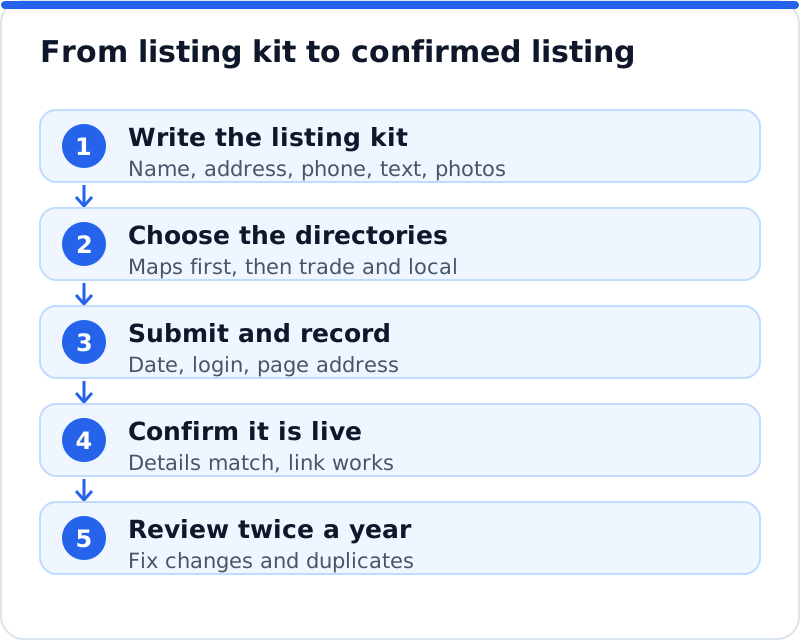
This is where our tools take the routine work off your hands. The AI Backlink Checker includes directory listings with a listing kit, so your details are ready to copy into each submission, and its link tracker confirms when each listing is live and whether the link is followed. It also shows the sites already linking to you, so you can see which listings you hold before adding new ones. Directories are one of the three channels in a wider plan for link building for business, alongside press coverage and guest articles. Listings point people to your website, so the AI SEO tools for business websites are worth running on the pages they land on.
Keeping business directory listings healthy
Listings drift out of date more often than owners expect. Google allows the public to suggest edits to a Business Profile, and Google may apply a change if it believes the edit is correct, so check your profile every month or two. Duplicates appear when a directory imports data from another source or when a former employee created an entry years ago. Each duplicate splits your reviews and confuses customers, so claim it and ask the directory to merge or remove it. When you move premises or change your number, work through every listing in your record, starting with the map listings.
Old listings can also bring old problems. A directory you joined years ago may have changed owner and turned into a link farm, and a listing there no longer helps. During your twice-yearly review, look again at each directory with the same questions you used to choose it. Remove or request removal from any that now fail, and note the outcome in your record. Over time the list becomes shorter, cleaner and more useful, which is exactly what you want.
Questions business owners ask
Do I need to pay for directory listings?
Most of the listings that matter come at no charge, including the three map listings and many general directories. Some industry directories and professional bodies charge for membership, and that can be worth it when customers in your trade use them to choose a supplier. Paying for a listing is not against Google's rules, but paying specifically for a followed link is, so be wary of any directory that sells "do-follow" placement. Judge a paid directory by the enquiries it brings, and review that after six months. If it brings nothing, stop renewing.
How many directories should my business be on?
Fewer than most submission services suggest. The three map listings, a few well-known general directories in your country, the main directories of your industry and your local chamber or association will usually cover the ground. That is usually a short list, and every entry on it is a place where real customers might find you. Beyond that point, each new listing adds very little and takes time to keep accurate. Spend the extra time on press coverage and guest articles instead.
Do directory links help my rankings?
They help in a modest, indirect way. Many directory links are nofollow, and Google counts links from directories that list anything very lightly or not at all. Their main value is confirming that your business is real, consistent and located where you say, which supports your presence in local results. A listing on a respected industry directory can also count as a relevant link in its own right. Treat directories as the foundation and look to other channels for the links that move rankings more noticeably.
Your directory plan for this month
This week, write your listing kit and check your Google Business Profile, Bing Places and Apple Business listings against it, fixing any difference you find. Next week, search for your main service and town, list the directories that appear, and add your professional body and local chamber. Submit to the five best, record each one and set a reminder to check them in a fortnight. In the final week, confirm which listings are live, correct any errors and mark the next five to submit. Once that list is working, check which sites already link to your website, so you can see what your directory listings have added.
Every site that links to yours, its authority and relevance, the trust your backlinks earn and the links your competitors have.
Check your backlinks with the AI Backlink Checker →