Nofollow vs Dofollow Links: Which Ones Count for SEO
What the rel values on a link really do, how Google reads them today, when your own website must use them, and why a business needs both kinds of link.
- Who links to you
- A trust score
- The competitor gap
Tucked inside the code of every link is room for a short note to search engines, and that note decides whether the link vouches for the page it points to. The note lives in the link's rel attribute, and its best-known value, nofollow, has been the subject of more confusion than almost any other part of link building. The usual debate over nofollow vs dofollow ends with a neat rule: followed links help rankings and nofollow links are worthless. That rule was never quite right, and since Google changed how it reads these values in 2019 it is even less accurate. You will learn what nofollow, sponsored and ugc mean, how Google treats them now, when your own website is expected to use them, why nofollow links still bring real value to a business, and how to check any link in under a minute.
To see who links to your own website, try our build quality backlinks for your business, part of our AI SEO Tools.
Put your links through the AI backlink checker to see which are followed and which are nofollow
Dofollow is not a real attribute
The first surprise for many business owners is that there is no such thing as a dofollow attribute. A normal link, written without any rel value, is followed by default, and the word "dofollow" is simply shorthand that people in SEO invented for it. Writing rel="dofollow" in your code does nothing at all, because search engines do not recognise it. What exists are values that qualify a link, telling search engines it should not be treated as a full endorsement. So the real comparison in nofollow vs dofollow is between a link with a qualifying value and a plain link without one.
The nofollow value dates back to 2005, when Google, Yahoo and Microsoft introduced it to fight comment spam. Blog comment sections were filling up with links placed purely to gain rankings, and nofollow gave website owners a way to say that they did not vouch for those links. Over the following years it spread to many other places, such as social media profiles, large reference websites and many directories. Website owners also began using it on advertising links, because Google asked for paid links to be marked so they would not pass ranking credit. By 2019 nofollow was doing several different jobs at once, which is part of why Google decided to change it.
The three rel values Google recognises
In September 2019 Google announced two new values alongside nofollow, so that website owners could describe the nature of a link more precisely. The sponsored value is for links that are advertisements, sponsorships or other paid placements, including affiliate links. The ugc value, short for user-generated content, is for links in comments, forum posts and other content written by visitors rather than the website owner. The nofollow value remains for any other link where you do not want to imply an endorsement or pass ranking credit. Values can be combined, for example rel="ugc nofollow", and Google has said existing nofollow links on paid placements do not need to be changed.
| Rel value | What it tells search engines | Use it for | Example |
|---|---|---|---|
| None (a plain link) | The site stands behind this link | Editorial links you chose freely | A florist in York linking to its flower supplier |
| sponsored | The link was paid for or is advertising | Ads, sponsorships, affiliate links, paid reviews | A sponsored post on a wedding blog |
| ugc | A visitor, not the owner, added the link | Comments, forum posts, user reviews | A link in a blog comment |
| nofollow | No endorsement for another reason | Links you cannot vouch for | A link to a site you are criticising |
The new values were designed to be more descriptive, not to create new rules for the people being linked to. If you run a website, choosing the right value helps Google understand your outbound links. If you are on the receiving end, the value a site uses for your link is their decision, based on how the link came about. A paid listing will rightly be marked sponsored, and a link in a forum post will rightly be marked ugc. There is nothing to gain from pressuring a website to remove a value that correctly describes the link.
How Google treats nofollow links today
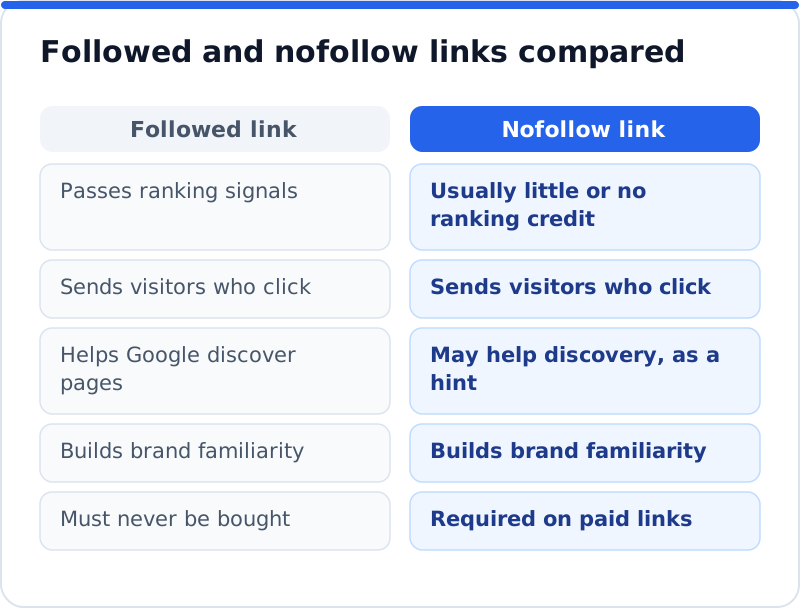
Before 2019, Google treated nofollow as a directive: a nofollow link was not used for ranking and, in general, was not followed for discovery. With the 2019 change, Google said it would treat nofollow, sponsored and ugc as hints about which links to consider or exclude for ranking. From March 2020 nofollow also became a hint for crawling and indexing. In plain terms, Google now decides for itself whether to use a qualified link, taking the rel value as strong guidance rather than an absolute instruction. Google's documentation still says that links marked with these values will generally not be followed, so you should not expect them to carry the weight of a plain editorial link.
The reason for the change was that nofollow had become so common that Google was losing useful information. Many major news and reference websites used nofollow on every outbound link, which meant some genuinely editorial recommendations were invisible to Google's link analysis. Treating the values as hints lets Google use those signals where they help, while still respecting the website owner's intent in most cases. Nobody outside Google knows exactly when a nofollow link is counted, and anyone who claims to know is guessing. The sensible conclusion is that nofollow links may contribute a little, followed links contribute more, and neither should be judged on rel value alone.
When your own website must use them
The rules matter most for the links you publish on your own website. If anyone pays you, in money, goods or services, for a link, Google's spam policies say the link must carry sponsored or nofollow. That covers paid guest posts, sponsored articles, advertising banners with links, affiliate links and product reviews written because a company sent you something in return. Selling followed links can lead to a manual action against your website, which would appear in Search Console's Manual actions report. A marketing agency in Amsterdam that publishes partner content on its blog should mark every paid link as sponsored, even when the partner would prefer otherwise.
User-generated links are the other case most businesses meet. Recent versions of WordPress add nofollow and ugc to links in comments automatically, so a standard blog comment section is already handled. Forums, review sections and community areas added by plugins may need checking, especially if they let visitors add links freely. In the WordPress block editor, several SEO plugins, including Yoast SEO, Rank Math and All in One SEO, add options to mark a link as nofollow or sponsored when you insert it. Without one of those plugins, you can choose "Edit as HTML" on the block and add the rel value to the link by hand.
Rules outside search also apply to paid content. Advertising regulators, such as the Federal Trade Commission in the USA and the Advertising Standards Authority in the UK, expect paid endorsements and sponsored content to be clearly disclosed to readers. That disclosure is a separate requirement from the rel value, which speaks only to search engines. A sponsored article therefore needs both a visible label for readers and a sponsored or nofollow value on its paid links. Neither one replaces the other. Treat the rel value as the search engine side of an honest disclosure you would make anyway.
Why nofollow links still matter
Rankings are only one reason a link is worth having, and nofollow links do well on the others. They send visitors: a nofollow link from a busy local directory, a popular forum thread or a news article's comment section can bring customers who are ready to buy. They build familiarity, because people who see a business mentioned in several places are more likely to recognise and trust it when it appears in search results. They also lead to further links, since a journalist or blogger who finds you through a nofollow mention may write about you on their own website with a plain link. A bakery in Lyon featured in a city food guide with a nofollow link may well get its best press coverage from a reporter who read that guide.
Nofollow links also make a link profile look natural. Real businesses collect links from social media profiles, review sites, directories, community pages and comment threads, and many of those are nofollow. A profile made up only of followed links can suggest that links were selected and placed rather than earned. Chasing only followed links also narrows your options, because some of the most visible places on the web use nofollow on every outbound link. A plumbing company in Seattle listed on a trusted neighbourhood forum gets real calls from that listing, whatever its rel value says. Judge a nofollow link by whether people will see and click it.
How to check a link's rel value
Checking a single link takes less than a minute. Open the page that links to you, right-click the link and choose Inspect, which opens the browser's developer tools with the link's code highlighted. Look inside the opening link tag for a rel attribute; if there is none, or if it contains only values such as noopener or noreferrer, the link is followed. If it contains nofollow, sponsored or ugc, the link is qualified. You can also view the page source with Ctrl+U (Cmd+Option+U on a Mac) and search for your web address to find the link and read its code.
There is one more place to look. A page can carry a robots meta tag with a nofollow value in its head section, which applies to every link on that page, so a link with no rel attribute can still be qualified at page level. Searching the page source for "robots" shows whether such a tag exists. For many links at once, browser extensions can highlight nofollow links on any page, and backlink tools report the rel value for each link they find. Our AI Backlink Checker shows for every linking site whether the link is followed, and its crawler confirms each link on its page so the result reflects the link as it is today.
A healthy mix of nofollow vs dofollow links
There is no ideal ratio, and anyone quoting an exact target is guessing. What matters is that your mix reflects how your links were earned. A business that is listed in directories, active on social media and mentioned in community discussions will naturally have a good number of nofollow links. A business that is covered in local news, linked by suppliers and listed by associations will have plain editorial links among them. A chiropractor in San Diego with both kinds has a profile that looks like a real practice with real relationships, which is exactly the point.
Spend your effort on the links that are relevant to your business and visible to your customers, and let the rel value fall where it falls. When you have a choice between two prospects of similar relevance, a likely followed link is worth more for rankings, but do not turn down a well-visited nofollow link because of its code. Never pay for a followed link, because that is the one choice in this area that clearly breaks Google's spam policies. If you want the full picture of what makes a link valuable beyond its rel value, our guide to backlink quality covers authority, relevance, placement and anchor text. For the website side of search, the AI SEO tools for business websites check the pages those links point to.
Questions business owners ask
Should I ask websites to change nofollow to followed?
Generally, no, and it rarely works anyway. The rel value is the website owner's decision, and if your link was paid for or added by a user, the qualified value is correct and required. If an editor linked to you freely from an article and used nofollow by habit, you can mention politely that the link is editorial, but do not push. Many publishers apply nofollow to all outbound links as a policy and will not make exceptions. Your time is better spent earning the next relevant link.
Do nofollow links help me get indexed?
They can, because Google has treated nofollow as a hint for crawling and indexing since March 2020. That means Google may follow a nofollow link to discover your page, although it is not guaranteed. For reliable indexing, the better tools are your XML sitemap, internal links from your other pages and the URL Inspection tool in Search Console. A plain link from another website also helps discovery. Treat any help from nofollow links as a bonus, not a plan.
Are sponsored links bad for my website?
No, they are not. Sponsored links are a normal part of advertising, and Google's policies say that buying links for advertising or sponsorship is acceptable as long as the links carry sponsored or nofollow. They can bring valuable visitors and brand exposure, which is why many businesses pay for them. The problem is only with paid links that pass ranking credit, which Google treats as link spam. A car repair garage in Dortmund sponsoring a local football club and receiving a sponsored link on the club's website is doing nothing wrong.
Reading rel values the right way
Treat the rel value as one fact about a link, not as its verdict. Followed editorial links from relevant websites carry most of the ranking benefit, nofollow links still bring visitors, discovery and recognition, and sponsored links are a legitimate form of advertising when they are marked correctly. On your own website, mark paid links as sponsored or nofollow and let WordPress handle comments. When you judge links to your business, look at relevance and visibility first and the rel value second. Check the rel values on your ten most important links this week, and use what you learn to decide which prospects deserve your next hour of outreach.
Every site that links to yours, its authority and relevance, the trust your backlinks earn and the links your competitors have.
Check your backlinks with the AI Backlink Checker →