Guest Posting for Businesses: Finding Sites and Pitching Well
How to find relevant sites that publish outside writers, judge them quickly, pitch ideas editors accept, write a piece worth running and handle the author link the right way.
- Who links to you
- A trust score
- The competitor gap
Writing for another website is like being handed someone else's microphone for ten minutes: the audience belongs to them, and they will only hand it over again if you used it well. Guest posting works for a business when the article teaches that audience something useful, written by someone who knows the subject from daily work. The link in the author bio is a pleasant result, not the purpose, and Google's policies make clear that articles produced mainly to place links are a problem. Done properly, a few good guest articles a year put your name in front of the people you most want to reach and earn relevant links along the way. You will learn what Google says about guest articles, how to find and judge host sites, how to pitch with three ideas, how to write a piece the editor is glad to run and how to handle the bio, the follow-up and the tracking.
To see who links to your own website, try our build quality backlinks for your business, part of our AI SEO Tools.
Try the AI Backlink Checker to prepare guest posting pitches and track each published link
Guest posting done properly
A guest post is an article you write for another website, published under your name with a short biography that usually names your business. The host gets expert content its readers value, and you get attention from an audience that already trusts the host. That exchange only works when the article is genuinely useful to those readers and could stand on its own without the link. A bookkeeping firm in Cardiff writing for a regional hospitality association about how cafés can prepare for their year-end accounts is offering real help to a relevant audience. The same firm placing a generic article about "finance tips" on a lifestyle blog that publishes anything would be doing something quite different, even if both articles carried a link.
The difference shows up in results as well as in rules. A relevant article brings readers who might become clients, invitations to speak and the chance to write again, while a generic placement brings nothing but a link that search engines may ignore. Good guest posting also builds the kind of reputation that earns links without asking, because people quote and share writers they have seen in respected places. Think of each article as a sample of your expertise that a potential client might read before calling you. If you would be embarrassed for a client to read it, it should not be published.
What Google says about guest posts
Google's spam policies describe link spam as links created mainly to manipulate rankings, and they name links with optimised anchor text in articles and guest posts distributed on other sites as one example. In 2017 Google also published a reminder about links in large-scale article campaigns, which set out the warning signs it looks for. Those signs include keyword-rich links in the article or bio, the same or similar articles published across many sites, a large number of articles placed on a few sites, and writers with no real knowledge of the subject. Google suggested that links in articles written mainly to gain links should carry the nofollow attribute, and it asked publishers to vet their contributors. Guest articles themselves are not banned; the problem is volume, low quality and links designed to pass ranking credit.
Paid placements are a separate matter. If you pay a site to publish your article, or the site charges a "contribution fee", the link should be marked sponsored or nofollow, because paying for a link that passes ranking credit breaks Google's rules. Google's site reputation abuse policy also targets pages from third parties published on a strong website with little oversight, mainly to borrow that site's ranking power. A sensible reading of all this is simple: write for relevant sites, write well, use your business name or a plain description as the link text, and treat any followed link as a bonus. Followed or not, the readers are what you came for.
Finding sites worth writing for
The best hosts are usually sites you already know. Start with the publications, blogs and newsletters your customers read, the trade magazines of your industry, the websites of associations you belong to, and the blogs of suppliers and partners whose customers overlap with yours. A garden design studio in Kent might look at regional home and lifestyle magazines, a horticultural society's website, a nursery that supplies its plants and a builder it works with on extensions. Each of those has readers who could hire a garden designer, and each has a reason to want expert content. Write down every candidate before judging any of them.
Search helps you widen the list. Combine your subject with phrases such as "write for us", "contribute", "guest article", "become a contributor" or "submission guidelines", for example "orthodontics" "write for us", and look through the first few pages of results. Note which sites publish articles by named outside experts, even if they have no formal guidelines page, because many editors welcome a good pitch without advertising for one. Look at where respected people in your field have written recently, which you can often see on their own websites or professional profiles. Keep every candidate in one list with the site, the editor's name, the topics it covers and the date you found it.
Judging a site in five minutes
Not every site that accepts guest articles is worth your time, and some will do more harm than good. The quickest test is to read three recent articles as a customer would. Ask whether the articles are edited and useful, whether they are written by people with real experience, and whether the comments, shares or newsletter suggest that anyone reads them. Then look at the links inside those articles: if each one carries several keyword links to unrelated businesses, the site is selling placements. The table sets out the most useful signals side by side.
| Signal | Worth writing for | Walk away |
|---|---|---|
| Subject | Close to your field or your customers | Covers everything from loans to pets |
| Authors | Named experts with real biographies | Anonymous or obviously invented names |
| Editing | Clear guidelines and visible editing | Publishes anything submitted |
| Links in articles | Few, relevant, mostly to sources | Many keyword links to unrelated firms |
| Payment | Never asks for money to publish | Price list for "do-follow" posts |
| Audience | Comments, newsletter, social following | No sign that anyone reads it |
Authority scores from link tools can help you compare sites, but they are third-party estimates rather than Google's own measure. A modest trade website read by your exact customers is often worth more than a high-scoring general site that nobody in your industry visits. An orthodontist in Chicago would gain more from a local parenting website than from a national blog about every health topic. Relevance and readership come first, and the score is a tie-breaker. If in doubt, ask whether you would be proud to send a client the link.
Pitching with three ideas
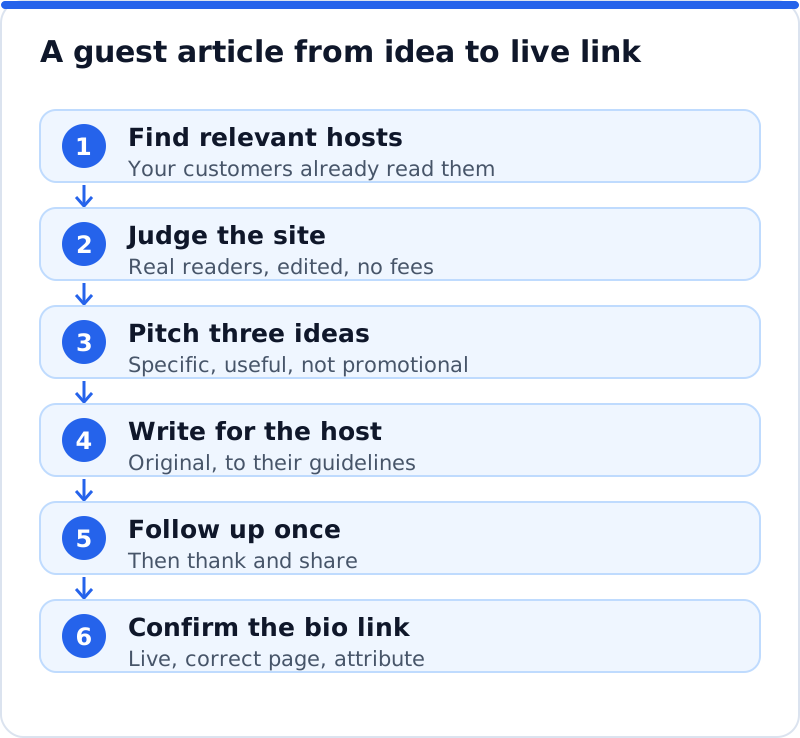
A pitch is a short email that shows you know the site and gives the editor something easy to say yes to. Address the editor by name, mention one recent article you read and why it was useful, and then offer three specific article ideas, each with a working title and one sentence on what the reader will learn. Three ideas give the editor a choice and show that you understand the audience, while one idea is easy to reject and ten looks like a template. Finish with two or three sentences on who you are and why you can write about the subject, plus links to one or two articles you have written before. Keep the whole email short enough to read on a phone.
The ideas themselves should fill a gap on the host site, not repeat what it has already published. Search the site for each topic before pitching, and choose angles that come from your daily work, such as common mistakes you see, questions clients ask or how a recent rule change affects the readers. An HR consultancy in Milan pitching an English-language business website might offer a guide to what a foreign company must know before hiring its first employee in Italy, a piece on the most common contract errors it sees, and a checklist for remote staff. Each idea is specific, useful and grounded in experience. None of them is about the consultancy itself.
Writing the article the editor wants
Once an idea is accepted, read the site's guidelines again and follow them exactly, including length, format, headings, images and deadlines. Write something original for that site, never an article already published elsewhere or a lightly changed copy of one, because duplicated content is one of the warning signs Google describes. Teach with specifics: steps, examples, figures you can stand behind and honest limits. Link to good sources where they help the reader, including the host's own articles, and keep links to your own website to the bio unless one genuinely adds something. Deliver on time, because reliable writers are the ones editors invite back.
Write for the host's readers, not for your sales funnel. A kitchen fitter in Glasgow writing for a home renovation website should explain how to plan a kitchen layout that works, what to ask a fitter and where budgets usually go wrong, not why his company is the best choice. Readers notice the difference immediately, and so do editors, who often reject or heavily edit promotional pieces. Include a short summary, clear headings and one or two images you have the right to use. Read the finished article aloud, cut every sentence that adds nothing, and send it in the format the editor asked for.
The author bio and its link
The bio is the part of a guest article that belongs to you, so keep it short and useful. Two or three sentences are usually enough: your name, your role, the business and one fact that explains your expertise, such as years of practice or a specialism. Most hosts allow one link, and it should point to the most relevant page of your website, often the home page or a page about the service the article discusses. Use your business name or a plain description as the link text rather than a keyword phrase, which looks natural and keeps you clear of the anchor text problems Google warns about. If the site lets you add a photo and a professional profile link, do it, because readers like to see who wrote what they just read.
Expect some hosts to mark bio links as nofollow, and accept it without argument. Many reputable publications do this as a matter of policy, partly because of Google's guidance on guest content. The article still reaches the audience, still carries your name and can still bring visitors who click through. Never offer payment to change a nofollow link to a followed one, because that turns a legitimate article into a paid link. If a host insists that the bio contain a keyword-rich link to your site, that request itself is a sign to reconsider.
Following up and tracking
Editors are busy, so silence is normal and not a refusal. If you hear nothing after about a week, send one short follow-up that repeats the three ideas in a line each, and then move on if there is still no answer. After an article is published, thank the editor, share it on your own channels and reply to any comments or questions from readers. Record the site, the article address, the publication date, whether the bio link is followed and any visits or enquiries it sends. Check the article again every few months, because sites are redesigned and links sometimes disappear.
Our tools help with the slow parts of this work. The AI Backlink Checker prepares guest post pitches you can adapt, and its link tracker confirms when the article and its bio link are live and whether the link is followed. It also shows the authority and spam signals of the sites already linking to you, so you know where you stand before you add more. Guest articles are one of three channels in a wider plan for link building for business, alongside directory listings and press coverage. To see how links fit with the rest of your website's health, the AI SEO tools for business websites check pages, titles and technical issues as well.
Guest posting at a sensible pace
More is not better with guest articles, and a steady pace keeps quality high. For most businesses, one well-researched article every month or two on a carefully chosen site is plenty, and even four a year can make a real difference in a niche. Spreading articles across different relevant sites looks natural, while placing many on one site or the same idea on many sites looks like the campaigns Google warns about. When a host likes your work, offer to write again or to contribute a regular column, because an ongoing relationship is worth more than a string of one-off placements. Over time, editors may start approaching you, which is the clearest sign the approach is working.
Questions business owners ask
Is guest posting still worth it for SEO?
Yes, when it is relevant and occasional, though the main benefits are often reputation and readers rather than rankings alone. A followed link from a respected site in your field can help your website, and a nofollow link still brings visitors and trust. What no longer works is mass placement on unrelated sites, which Google has warned about for years. Judge each article by who will read it and whether it shows your expertise. If both answers are good, the link takes care of itself.
Can I publish the same article on my own blog?
It is better not to, at least not in full. Duplicate copies are one of the warning signs Google describes, and most editors want original work they can call their own. A good alternative is to write a short summary on your blog that links to the guest article, which sends your readers to the host and keeps both pages useful. Some hosts allow republishing after a period with a canonical tag pointing to the original, but ask first and follow their rules. In most cases a fresh article for your own blog is the cleaner choice.
Should I pay a site to publish my article?
Paying for a placement is allowed only if the link is marked sponsored or nofollow, because paying for a link that passes ranking credit breaks Google's policies. Many sites that ask for fees are selling links to anyone, which makes them poor hosts in any case. Reputable publications rarely charge contributors, because they want expertise rather than income from writers. If a site you respect offers a sponsored feature, treat it as advertising and judge it on the audience it reaches. Keep it clearly separate from your guest articles in your records.
Your first guest article
This week, list ten sites your customers read and judge each one against the table above, keeping the best three. Read several recent articles on each, then write a pitch for the strongest site with three specific ideas drawn from questions your clients ask. Send it to a named editor, follow up once after a week and start the next pitch while you wait. When an article is accepted, write it to the host's guidelines, keep the bio short and record the link once it is live. Before you begin, check which sites already link to your website, so you can see clearly what your guest posting adds over the coming months.
Every site that links to yours, its authority and relevance, the trust your backlinks earn and the links your competitors have.
Check your backlinks with the AI Backlink Checker →