 AI Web Maker
Law firm website example
Here is what a law firm website example has to do: name the matters a firm handles in the words clients use, explain what follows a first enquiry and make clear that reading the site is not legal advice. Hartwell Legal, a made up practice, manages it in 4 pages through six practice areas, a four step approach to new matters, a confidential enquiry form and a disclaimer in every footer.
Hartwell Legal is a fictional practice, and its lawyers, its past matters and its contact details were invented for this sample.
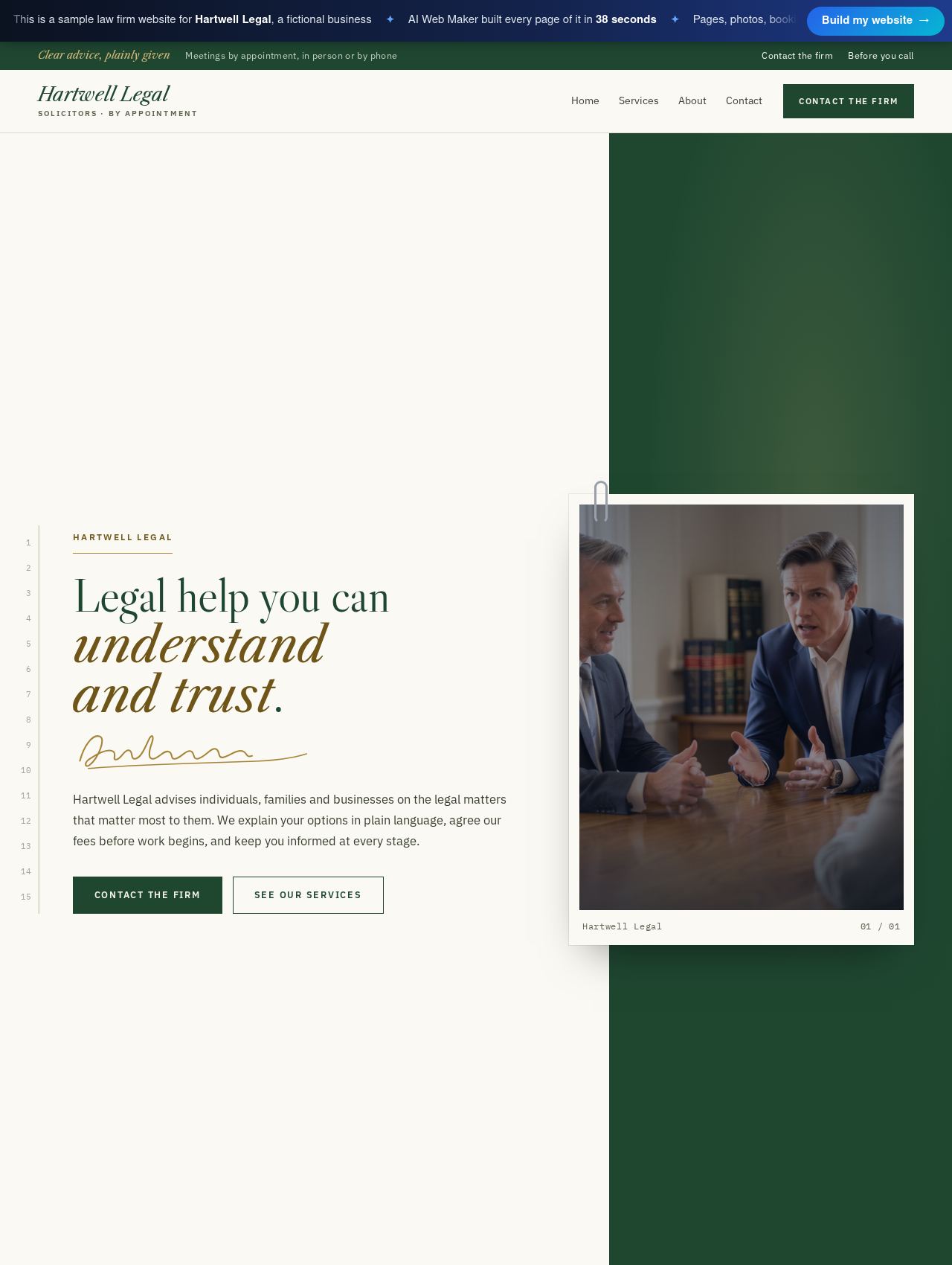
Someone visiting a lawyer's website is usually worried, and often unsure whether their problem is even a legal one. Hartwell Legal greets them with a header strap that reads Clear advice, plainly given, beside a note that meetings are held by appointment, in person or by phone. The Services page lists six practice areas, from business and commercial matters and property to family, wills and estate planning, employment and general legal advice. Each area is described in one plain sentence, so a reader can match a situation to a heading without knowing the legal term. A Who Our Services Suit list and a four step approach to a new matter then show how the firm begins. The visitor learns where they fit before being asked to share anything.
The sample is equally careful about what the website itself is. A disclaimer in every footer says the site gives general information only, that contacting the firm does not create a solicitor client relationship until the firm confirms in writing, and that past results do not guarantee future outcomes. The Contact page form asks for a description of the matter and notes that enquiries are treated confidentially. On the About page, Meet the Team holds a note that profiles will be added, rather than inventing lawyers. Titles such as solicitor, attorney, advocate or barrister, and the rules on how lawyers may advertise, vary by country, so a real firm should follow its own regulator. Those boundaries are what make a legal site trustworthy rather than merely polished, and they are the first thing to check in any law firm website examples a practice studies.
Hartwell Legal across four pages
Hartwell Legal keeps to 4 pages, and its home page does much of the work, with seven sections running from the matters people bring to notes from the practice. The table lists each page with its headings.
| Page | What it opens with | Its sections |
|---|---|---|
| Home | Legal help you can understand and trust. | Support across the matters people bring us. · Prepare for your first conversation. · Who you will be speaking to. · Our work, in brief. · Advice that makes sense to you. · Notes from the practice. · Tell us what you need help with. · Get a website like this for your business |
| Services | Our Legal Services | Practice Areas · Taking the First Step · Get a website like this for your business |
| About | About Hartwell Legal | Our Story · What We Stand For · How We Work · Meet the Team · Explore Further · Ready to Talk? · Get a website like this for your business |
| Contact | Contact Hartwell Legal | Send us an enquiry · Get a website like this for your business |
Hartwell Legal's build, from brief to finished pages
One run of the builder produced Hartwell Legal from a line about a firm advising individuals and businesses on contracts, property, employment and family matters.
The draft also reached further than its brief, adding wills and estate planning and general legal advice, areas a real firm should keep only if it practises them.
Five things a client needs before describing their problem to a lawyer
Practice areas named the way problems feel
Clients search for their problem, such as a dispute with an employer or a house sale, rather than for a branch of law. Hartwell Legal's Services page meets them with six areas, each in a single plain sentence. Business and Commercial Matters covers contracts and day to day decisions, Property Matters covers buying and selling, and Employment Matters speaks to both employers and employees. A General Legal Advice entry catches questions that fit no single heading, and a line tells visitors that not knowing their area is perfectly fine. A real firm should list only the areas it is qualified and insured to handle, using the terms its clients use in its own country. Well named areas are the quiet engine of law firm website design, bringing the right enquiries and turning away the wrong ones.
A first step with the obligations spelled out
Many people delay calling a lawyer because they fear the first conversation will commit them or cost them. Hartwell Legal's Taking the First Step section says an initial enquiry lets the firm understand the matter and say whether it can help, with no obligation to proceed. The approach to a new matter lists four steps: listening, explaining in general terms which areas of law may apply, discussing next steps and agreeing how to proceed before any work begins. A real firm should add whether the first meeting is charged, how long it lasts and what to bring. It should also explain how fees are set once it takes the matter on, whether by the hour, as a fixed fee or on another basis its rules allow. Removing the fear of the first call is worth more than any slogan.
The relationship's limits stated in plain sight
Every website for law firms must make clear that reading it is not the same as being advised. Hartwell Legal's footer says the information is general, that contacting the firm creates no solicitor client relationship until the firm confirms in writing, and that past results do not guarantee outcomes. This matters because a firm usually needs to check for conflicts of interest before it can act. The enquiry form asks for a description of the matter, and a real firm should ask visitors to keep that first message to a short outline and to hold back documents until it confirms it can help. The disclaimer itself should be reviewed under the firm's own professional rules, since the required wording varies between jurisdictions. Stating these limits early protects the visitor as much as the firm.
Lawyers introduced with the titles they hold
Clients choose a person as much as a firm, so the team page has to be specific and accurate. Hartwell Legal's About page has a Meet the Team section that promises profiles showing each person's role and area of expertise, and the header describes the firm as Solicitors, by appointment. A real firm should name each lawyer with the exact title their regulator grants, which may be solicitor, attorney, advocate or barrister depending on the country. Some regulators restrict words such as specialist or expert to lawyers with a recognised certification, so those words need checking. The page should also give the regulator's name and the firm's registration details where the rules require them. Accurate titles reassure clients and keep the firm on the right side of its regulator.
Proof of work that keeps client confidences
Visitors want evidence that a firm has handled matters like theirs, but a law firm cannot simply publish its clients' stories. Hartwell Legal's home page has two sections for this, one headed Our work, in brief and another headed Notes from the practice. Because the firm is invented, any examples there are invented too, and a real firm must replace them. Past work should be described only with the client's consent or in a form that identifies nobody, and without suggesting that a result can be repeated. Short articles in the practice notes can explain common problems in general terms, which helps both readers and search engines. Careful proof of this kind builds confidence without breaking confidences.
Guides for practices that take on new matters
Hartwell's search check results
Legal searches usually describe a problem rather than a practice area, such as a contract dispute, a will or an unfair dismissal, often with a town added. Hartwell Legal scored 78, losing points because one of its four pages lacks a search title of its own and one lacks a search description of the right length.
- ✗Search titles (3 of 4 pages)
- ✗Search descriptions (3 of 4 pages)
- ✓One main heading (4 of 4 pages)
- ✓Section headings (4 of 4 pages)
- ✓Image alt text (4 of 4 pages, 0 of 4 images without it)
- ✓Phone ready (4 of 4 pages)
- ✓Language set (4 of 4 pages)
- ✓Internal links (4 of 4 pages)
- ✓Page weight (4 of 4 pages)
A firm that does not exist should not tell search engines that it does, so Hartwell's business schema was removed and its two checks dropped from the list.
find out how your firm's pages perform in search
Other AI tools a legal practice may want
Winning new matters takes more than a website, and these tools cover some of the other work.
Set up a site for your own legal practice
Describe the matters you handle and the clients you act for, and the builder drafts your pages, words and photos. Before publishing, add your regulator's name, your registration details and a disclaimer reviewed under your own professional rules. Drafts and previews are never charged, however many times you revise them.
Questions solicitors and attorneys ask about going online
Can a law firm show client reviews and case results online?
It depends on where the firm practises. Some regulators allow reviews and results with conditions, while others restrict testimonials or require a warning that past results do not guarantee future ones, a line Hartwell Legal already carries in its footer. Any review must come from a real client who agreed to share it, and any result must be described without revealing confidential details. Check your own regulator's advertising rules before publishing either.
How should the enquiry form treat confidential details?
It should collect just enough to start, such as a name, contact details and a short outline of the matter. Hartwell Legal's form asks for exactly that and says enquiries are treated confidentially. Many firms add a line asking visitors not to send documents or sensitive details until the firm has checked for conflicts and confirmed it can act. That protects the visitor and keeps the firm clear of information it may not be able to use.
Did a lawyer draft the Hartwell Legal pages?
No. The AI Web Maker builder drafted them, with their photos, from a short description of a practice invented for this sample, and it finished the 4 pages in 38 seconds. A real firm should treat such a draft as a starting point and have a qualified lawyer approve every statement, including the disclaimer.
How much does a law firm pay to keep its site live?
Keeping the site live costs $119 a year in hosting, or $19 a month for a firm that prefers smaller payments. The domain is a separate purchase, priced by the ending, and there are around 400 endings to choose from. Building the site and previewing every page are not billed.
Updated 7 November 2026 · by AI Web Maker · More legal financial website guides · All sample websites