 AI Web Maker
Gym website example
A gym website example worth studying shows what training is on offer, who coaches it, what joining costs and when the doors are open. This sample, built for the invented Peak Motion Fitness, covers the first two across 5 pages, with a programs page, a coaches page and 4 sessions to book, and leaves clear room for the membership terms and opening hours a real gym must add.
Peak Motion Fitness is not a real gym, so the coaches, member comments, session prices and contact details on it were all made up for this sample.
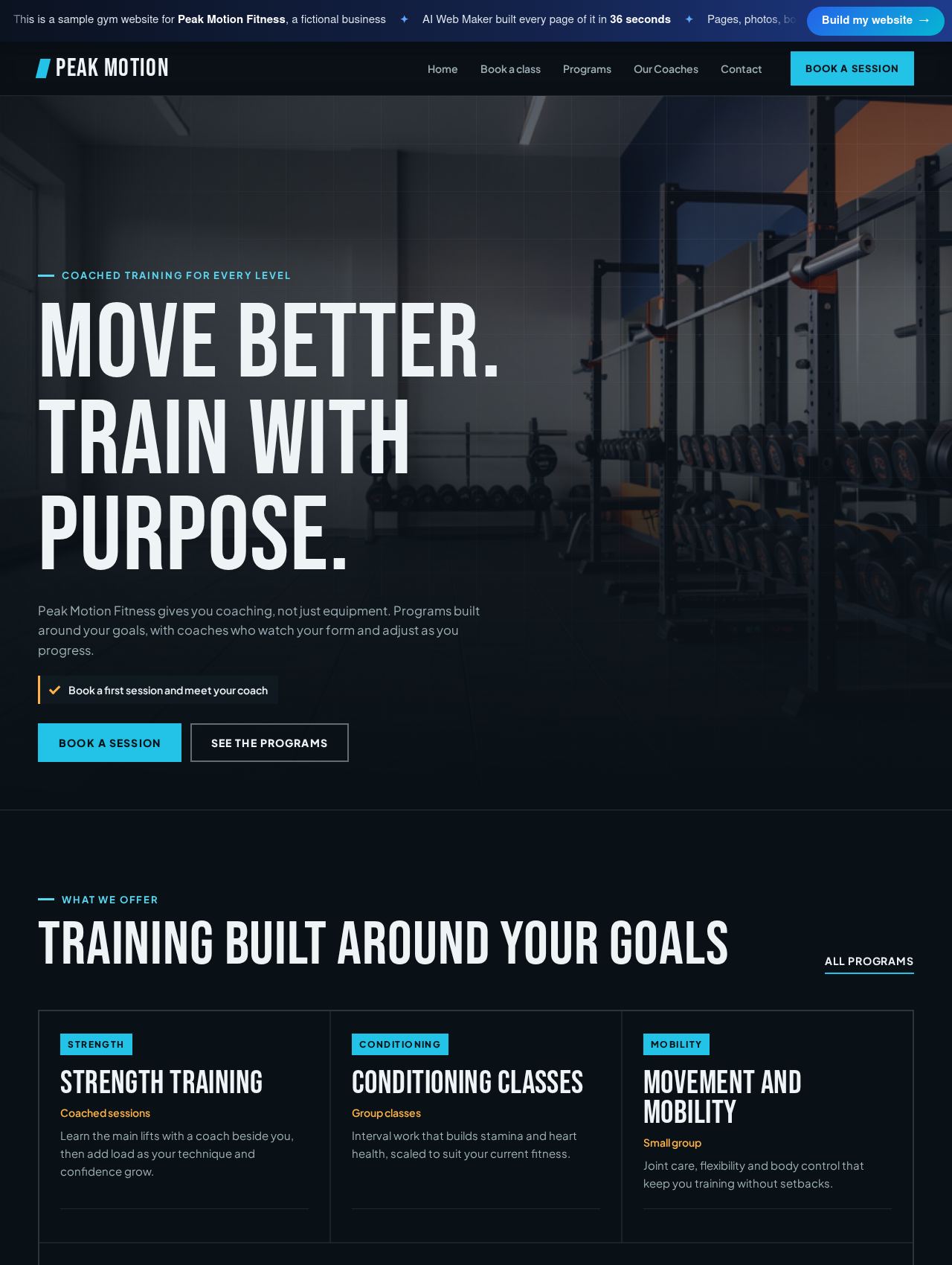
People comparing gyms online are usually choosing between a few places close to home or work. Peak Motion's site makes its case through coaching rather than through a list of machines. The Programs page sets out two ways to train, Personal Training and Group Sessions, and explains who each suits and how a session runs, from the warm up to a short review of progress. A section called How to Get Started asks the visitor to book a first session before committing to anything longer. The home page backs this up with sections on training built around goals, the coaches, an option finder and member comments. Together they tell a wary newcomer that someone will guide them from the first visit, a promise that many gym website examples bury under photos of machines.
The remaining pages carry the practical side of joining. The booking page offers 4 sessions, all at 60 minutes: Strength Training at USD 45, Conditioning Classes at USD 25, Movement and Mobility at USD 35 and One to One Coaching at USD 85. Our Coaches page states a coaching philosophy and holds three profile cards marked Coach Name, waiting for the gym's real team. The Contact page carries an enquiry form and a box where phone, email, address and opening hours will appear exactly as the gym supplies them. Membership prices and contract terms appear nowhere yet, even though the brief to the builder mentioned memberships. A real gym keeps this structure and writes those terms in before launch.
Peak Motion, page by page, as a new member meets it
The sample has 5 pages, and each one handles a separate step, from comparing training options to sending a first enquiry. The table shows them with their main headings.
| Page | What it opens with | Its sections |
|---|---|---|
| Home | Move better. Train with purpose. | Training built around your goals · Meet the people who train you · Find the option that fits · What members say · Book your first session · Before you book · Get a website like this for your business |
| Book a class | Book an appointment | Get a website like this for your business |
| Programs | Training Programs at Peak Motion Fitness | Our Training Options · How to Get Started · Get a website like this for your business |
| Our Coaches | Meet the Coaches | Our Coaching Philosophy · Our Coaches · Welcome, Whatever Your Fitness Level · Ready to Train With Us? · Get a website like this for your business |
| Contact | Contact Peak Motion Fitness | Send us an enquiry · Get in touch directly · Looking for more before you reach out? · Get a website like this for your business |
From one sentence to a coached gym: the build record
One sentence about a gym and fitness centre with memberships, group classes and personal training was all the builder received, and the figures below are what came back.
Those 36 seconds produced the structure, but membership prices, opening hours and coach profiles remain the gym's own work.
Four promises good gym website design keeps before anyone signs up
Membership terms laid out like a contract summary
Joining a gym is a financial commitment, so the website must state what membership costs and what it binds a member to. Peak Motion's home page has a section called Find the option that fits, and its Programs page compares Personal Training with Group Sessions, but neither shows a monthly fee, a joining fee or a minimum term. A real gym should list each membership with its price, what it includes, how long it runs and how to pause or cancel it. Rules on contracts, cooling off periods and automatic renewal differ between countries, so the owner should check the consumer rules where the gym trades. Plain terms reduce disputes at the front desk and complaints later. A member who understood the deal before joining is far more likely to stay.
An induction booked as easily as a class
Most gyms ask new members to complete an induction before they train alone, and the website should make that step easy to book. The sample comes close with How to Get Started, which tells visitors to choose an option and book a first session. Its booking page, however, lists only four training sessions, with no item for a floor induction or an equipment walk through. A real gym can add one alongside Strength Training and the others, with a line on what it covers and how long it takes. Many gyms also ask newcomers to fill in a health questionnaire, and anyone with a heart condition, a recent injury or a pregnancy should be told to check with a doctor before starting. An induction that is simple to book turns a new sign up into a confident member.
Opening hours, staffed hours and holiday changes
Opening hours are among the first things anyone checks on a gym website, often from a phone in the car park. The sample's Contact page has a Get in touch directly box that says phone, email, address and opening hours will be listed exactly as the gym provides them, so the space is reserved but empty. A real gym should fill it with its weekday and weekend hours, and if access runs longer than staffing, it should say when a coach or receptionist is actually on site. Holiday closures and class timetable changes belong close by. The same hours must appear on the gym's map listings, because searchers trust whichever source they saw first. Accurate hours prevent the worst first impression a gym can give, which is a locked door.
Coaches with names, faces and checked qualifications
A gym that sells coaching must show who does the coaching. Peak Motion's Our Coaches page opens with a philosophy about meeting people where they are, then shows three cards that each read Coach Name, with the areas of focus left for the owner. The home page repeats the idea in a section called Meet the people who train you. On a real site each card needs a name, a recent photo taken in the gym, the coach's specialisms and the qualifications they actually hold. Registers and recognised qualifications for fitness professionals vary by country, so the wording should match the body that issued them. On a website for gyms that sell coaching, real profiles turn that promise into people a newcomer can ask for by name.
Reading for owners who want a busier training floor
Search readiness of the Peak Motion pages
A newcomer usually searches for a gym by area, by opening time or by a type of training such as strength or conditioning. The checks below show how the 5 pages of Peak Motion are prepared for those searches, with an overall score of 67 and a few gaps in titles and descriptions to close.
- ✗Search titles (4 of 5 pages)
- ✗Search descriptions (3 of 5 pages)
- ✓One main heading (5 of 5 pages)
- ✗Section headings (4 of 5 pages)
- ✓Image alt text (5 of 5 pages, 0 of 8 images without it)
- ✓Phone ready (5 of 5 pages)
- ✓Language set (5 of 5 pages)
- ✓Internal links (5 of 5 pages)
- ✓Page weight (5 of 5 pages)
The list leaves out two checks on business schema, since that schema was stripped from the sample so that search engines are not told an invented gym exists.
test your gym's pages with the same checks
Tools that sit beside a gym's website
Filling a gym takes more than a website, and the AI Web Maker tools listed here help with several of the jobs around it.
Compare this sample with other websites that take bookings online on our AI booking website builder page.
Draft a site for your own training floor
Write a short description of your gym: the training you offer, who coaches it and the kind of member you want to welcome. The builder turns it into pages, wording and photos, and you then add your real membership terms, hours and coaches before publishing.
What gym owners ask about selling memberships online
Should a gym show membership prices on its website?
In most cases yes, because people comparing gyms tend to skip the ones that hide their prices. Listing the monthly fee, any joining fee and the minimum term lets a visitor decide before visiting. If prices change with offers, the site can show the standard rate and mention that promotions vary. Consumer rules on how contracts and renewals must be explained differ by country, so check the local requirements.
Can new members book an induction or a first session online?
Yes. A newcomer sends a request for the session and a day, and the gym accepts it, offers another time or declines it from its Booking Manager. Payment for the session is agreed between the gym and the member, and AI Web Maker keeps none of it. Adding an induction item to the booking list makes this the natural first step for anyone new.
Was Peak Motion Fitness written by gym staff?
No. The AI Web Maker builder received a single sentence describing an imaginary gym with memberships, group classes and personal training, and from that alone it wrote every page, chose the photos and set out the 5 page structure. A real gym starts from its own sentence and then corrects everything the builder drafted.
How much does it cost a gym to run this kind of website?
There is no bill while the gym writes, rearranges and previews its draft. Hosting begins when the site is published and costs $19 a month, or $119 if the gym pays for a full year at once. The domain is a separate purchase, priced by whichever of roughly 400 endings the gym picks.
Updated 7 November 2026 · by AI Web Maker · More fitness instruction website guides · All sample websites