 AI Web Maker
Real estate company website example
A real estate website serves four audiences at once, so it must route sellers to a valuation, buyers and tenants to listings and viewings, and landlords to letting help, while proving local knowledge with sold homes. Keystone Property Agents, an invented agency, lays this out across 5 pages, and the builder spent 54 seconds on them, ending with a form that first asks the type of enquiry.
Keystone Property Agents and its agents, listings, client reviews, fees and contact details were all invented to illustrate this sample.
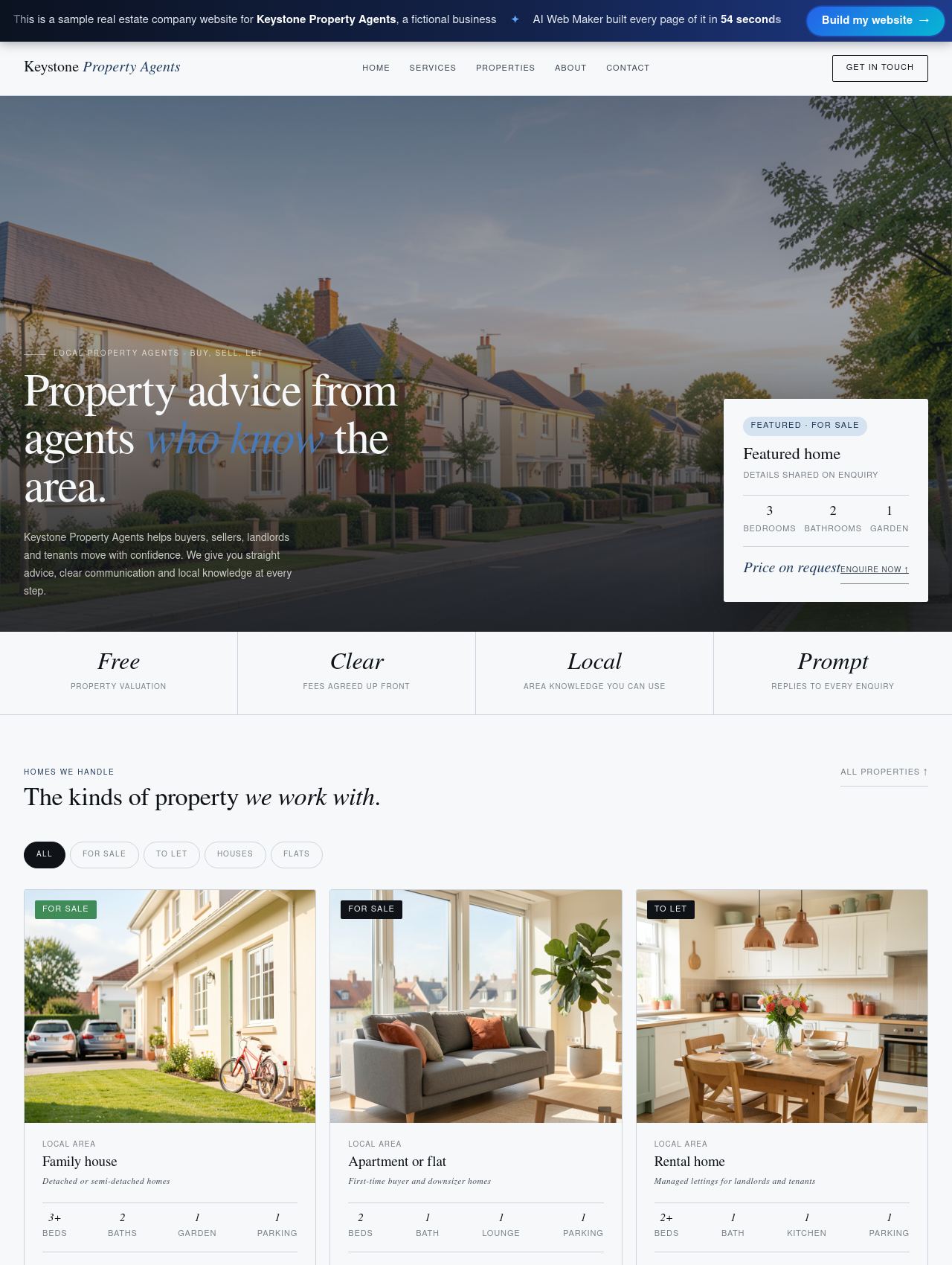
An estate agency's website has to greet a seller, a buyer, a landlord and a tenant on the same page without confusing any of them. Keystone Property Agents opens with property advice from agents who know the area, then shows the kinds of property it handles, a section headed book a viewing and the neighbourhoods it knows well. Its Services page splits the work into selling, letting and property management, help for buyers and tenants, and a valuation with no obligation to proceed. A six step path follows, from first enquiry and consultation through marketing, viewings and offers to agreement and completion. The Properties and Areas page adds property types, local market knowledge and a space for featured and recently sold homes. Each visitor can find their own door within a few seconds, which is the test the best real estate website examples pass.
The sample leaves the evidence an agency lives on for the owner to supply, and that is exactly where a real agent should start. Featured and recently sold properties are marked coming soon, the areas covered are waiting for real place names, and the team and reviews are to be shown only once confirmed. A real agency should fill those spaces with live listings, sold homes it actually handled and named agents with their roles. Licensing of agents, rules on how property is described in adverts and the way fees must be shown vary by country and sometimes by state or region. The site should stay factual and avoid anything that sounds like mortgage, tax or legal advice. Real listings and real names are what turn a polished draft into an agency people trust.
Keystone's pages for sellers, buyers, landlords and tenants
Keystone Property Agents divides its 5 pages so that each kind of client reaches their own section quickly. The table lists the pages with the headings on each.
| Page | What it opens with | Its sections |
|---|---|---|
| Home | Property advice from agents who know the area. | The kinds of property we work with. · Book a viewing. · The neighbourhoods we know well. · Straightforward agents, not salespeople. · A simple process, done properly. · What clients can expect from us. · Tell us what you need. · Get a website like this for your business |
| Services | Our Services | Selling your property · Letting and property management · Help for buyers and tenants · Free, no-obligation valuation · How it works: from first enquiry to completion · Get a website like this for your business |
| Properties | Properties and Areas | Types of Property We Handle · Areas We Cover · Local Market Knowledge · Featured and Recently Sold Properties · Looking for a Property Not Shown Here? · Get a website like this for your business |
| About | About Keystone Property Agents | Our Story · Meet the Team · Memberships and Reviews · Let's Talk About Your Property · Get a website like this for your business |
| Contact | Contact Keystone Property Agents | Send an enquiry · Get in touch directly · What happens after you send an enquiry · Get a website like this for your business |
Keystone's build, timed from brief to finished pages
From a short note about an invented estate agency, the builder put together 5 pages, and the whole job took 54 seconds.
No bookable items were added, since viewings and valuations are arranged by the agency once it knows the property and the client.
Five things an agency site must prove before a seller calls
Give each type of client a separate door
Sellers, buyers, landlords and tenants arrive with different questions, so a single block of text serves none of them well. Keystone's Services page gives each its own section, from selling your property to letting and property management and help for buyers and tenants. The contact form begins with a type of enquiry field, so the agency can route each message to the right person. A real agency should keep that split and make the home page point each audience to its section in one click. The words in each section should match how that client thinks, such as asking price for a seller and viewing for a buyer. In real estate agency website design, clear routes mean fewer lost visitors and better enquiries.
Offer a valuation and explain what it is
The valuation is the main way a seller first meets an agent, so the site should make that step simple and honest. Keystone offers a valuation with no obligation to proceed, promising a talk through the local market and the seller's options. A real agency should say what the visit involves, how long it takes and what the seller receives afterwards, such as a suggested asking price. In many countries an agent's market appraisal is different from a formal valuation by a qualified valuer for a lender, and the site should not blur the two. Fees for selling should be explained in outline, following the local rules on how agents show charges. A clear, honest valuation offer brings sellers in without false expectations.
Prove local knowledge with listings and sold homes
Every agency claims to know the area, so the claim only counts when the site shows evidence. Keystone's Properties and Areas page has sections on types of property, areas covered, local market knowledge and featured and recently sold homes. Today the sold homes are marked coming soon and the areas are waiting for real names, which is right for an invented agency. A real one should show current listings with clear photos, asking prices and key details, plus homes it has sold where clients agree to it. The local market section can then describe transport, schools and the character of each street in the agency's own words. Sold evidence persuades a seller far more than any slogan about expertise.
Walk people through the steps to completion
Buying or selling a home can take months, and clients want to know what happens between an offer and moving day. Keystone's Services page answers with six numbered steps, from first enquiry and consultation to marketing or search, viewings and offers, agreement and progression and completion. A real agency should add typical timings and explain who else is involved, such as lawyers, surveyors or lenders, using the terms that apply in its country. The names and order of steps differ around the world, so the page should describe the local process rather than a generic one. Saying when the client will hear from the agent at each stage reduces anxious calls. A clear map of the journey makes the agency look like the safe pair of hands.
Name the agents and back them with real reviews
People choose an agent as much as an agency, so the team deserves a proper introduction. The sample's Meet the Team section says profiles will be added once confirmed, and Memberships and Reviews waits for verified memberships and client comments. A real agency should name each agent, their role and the areas they cover, with a recent photo. Licences or registrations that agents must hold vary by country and state, so the site should list only the ones it holds. Reviews should come from real clients who agreed to be quoted, ideally with the kind of sale or let they relate to. On a website for real estate agents, named people and honest reviews do more to win instructions than any promise of results.
Guides for agents bringing listings and valuations online
Keystone's search checks, room by room
Under the AI Website SEO Tools, the 5 Keystone pages reached 89. Titles, headings, alt text on all eight images, phone layout and links passed, and one page still needed a search description of the right length.
- ✓Search titles (5 of 5 pages)
- ✗Search descriptions (4 of 5 pages)
- ✓One main heading (5 of 5 pages)
- ✓Section headings (5 of 5 pages)
- ✓Image alt text (5 of 5 pages, 0 of 8 images without it)
- ✓Phone ready (5 of 5 pages)
- ✓Language set (5 of 5 pages)
- ✓Internal links (5 of 5 pages)
- ✓Page weight (5 of 5 pages)
Keystone sells no real homes, so the sample's business schema was withdrawn, leaving out two checks that would have read it.
Run these checks on your agency's own site
Other AI Web Maker tools for an estate agency
An estate agency can also lean on other AI Web Maker tools when it wants a fresh name, tighter listing copy or wider local reach.
Open your own agency site with a two line brief
Tell the builder whether you sell, let or manage, which neighbourhoods you know and who your clients are. A draft comes back with pages, copy and photos, and you can edit and preview it as long as you like without a charge. Publishing switches on hosting, a choice between $119 once a year and $19 every month, and the domain is registered and paid for apart from that.
Agents ask about listings, valuations and the hosting bill
Should an estate agency put sold prices on its website?
Showing homes it has sold is strong proof of local results, and many agencies do. Whether sold prices can be published depends on local rules and on the seller's permission, so a real agency should check both first. Keystone's featured and recently sold section is marked coming soon, which is the honest state for an invented agency.
Is an online valuation request the same as a formal valuation?
Usually not. An agent's valuation is a market opinion meant to help set an asking price, while lenders and courts often need a formal valuation from a qualified valuer or surveyor. The names and rules differ by country, so an agency site should say which kind it offers. Keystone describes a talk through the local market and the options, with no obligation to proceed.
What does a site like Keystone's cost to keep live?
An agency pays nothing while it builds and previews. After launch the only running charge is hosting, billed either yearly at $119 or monthly at $19, with the agency's domain registered on a separate bill from about 400 endings.
Is Keystone a real agency, and who wrote its pages?
Keystone is not real. Its pages, wording and property photos were generated by the AI Web Maker builder, which had only a short description of an imaginary estate agency to work from. Listings, sold homes, team profiles and reviews were left for a real owner to add, which is why they show as coming soon or awaiting confirmation.
Updated 7 November 2026 · by AI Web Maker · More real estate property website guides · All sample websites