 AI Web Maker
Construction company website example
A construction company website should tell a client within seconds which jobs the firm takes on, prove it with finished buildings, and explain how a price is fixed before work starts. Stonebridge Builders, an invented general contractor, shows that shape: in 50 seconds AI Web Maker drafted its 5 pages, from new builds and extensions to commercial fit outs, with a quote form on the Contact page.
Stonebridge Builders has never laid a brick: the firm, its crews, its client reviews, any prices and every contact detail on the sample were invented for this example.
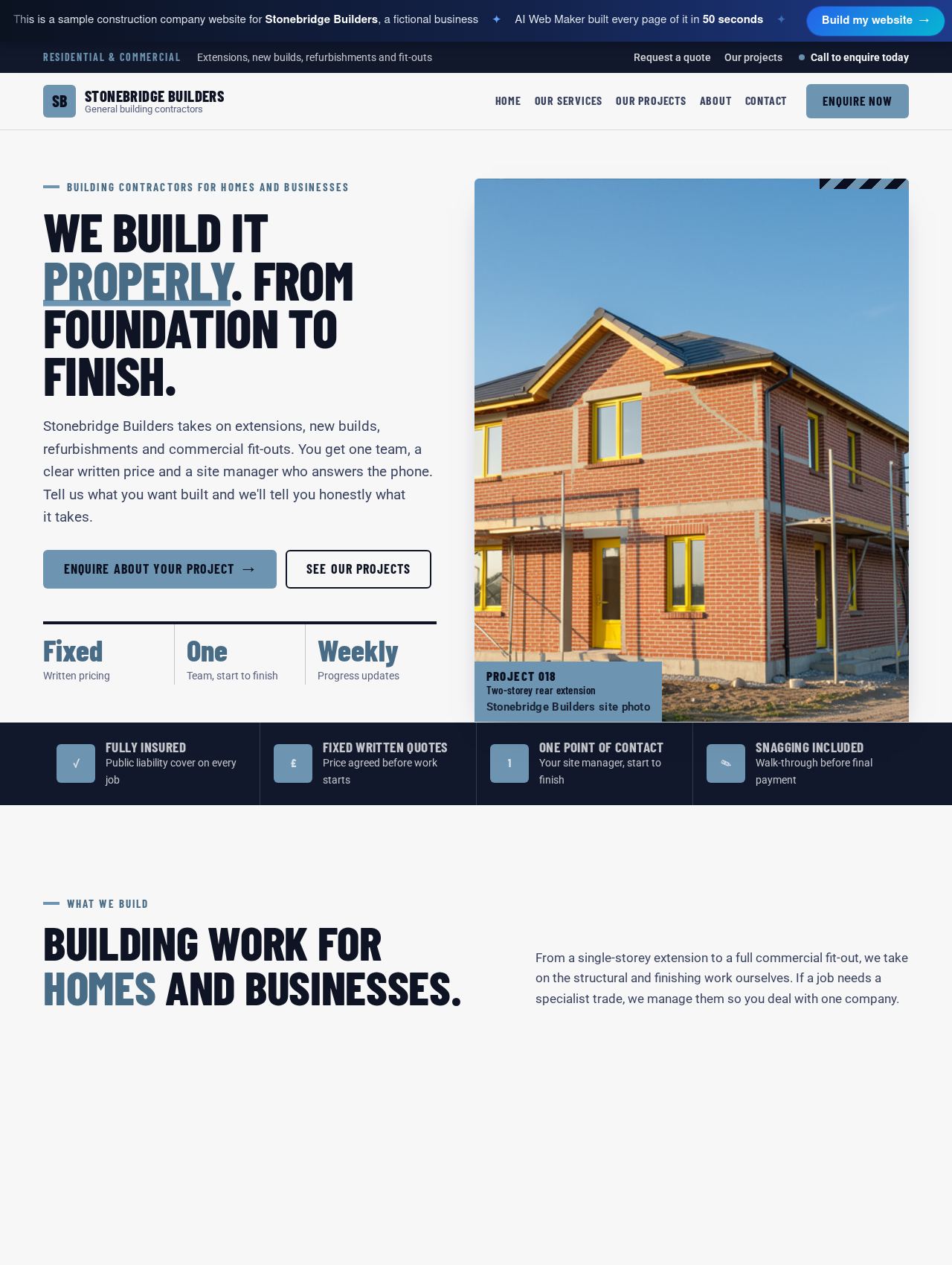
A building project can run for months and swallow a large share of a client's savings, so a contractor's website gets read slowly and with suspicion. Stonebridge Builders answers that reader with a home page that opens on building work for homes and businesses. A two storey extension built to match the existing house follows, and then completed projects from the firm's sites. Next come the four steps that run from enquiry to handover, then a team that stays on the job. The footer adds the promise of fixed written pricing and one accountable team. Together these sections give a careful client the outline of a firm worth calling, which is more than many construction company website examples manage.
Behind the home page sit four more pages, and several of them openly leave gaps for the owner to fill. The Services page splits the work into new builds, extensions and renovations and names homeowners, landlords and commercial customers as clients. The Projects page sorts work into four categories, but each project card still says the type of work and outcome are to be confirmed by the owner. The About page sets out clear communication, agreed timelines and site standards, while the Contact page leaves phone, area and hours waiting for real details. Licences, insurance and planning rules for building work differ from country to country, so they belong on the site only once the owner has checked what applies locally. Filled in this way, the draft becomes a contractor's working shopfront rather than a sketch.
Stonebridge's five pages, set out like a site plan
Stonebridge Builders runs to 5 pages, and the table lists each one with the headings the builder gave it. Read in order, they follow a client from a first look at the work to the enquiry form.
| Page | What it opens with | Its sections |
|---|---|---|
| Home | WE BUILD IT PROPERLY. FROM FOUNDATION TO FINISH. | BUILDING WORK FOR HOMES AND BUSINESSES. · A TWO-STOREY EXTENSION, BUILT TO MATCH. · COMPLETED PROJECTS FROM OUR SITES. · FOUR STEPS FROM ENQUIRY TO HANDOVER. · A SMALL TEAM THAT STAYS ON YOUR JOB. · READY TO START YOUR BUILD? · Get a website like this for your business |
| Services | Our Services | Who We Work With · How a Project Starts · Ready to Start Your Project? · Get a website like this for your business |
| Projects | Our Projects | Completed Projects · What Our Clients Say · Have a Project in Mind? · Get a website like this for your business |
| About | About Stonebridge Builders | Our Story · The People Behind the Work · How We Work With You · Ready to Talk About Your Project? · Get a website like this for your business |
| Contact | Contact Stonebridge Builders | Send Your Enquiry · Get in touch directly · Looking for more information? · Get a website like this for your business |
How long the builder took to raise Stonebridge
One short description of an invented general contractor was all the builder had, and from it the pages were planned, written and illustrated: 5 of them in 50 seconds.
Nothing here can be booked by the hour, since a builder prices work after a conversation and usually a site visit, so each visitor is steered to an enquiry.
Five things a builder's website has to settle before the first site visit
Sort the work by size of job and type of client
Clients search for the job before they search for the firm, so a contractor's site has to name its work in their words. Stonebridge's Services page does this with three cards for new builds, extensions and renovations. A section headed Who We Work With then names homeowners, landlords and commercial customers, which lets each reader find a place on the page. Every service card still ends with a note that details are to be confirmed by the owner, and that note is the first thing a real firm should replace. Write what a typical extension involves, which sizes of commercial job you take and whether you work from an architect's drawings or arrange them. In construction company website design, specific services pull in the specific searches that a general promise misses.
Give every project a scope, a place and an outcome
Finished buildings are the strongest proof a contractor has, but only when each one is explained. Stonebridge's Projects page offers four categories, from new builds to refurbishments, and the home page features a two storey extension built to match the existing house. The project cards themselves are still blank, saying only that the type of work and the outcome are to be confirmed. A real firm should fill each card with the building type, the town or region, the main work done and how long the programme ran. Photos taken at different stages help, as long as the client has agreed and no address can be read. A project page built this way keeps selling while the owner is out on site.
Explain how a price becomes a fixed written quote
Money is the fear behind most building enquiries, because clients have heard stories of budgets that doubled halfway through. Stonebridge's footer promises fixed written pricing, and the Services page explains that every project starts with a conversation before anything is agreed. The home page backs this up with four steps from enquiry to handover. A real contractor should say what its quote includes, how long it stays valid and how changes asked for during the build are priced. It helps to state whether a site visit comes before the quote and whether drawings are needed first. Clear rules about price turn a nervous browser into a client who sends the form.
Put a name to the person who runs the site
A client lets a building crew onto their land for weeks or months, so they want to know who is in charge. Stonebridge's home page has a section on a team that stays on the job, and the About page adds The People Behind the Work. Its How We Work With You list promises one main point of contact, a schedule agreed upfront and a clean, safe and organised site. A real firm should name its site managers and lead trades, show their own photos and say who answers the phone during a build. Promises about tidy sites should match what the neighbours will actually see. People who can picture the foreman are far readier to sign.
Show licences, insurance and who handles permissions
Building work is regulated almost everywhere, but the rules, the registers and the approvals differ by country and often by region. Stonebridge's About page mentions planning and hands on supervision on every project, and its Contact page leaves the area covered and the business address to be confirmed. That leaves room for the details a cautious client checks first. A real contractor should list the registrations and insurance it truly holds and say whether it applies for planning or building approval on the client's behalf. It should never suggest that a job needs no approval, since only the local authority or a qualified professional can say so. Proof of this kind is what separates a firm from a rumour.
Reading for contractors who price from drawings
Search checks, walked like a snagging list
Run through the AI Website SEO Tools, Stonebridge's pages scored 89. Titles, headings, image text, phone layout and links between pages all passed, and the only gap was one page whose search description fell outside the right length.
- ✓Search titles (5 of 5 pages)
- ✗Search descriptions (4 of 5 pages)
- ✓One main heading (5 of 5 pages)
- ✓Section headings (5 of 5 pages)
- ✓Image alt text (5 of 5 pages, 0 of 7 images without it)
- ✓Phone ready (5 of 5 pages)
- ✓Language set (5 of 5 pages)
- ✓Internal links (5 of 5 pages)
- ✓Page weight (5 of 5 pages)
Stonebridge Builders has no real yard or office to list, so its business schema was pulled out and the two checks that test that schema were never run on it.
Check a contractor's site with these SEO tools
More tools for a contractor between site visits
Alongside the website, these AI Web Maker tools take on the writing a contractor tends to leave for the evenings after a long day on site.
Compare this sample with other contractor, builder and trade websites on our AI contractor website builder page.
Break ground on a site for your own building firm
Describe the jobs your firm takes on, the kinds of clients you build for and the region you work in, and from that the builder sets out a draft of pages, wording and photos. Drafting and previewing are never billed, so you can check every page against the way your firm really works before anything goes live.
What contractors ask before putting their firm online
Should a builder put prices on the website?
Many contractors avoid fixed figures, because two extensions of the same size can end up far apart once ground conditions and finishes are known. Stonebridge shows no prices and sends every visitor to a quote request instead. A useful middle way is to explain what drives the price, such as size, access, specification and approvals, and to say that the written quote is fixed before work begins.
Can one site serve homeowners and commercial clients at once?
Yes, and a good website for construction companies with mixed work lets each reader find their own path quickly. Stonebridge names homeowners, landlords and commercial customers in its Who We Work With section and keeps a separate Commercial Projects category on the Projects page. A real firm should give commercial clients the details they look for, such as working around premises that stay open, while keeping the pages for homeowners plain and friendly.
What does a contractor pay to keep a site like this standing?
The bill starts only when the site goes public. Hosting then runs at $119 for a year, or $19 a month for a firm that would rather match it to the rhythm of its stage payments, and the web address is bought on its own from roughly 400 endings. Raising the draft and walking through every preview are never billed, so the pages can be snagged like a finished build before anyone pays.
Who drew up the Stonebridge Builders pages?
No contractor wrote them. AI Web Maker's builder was handed a short description of a firm that builds homes and commercial buildings and handles renovations from the plans to the handover, and from that it planned the pages, wrote the wording and picked the photos. The firm is invented, so a real owner would start from their own description and then swap in true projects and people.
Updated 7 November 2026 · by AI Web Maker · More home services website guides · All sample websites