Website Traffic Potential: How Many Visits You Could Be Getting
A practical method for estimating the visits a month your website could win from Google, measuring what it wins today, and turning the difference into a plan.
- Any website
- Visits within reach
- Each problem joined to its fix

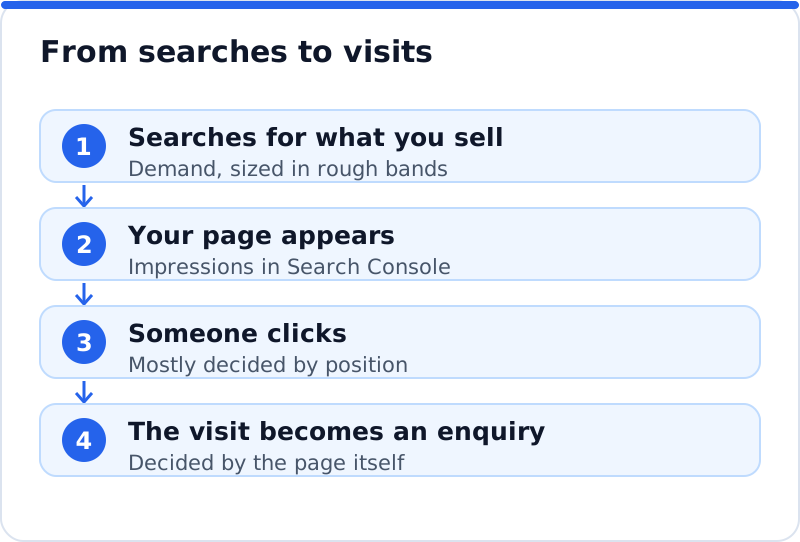
Every month a fixed number of people search Google for what you sell, and your website receives some share of them, large or small. The visits you are missing are not a mystery: they sit on searches you already appear for, just not high enough, and on searches none of your pages properly answer. Your website traffic potential is the size of that missing share, estimated honestly, and it is the most useful number to have before you spend money or time on SEO. It tells you whether your website is close to its ceiling or nowhere near it, which pages deserve attention first, and what a better position would really be worth in visits. You will learn how to size demand without trusting any single keyword tool too much, how positions on the results page turn searches into clicks, and how to read your own Search Console data to see where you stand today.
To see your own website the way Google does, try our AI website SEO tools, part of our AI SEO Tools.
This article is part of our complete guide: Website SEO Analysis.
Check your website traffic potential with the AI website SEO tools, page by page
What website traffic potential actually means
Website traffic potential is the number of visits a month your website could earn from Google if its main pages ranked as well as they reasonably could. The important word is reasonably, because potential is not the whole market. A kitchen fitter in Manchester could in theory appear first for every kitchen search in Britain, but national retailers and comparison sites own the broad terms and are not going anywhere. The realistic potential is the share of searches that fall within reach of your pages, given what they cover, where you work and how strong your website already is. Thinking in those terms changes the question from "why are we not number one?" to "where are we close, and what would closing the gap bring in?"
The estimate matters because it puts a value on SEO work before the work starts. If your website already wins most of the searches it can realistically win, further SEO brings small gains, and your budget may do more in advertising, referrals or a new service. If it wins only a fraction of what sits within reach, improving pages you already have is probably the cheapest growth available to you. The number also keeps conversations with agencies and freelancers honest, since "traffic went up" means little until you know whether it moved a long way towards the ceiling or barely at all. A modest, well-reasoned estimate is worth far more than an exciting one.
Sizing the searches for what you sell
Every estimate starts with demand, meaning how often people search for the things you offer in the places you offer them. Write down your services or products in the words customers use, not the words on your price list, because people type "boiler making a noise" long before they type "heating system diagnostics". Add the town or area to every local service, since a veterinary practice in Utrecht competes for "dierenarts Utrecht" and "vet near me" typed by people nearby, not for searches across the whole country. Then add the questions people ask before they buy, such as costs, comparisons and how long a job takes, because good answers to those questions bring in visitors who become customers later. A list of twenty to forty searches covers the core of most business websites.
To put a size on the list, give each search a rough band rather than an exact figure. Keyword tools, including Google Keyword Planner, give estimates that often disagree, so think in orders of magnitude: a search made about fifty times a month, one made about five hundred times and one made about five thousand times are genuinely different, while small differences between tools are noise. A website-level estimate is forgiving in one useful way, because errors on single searches tend to cancel out across a list of thirty. What matters more is that the list is complete, since a service you forgot to include is potential you will never count. Use yearly averages rather than the best month, so the total describes a typical month for the business.
How position decides the share of clicks
Searches are not visits, and the results page sits between the two. The share of searchers who click your result depends mostly on how high it appears and on what else Google shows above it. The top few plain results collect most of the clicks, the share drops steeply as you move down page one, and results on page two are seen by very few people. The curve is steep at the top and flat at the bottom, which means moving from ninth to fourth usually brings far more visits than moving from nineteenth to twelfth. That shape is the reason potential tends to sit on page one rather than deep in the results.
What appears above the plain results changes the curve for each search. Ads, a map with local businesses, an AI Overview or a block of shopping results can take clicks before anyone reaches the website links, so the same position is worth less on a crowded page. For a local business, the map is also a second route to the same customer, because it draws on the Google Business Profile rather than on the website alone. Searches for a business name behave differently again, since the searcher already knows where to go and almost always clicks the official website. When you add up the potential of a whole website, mark which of your important searches show a map or ads, and expect less from a better website position on those.
Reading today's visits in Search Console
Potential only means something next to what you already win, and Google Search Console is the best source for that, because it reports what actually happened in Google's results for your website. Open the Performance report, set the date range to the last three months and look at clicks, impressions and average position together. Clicks are the visits Google sent, impressions are the times your pages appeared in results someone loaded, and average position is the position of your highest result for each search, averaged across the times it appeared. Switch to the Queries tab to see the searches, and to the Pages tab to see which pages earned the clicks. Searches for your business name usually sit at the top, so filter them out with a query filter to see the visits that came from people who did not know you yet.
Those non-brand visits are the honest baseline for your website traffic potential. A family law firm in Dublin might find that most of its clicks come from people typing the firm's name, while its pages on separation, custody and mediation earn very little despite appearing thousands of times. That pattern says the website is visible but not chosen, which is exactly where the gap lives. Note the average position and impressions of each important query alongside its clicks, because together they show how far each search is from earning its fair share. Search Console keeps sixteen months of data, so compare the same months of last year as well to separate real change from seasonal swings.
Finding the gap that sits within reach
The searches within reach are the ones where your page already appears but sits too low to collect many clicks. In practice that usually means an average position somewhere on the lower half of page one or the top of page two, with plenty of impressions and few clicks. Google already considers those pages relevant, so a clearer title, a fuller answer, better internal links or a few good backlinks can move them up. Searches where you sit far down the results are a longer project, and searches where no page of yours appears at all need new or reworked content. Sorting your queries into those groups turns a vague feeling that "SEO could be better" into a specific picture.
| Situation in Search Console | What it usually means | Typical fix | How soon it can pay |
|---|---|---|---|
| Many impressions, low position on page one | Google sees the page as relevant but not the best | Improve title, content depth and internal links | Weeks to a few months |
| Position on page two for a valuable search | The page is close but outweighed | Strengthen the page and earn relevant links | A few months |
| Several of your pages swapping for one search | Your own pages compete with each other | Choose one page per search and merge or re-target | Weeks after the change |
| Good position, very few clicks | The listing does not win the click | Rewrite title and description to match the search | Weeks |
| No impressions for a service you offer | No page answers that search properly | Write a dedicated page for it | Several months |
The pages that hold most of your potential
On almost every business website, a handful of pages hold most of the potential: the home page, the main service or product pages, and one or two articles that answer common questions well. Each of those pages should have one main search it is built to win, with its close variants and longer questions around it. A heating and cooling company in Phoenix might give its air conditioning repair page the search "AC repair Phoenix", while the same page also collects variants such as emergency repairs, specific brands and nearby suburbs. That cluster of smaller searches, often called the long tail, can add up to more visits than the main term itself, so count it when you size a page's potential. If two pages both chase the same main search, they tend to weaken each other, and fixing that overlap is often one of the fastest ways to release visits.
Realistic timelines for closing the gap
Traffic potential is not a promise about next month, and timelines depend on the kind of change. Rewriting titles and descriptions can show results within a few weeks of Google recrawling the pages, because the ranking already exists and only the click is changing. Improving the content of a page that sits low on page one usually takes one to three months to settle, as Google reassesses the page against its competitors. New pages for services you never covered take longer, often several months, because they start without history, links or signals that people find them useful. Gains from new backlinks build slowly and unevenly, and they compound over time rather than arriving in one step.
That spread of timelines is why a good plan mixes quick fixes with slower projects. A pilates studio in Barcelona might rewrite the listings of its class pages this month and expand its beginners page next month. Alongside both, it can start a new page for private sessions, which will take longest to pay. Keep a dated log of every change so you can connect movements in Search Console to the work that caused them. Without that log, any improvement after three months is guesswork about what helped.
Turning the estimate into a priority list
An estimate is only useful if it changes what you do first. For every page or search in the gap, weigh three things: how many visits are within reach, how much those visits are worth to the business, and how much effort the fix takes. A search with modest volume but high value, such as an emergency service or a high-ticket product, can beat a much bigger search from people who are only browsing. Effort matters as much as size, since a title rewrite takes minutes while a new service page takes days. Use the list below as a routine you repeat each quarter. Ranking the work by visits gained for effort spent is far more useful than ranking it by the number of problems a report lists.
- Group your queries by page and note each page's impressions, clicks and average position over the last three months.
- Mark the searches within reach, then estimate roughly how many more visits each page could win if it moved up a few places.
- Weigh each page by the value of an enquiry and the effort of the fix, and pick the three with the best return.
- Make the changes, log the date, and compare the same pages in Search Console after four to eight weeks.
How the AI WebMaker analysis estimates it
Working all of this out by hand takes an afternoon with Search Console, a keyword tool and a spreadsheet, and many owners never find that afternoon. Our website SEO analysis that checks any website does the groundwork for you, on WordPress, Wix, Squarespace, Shopify or any other platform. It reads up to twelve of your pages the way Google does, gives the website a score out of 100, and shows the keyword each main page should win alongside the visits a month the website gets now and the visits within reach. Every problem it finds is joined to the page it affects and to the tool that fixes it, so the gap comes with a reason and a next step. Fixes arrive with clear steps and the code to paste, or they can be applied by the plugin on a WordPress website, and the tools include a monthly re-check with an email of what changed.
The analysis is a starting estimate, not a guarantee. It works best beside your own Search Console data. Use its view of each page's main keyword to check that no two pages compete for the same search, and its visits within reach to choose which pages to work on first. The score is split between on-site checks and backlink trust, which helps you see whether the gap comes mostly from your pages or from the website's authority. For a wider view of everything else that helps, the AI SEO tools for business websites cover backlinks, content and fixes in one place.
Questions business owners ask
How accurate is a traffic potential estimate?
Any estimate of website traffic potential is a range, not a precise forecast. Search volumes are approximate, click shares change with the layout of each results page, and competitors move while you do. A good estimate is accurate enough to tell you which pages matter most and roughly how much they could bring, which is all you need to decide what to do first. Treat a difference between two estimates of a few visits a month as noise, and a difference of several times as a signal worth investigating. Your own Search Console data, collected over a few months, is the best check on whether the estimate was sensible.
Should I chase the biggest keywords in my industry?
Usually not, at least not at first. The biggest searches are dominated by national brands, directories and comparison sites, and they often come from people at an early, uncommitted stage. Searches that combine a service with a place or a specific need are smaller, but your pages can actually win them, and the people typing them are closer to buying. Once your website owns the searches within reach, it gathers the authority that makes broader terms more realistic. Building from specific to broad is slower to impress but faster to pay.
Does more traffic always mean more business?
No, and that is why value belongs in the priority list. A page that attracts many visitors looking for general advice might bring few enquiries, while a page about an urgent local service might bring fewer visitors and more calls. Track enquiries, calls or bookings alongside visits if you can, even with a simple note of how each new customer found you. When you compare pages, ask which visits are likely to turn into work, not only which are the largest. The best estimate of potential is one that counts the right visits.
Putting a number on the next quarter
Start by writing down your non-brand clicks from Search Console for the last three months, because that is the baseline every improvement will be measured against. Then list the pages with plenty of impressions and few clicks, and the services you offer that have no page at all. Pick three pages from those lists that combine a sizeable gap with a fix you can make soon, and set a date to review them in about two months. Keep the log of changes, compare the same weeks before and after, and adjust the next round based on what moved. When you are ready to see the whole picture in one place, run an analysis of your website and let the visits within reach decide which page you open first.
Your score out of 100, the visits within reach, every page read the way Google does and the tool that fixes each problem. Works on any website.
Analyse your website with AI Website SEO Tools →