Zero Waste Store Website Cost, Tare Weights and an Honest Refusal List
A zero waste store pays $119 once yearly for hosting, or $19 monthly when counters prefer smaller bills, plus a web address. Covered: who brings a jar, the routine, unit prices, hygiene, refusals and allergies, online orders, bulk sacks, search and the yearly budget.
- No coding required
- Live in minutes
- Blog, SEO and chatbot tools included
Hosting a zero waste store comes to $119 once a year, or $19 a month for counters preferring smaller bills, plus a web address priced by its ending. No AI Web Maker invoice appears while the jar routine, the price table and the shop pages take shape and are reread in the preview. One café ordering oats by the sack, or a fortnight of regulars topping up laundry liquid, settles the whole year. Teaching strangers a routine they have never tried is harder, because a first time refill shopper worries about arriving with the wrong container and looking lost at the scale. What follows covers the routine, unit prices, hygiene, refusals, online orders, bulk sacks, search and the yearly sums.
This article is part of our complete guide: Retail Website Design.
First timers, regulars and bulk buyers: who walks in with a jar
Three quite different people arrive at a refill counter, and one website must greet all three without muddling them. The first timer has read about cutting packaging, owns a cupboard of empty jars and has no idea whether they need weighing, washing or labelling. The regular already knows the bins and wants the opening hours, the price of shampoo this month and whether the red lentils are back. The bulk buyer runs a café, an office kitchen or a large household and wants sacks, steady supply and a price per kilo. A page that serves all three in a few clear sections turns curiosity into a first visit and habit into a weekly round.
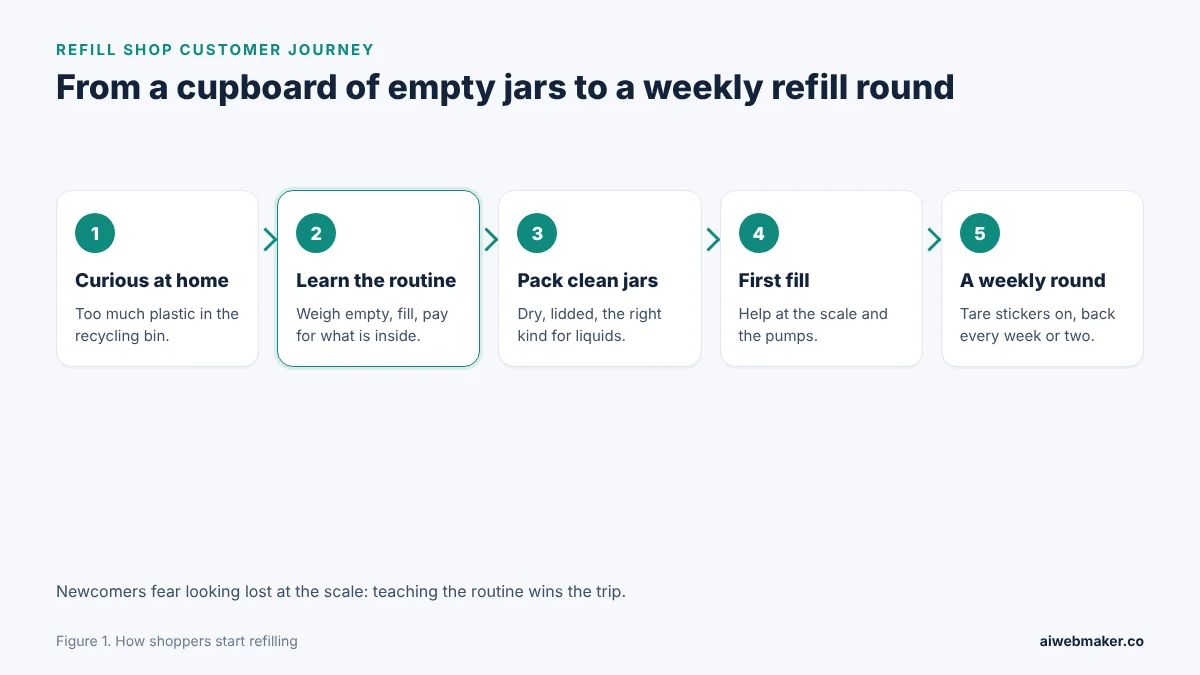
Left to right, the five panels begin beside a kitchen cupboard of empty containers and finish with a refill round woven into the week. Curiosity comes first, often sparked by a neighbour or an overflowing recycling bin. The highlighted stage is learning the routine, because a shopper who cannot picture the scale, the bins and the till rarely makes the trip. Packing clean jars comes next, and the site should say which containers work. Once the tare stickers are on the jars, the refill becomes a routine that comes back every week or two.
Pages that teach the routine before the shelves
A refill site should explain how buying by weight works before it lists a single product, because teaching comes before selling at this kind of counter. The opening view needs one plain promise and a link to the steps. A routine section shows the four stages from washing a jar at home to paying at the till. The price page lists every staple by the 100 g or the litre, the same units shown on the bins. A container page, a safety page and an online shop follow, with a bulk order route for cafés and offices.
| Page or section | The shopper's question | What it should say |
|---|---|---|
| Opening view | What is this place? | Bring a clean container and pay for what goes in it |
| How a refill works | What happens at the counter? | Wash, weigh empty, fill, weigh and pay |
| Prices | Is it dearer than a packet? | Price per 100 g or per litre, with an honest note |
| Containers | Which jars are welcome? | Clean, dry, lidded, plus a fallback for the forgetful |
| Safety limits | What will you refuse? | The refusal list and the reason for each line |
| Shop and bulk orders | Is ordering possible without a visit? | Returnable jars, deposits, sacks by enquiry |
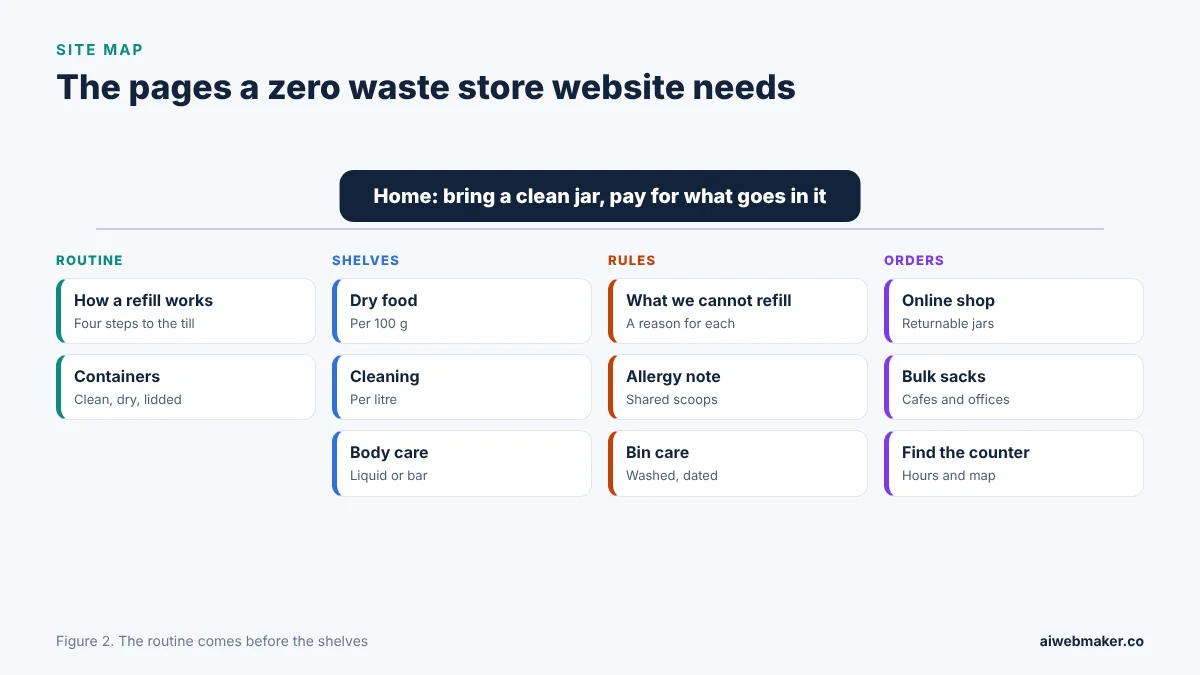
Sorted by the questions a shopper brings, the refill site falls into four clusters: the routine, the shelves, the rules and the orders. Routine pages carry the four steps and the container advice. Shelf pages hold the price table for dry food, cleaning liquids and body care, while rule pages gather the refusal list and the allergy note. Our sample counter, Fill Good Refills, walks through four steps, then an online shop listing rolled oats, red lentils or basmati rice, laundry liquid, washing up liquid, shampoo and bulk sacks for cafés and households. A dark section then lists six things the shop will not refill, ahead of a gallery, reviews and a bulk order form. The zero waste store website example with tare weights and a refusal list shows how a teaching page and a shop can share one scroll.
Tare weights, unit prices and the honest comparison with packets
Pricing by weight confuses newcomers until the tare is explained, so the website should describe it in one calm paragraph. The empty container is weighed at the counter and the figure is written on a sticker that stays on the jar. At the till that empty weight is taken off, and the shopper pays only for the oats, the rice or the soap inside. Every product should then carry a unit price, by the 100 g for dry goods and by the litre for liquids, matching the labels on the bins. Some refills will cost less than a supermarket packet and some will cost more, and saying so openly protects the shop from accusations of a green markup. Shoppers who see the sums laid out plainly trust the rest of the page.
| Product group | Unit to show | Note worth adding |
|---|---|---|
| Oats, rice, lentils, pasta | Per 100 g | Bought by the scoop, from a few grams upwards |
| Coffee, spices and loose tea | Per 100 g | Small amounts make sampling cheap |
| Laundry and washing up liquid | Per litre | Scent options and whether concentrated |
| Hand soap and shampoo | Per litre | Liquid or solid bar, and how long a bar lasts |
| Bulk sacks | By enquiry | Sack size and how often it can be supplied |
Clean jars, separate stations and the deposit on returnables
Container rules are where a refill shop protects its stock and its customers, so they deserve their own section rather than a footnote. A container should be clean, completely dry and closed with a lid that fits, because damp jars spoil oats and flour within days. Food containers and cleaning containers should be filled at separate stations, and the page can say so to reassure careful shoppers. Forgetful visitors need a fallback, such as paper bags at the door or a shelf of washed jars donated by other customers. Returnable jars carry a deposit, and the page should say how much it is and what condition earns it back. Clear rules here save awkward conversations at the scale and keep every bin safe for the next person.
The refusal list, chemical labels and allergy honesty
Every refill counter handles food and household chemicals in one room, so the list of what it will not refill is part of the service. Food should never go into a container that once held paint, fuel, oil or cleaning chemicals, and cleaning liquids should never go into drink bottles that a child might mistake for juice. Cracked, damp or unlidded containers are best refused for every product. Rules on labelling refilled cleaning products differ between countries, so owners should check what their own regulator requires and print the product name and safety advice on each refill. A refusal list written with a reason beside each line reads as care rather than fussiness.
| Refusal | Reason to give in a few words |
|---|---|
| Food into a former chemical container | Residues cannot be washed out reliably |
| Cleaning liquid into a drink bottle | It can be mistaken for something to drink |
| Cracked, damp or dirty containers | Spoilage and contamination of the bin |
| Liquids without a secure lid | Spills on the journey home |
| Bleach, drain cleaner, solvents | Too hazardous to dispense loose |
| Anything for a baby's feeding | Hygiene standards a shop counter cannot promise |
Allergy wording needs the same honesty, because shared scoops and a shared room mean traces can travel between nuts, seeds, flours and grains. A refill shop should say plainly that it cannot promise any loose food is safe for someone with a severe allergy. Allergen information rules differ by country, and many require the main allergens in loose foods to be available on request, so owners need to confirm the local requirement before writing the note. Bins should be emptied, washed and dried before each new batch rather than topped up on old stock, with a best before date on the front. Careful wording on these points protects shoppers and the shop at the same time.
Online orders in returnable jars, and the shop builder behind them
Selling online can seem to clash with the idea of bringing a jar, but returnable containers and a deposit keep the two together. Each product needs a page with the amounts it comes in, such as 500 g or 1 kg of oats, or one or two litres of laundry liquid. With the online store builder for refill shops selling by weight, every refill can offer those amounts as product options, picks collect in a bag, and the delivery fee joins the total once the shopper opens checkout. Discount codes can thank regulars who return their jars, and items with no fixed price, such as bulk sacks, can carry an Enquire button instead. A clear online shop reaches busy households without asking the refill idea to bend.
Sacks for cafés, offices and big households
Bulk customers are the steadiest income a refill counter can find, so they deserve a section of their own rather than a line in the footer. Cafés want oats, rice and coffee by the 10 kg sack, offices want washing up liquid and hand soap in large returnable containers, and schools or big families want a regular order they can forget about. The page should ask what the buyer uses in a month, how often they want supplies and whether they will collect or need delivery. Payment for these orders is arranged directly between the shop and the buyer, and the page can say so plainly. One reliable café account can carry a quiet month on its own.
Searches like oats by weight near me and laundry liquid top up
Refill shoppers type the product and the way it is sold, such as oats by weight, laundry liquid refill, bulk rice near me or refill shop open on Sunday. Naming each product and its unit price in plain text, rather than only on a photograph of a bin, gives search engines something real to match. The map listing should carry accurate opening hours, a photo of the scale and the bins, and the address of the counter. Reviews that mention the weight stickers, friendly help with the pumps or the returnable jars persuade nervous first timers. Articles on topics such as how to clean a jar for refilling, which containers suit liquids or how to store flour without pests keep the site useful between visits. Practical writing like this brings in neighbours long before they need to buy anything.
Twelve months of hosting for a refill counter, line by line
A refill shop's recurring bill is short: hosting, a domain, and a dozen container care articles drafted through AI credits for less than the price of a bag of lentils. Annual billing at $119 suits a counter with steady takings. A shop in its opening months may want the $19 monthly route while trade builds. New products, price changes and fresh photos of the bins carry no charge at all. Each column below follows one billing route, and the $189 row sits there only as a reference point.
| Item | Yearly | Monthly |
|---|---|---|
| Hosting the refill shop pages | $119 | $228 over twelve months |
| Domain | Depends on the ending | Depends on the ending |
| Higher plan, for comparison | $189 a year | Not needed |
| Twelve container care articles at about $0.65 | About $7.80 | About $7.80 |
| Price, product and photo updates | No charge | No charge |
| Year before the domain | About $126.80 | About $235.80 |
Reasons a curious shopper never makes the first trip
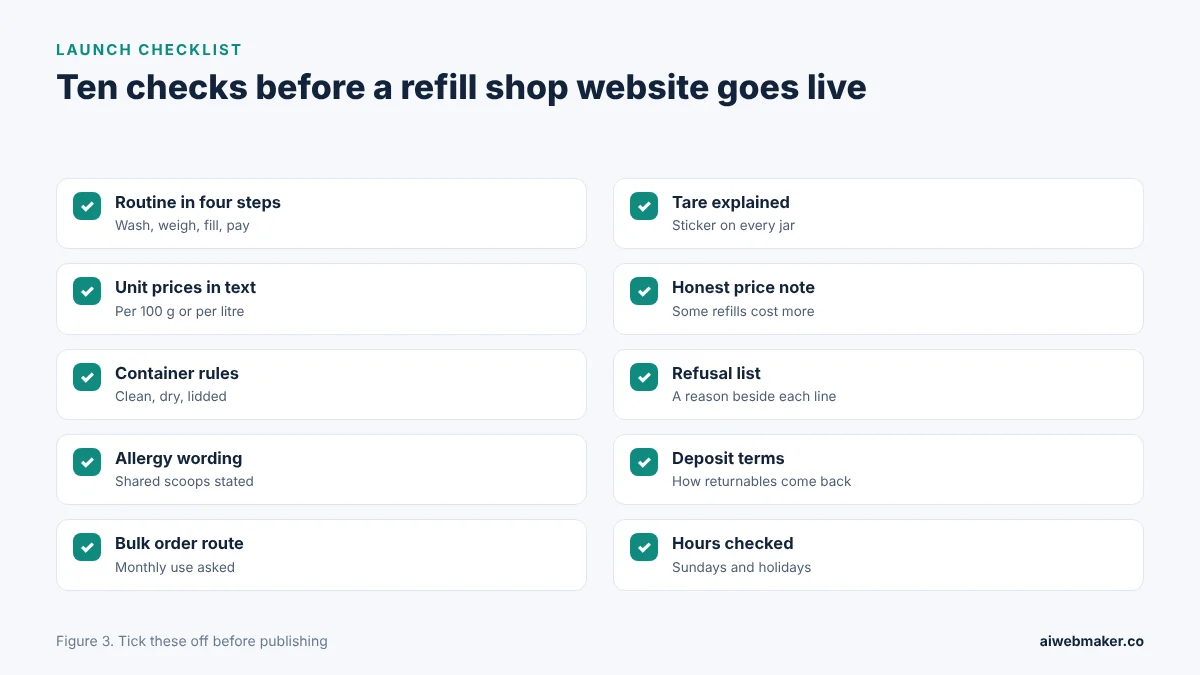
Curious shoppers stay at home when a refill site never explains what happens at the scale, because nobody wants to learn a new routine in front of a queue. Prices shown only on photos of bins leave them guessing whether refilling suits their budget. A missing refusal list means the wrong bottle gets turned away at the counter, and that embarrassment ends a new habit before it starts. Silence about allergies worries families who need to be careful. Out of date hours on a Sunday send a carful of jars to a locked door. Ten quick checks, shown next, prevent each of these lost first visits.
Frequently asked questions
Does a refill counter need to explain tare weights online?
Explaining tare online pays off more than almost any other paragraph on a refill site, because it removes the main fear of a first visit. The explanation needs only a few lines: the empty container is weighed, the weight goes on a sticker, and it is taken off at the till. A photo of the scale and a sticker makes the idea concrete. Regulars rarely need it again once their jars are marked. New shoppers who understand the tare arrive relaxed and ready to fill.
Is a refill really cheaper than packaged goods?
Sometimes a refill is cheaper and sometimes it is not, and the honest answer is the one shoppers remember. Staples and cleaning liquids are often competitive, while specialist foods can cost more than a supermarket packet. Buying a small amount of a spice or a seed, instead of a whole packet that goes stale, is where many people save. A unit price on every line lets shoppers make the comparison for themselves. Plain figures build more trust than any promise about savings.
Can a shop refill a customer's bottle from another brand?
A clean bottle that held the same kind of product can usually be refilled, and the shop's own label then shows what is inside and its safety advice. A bottle that held a different chemical, or any food or drink container used for cleaning liquids, should be refused. Rules on labelling refilled chemicals vary by country, so the owner should check local requirements. The website can state the shop's policy in two sentences. Consistent answers at the counter come from clear words on the page.
Which green claims are safe for a refill website to make?
Specific, checkable statements are the safest, such as saying that dry goods arrive in paper sacks or that online orders use returnable jars. Vague promises about saving the planet invite doubt and, in some countries, the attention of consumer regulators. Regulators in several places, the United Kingdom and the European Union among them, have issued guidance on misleading environmental claims. Owners ought to read their own country's guidance before calling any product sustainable. Modest, factual wording earns more respect from refill shoppers than grand slogans.
How many jar fills settle the hosting bill
A week of steady refill trade normally clears the $119 that keeps a zero waste store online for a year. Owners paying $19 a month recover it from a few litres of laundry liquid and a jar of oats. Every bulk sack sold to a café, and every first timer who arrives with clean jars and a sticker, is trade the page helped to start. Plain steps, honest unit prices and a clear refusal list do more for a refill counter than any green slogan. Shops that keep their price table dated and their hours accurate become the counter neighbours recommend. A queue of jars already wearing tare stickers shows the pages have taught the routine well.
Build your website in Minutes and get the AI Tools that work
Start Building Your Website →