Flooring Store Website Cost: Packs, Rolls, Samples and the Edges
A flooring store's shop, sample and measure pages are hosted for $119 each year, or else $19 in a month paid singly, with a domain beside that. Covered: who shops, pack and roll pricing, samples, room suitability, edges, returns, search phrases and the year's costs.
- No coding required
- Live in minutes
- Blog, SEO and chatbot tools included
A flooring store's shop, sample and measure pages stay online through AI Web Maker for $119 per hosting year, or $19 in a month paid singly, with a domain beside that. Loading packs, rolls and edge trims into the shop, then running a test order through the preview, costs the store nothing. Three square metres of the sample's engineered oak, at $54 a square metre, more than cover that yearly figure. The hard part is that floors are priced by area but sold by the pack or cut from the roll, so shoppers struggle to turn a room size into an order. They also want to see a floor in their own light, know which floor suits a kitchen and remember the door bars that finish the job. This guide covers who shops, pack and roll pricing, samples, room suitability, edges, returns and search, ending with the yearly budget.
This article is part of our complete guide: Retail Website Design.
New homes, tired hallways and landlords between tenants: who shops a flooring store online
Flooring shoppers range from first time buyers furnishing an empty house to landlords who need a hard wearing floor laid before the next tenant arrives. Couples redoing a lounge or a bedroom often browse for weeks, comparing colours and borrowing samples. Families with dogs and young children look for floors that shrug off scratches and spills. Landlords and builders want stock, prices per square metre and delivery they can plan around. Confident home improvers and independent fitters buy online once they know the quantity and the edges they need.
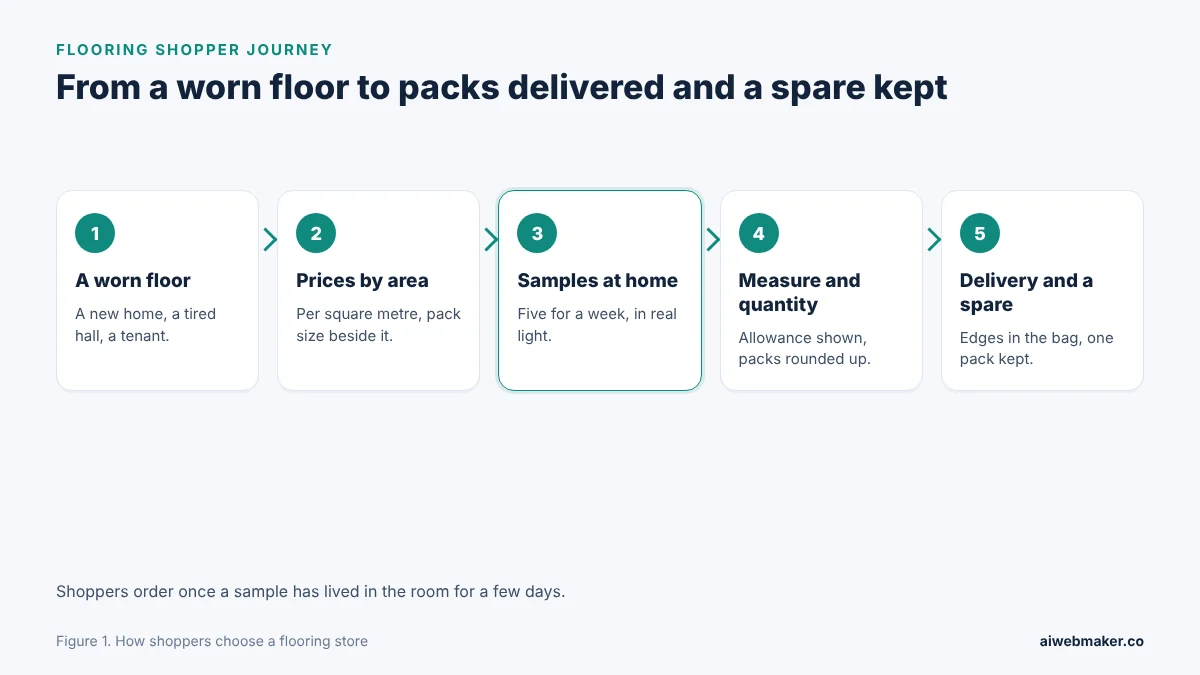
The third step is outlined because samples seen at home in morning and evening light decide more flooring orders than any photograph. A worn carpet or a new home starts the search, and a shop page with honest square metre prices narrows the choice. Samples borrowed for a week show how each floor looks beside the walls and furniture. A measure then turns rooms into a written quantity with the cutting allowance shown. Delivery, settling and fitting follow, and the store that told the buyer to keep a spare pack is remembered when a board gets damaged.
Floors by the pack, samples, edges and the measure: pages for a flooring store
A flooring store's site has to sell materials by area while making the practical steps around them clear. The home page names the floors the store sells, the sample offer and the measure. The shop lists each floor with its square metre price, pack size or roll width and options. A samples page, a room guide and an edges page answer the questions that stop shoppers ordering. Measure, delivery, returns and fitter referrals close the site, with the shop's opening hours and van access noted.
| Page | Shopper's question | What it should hold |
|---|---|---|
| Home | Does this store sell the floor in mind? | Wood, laminate, vinyl, carpet, samples, measure |
| Shop | What will the room cost? | Price per square metre, pack size, roll width, options |
| Samples | Can it be seen at home first? | How many, how long, deposit or postage |
| Which floor for which room | Will it cope with a kitchen or a dog? | A grid by room, with honest limits |
| Edges | What else is needed? | Underlay, door bars, beading, nosings |
| Measure | How much should be ordered? | Fee, what is checked, written quantity |
| Delivery and returns | What happens after ordering? | Charges by weight, returns window, cut carpet |
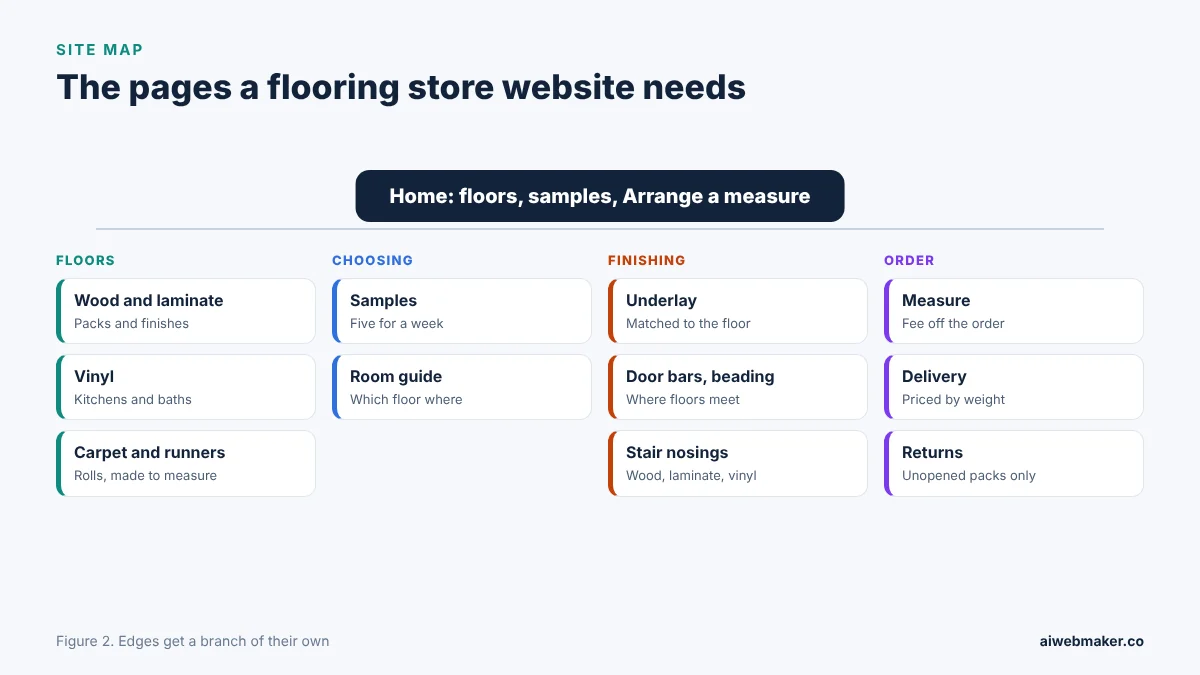
Floors and choosing pages lead this map, since shoppers settle on a floor before they think about edges and delivery. Floor pages carry wood, laminate, vinyl and carpet with their pack and roll details. Board and Broadloom Flooring, the invented shop in our flooring store website example with samples on loan and a room guide, sells engineered oak plank, oak herringbone blocks, laminate, 8 mm, rigid core vinyl plank, wool blend twist carpet and a stair runner made to measure. Its edges section lists underlay, door bars and thresholds, beading and skirting and stair nosings. A measure request sits at the end, with the fee taken off the order.
Square metre prices, whole packs and the cutting allowance
Floors are priced by area, but hard floors are sold in whole packs and carpet is cut from rolls of fixed width, and the shop page must show both figures. A shopper who sees $54 per square metre needs the pack size beside it to understand that a room is bought in steps of 2.2 square metres. A cutting allowance, usually 5 to 10% for straight planks and more for herringbone, is added before rounding up to whole packs. Carpet depends on the roll width and the shape of the room, which is why a measure matters more for carpet than for planks. A lounge of 4.6 by 3.8 metres in the sample's oak works out at nine packs, about $1,070 before edges and delivery.
| Floor | Sold as | Price shown | Detail the page should add |
|---|---|---|---|
| Engineered oak plank | Packs of 2.2 m² | $54 per m² | Top layer thickness, width, finishes |
| Oak herringbone blocks | Left and right packs | $68 per m² | Larger allowance for the pattern |
| Laminate, 8 mm | Packs of 2.13 m² | $22 per m² | Decor choices, sealed edges in kitchens |
| Rigid core vinyl plank | Packs, underlay attached | $38 per m² | Suits kitchens and bathrooms |
| Wool blend twist carpet | Cut from 4 m and 5 m rolls | $46 per m² | Roll width and allowance |
| Stair runner, made to measure | Priced by the flight | Enquire | Stair width and binding |
Five samples for a week and the deposit that comes back
Samples are the flooring store's strongest selling tool, because a floor looks different in every room's light and beside every wall colour. The sample lends up to five samples for a week against a $10 deposit each, returned when the samples come back. Wood, laminate and vinyl samples are full width offcuts, and carpet samples are squares large enough to stand on. The samples page should suggest laying them where the new floor will go, looking at them in the morning and after dark and walking on them in socks. Shoppers who have lived with a sample for a week order with far fewer regrets and returns.
Which floor for which room: a suitability grid
A room by room grid answers the most common question at the counter and saves shoppers from expensive mistakes. Engineered wood suits living rooms but needs care near a kitchen sink and is rarely advised in bathrooms. Laminate wears well but needs sealed edges in kitchens, while rigid vinyl copes with kitchens, bathrooms and pets. Carpet suits bedrooms and stairs but wears fast by a front door. Heating under the floor and the maker's temperature limits deserve a row of their own, with a note to check each product's instructions.
| Room | Engineered wood | Laminate | Rigid vinyl | Carpet |
|---|---|---|---|---|
| Living room | Best choice | Yes | Yes | Yes |
| Kitchen | With care near the sink | Yes, edges sealed | Best choice | Not advised |
| Bathroom | Not advised | Not advised | Best choice | Not advised |
| Hall | Yes | Yes | Yes | Wears fast by the door |
| Stairs | Yes, with nosings | Possible, with nosings | Yes, with nosings | Best choice |
| Heating under the floor | Check the maker's limit | With the right underlay | Check the maker's limit | Thin underlay only |
Underlay, door bars and nosings: the edge items that finish an order
Edge items are where flooring orders go wrong, because shoppers forget them until the fitter arrives. The online store builder for flooring shops that sell by the pack and the roll gives each floor a choice of finish, decor, tone or colour, a bag where underlay, door bars, beading and nosings can join the planks, and a checkout that adds the shop's delivery fee before payment. Discount codes suit a roll end sale or a returning fitter, while the made to measure stair runner swaps its price for an Enquire button. The sample prices delivery by weight and charges from $30 per drop for van delivery to a ground floor. A short note beside each floor listing the edges it usually needs raises the value of every order and prevents a second trip.
Cut carpet, opened packs and the returns line
A clear returns policy protects a flooring store's margin, because cut carpet and opened packs cannot be sold again. The sample takes back unopened packs within 28 days with the receipt, while cut carpet, opened packs and made to measure runners cannot come back. Wood and laminate should be delivered a couple of days before fitting so they can settle to the room, and the page should point to the maker's instructions and the fitter for the exact time. Suggesting that buyers keep one spare pack or a carpet offcut for repairs is both good advice and an honest reason to round up. Ends of carpet rolls, sold at a reduced price for small rooms and halls, turn leftover stock into sales.
Engineered oak near me, carpet roll ends and other phrases shoppers type
Flooring shoppers search with phrases such as flooring store near me, engineered oak flooring, waterproof vinyl flooring, wool carpet or carpet roll ends, often with a town. Product pages named after the floor and its key feature catch those searches without jargon. The map listing should show the roll racks, the plank wall and the cutting table, for shoppers who want to see stock before they visit. Reviews that mention samples, accurate quantities and carpet cut while waiting make the store stand out from online sellers. Articles on choosing a floor for a kitchen, living with pets or what underlay to buy bring shoppers long before they measure.
Roll racks, a cutting table and the hosting bill
Stock, the cutting room, van running costs and staff dwarf what a flooring store spends on its website each year. Paying $119 annually keeps the outlay lowest, and a newly opened shop can choose the $19 months while trade builds. On top sits the domain, priced by which of about 400 endings the shop settles on. Twelve articles on choosing floors use about $7.80 of AI credit, and changing prices, adding roll ends or updating stock carries no fee. Plans above hosting are shown by one $189 row, kept for comparison and not needed by a flooring shop.
| Item | Yearly | Monthly |
|---|---|---|
| Hosting the flooring store pages | $119 | $228 over twelve months |
| Domain | Depends on the ending | Depends on the ending |
| Higher plan, for comparison | $189 a year | Not needed |
| Twelve floor choosing articles at about $0.65 | About $7.80 | About $7.80 |
| Price, stock and roll end updates | No charge | No charge |
| Year before the domain | About $126.80 | About $235.80 |
Prices without pack sizes, no samples and no word on edges: why floor shoppers drift away
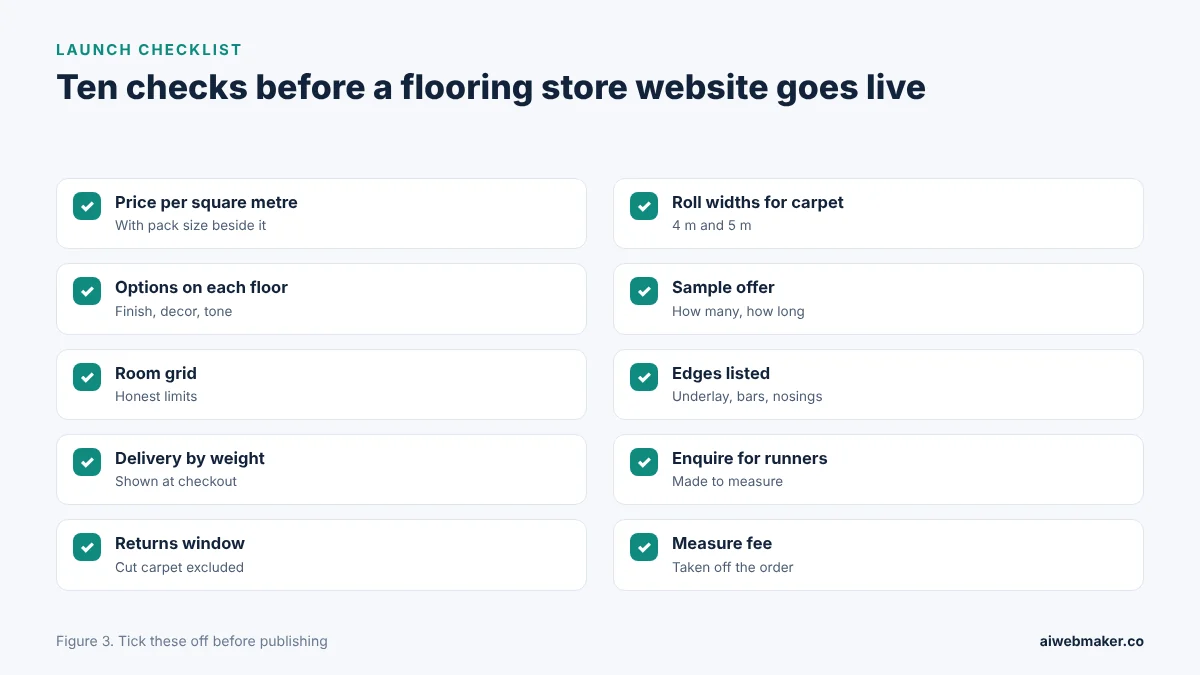
Flooring shoppers leave a store's site that shows a square metre price with no pack size or roll width beside it. No sample offer makes them fear choosing a colour from a screen. A shop without door bars, underlay or nosings leaves them unsure what the finished floor will really cost. Vague returns terms worry anyone who has measured a room for the first time. Ten checks in the next figure pair off with those doubts, one for one.
Frequently asked questions
How much extra flooring should a buyer order?
Straight planks usually need 5 to 10% more than the measured area, herringbone needs more, and carpet depends on the roll width and the room's shape. The total is then rounded up to whole packs or a length of roll. A measure by the store works the quantity out room by room and shows the allowance. Keeping one spare pack or an offcut helps with future repairs. Ordering the right amount once avoids a second batch that may not match.
Can unopened packs go back?
Many stores accept unopened packs within a set period with the receipt, such as the sample's 28 days. Cut carpet, opened packs and anything made to measure usually cannot come back. The website should state the returns window and the exceptions next to the shop. Buyers who know the rules order with more confidence. Clear terms also protect the store from returns it cannot resell.
Is rigid vinyl suitable for a bathroom?
Rigid vinyl boards do not swell when wet, which makes them a common choice for bathrooms and kitchens. Water can still creep underneath at the edges, so the edges are usually sealed and spills are wiped up rather than left. The maker's instructions should be followed for wet rooms. The website can explain this plainly beside the product. Honest advice prevents disappointment a year later.
Does the store lay the floors itself?
Some flooring stores employ fitters, while others, like the sample, sell, measure and deliver and pass names of independent fitters to buyers. Those fitters quote separately and are paid directly by the buyer. The website should say which model the store follows and who guarantees the workmanship. Buyers then know whom to call if a board lifts. Clear roles prevent arguments when something goes wrong.
A lounge floor against the hosting year
A single lounge in the sample's engineered oak, at around $1,070 in whole packs, pays for about nine years of hosting at $119. Under monthly billing, the edges for one doorway and a stair nosing cover more than two $19 payments. Every shopper who borrows samples, orders the right quantity and returns for the next room adds value no hosting bill comes close to. Square metre prices shown with pack sizes, samples on loan and an edges list beside every floor sell more than any slogan. Orders that arrive with the door bars and underlay already in the bag show the shop pages are working.
Build your website in Minutes and get the AI Tools that work
Start Building Your Website →