Planning a Tutor Booking Website Around Terms, Trials and Exam Weeks
This guide answers how a tutor booking website turns subjects and levels into lessons parents can request, and how tutors manage after school capacity, safeguarding, trials, terms and exam peaks. A tutor pays $119 for each hosted year, or $19 whenever a month is paid alone, the domain comes extra, and nothing is invoiced while pages are drafted.
- No coding required
- Live in minutes
- Blog, SEO and chatbot tools included
A tutor booking website lets parents and older students request lessons by subject, level and time, while the tutor fits each request into a timetable squeezed into after school hours. Private tutors, tutoring centres, online tutors with students abroad, language teachers and exam coaches all work this way. Parents usually choose by subject and year, which is exactly how our tutoring website example arranges the lessons of an invented tutoring service, every page of it made in AI Web Maker. A tutor pays AI Web Maker $119 to keep the lesson pages up all year, or $19 for any month paid on its own, a domain from about 400 endings is extra, and no bill arrives while lessons and profiles take shape in the preview. The hard part is that the most wanted hours are few, the students are often children, and demand jumps sharply before exams. A good booking setup has to ration those hours fairly, make safeguarding visible and keep regular families from losing their slot. What follows covers who books and when, the pages needed, lesson types, capacity, requests, safeguarding, first lessons, policies, regulars, search and the yearly cost.
This article is part of our complete guide: Website Builder Comparison.
Report cards, mock exams and Sunday evenings: when families look for a tutor
Parents usually look for a tutor after a trigger, such as a disappointing report, a mock exam result or a teacher's comment at a parents' evening. Families of younger children want confidence and homework support. Parents of teenagers want exam results and a tutor who knows the syllabus. Older students increasingly search for themselves, especially for university entrance tests, languages and subjects their school cannot cover. Many requests are sent on Sunday evenings and late weekday nights, once children are in bed and the week ahead feels real.
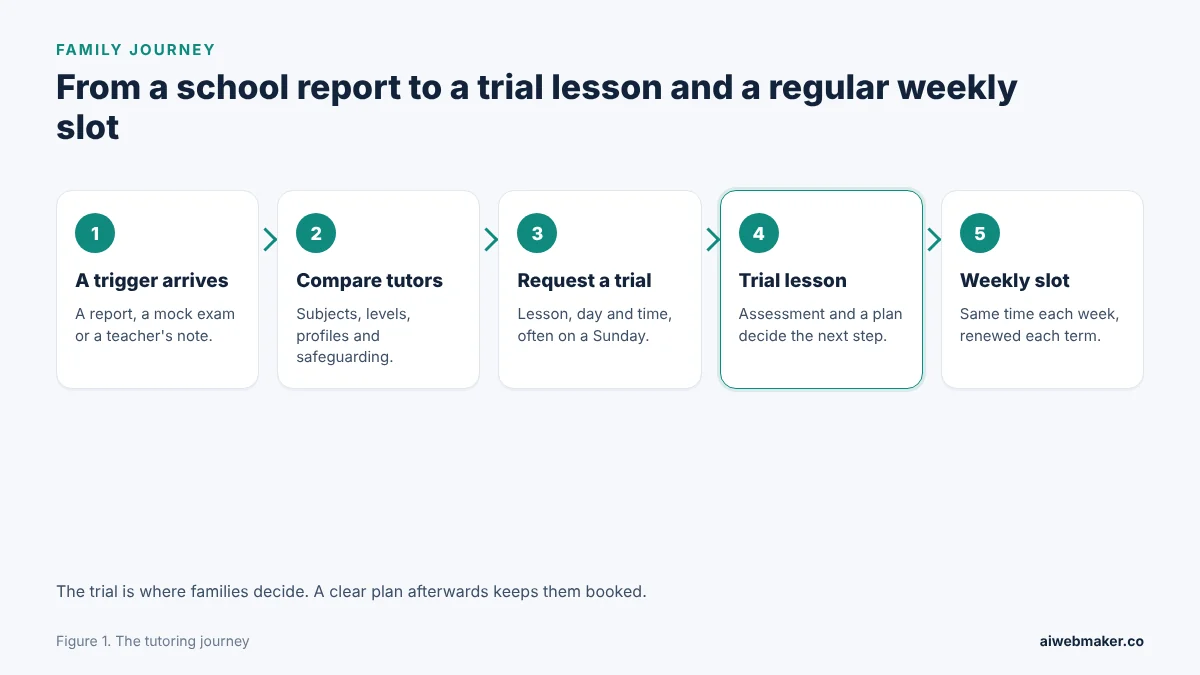
The pivotal moment in this journey is the trial lesson, which is why it is marked as the step where a family decides to continue or walk away. Before it, the parent compares subjects, levels and tutor profiles, then requests a time that fits around school and activities. After it, a family that saw a clear plan usually asks for the same slot every week. The final step is renewal, when the family returns for another term or a revision course before exams. Every page on the site should either get a family to the trial or keep them booked after it.
The pages and settings a tutoring timetable relies on
A tutoring site can stay compact, provided each page settles a parent's question before it is asked. Subjects should be listed by level, with each lesson type priced on its own line and its length stated. Tutor profiles carry qualifications, teaching experience and the checks that apply where the tutor works. A page on formats explains home visits, lessons at a centre and online lessons, with time zones shown for students abroad. Policies, safeguarding and the request page complete a set that lets parents decide without a long phone call.
| Page or setting | What it holds | Question it answers |
|---|---|---|
| Subjects and levels | Each subject by age or year group | Can this tutor teach my child's level? |
| Lesson types and prices | One to one, small group, revision course | What does a lesson cost and how long is it? |
| Tutor profiles | Qualifications, experience, checks | Who will be with my child? |
| Formats | Home visit, centre, online, time zone | Where and how do lessons happen? |
| Safeguarding page | Checks, shared spaces, contact rules | Is my child safe in these lessons? |
| Lesson policies | Notice, missed lessons, term payments | What happens if we cancel? |
| Request page | Lesson, day, time and contact details | How do we start? |
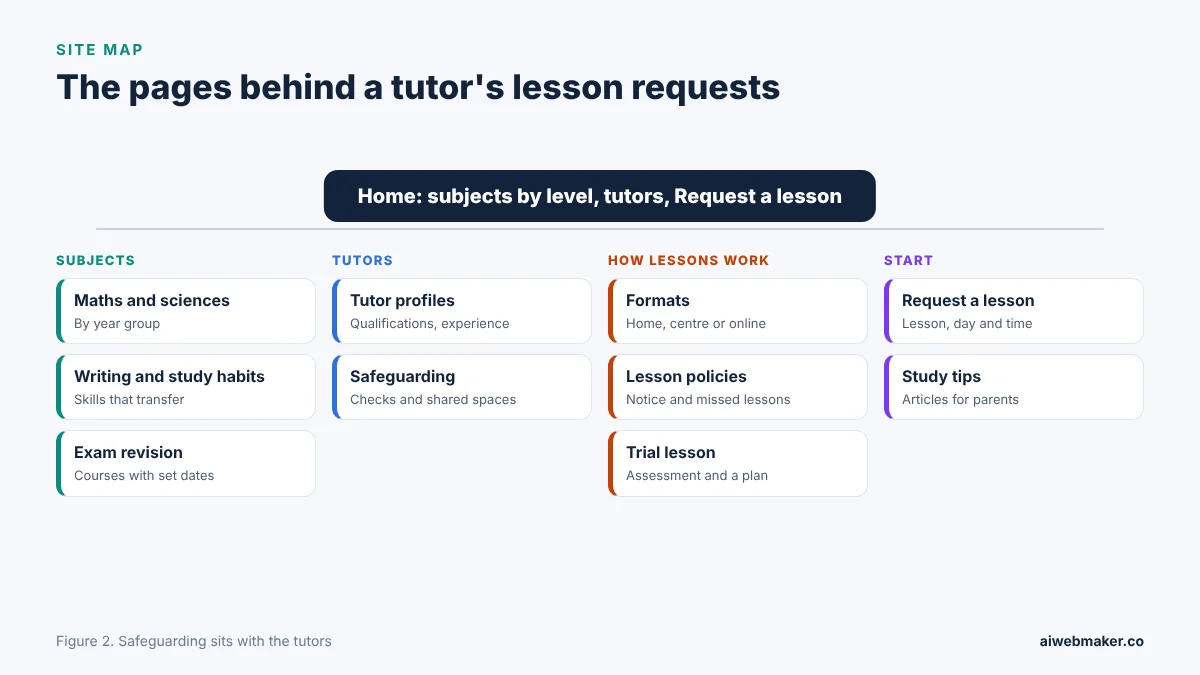
Four groups sit beneath the home page here, and safeguarding is placed with the tutors rather than buried among the policies. Subjects and levels lead, because a parent's first question is whether the child's need is covered at all. Tutor profiles and safeguarding come next, followed by pages on formats, policies and trial lessons. Brightpath Tutoring, an invented business in our samples, covers five areas, from maths and the sciences to writing, study habits and exam revision, with each lesson priced on its own. The tutoring sample with five subject areas to request places a subjects page and tutor profiles beside the booking, which shows how this structure reads to a parent.
Naming lessons by subject, level and length
Lesson names work best when they join a subject to a level, because a parent scanning for help with secondary chemistry ignores a vague science lesson. Curricula and exam systems differ between countries, so naming the ones the tutor teaches, such as a national curriculum, the International Baccalaureate or a particular entrance test, reassures parents quickly. Length should follow age, with shorter sessions for young children and longer ones for exam students who need worked papers. Group lessons and one to one lessons belong on separate lines, since they differ in price, pace and attention. A clear lesson list means the first request already matches what the student needs.
| Lesson type | Usual shape | Suits | Line for the description |
|---|---|---|---|
| Primary one to one | Shorter weekly session | Confidence, reading, number skills | What a session covers |
| Secondary one to one | Standard weekly session | Coursework, exam topics | Syllabus or exam system taught |
| Small group | Fixed weekly class | Shared revision, lower price | Maximum group size |
| Exam revision course | Set number of sessions | The weeks before exams | Dates and places available |
| Adult or professional | Daytime or evening session | Languages, work exams | Goals and materials used |
| Trial lesson | Short first session | New families | Assessment and a plan |
After school hours, online slots and the exam calendar
The real limit on a tutor's capacity is the narrow window between the end of school and the evening meal, which every family wants. A tutor who visits homes loses part of that window to travel, so grouping students by area protects several lessons a night. Online lessons widen the timetable, since daytime slots suit adult learners, home educated children and students in other time zones. Exam seasons then compress demand into a few weeks, and a revision course with a fixed number of places shares those weeks more fairly than endless single lessons. Because every request waits for the tutor to accept it, the prime hours can be kept for regular students before new families are offered what remains.
Answering a parent's request within a day
A parent who sends a request has usually compared several tutors, so a prompt, specific reply often decides the choice. The reply should confirm the lesson, or offer the nearest time that genuinely suits, and say what the first session will cover. When the level or subject is outside the tutor's expertise, a polite decline that suggests another route builds a reputation worth more than one booking. Older students who request their own lessons should have a parent copied into the reply, especially when they are under the age of majority where they live. A reply within one working day is a sensible standard, and same evening replies win many families.
| What the request shows | A good reply |
|---|---|
| A level and time the tutor can cover | Confirms and explains the first session |
| A popular after school slot already taken | Offers the nearest open time, or online |
| A subject or level outside the tutor's skills | Declines and suggests another route |
| A student under the age of majority booking alone | Confirms only with a parent involved |
| Several siblings at once | Proposes back to back or shared slots |
The booking website builder for tutors who answer every request works on exactly this principle of human replies. Once a family chooses a lesson slot and submits it, the tutor can accept, propose another hour or decline. Lesson fees are paid to the tutor directly, in whatever way the tutor already invoices, and the platform takes no commission on them. The builder writes the subject pages, tutor profiles and request page in one draft once the tutor describes what is taught. Nothing becomes a fixed lesson until the tutor replies, which leaves room for the judgement that teaching children requires.
Safeguarding when the student is a child
Safeguarding should be visible on a tutoring site, because parents are inviting an adult into their child's learning and often their home. Rules on background checks for people who work with children vary by country and region, for example a Disclosure and Barring Service check in England and Wales or a working with children check in parts of Australia. Where such a check exists, the tutor profile can say it is held without publishing personal details. Practical habits matter as much as paperwork, and the page should explain how lessons happen in shared spaces and how messages flow. Privacy rules on recording lessons and storing children's details also differ between countries, so a tutor should follow local guidance and say what it does.
| Setting | Sensible safeguard to describe |
|---|---|
| Home visits | A parent or carer at home throughout |
| Online lessons | A shared room, with the link sent to the parent |
| Messages | Arranged through a parent for younger students |
| Recording | Only with consent, following local rules |
| Tutoring centre | Signing in and collection by a named adult |
| Checks | The background check that applies locally, where one exists |
A trial lesson that shows parents a plan
A trial lesson deserves its own listing and price, because it lets the tutor assess the student and lets the family judge the fit before committing to a term. The description should say what happens, typically a talk about goals and a few tasks to find the gaps. A plan for the weeks ahead closes the session. Families can be asked to bring recent schoolwork, a report or past papers, which makes the assessment sharper. A short written summary afterwards gives parents something concrete to decide on, and it often turns a trial into a regular slot.
Notice periods, missed lessons and the families who stay
Lesson policies should protect the tutor's few prime hours without punishing families for ordinary life, such as illness, school trips and holidays. A notice period of about a day, stated before the request and repeated in the reply, covers most cases. Tutors who sell lessons by the term can explain whether missed lessons are moved or lost, and any advance payment is arranged by the tutor directly, never through the platform. Consumer rules on refunds and cancellation charges differ between countries, so tutors should check the local position before setting terms. Offering current families their slot for the next term before it opens publicly is the simplest way to keep regulars, and it rewards the families who keep a timetable stable.
Searches like maths tutor for year 9 or online chemistry help
Search phrases from parents usually lead with a subject and a level, for example reading help for a seven year old or an exam revision course. A lesson list that uses those exact words gives each search a matching page. A centre with a fixed address gains from a map listing with its real hours and pictures of its rooms, whereas online tutors lean on subject pages. Reviews from parents, shared with permission and never naming children, carry weight with families who are still deciding. Helpful articles, such as building a revision timetable or reading a school report, reach parents weeks before they request a first lesson.
Lesson pages online for twelve months, in figures
Twelve months of hosting for the subject pages, profiles and request page comes to $119 when paid once, or $228 as twelve payments of $19. A domain is added on top, priced by the ending the tutor picks. A dozen study skills articles, written on AI credits, come to about $7.80. Changing subjects, prices and the timetable each term adds nothing. Purely for reference, the $189 tier is shown as well.
| Item | Yearly | Monthly |
|---|---|---|
| Hosting the pages | $119 | $228 over twelve months |
| Domain | Depends on the ending | Depends on the ending |
| Higher plan, for comparison | $189 a year | Not needed |
| Twelve study skills articles at about $0.65 | About $7.80 | About $7.80 |
| Subject, timetable and term updates | No charge | No charge |
| Year before the domain | About $126.80 | About $235.80 |
Gaps that make a careful parent close the tab
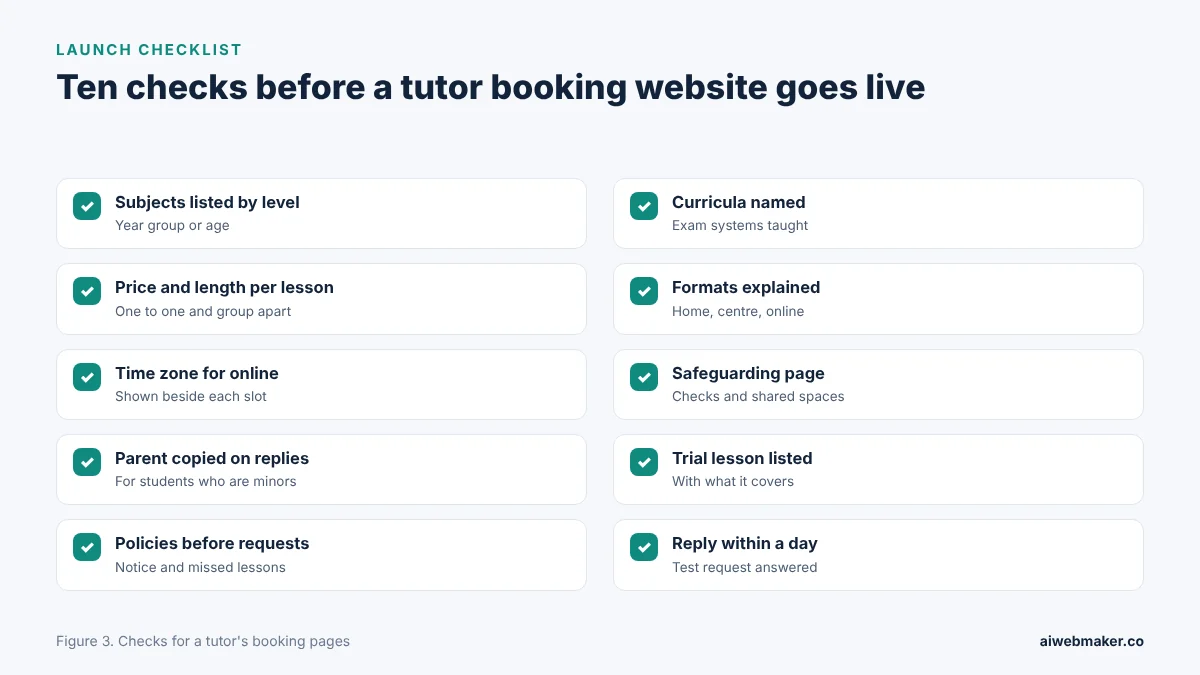
Parents close a tutor's site when they cannot see whether their child's level is taught, because a guess wastes a whole evening of comparing. Missing prices or lesson lengths make the commitment feel open ended. Silence on safeguarding worries parents of younger children more than any other gap. A request that waits days for an answer suggests the tutor will be just as slow with feedback. Ten fixes for these tutoring gaps fill the figure here, two to a row.
Frequently asked questions
Should a teenager request lessons without a parent?
A teenager can start the request, but a parent should normally be part of the arrangement when the student is under the age of majority where they live. The tutor can reply to both, confirming the time, the price and the policies. This protects the student, the family and the tutor if questions arise later. Older students often take more ownership of lessons they chose themselves, which helps progress. Keeping a parent informed is simply good practice with minors.
Can siblings share a lesson or a time slot?
Siblings can share a slot when their levels and goals are close, and many families like back to back lessons on the same evening instead. A shared lesson can be listed as a small group with its own price. Back to back lessons work well for home visits because the tutor travels once. The tutor should be honest when two children need different pacing. Separate slots on one evening are often the fairest arrangement for everyone.
What if the tutor is not the right fit after a few lessons?
When the fit is wrong, an honest conversation after a few lessons is better than a term of polite frustration. The tutor can adjust the approach, change the lesson length or suggest a colleague with a different style. Clear policies on ending lessons, stated at the start, make this conversation easier. Parents appreciate a tutor who puts the student's progress ahead of keeping the booking. A graceful ending often brings referrals that a forced arrangement never would.
Can lessons move online partway through a term?
Lessons can usually move online partway through a term, which helps when a family moves, a student is unwell or the weather closes roads. The tutor should confirm that the student has a quiet space, a working camera and any materials needed. Online lessons can be listed as their own lesson type, so the switch is a simple new request. Some families end up mixing formats, with online sessions in exam weeks and visits otherwise. Flexibility of this kind keeps a regular student booked through changing circumstances.
A term of weekly lessons against the year's hosting
The fees from two or three lessons pay the $119 that keeps a tutor's booking pages online all year, so hosting is a minor decision. A tutor on monthly billing recovers the $19 from a fraction of a single session. The lasting value sits with families who stay, since one student booked weekly for a term brings in many times the yearly bill. Clear levels, visible safeguarding and quick replies are what turn a first request into that kind of arrangement. A timetable that fills itself with returning names each term shows the pages are doing their work.
Build your website in Minutes and get the AI Tools that work
Start Building Your Website →