Running Tour Departures Online: Group Sizes, Pace and Weather Calls
How a tour booking website presents each trip, takes date requests and confirms departures without overselling a guide or a vehicle. Operators pay $119 yearly or $19 monthly for hosting, plus their chosen domain, and trying the tour pages out before launch is not charged.
- No coding required
- Live in minutes
- Blog, SEO and chatbot tools included
On a tour booking website, travellers choose a trip, a date and a party size, and the operator confirms places once a guide and seats are secured. Walking guides, food tour hosts, boat and wildlife operators, winery tours, trekking companies and travel agencies all sell this way. Each tour sits on the site as a bookable item with its own price, and the operator's hosting comes to $119 over a year, while an operator testing a new season can pay $19 monthly instead, plus whatever the chosen domain ending costs. Our travel agency website example shows the same setup for an agency we made up, its mountain tours listed on AI Web Maker pages as trips visitors can book. Tour pages and the request flow can be built and tried in the preview before any bill arrives. The hard part is that each departure depends on a guide, transport, permits and the weather, so the site must sell places without promising what the day cannot deliver. Covered here are travellers' habits, trip pages, group limits, request handling, weather and safety, seasons, search and what twelve months online add up to.
This article is part of our complete guide: Website Builder Comparison.
Who books a guided tour, and how do travellers decide?
Travellers book tours in two very different rhythms, and one website must suit both of them. Long trips such as treks, safaris and multi day itineraries are planned weeks or months ahead, often by one organiser for a group. City walks, food tours and boat trips are usually chosen a day or two before, from a phone in a hotel room. Both groups compare length, pace, group size and reviews before anything else. Families check age limits, solo travellers look for small groups, and companies ask for private departures. A tour page that answers these points quickly wins the request before the next tab opens.
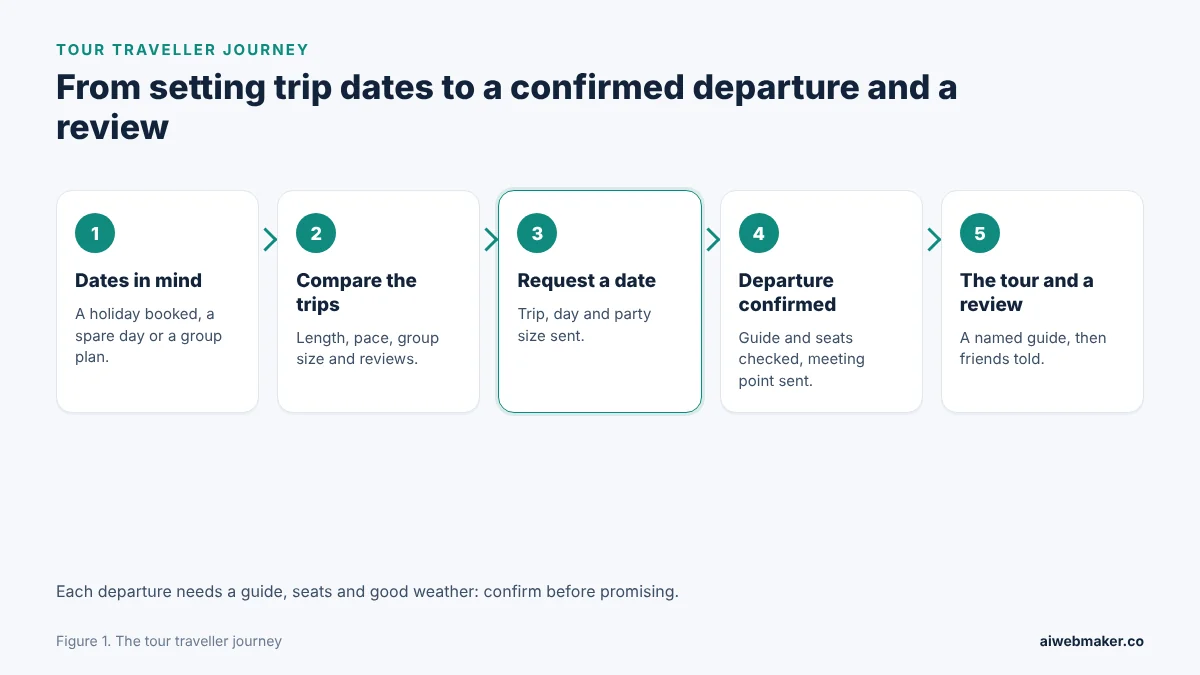
Requesting a date is marked out in this journey, as the moment a browsing traveller settles on a day. The first two steps decide whether the tour even makes the shortlist, which is why length, pace and inclusions belong near the top of every trip page. After the request, the operator's confirmation turns interest into a place on a departure. That reply should carry the meeting point, timing and what to bring, so the traveller arrives prepared. The final step, the tour itself and the review that follows, feeds the next traveller's comparison. Each stage therefore depends on information given clearly at the one before.
Pages and settings a tour operator needs
A tour operator's site needs one page per trip and a small set of pages that every trip shares. Dates and departures explain when each tour runs and how far ahead requests are taken. Meeting points need their own clear description, because a missed meeting point ruins a day. Guide profiles, practical terms and a route for private groups complete the set. Each page settles something a traveller would otherwise have to write in and ask.
| Page or setting | What it holds | Why travellers need it |
|---|---|---|
| A page for each tour | Length, pace, route, inclusions, price | To compare trips at a glance |
| Dates and departures | Days each tour runs, booking window | To plan around a holiday |
| Meeting points | Exact spot, landmark, arrival time | To arrive at the right place |
| Guides | Names, languages, training | To choose who leads the day |
| Practical terms | What to bring, weather, cancellation, ages | To know the rules before booking |
| Private and group tours | Enquiry for families, companies, schools | To arrange a departure of their own |
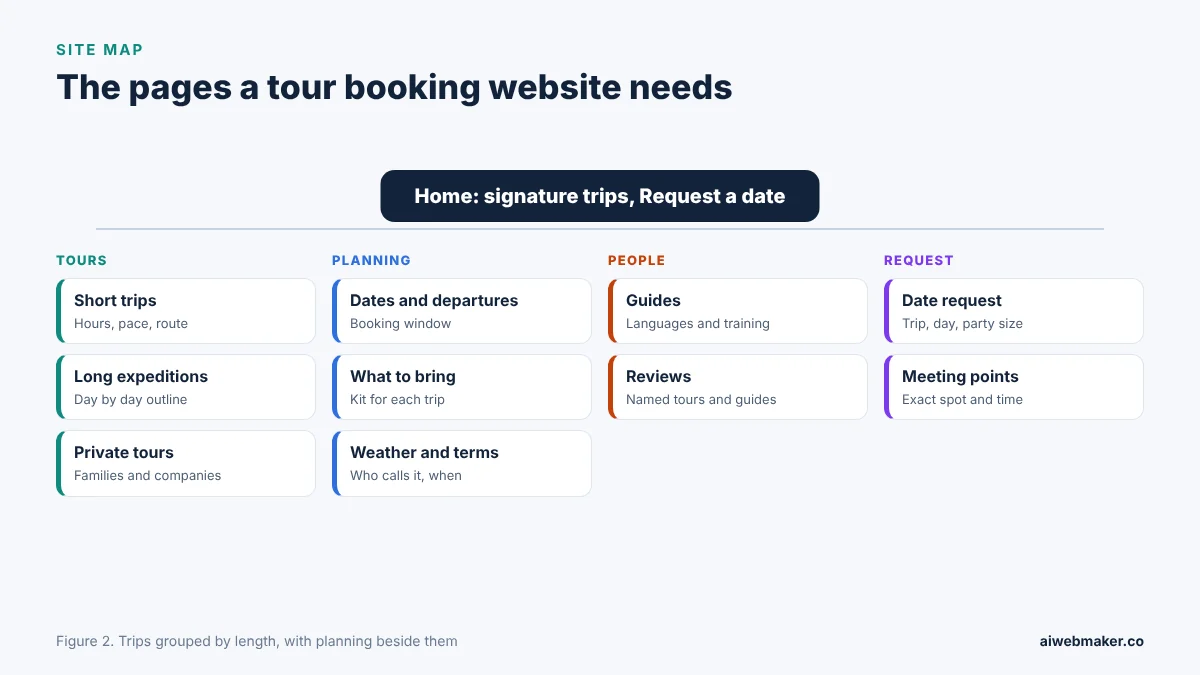
Tours, planning, people and the request form the four branches in this layout, and the home page leads with the signature trips. The tour branch splits trips by length, from short outings to expeditions with a day by day outline. Planning pages explain dates, kit and weather, while the people branch introduces guides and gathers reviews that name each tour. Horizon Trails Travel, one of our samples, sells three trips that travellers can request, ranging from a brief journey to a long expedition, each at a gentler or faster pace. Its sample travel website whose three trips run from brief to long shows how a traveller moves from the itinerary to a date request. Grouping trips by length in this way lets every visitor find a day that fits.
Group limits, minimum numbers and private departures
Every tour has a natural maximum, and it is set by what the guide can manage safely and well rather than by demand. On a busy street the limit is the guide's voice, while on a boat it is the licensed number of seats. Many tours also need a minimum to cover costs, such as fuel for a boat or a vehicle hire for a day trip. Requests below the minimum can be accepted as provisional, with the traveller told when the departure is confirmed. Private tours suit families, couples and companies who want the guide to themselves, and they work best as a separate bookable item at their own price. Clear limits keep both the group and the guide comfortable.
| Tour type | What caps the group | Minimum to run | Points to plan |
|---|---|---|---|
| City walking tour | The guide's voice on busy streets | Low | Earpieces for larger groups |
| Food tour | Seats at each tasting stop | Agreed with venues | Dietary needs asked in advance |
| Boat or wildlife trip | Licensed seats on the vessel | Enough to cover the trip | A weather call the day before |
| Multi day trek | Guide ratio, huts and permits | Set per departure | Fitness and kit checks |
| Winery or brewery tour | Tasting room and vehicle seats | Vehicle hire covered | Drinking ages vary by country |
Length, inclusions and terrain on every trip page
A good tour page lets a traveller decide without sending a single message. It opens with the length, the pace and the distance covered, because those decide whether the tour suits the group at all. Inclusions and exclusions follow, since surprise costs for tickets, food or transport sour a day. Longer trips deserve a day by day outline, while short walks benefit from a simple route description. Honest notes on steps, terrain and rest stops let travellers with limited mobility judge for themselves. Photos taken on the actual route, rather than generic scenery, prove that the tour exists as described.
| Detail | What to state | Why it matters |
|---|---|---|
| Length and pace | Hours or days, gentle or brisk, distance | Matches fitness and plans |
| Meeting point | Exact spot, landmark, arrival time | Prevents missed departures |
| Inclusions | Tickets, food, transport, equipment | Avoids surprise costs |
| Exclusions | Tips, drinks, travel to the start | Sets honest expectations |
| Accessibility | Steps, terrain, seating, rest stops | Lets travellers judge for themselves |
| Ages and health | Minimum ages, fitness notes | Protects travellers and guides |
Answering date requests and confirming departures
A date request is a promise only once the operator has checked the guide, the seats and any permits for that day. On AI Web Maker the traveller requests a trip, a date and a party size, and the operator then confirms the places, suggests another departure or declines. Deposits for long trips and payment for day tours are arranged by the operator directly, and the price reaches the operator whole, with nothing kept by the platform. Our booking website builder that lists tours as trips to request drafts each tour with its price, plus the guide and practical pages, once the operator describes the trips. Requests for tours within the week deserve a same day answer, because travellers on holiday move fast. Bookings taken by phone, by partner agencies or at the meeting point must be recorded alongside online ones, or a departure will be oversold.
Weather calls, cancellations and safety on the day
Outdoor tours live with the weather, so the website should explain who makes the call, when and what happens next. Most operators decide by a set time, such as the evening before, and offer another date or a refund under their published terms. Traveller cancellations need a notice period, usually longer for multi day trips than for a short walk. Rules for package trips and consumer refunds vary by country, and combined trips may fall under special package rules in some regions, so local advice is essential. Guide licences, first aid training and insurance requirements also differ between places, and the site should state what applies. A calm, written safety briefing reassures travellers before they ever arrive.
| Situation | Policy to state | Where it belongs |
|---|---|---|
| Weather unsafe | The guide decides by a set time, then a new date or a refund | Tour page and the reply |
| Minimum not reached | The departure moves or is cancelled with notice | Dates page |
| Traveller cancels | Notice period, longer for multi day trips | Terms page |
| Late arrival | How long the group waits at the meeting point | The reply |
| Health or fitness doubts | Speak to the operator before requesting | Tour page |
Seasons, booking windows and returning travellers
Tour demand follows the seasons more closely than almost any other trade, so the website should be reset before each one. Peak dates fill early, which means opening requests for the high season months ahead. Shoulder seasons suit special departures, smaller groups or a tour that only runs when the weather allows. Day tours are usually requested a few weeks ahead at most, while expeditions may be planned a year out, and each tour page should state its window. Returning travellers often bring friends, so a short note inviting them back for a different route pays off. A diary planned around the seasons keeps guides busy for longer each year.
What travellers type when they look for a tour
Travellers searching for tours usually combine an activity with a place and sometimes a length or a style. Typical phrases include walking tour of the old town, food tour near the market, day trip from the city to the coast, small group safari and private guide for a family. Tour names and headings built on those words help the right page appear. An operator with an office or a fixed meeting point should keep a map listing showing photos of real departures. Reviews that name the guide and the tour carry particular weight with travellers comparing options. Articles on the best season to visit or what to pack draw planners long before they choose a date.
Twelve months of tour pages in dollars
The operator's bill holds hosting and a domain, and twelve destination articles bought with credits total about $7.80 for the year. An operator trading all year spends least on the yearly route. A seasonal guide may prefer to pay by the month during the months the tours run. Adding departures, routes or new prices carries no fee beyond the hosting. Each billing rhythm has its own column, and the $189 tier is listed simply as a benchmark.
| Item | Yearly | Monthly |
|---|---|---|
| Hosting the tour pages | $119 | $228 over twelve months |
| Domain | Depends on the ending | Depends on the ending |
| Higher plan, for comparison | $189 a year | Not needed |
| Twelve destination articles at about $0.65 | About $7.80 | About $7.80 |
| New departures, routes and prices | No charge | No charge |
| Year before the domain | About $126.80 | About $235.80 |
Why do travellers close a tour page without requesting a date?
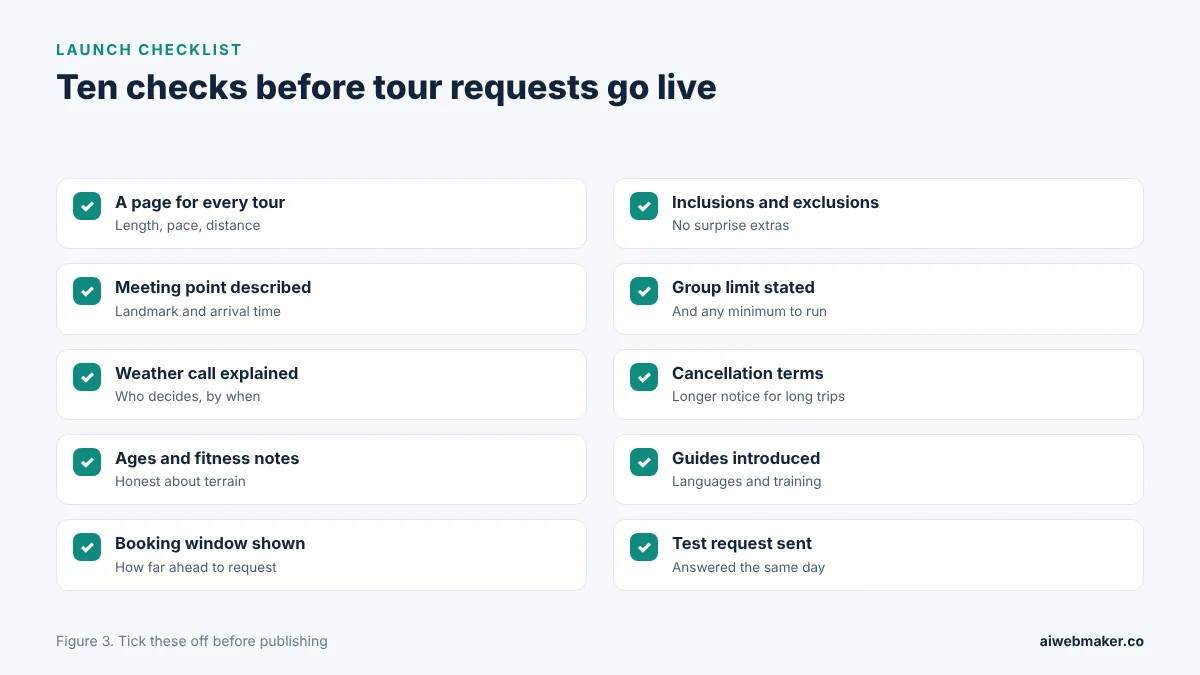
Travellers close a tour page when they cannot picture the day it describes. A missing meeting point makes the whole tour feel uncertain. No length, pace or distance leaves families and older travellers unsure it suits them. Hidden extras, such as tickets or transport that are not included, look like a trap. Silence on weather and cancellations worries anyone booking months ahead. Ten checks that answer each of these worries sit in the following image.
Frequently asked questions
What should travellers bring on a guided tour?
What to bring depends on the tour, so every trip page should carry its own short kit list. Walking tours need comfortable shoes, water and clothing for the season. Boat and wildlife trips often call for a warm layer, sun protection and something waterproof. Treks need a full list that names any equipment the operator provides. Repeating the list in the confirming reply catches travellers who skipped the page.
Can a tour run for a single traveller?
A tour can run for one traveller when the operator's costs allow it, and the dates page should say so. Some tours need a minimum number to cover a vehicle or a boat, and a lone request may then be held as provisional. Solo travellers can be offered a private version at a higher price instead. Telling them early whether the departure is confirmed lets them plan the rest of the trip. Honest handling of single requests builds trust with a group that travels often.
Are children welcome on guided tours?
Children are welcome on many tours, but age limits and supervision rules should be stated clearly on each page. Long walks, wine tastings and some boat trips are unsuitable for young children or bound by legal age limits that vary by country. Family friendly tours can say whether pushchairs fit the route and whether there are rest stops. Parents usually remain responsible for their children throughout, and the terms should say so. Clear rules spare families a disappointing day and protect the guide.
How should tips for guides be mentioned?
Tipping customs vary widely by country, so a short, neutral note on the practical terms page helps visitors from abroad. Where tips are customary, the page can say they are welcome but never expected. Where a service charge is included, it should be stated so travellers do not pay twice. Guides on tip based walking tours should explain the model plainly before the day. A clear note removes an awkward moment at the end of a good tour.
A single full departure and the year online is paid
One full departure of a modest group tour usually earns more than a whole year of tour page hosting at $119. For an operator on monthly terms, a single traveller's place often covers the $19 several times. Every date requested at midnight from another time zone is a booking a phone line would have missed. The details that keep requests coming are clear trip pages, honest limits, written weather terms and fast replies. Reviews that name the guides then carry each season's work into the next. A departure board full well before the high season proves the tour pages are working hard.
Build your website in Minutes and get the AI Tools that work
Start Building Your Website →