How a Salon Booking Website Turns Treatment Lengths Into a Full Diary
This guide answers how a salon booking website works, from treatment lengths and stylist requests to gaps, reply times, house rules, first visits and regulars. Salon hosting is billed at $119 for twelve months or at $19 per month, plus whichever domain the salon picks, and drafting the salon's pages in preview is never billed.
- No coding required
- Live in minutes
- Blog, SEO and chatbot tools included
A salon booking website lets clients ask for a cut, colour or facial at an hour that suits them, while the salon decides which requests fit. It suits hair salons, beauty salons and mixed studios where several stylists share chairs, basins and a treatment room. In our hair salon website example, an invented salon built on AI Web Maker presents colour, cuts and braids as separate services, which is where honest treatment lengths begin. Publishing through AI Web Maker means a hosting bill of $119 per salon year, or monthly instalments of $19, the domain comes on top, and the salon owes nothing for drafting its pages or testing them in preview. The hard part is time rather than money, because every treatment needs an honest length and the diary still has to leave gaps that someone can book. The guide moves from clients and pages through treatment lengths, stylist requests, capacity and house rules, then ends with first visits, search and costs.
This article is part of our complete guide: Website Builder Comparison.
Who asks for a salon appointment after hours, and what are they checking?
Most salon requests come from people who already know roughly what they want and are checking whether a convenient time exists. Regulars want their usual cut with their usual stylist, often on the same weekday as last time. New clients compare two or three salons on a phone, reading treatment names, prices and lengths before trusting anyone with their hair. Colour clients are more cautious, because a change of shade carries risk and they want to know about consultations and skin tests first. Event clients, such as brides, plan weeks ahead and often come as a group, usually looking in the evening when the salon phone is unanswered. A request page that answers at any hour serves every one of these groups.
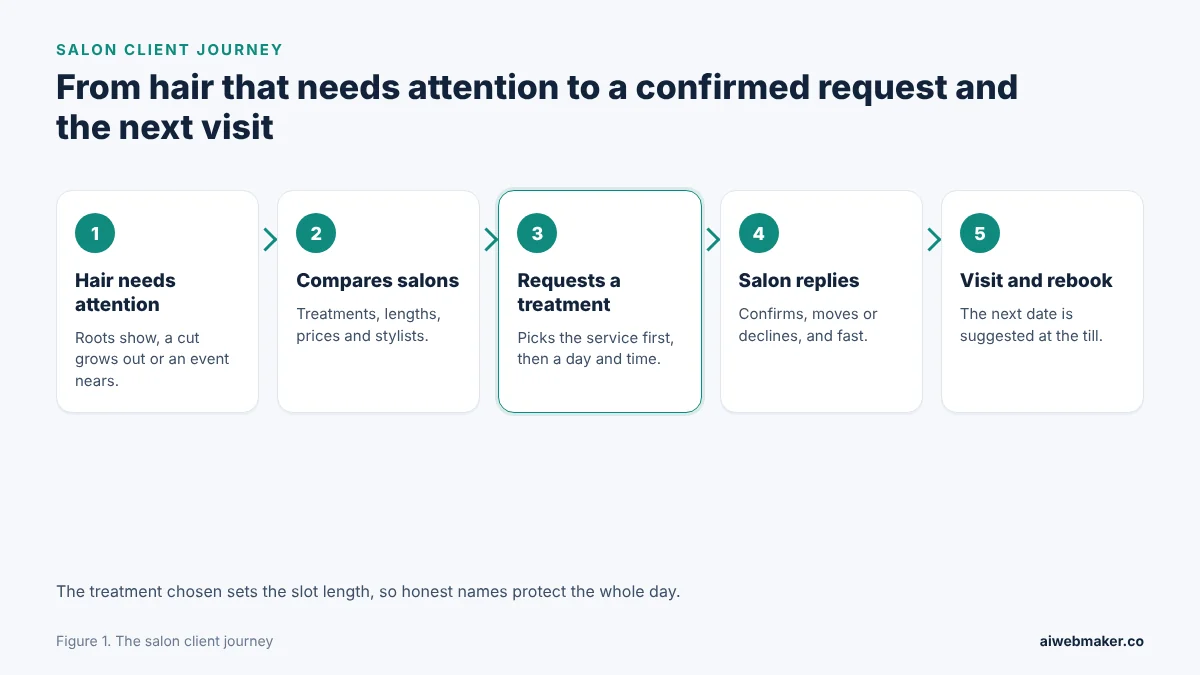
The journey opens with a need and closes with a habit, and a salon usually wins or loses the client at the third step. They compare treatments, prices and lengths, and the emphasised third card marks the point where they choose a treatment and ask for a time. Next comes the salon's reply, a yes, a nearby alternative or a polite no, and its speed shapes the first impression almost as much as the haircut. After the visit, a suggested next appointment turns one booking into a cycle. Every page on the site should make one of those five steps a little shorter.
Treatment menu, stylist pages and house rules: what the salon site holds
A salon site needs fewer pages than most owners expect, yet every page must settle one booking question before it turns into a phone call. The treatment menu carries most of the weight, because it is where the length and price of every service are set. The request page turns a chosen treatment into a proposed time. A team page tells clients who works which days, while a short policies section sets the rules before anyone commits. Colour clients need a section on consultations and skin tests, and everyone needs the address and hours. Taken together, these pages behave like a booking system written in plain language.
| Page or setting | What it holds | Question it settles |
|---|---|---|
| Home | Salon photo, hours, a request button | Can they fit me in? |
| Treatment menu | Cuts, colour, styling, facials, with lengths and prices | Which treatment is mine? |
| Request page | Treatment, preferred day and time, contact details | When can the visit be? |
| Team | Stylist levels, specialities, working days | Who does the work? |
| Colour and consultations | Consultations, skin tests, corrections | Is the colour safe? |
| Policies | Lateness, cancellation notice, deposits | What if plans change? |
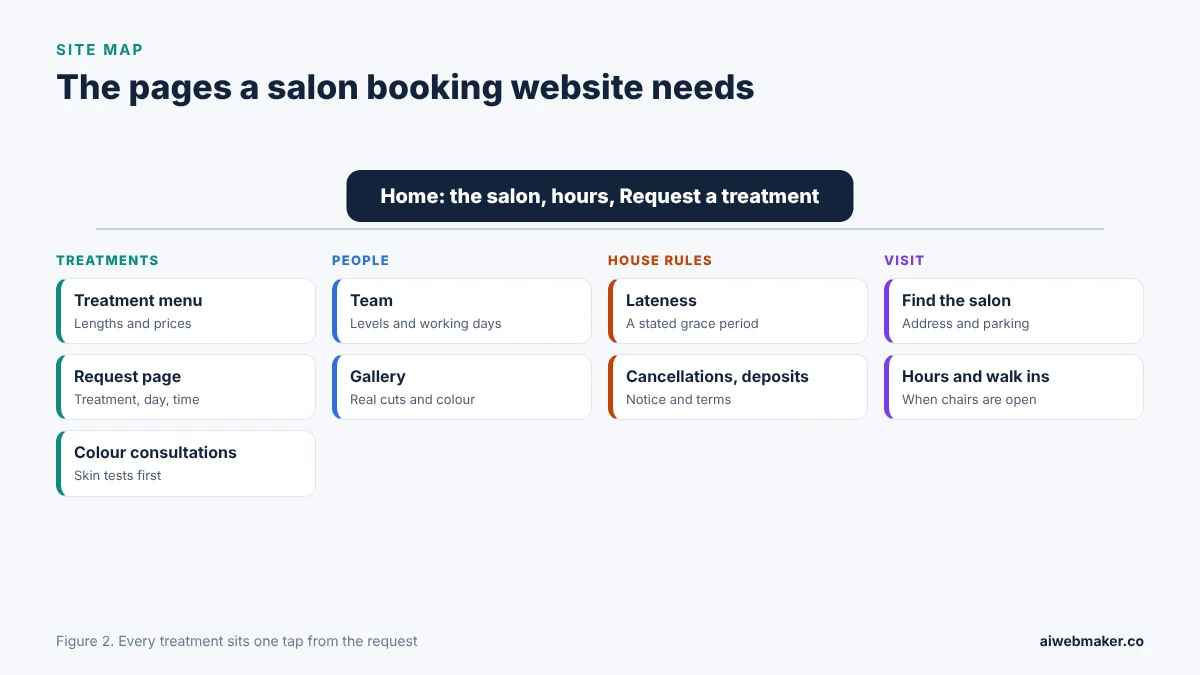
Grouped into four branches, the salon site keeps the request one tap away from every treatment description. The treatments branch holds the menu, the request page and colour consultations, while the people branch holds the team and a gallery. House rules carry lateness and cancellation terms, and the visit branch carries the address, hours and walk in times. Among our invented sample businesses, Velvet Touch Beauty Salon sorts its menu into four treatment types, facial care, nail care, body care and hair styling, and gives each its own price. The beauty salon sample where clients request four treatment types shows a client choosing a treatment first and a time second, which is the right order because the treatment decides how long the slot must be.
Naming every treatment so the slot it asks for is the right size
A treatment name on a salon menu is really an instruction to the diary, so it should tell client and stylist how much time is being requested. A single line reading "Cut" is too vague, because a fringe trim and a restyle on long hair differ by an hour. Names such as "Cut and blow dry, shoulder length" or "Root colour with cut and finish" carry the length inside them. Colour services should include their processing time, since the client stays in the salon while the stylist works elsewhere. A menu written this way prevents most of the double bookings that make a Saturday unravel.
| Treatment | Length to start from | What stretches it |
|---|---|---|
| Cut and blow dry, short hair | 45 minutes | Thick or curly hair |
| Cut and blow dry, long hair | 60 to 75 minutes | A full restyle |
| Root colour with finish | 90 minutes | Processing, a toner |
| Full head highlights | 2 to 3 hours | Foils, length |
| Balayage or colour change | 3 hours or more | Lightening in stages |
| Consultation and skin test | 15 minutes | Past colour history |
Requests for a favourite stylist, and how quickly the salon should answer
Many salon clients follow one stylist for years, so the website should let them ask for that person without a phone call. The simplest method is to list stylist levels as separate treatments, such as "Cut and finish with a senior stylist", and to show working days on the team page. When the requested person is fully booked, the salon can offer that stylist on another day or a colleague at the same hour. Speed matters as much as the answer, because a client who waits a day may book elsewhere. Checking requests at opening, at lunch and before closing keeps waits short, and saying so on the request page turns silence into a promise.
The booking website builder for salons that accept, move or decline each request works on exactly this principle, with the client proposing and the salon deciding. A visitor proposes a treatment and an hour, after which the salon says yes, shifts the appointment to a nearby slot or says no. Any payment, including a deposit for a long colour, is settled between salon and client directly. Nothing is taken from the booking by the platform, so a full Saturday costs no more than an empty one. The builder drafts the treatment pages, the team page and the request page once the owner writes a few lines about the salon. Keeping the final word with the people in the salon is what stops a busy day from being overbooked.
Chairs, basins and colour processing: where a salon diary loses time
A salon's real capacity is set by its tightest resource, which is not always the number of stylists. Two stylists cannot shampoo at once with one basin, and a facial cannot start while the treatment room is still being reset. Colour processing leaves the stylist with spare minutes, and experienced salons fill that time with a quick cut, but only if the diary allows it. Gaps of fifteen or twenty minutes between longer services are almost impossible to sell, so they quietly drain the day. Offering times next to existing appointments when replying to requests fills the diary from its edges inward. A salon that knows its bottleneck can promise times it will actually keep.
| Limit | Effect on the diary | How to handle it |
|---|---|---|
| Stylists on shift | Caps clients at once | Working days on the team page |
| Basins | Queues at the start of services | Stagger starts by ten minutes |
| Colour processing | Leaves a stylist idle for 20 to 40 minutes | Fit a short service inside |
| Treatment room | One facial at a time | Reset time between clients |
House rules for late arrivals, cancellations and deposits
A salon's rules on lateness and cancellations are fairest when clients read them before they request, not when they arrive. A grace period of ten or fifteen minutes lets a client who is slightly late still have the full treatment. Beyond that, the stylist may need to shorten the service or offer a new time so the next client starts on schedule. Cancellation notice of a day or two gives the salon a realistic chance to offer the slot to someone else. For long colour work or extensions, many salons ask for a deposit, agreed and collected by the salon itself rather than by the website. Friendly, plain wording protects the diary without making loyal clients feel accused.
| Situation | Common approach | Wording that keeps goodwill |
|---|---|---|
| A few minutes late | Full treatment within the grace period | The time is still yours |
| Very late | Shorter service or a new time | The next client starts on time |
| Late cancellation or no show | A fee or deposit next time, at the salon's discretion | Missed time cannot be resold |
| Long colour or extensions | Deposit arranged by the salon | Details come with the confirmation |
First visits, skin tests and regulars who come back every few weeks
Newcomers arrive with questions that regulars stopped asking long ago, and a short section on the website answers most of them. New clients want to know whether a consultation is included, how early to arrive and whether to come with washed hair. Colour clients should be told that many hair dye makers instruct a skin allergy test, commonly about 48 hours before colouring, and that the salon follows the product's guidance and local rules. Saying that inspiration photos are welcome helps clients show a shade rather than struggle to describe it. Regulars then need the opposite treatment, a next request that feels almost automatic, prompted by a line on each treatment about its usual interval. A salon that plans first visits and repeat visits through the website spends far less time apologising for full days.
Searches with a time inside them: blow dry today, balayage near me
People looking for a salon often type the treatment and the time together, such as blow dry today, balayage near me or hair salon open Sunday. Each treatment group on the website should carry those plain words in its heading, because search engines match pages to the phrase rather than to the salon's brand language. Same day deciders often find a salon through its map listing, so the hours there must be right and the link should point at the request page. Reviews that mention a stylist by name or a colour that turned out well help the next client choose. Short articles on how long balayage takes or why a skin test comes first bring readers in weeks before they book. Together these pieces make the salon easy to find when someone is ready to ask for a time.
A year of hosting for the salon, set beside the chair it fills
The salon's website bill has only two fixed parts, hosting and the domain, and neither grows with the number of requests. Paid annually, hosting comes to $119, and a salon preferring smaller instalments can pay $19 each month instead. Twelve articles, one a month on topics like colour aftercare, use AI credits of about $0.65 each. Changing a price, adding a treatment or updating a stylist's days adds nothing to what the salon pays. A $189 tier also exists and appears in the table only so the prices can be set side by side.
| Item | Yearly | Monthly |
|---|---|---|
| Hosting the salon's pages | $119 | $228 over twelve months |
| Domain | Depends on the ending | Depends on the ending |
| Higher plan, for comparison | $189 a year | Not needed |
| Twelve salon aftercare articles at about $0.65 | About $7.80 | About $7.80 |
| New treatments, prices and stylist days | No charge | No charge |
| Year before the domain | About $126.80 | About $235.80 |
Why a client gives up on a salon page and phones a rival
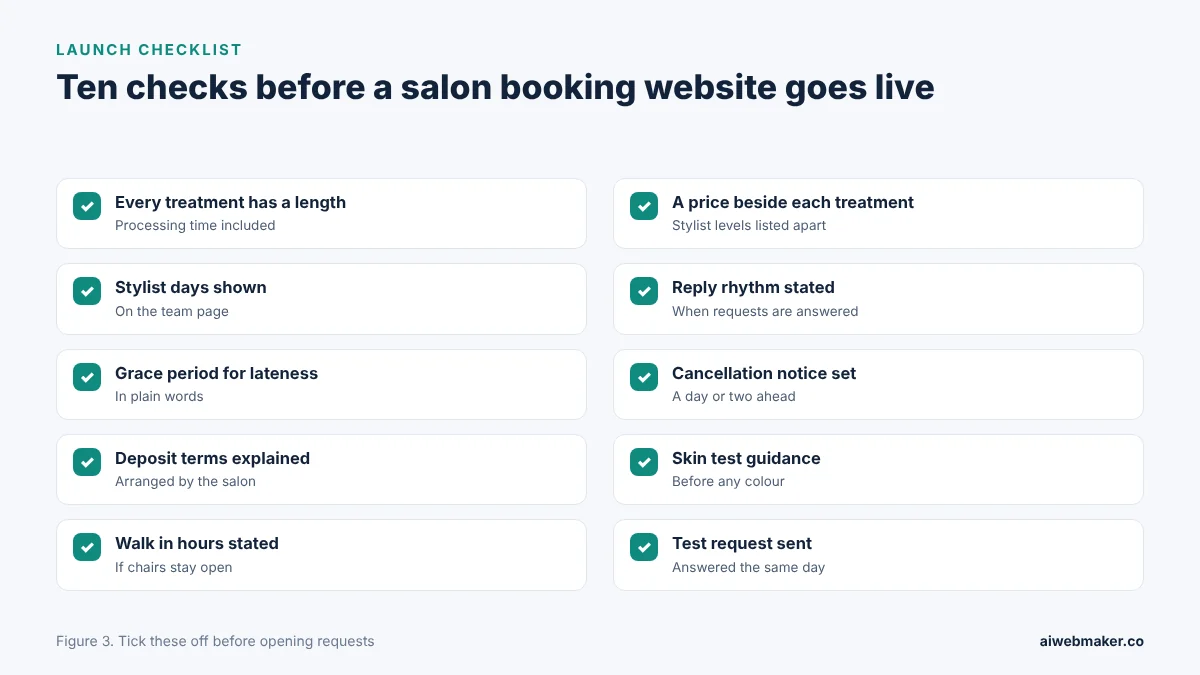
Clients abandon a salon website when they cannot tell what a treatment involves, how long it takes or what it costs. A menu that says only "colour, from" leaves them guessing whether they can afford a full head. Rules on lateness or deposits feel like a trap when they appear only after the request is sent. A request page that gives no idea of when a reply will come pushes people towards whichever salon answers first. Ten quick checks, pictured next, shut each of those exits before requests open.
Frequently asked questions
Can a salon keep chairs open for walk ins as well?
A salon can welcome walk ins and still take requests, provided the website says when walk ins are most likely to be seen. Some salons keep one stylist unbooked on weekday mornings, while others take walk ins only for fringe trims and blow dries. Saying which days suit walk ins saves wasted trips. Online requests then fill the rest of the diary in advance. The two routes sit together comfortably when each has stated hours.
What happens when the requested time has already gone?
When a requested time has gone, the salon replies with the nearest alternatives rather than a plain refusal. Offering the same stylist an hour later or another stylist at the original time lets the client choose in one message. The reply should come quickly, since the client may still be comparing salons. If nothing suits that week, a polite decline with a suggestion for the next keeps goodwill. A refusal handled well often becomes a booking a few days later.
Should colour corrections be requested online?
Colour corrections are better handled as a consultation first, because nobody can judge the time or price without seeing the hair. The menu can list a short correction consultation, after which the stylist proposes a plan and books the main work. Corrections can take several hours or more than one visit, and the salon should say so openly. A consultation also leaves room for any skin test the product needs. The consultation also allows any skin test the product needs. Clients value honesty about a difficult job more than an optimistic estimate.
How should a wedding party arrange its hair appointments?
A wedding party usually needs several stylists on one morning, so the salon can list a bridal trial and a wedding morning as separate treatments. The organiser requests the wedding morning for the date, and the salon replies to agree numbers, timings and any deposit. Trials fit best on quieter weekdays, weeks before the date. The salon should state whether it travels to venues. Clear wedding terms turn one request into a well planned morning.
One colour appointment against twelve months online
One long colour appointment can be worth more than the whole year's hosting, which makes the website one of the cheapest chairs in the salon. Clients who can request a time in the evening fill weekday gaps that the phone would never reach. A regular who rebooks every six weeks adds eight or nine visits a year, and none of them carries a booking fee. The salon decides every request, so the diary stays under the control of the people working in it. Measured against a single balayage, the year online is a small and quickly recovered cost.
Build your website in Minutes and get the AI Tools that work
Start Building Your Website →