One Coach, One Diary: How a Personal Trainer Booking Website Works
This guide answers how a personal trainer booking website lists sessions, blocks and remote coaching, protects a single coach's diary and handles consultations, policies and regular clients. A trainer spends $119 on a hosted year, or $19 in a single month, adds a domain, and sees no bill while the pages take shape.
- No coding required
- Live in minutes
- Blog, SEO and chatbot tools included
A personal trainer booking website lets clients request one to one sessions, remote coaching or a written plan, while the trainer decides how each request fits a single, finite diary. It suits trainers who rent space in a gym, independent studio owners, mobile trainers who visit homes and parks, and online coaches whose clients live in other cities or countries. Plans and proof sit side by side on our personal training business website example, a sample site built on AI Web Maker for a trainer we invented to show the idea. On AI Web Maker a trainer's site costs $119 for each year it stays online, or $19 for a single month, with a domain chosen from about 400 endings, and shaping the pages in the preview is never billed. The hard part is that a trainer has one body and a handful of prime hours, so every early morning and after work slot given to the wrong client is lost for months. Travel between locations eats into the day, and remote clients need a different rhythm altogether. The topics ahead run from the people who book and the pages they read to session lengths, the weekly diary, replies, policies, consultations, regular clients, seasons, search and cost.
This article is part of our complete guide: Website Builder Comparison.
Goal setters, returners and remote clients: who asks for a trainer's time
People who request a personal trainer usually arrive with a goal and a deadline, which makes them motivated but impatient. Some want to get stronger or lose weight, some are returning after an injury or a pregnancy, and others have a race or a wedding on the calendar. Older adults often look for help with balance, strength and confidence, and they value a calm, patient coach. Remote clients choose a trainer by expertise and communication rather than location, and many already train in a gym of their own. Most of these people compare several trainers in an evening before requesting anything.
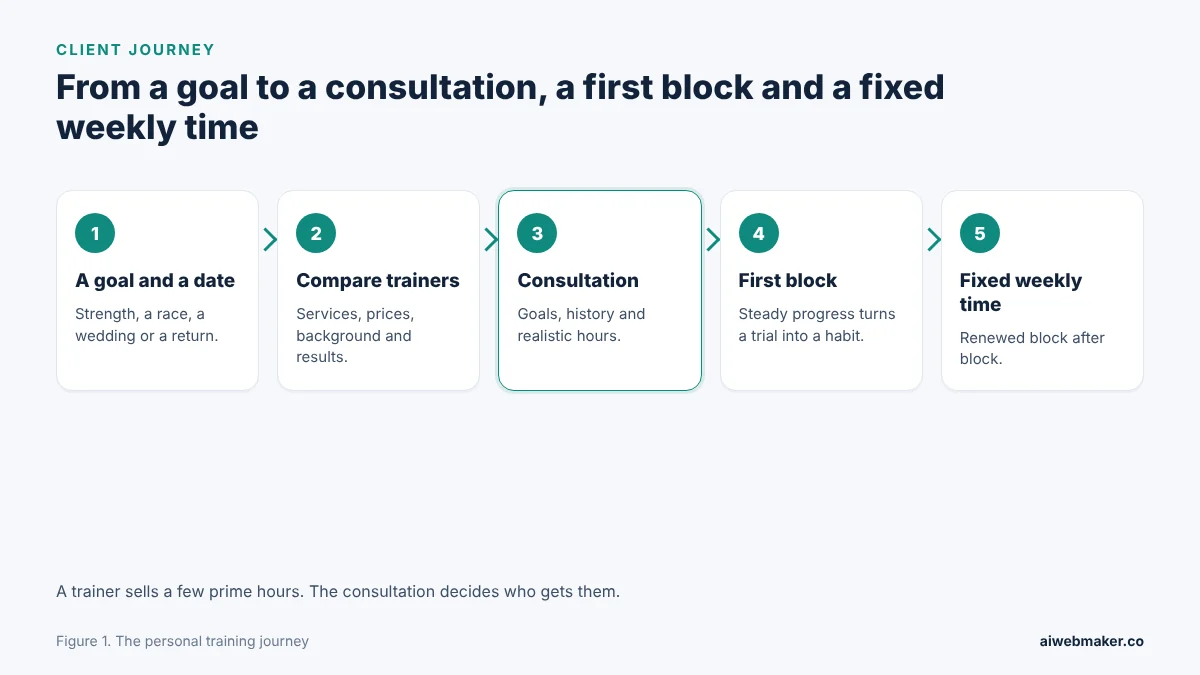
Everything in this path hinges on the consultation, the highlighted step, where trainer and client decide whether to work together. Before it, the client compares services, prices and the trainer's background, then requests a first meeting. During it, the trainer learns the goal, the history and the timetable the client can realistically keep. A first block of sessions follows, and steady progress during that block is what converts a trial into a habit. The last step is a fixed weekly time, renewed block after block, which is the stable core of any trainer's income.
Service pages and diary settings a trainer relies on
Few pages are needed on a trainer's site, as long as each one replaces a message the client would otherwise send. The service list names each offer, from a single session to a block and remote coaching, with its length and price. A coach page explains qualifications, insurance where it is required, specialisms and the kind of client the trainer works best with. A locations page says where sessions happen and which areas a mobile trainer covers. Policies and the request page complete the set, so that a client can decide and request in one sitting.
| Page or setting | What it holds | What the visitor learns |
|---|---|---|
| Service list | Sessions, blocks, partner sessions, remote coaching | Services and their lengths |
| Coach page | Qualifications, insurance, specialisms | Whether the coach suits them |
| Locations | Gym, studio, parks, homes, areas covered | Where training happens |
| Results stories | Client stories shared with consent | Proof from similar clients |
| Session policies | Notice, lateness, block expiry, weather | What a cancellation costs |
| Request page | Service, day, time and contact details | How to begin |
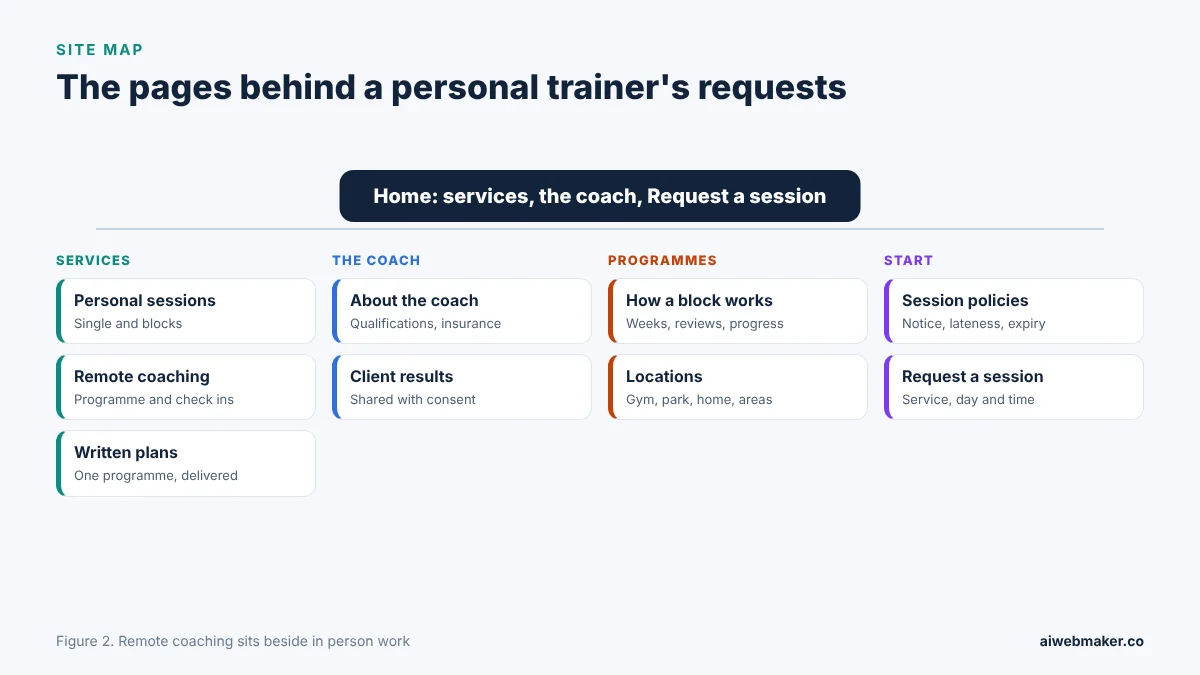
This plan splits into four branches, with remote coaching placed beside in person work rather than tucked away at the end. The services branch lists sessions, blocks and remote coaching, each with its own price. The coach branch holds the trainer's background and the results stories that clients read closely. A programmes branch explains how a block is built, and the last branch carries policies and the request itself. Forge Fit Coaching, an invented business in our samples, sells remote coaching beside in person sessions and written plans, with pages describing its programmes, the coach and client results. Its personal trainer sample with remote coaching to request sets those services side by side, so a visitor can compare them before asking for a time.
Sessions, blocks and remote coaching, each with its own length
Every service should state its length and shape, since choosing between a session and a remote plan means choosing how much attention the client receives. Sessions of about an hour are common, while shorter sessions suit lunch breaks and older clients building up slowly. Blocks of sessions belong on their own line at their own price, with an expiry period that the trainer can honour. Remote coaching needs a description of what is included, such as the programme, how often it is updated and how check ins work. A list that states these shapes plainly helps clients pick the right commitment first time.
| Service | Typical shape | Where it happens | Line for the description |
|---|---|---|---|
| Single session | About an hour | Gym, studio, park or home | Good for a first taste or occasional help |
| Block of sessions | Set number, with an expiry | Same as single sessions | Lower price per session, set weekly time |
| Partner session | One trainer, two clients | Gym, studio or park | Shared goals and similar levels |
| Remote coaching | Monthly programme with check ins | The client's own gym or home | How often plans change, how check ins run |
| Written plan | One programme delivered once | Anywhere | What it covers and how to follow it |
Prime hours, travel and the shape of a trainer's week
A trainer's capacity is set less by the total hours worked than by the few hours clients actually want. Early mornings, lunchtimes and early evenings fill first, while mid morning and mid afternoon are hard to sell except to retirees, shift workers and parents. Mobile trainers lose part of each prime window to travel, so grouping home and park sessions by area protects more sessions per day. Trainers who rent space in a gym must also respect its rules on floor time, equipment and peak hours. Remote coaching fills the quiet hours, because programmes and check ins can be written when no client is waiting. Because each request waits for the trainer's reply, prime slots can go to regulars and blocks before single sessions.
| Time band | Who usually asks for it | What the trainer can offer |
|---|---|---|
| Before work | Office workers, early risers | Regular block slots, held for regulars |
| Lunchtime | People near offices | Shorter sessions with tight timing |
| Mid morning or afternoon | Retirees, parents, shift workers | Longer sessions, gentler progressions |
| After work | Most new clients | Blocks first, single sessions if space remains |
| Quiet hours | Remote clients | Programme writing and check in replies |
Replying to a request before the client books someone else
A prompt reply matters more for trainers than for most trades, because a motivated client cools quickly and the next trainer is one search away. A good answer confirms the consultation, or names the closest workable time, and adds the meeting place and the kit to bring. Requests for a prime slot that is already taken can be met with a quieter time, remote coaching or a place on a short list for the next opening. Anyone who raises an injury, a heart condition or a recent operation at first contact should be asked to check with a doctor before training starts. A reply within the same day is a sensible standard for a business that sells motivation.
The booking pages where the trainer approves every session are built around this kind of personal reply. A client selects a service and suggests a time, and the trainer answers by confirming, proposing a better hour or saying no. Session and coaching fees are paid to the trainer in whatever way the trainer already invoices, and nothing is deducted by the platform. AI Web Maker drafts the programme pages, the trainer profile and the request page in a single build once the trainer explains what is on offer. Since nothing is settled until the trainer replies, a quick screen for health questions fits naturally into the answer.
Late cancellations, lateness and block expiry
Cancellation rules for a trainer should fit in a few lines and appear before anyone requests, since a prime slot cancelled late rarely finds a new client. Asking for roughly twenty four hours of notice protects the trainer, yet still leaves room for genuine emergencies. Lateness is usually handled by finishing at the planned time, so one late client does not delay the next. Blocks need a clear expiry, such as a number of weeks, with any pause for illness or travel explained. Outdoor sessions need a bad weather rule, whether moving indoors, switching to a video session or rescheduling. Consumer rules on prepaid sessions, refunds and expiry differ between countries, so trainers should confirm the local position before publishing terms.
Consultations, health questions and the first session
A first consultation should feel like a conversation about goals rather than a test, because many new clients fear being judged. The trainer can ask about goals, training history, injuries and the hours the client can genuinely commit, then plan a first block. Many trainers use a screening form before exercise starts, and its answers show who ought to get clearance from a doctor before hard training begins. Trainers should also stay within the scope their qualifications and local rules allow, for example by referring detailed diet plans or injury treatment to the appropriate professional. A short written plan after the consultation gives the client a reason to commit to the first block.
Regular clients, fixed weekly times and the training year
Regular clients are the backbone of a trainer's week, and the booking pages should make their next block as easy to request as their first session. A fixed weekly time, held as long as the block is renewed, gives both sides a rhythm that is hard to break. Progress reviews every few weeks, comparing lifts, measurements or how daily tasks feel, show the client why the habit is worth keeping. Offering regulars the first choice of slots before the trainer opens a new term or season rewards loyalty. Demand also moves through the year, with new clients arriving in January, a rush before summer and wedding seasons, and a dip during holidays, though patterns vary by country and climate. Remote coaching carries many clients through holiday weeks when in person sessions pause.
Searches that pair a goal with a place, from postnatal fitness to online running
Trainer searches usually join a goal to a place, for example personal trainer for beginners, strength coach near me, postnatal fitness trainer or online running coach. Service and programme pages named in those words meet each search with a matching answer. A trainer who works from a studio benefits from a map listing with accurate hours and photos of the real training space, while mobile and remote coaches rely more on their pages. Reviews from clients, shared with consent, that mention patience, clear plans and steady progress persuade people who are nervous about starting. Articles such as how to start strength training after forty draw readers who are not yet ready to book.
What the session pages cost to keep online all year
Keeping the service pages, coach page and request page online takes $119 a year paid upfront, or $228 spread as twelve monthly amounts of $19. The domain is extra, priced by whichever ending the trainer picks. A dozen training articles produced with AI credits add roughly $7.80. Updating services, prices and the weekly diary costs nothing extra. Only as a reference point, the $189 tier also appears below.
| Item | Yearly | Monthly |
|---|---|---|
| Hosting the pages | $119 | $228 over twelve months |
| Domain | Depends on the ending | Depends on the ending |
| Higher plan, for comparison | $189 a year | Not needed |
| Twelve training articles at about $0.65 | About $7.80 | About $7.80 |
| Service, price and diary updates | No charge | No charge |
| Year before the domain | About $126.80 | About $235.80 |
Signals that make a hopeful client close the page
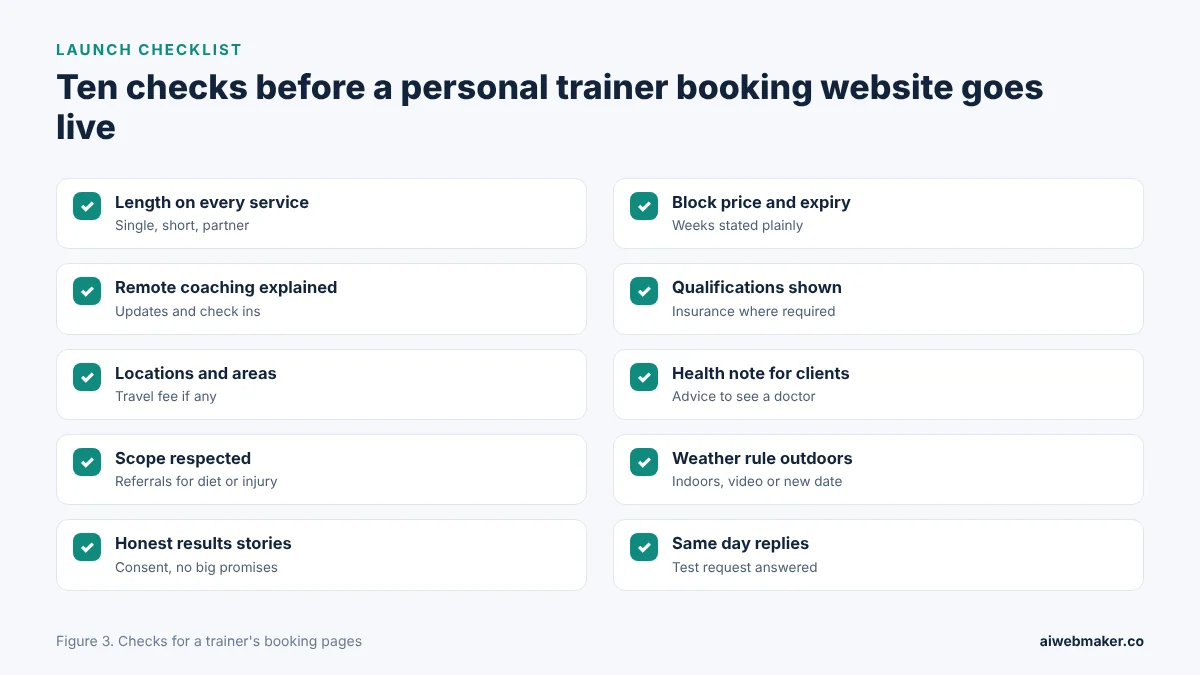
Visitors leave a trainer's site when they cannot see what a session costs or how long it lasts, because an open ended commitment feels risky. A coach page with no qualifications or insurance details leaves cautious clients unsure. Results stories that promise dramatic transformations make sensible people suspicious rather than excited. Slow answers to a first request hint that coaching feedback will be slow as well. Each gap has a fix among the ten boxes drawn below, ready to tick off.
Frequently asked questions
Can a client mix in person sessions with remote coaching?
Mixing the two works well, and many clients train in person once a week and follow a remote plan on the other days. The trainer can list a combined option with its own price, or let clients request each part separately. Check ins on the remote days keep the plan honest and show progress between sessions. This mix often suits people with busy weeks or regular travel. A flexible offer keeps clients training when their schedules change.
What should a trainer do when a client keeps cancelling?
When a client cancels repeatedly, an honest conversation usually works better than quietly enforcing charges. The trainer can ask whether the time still suits, the goal still matters or the format needs to change. A quieter slot or a remote plan sometimes fits a crowded life better than a prime evening session. The cancellation policy should still apply fairly, as stated before the block began. Solving the cause keeps the client, while charging alone often loses them.
How far can a mobile trainer travel for a session?
A mobile trainer should set a clear area and say whether any travel fee applies outside it. Grouping clients by district keeps travel time from eating prime hours. The trainer can confirm the address or preferred park in the reply, and accepts the session once the route fits the day. Insurance for training in homes and public spaces is worth confirming before offering it. A clear area protects the trainer's diary and sets fair expectations.
Should a trainer offer sessions for two people at once?
Partner sessions suit friends, couples and family members with similar goals and levels, and they make training more affordable for each person. The trainer should list them separately with their own price and length. Very different levels or goals make a shared session less useful for both people. A short consultation with each person first helps the trainer judge the fit. Well matched pairs often stay committed because they motivate each other.
How few regular clients cover the trainer's year online
The fees from one or two sessions are usually enough to cover the yearly $119 for a trainer's booking pages. On monthly billing, a single session typically more than pays the $19 for that month. The lasting value comes from regular clients, since one person on a fixed weekly time across a year brings in many times the hosting bill. Plain service lengths, modest results stories and fast answers are how a first request grows into a long arrangement. A diary where the prime hours fill with familiar names each week shows the pages are pulling their weight.
Build your website in Minutes and get the AI Tools that work
Start Building Your Website →