Inside a Nail Salon Booking Website: Removals, Art Levels and Infills
This guide explains how a nail salon booking website works, from timing removals, new sets and nail art to desks, pedicure chairs, lateness, first visits and infills. Hosting is priced at $119 yearly or $19 monthly, the nail bar adds its own domain, and drafting the site in preview carries no bill.
- No coding required
- Live in minutes
- Blog, SEO and chatbot tools included
A nail salon booking website lets clients request a manicure, pedicure, gel set or nail art at a time that suits them, with the salon confirming each one. It suits nail bars, home studios, mobile nail technicians and beauty salons with a single nail desk. Gel, acrylic and nail art each get their own place on the nail salon website example, an invented salon's site that AI Web Maker built so owners can judge a whole menu at once. A nail bar publishing with AI Web Maker settles $119 per year of hosting, or a monthly invoice of $19 instead, and adds a domain, and nothing is charged for building it and trying the request page in preview. Nail appointments are deceptively variable, because soaking off an old set, repairing a broken nail or adding hand painted art can stretch a short visit to well over an hour. The sections that follow cover who requests, the pages to publish, timing, nail art, capacity, replies and rules, first visits, regulars, search and the yearly cost.
This article is part of our complete guide: Website Builder Comparison.
Brides, gel regulars and last minute polish: who sends a nail request
Nail clients are more varied than they first appear, and each group sends a different kind of request. Gel and builder gel regulars return every two to four weeks and usually know exactly which infill or colour they want. Occasion clients, from brides to holiday travellers, plan a few days or weeks ahead and often arrive with a design photo saved on their phone. Lunchtime clients want a quick polish change or a tidy file and paint, sometimes on the same day. Groups, such as bridal parties or birthday outings, need several technicians at once. Knowing this mix tells a nail bar which treatments must be easy to find and which can sit further down the menu.
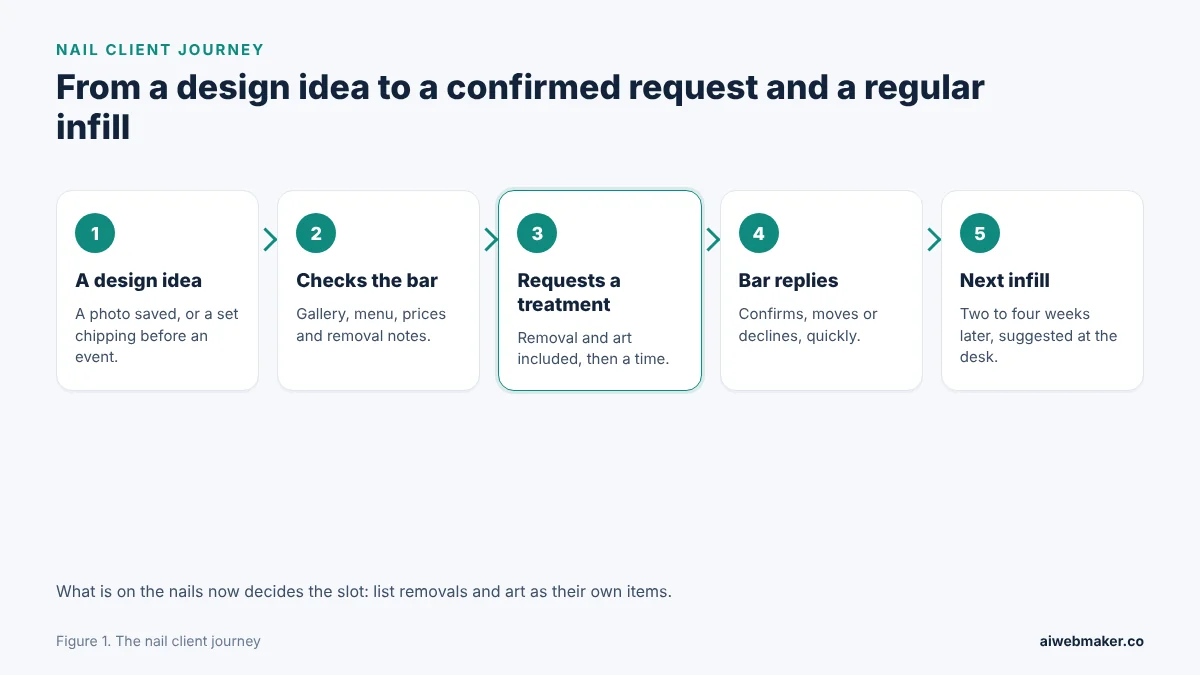
Five stages carry a nail client from a picture on a phone to a seat at the desk every few weeks. The client then checks the gallery and menu to see whether the bar can recreate the look and what it costs. The highlighted step is the request, where the treatment chosen, including any removal or art, sets how many minutes the slot needs. Once the bar replies and the visit goes well, the next infill date becomes the natural close of the appointment. A menu and gallery built around those five moments turn browsing into a steady diary.
Menu, design gallery and removal notes: what a nail bar puts online
A nail bar needs a compact set of pages, but its menu has to work harder than most because nail services vary so much in length. The treatment menu lists hands and feet separately, with removals, sets, infills and art as their own items. The request page then carries that treatment into a suggested day and hour. A design gallery shows real work, grouped by style, while a short page on hygiene and nail health reassures cautious clients. Policies on lateness and missed appointments sit together, and the visit details close the set. Every one of these pages saves a technician from answering a question with wet polish on their hands.
| Page or setting | What it holds | Why it matters |
|---|---|---|
| Home | Hours, a few strong designs, a request button | Gets the first look right |
| Treatment menu | Manicures, pedicures, removals, sets, infills, art | Sets the length of each slot |
| Request page | Treatment, preferred day and time, contact details | Turns a design idea into a time |
| Design gallery | Real sets grouped by style and season | Proves the bar can do the look |
| Hygiene and nail health | Tool cleaning, when treatment is refused | Builds trust with first timers |
| Policies | Lateness, cancellations, deposits for long sets | Keeps the day on schedule |
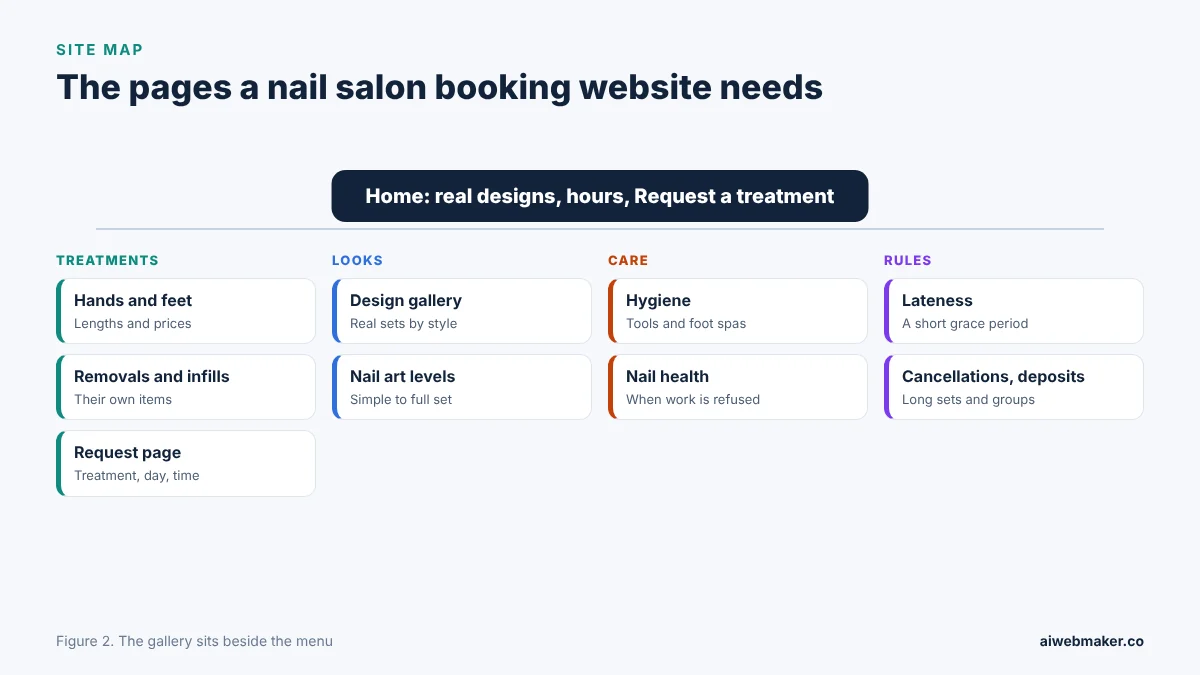
Four branches organise the nail site, and the gallery sits right beside the menu because clients move back and forth between them. The treatments branch carries hands, feet, removals and art, each linked to the request page. The looks branch carries the design gallery and seasonal sets, and the care branch carries hygiene, nail health and aftercare. A short rules branch holds lateness and cancellation terms. Polished Petal Nail Bar, an invented business in our samples, offers six treatments clients can request, covering hands, feet, gel, designs and quick colour refreshes. The nail bar sample with six requestable treatments and a design gallery shows how a client moves from a look in the gallery to a treatment and then a time.
Timing removals, new sets and infills so the next client starts on time
The length of a nail appointment depends less on the polish than on what is already on the nails and what is being added. A gel manicure on bare nails is quick, while the same manicure after soaking off an old set takes noticeably longer. Removal of another salon's work can take longer still, since the products and thickness are unknown. The menu should therefore list removal as its own item or as clear variants, such as "Gel manicure with removal". Extensions and full sets need generous time, and infills should be timed against the technician's real pace rather than an ideal. The lengths below are starting points to test against each technician before they go live.
| Treatment | Time to allow | What stretches it |
|---|---|---|
| Classic manicure | 30 to 45 minutes | Cuticle work, shaping |
| Gel manicure, bare nails | 45 to 60 minutes | Colour changes |
| Gel removal on its own | 15 to 20 minutes | Thick or layered product |
| Removal and new gel | 60 to 75 minutes | Another salon's product |
| Full set, acrylic or builder gel | 75 to 120 minutes | Length, shape, art |
| Infill | 45 to 75 minutes | Growth, lifting, repairs |
| Gel pedicure | 60 minutes | Hard skin, foot soak |
Nail art levels, add ons and the photo a client has in mind
Nail art needs its own listings because it changes both the price and the time, and the technician needs to know before the client sits down. Listing art by level, such as simple, detailed and full set, gives clients a clear choice without a long conversation. Add ons like chrome powder, French tips, extra length, paraffin wax or a longer hand massage can sit beneath the main treatments in the same way. Clients often arrive with a photo of a design, and the request page can suggest choosing the nearest art level and showing the photo at the start of the appointment. Clear levels keep the art honest and stop the afternoon from slipping.
| Art level | What it covers | Time to add |
|---|---|---|
| Simple | One or two accent nails, dots, lines | 10 to 15 minutes |
| Detailed | Hand painting on several nails | 20 to 30 minutes |
| Full set art | Every nail designed, chrome, gems, 3D | 30 to 60 minutes |
| Repairs | Per broken or lifted nail | 5 to 10 minutes each |
Desks, lamps and pedicure chairs: the capacity a nail diary must respect
A nail bar's capacity is set by people, desks, lamps and pedicure chairs together, and the scarcest one decides how many requests can be accepted. Two technicians with one pedicure chair cannot both do feet at the same hour. A manicure and pedicure done at once needs two technicians available together, which is why it should be listed as its own treatment. Foot spas and basins need cleaning and disinfecting between clients, as hygiene rules in many places require, so pedicure slots need a short gap after them. Dust extraction and ventilation can limit how many acrylic sets run at once in a small room. A diary that respects these limits is one the bar can actually keep.
Replies, lateness and missed sets in a tightly packed nail day
A nail request deserves a quick reply, since the client often wants the set before a specific event and will try elsewhere if nobody answers. Checking requests between clients, and offering the closest open time when the first choice is taken, keeps most of them. A grace period of about ten minutes is common, after which the technician may simplify the art or switch gel for polish so the next client is not delayed. Cancellation notice of around a day lets the slot go to someone else, and deposits for long sets or group bookings are arranged by the salon directly. Repeated no shows are often better handled with a polite word than with a penalty. Clear, friendly rules keep a packed day moving without upsetting regulars.
| Situation | A common rule | Wording that keeps goodwill |
|---|---|---|
| Up to ten minutes late | Full treatment if possible | Your time is kept for you |
| Later than that | Simpler art or polish instead of gel | The next client starts on time |
| Cancelling a day ahead | No charge | The slot can go to someone else |
| Long sets or group bookings | A deposit arranged by the salon | Details come with the confirmation |
Every one of these rules works best when the request system leaves the decision with the salon. The booking website builder where nail bars accept, move or decline each request does exactly that. Clients pick a treatment and an hour, the request lands with the bar, and the bar can say yes, propose a nearby hour or decline. Money for the visit, deposits included, passes straight between bar and client, and the platform claims no portion of it. The builder drafts the menu, gallery and request pages once the owner describes the bar in a short paragraph. That leaves technicians in charge of their own day.
First visits, nail health and regulars on a three week rhythm
A first visit goes more smoothly when the website explains what to expect before the client arrives. New clients should know whether to come with bare nails or mention any product already on them, so removal time can be planned. Anyone with a known allergy or past reaction to nail products should say so, and a technician may decline to work over nails or skin that look infected and suggest seeing a doctor or podiatrist, as hygiene rules in many places expect. Regulars then need a reason to come back, and a line on each treatment saying how long it usually lasts, such as two to three weeks for gel, sets that rhythm. Busy seasons, like summer for pedicures and the weeks before weddings and holidays, are worth flagging so regulars request early. A well informed first visit and an easy repeat request build the steadiest diary a nail bar can have.
Gel nails near me and other searches with a design in mind
People searching for a nail salon often type the finish and the place together, such as gel nails near me, builder gel infill, acrylic removal or bridal nails. Putting that exact wording into each treatment heading helps the page match what was typed. A map listing with accurate hours, fresh photos of real sets and a link to the request page reaches people deciding on the same afternoon. Reviews describing a set that survived a fortnight of work, or a technician who took real care, carry weight with newcomers. Short articles on topics like how long gel lasts, or why removal belongs in a salon rather than at home, attract readers before they need an appointment. Over time these pages make the bar a familiar name whenever someone nearby wants their nails done.
Twelve months online measured in gel sets
Only hosting and the domain are fixed on a nail bar's website bill, and neither moves with the number of requests. Annual payment brings hosting to $119, or $19 at each month's end for a bar that likes lighter instalments. A monthly article on nail care, drafted with AI credits, costs about $0.65 each time. Adding designs to the gallery, an extra treatment or new prices bring no further charge. A $189 tier exists as well and is shown in the table only for comparison.
| Item | Yearly | Monthly |
|---|---|---|
| Hosting the nail bar's pages | $119 | $228 over twelve months |
| Domain | Depends on the ending | Depends on the ending |
| Higher plan, for comparison | $189 a year | Not needed |
| Twelve nail care articles at about $0.65 | About $7.80 | About $7.80 |
| New designs, treatments and prices | No charge | No charge |
| Year before the domain | About $126.80 | About $235.80 |
Signs that make a nail client close the tab and try another bar
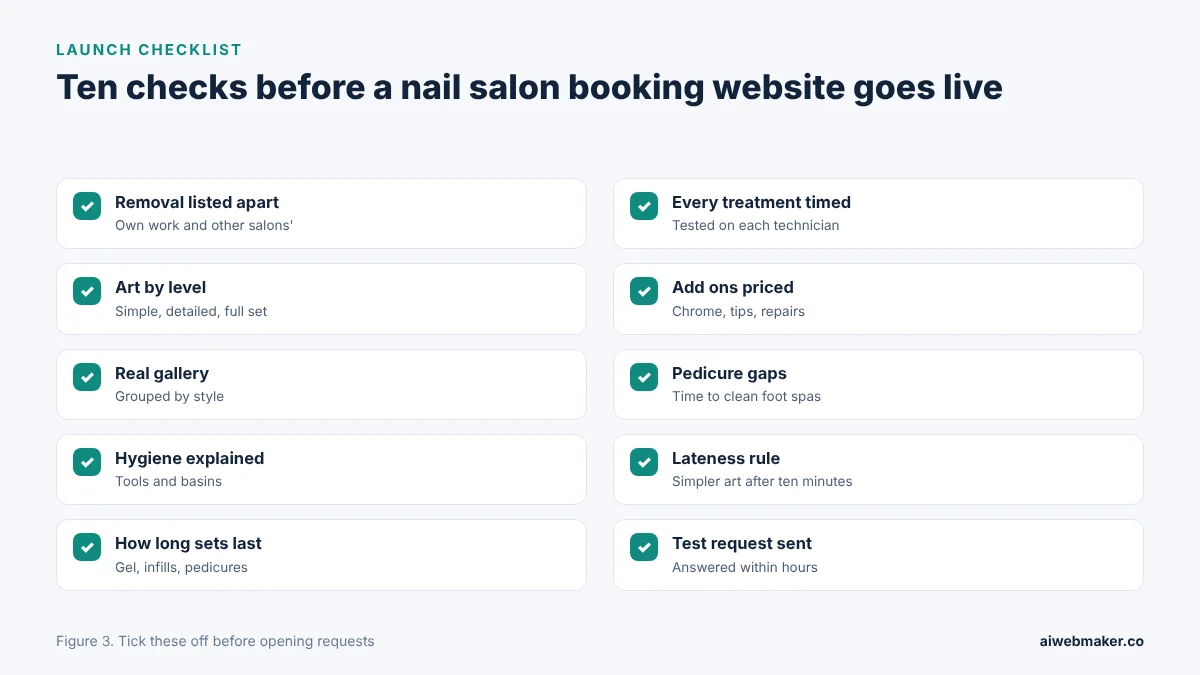
Nail clients leave a website when they cannot work out which treatment matches what is on their nails now. A menu that never mentions removal leaves them unsure whether their old gel will be dealt with. A gallery of stock images makes them doubt the bar can recreate their design. Silence about hygiene worries anyone who has heard stories about poorly cleaned foot spas. No hint of when a request will be answered sends event clients to whoever replies first. The ten checks in the next picture close those gaps before the bar starts accepting requests.
Frequently asked questions
Should removing another salon's gel be a separate treatment?
Removing another salon's product deserves its own listing or variant, because its thickness and type are unknown until the technician starts. A separate item lets the diary hold extra minutes for it. It also lets the bar price the work fairly without surprising the client. Some bars ask clients to mention the product type when they arrive. Clear listings keep both the price and the timing honest.
Can a client have a manicure and pedicure at the same time?
A manicure and pedicure together is possible when two technicians are available at the same hour and the room has space for both. Listing it as a single treatment lets the bar check that both people are available before confirming. Doing them one after the other with one technician takes longer but needs less space. The bar should state which option it offers. Either way, the client knows how long to set aside.
What happens when a client arrives with a broken or lifted nail?
A broken or lifted nail can usually be repaired within the appointment, but it adds time that should be planned. The menu can list repairs per nail, so clients choose the add on when they request. If several nails need work, the technician may suggest a full new set instead. Any sign of infection under a lifted nail means the technician should stop and suggest the client sees a health professional. Honest repairs protect both the nails and the timetable.
How far ahead should bridal nails be requested?
Bridal nails are best requested a few weeks ahead, with a trial a little earlier if the design is detailed. The trial can be listed as its own treatment, so it lands on a quieter weekday. The wedding set itself is usually done a day or two before the event, and group requests for bridesmaids need several technicians at once. Any deposit for a bridal party is agreed with the salon directly. Early planning turns a stressful week into a calm appointment.
Infills, bridal parties and what twelve months online are worth
A few infills or a single bridal party can bring in more than the year's hosting, while one or two manicures cover each monthly payment. A regular on a three week rhythm returns more than fifteen times a year, and none of those visits carries a booking fee. Clear removal listings, honest art levels and quick replies keep those visits arriving on time. The salon decides every request, so its technicians always control their own day. Counted in gel sets, a year of hosting ranks among the lightest costs a nail bar carries.
Build your website in Minutes and get the AI Tools that work
Start Building Your Website →