What a Massage Booking Website Needs Before the First Session
This guide sets out how a massage booking website works, from types and lengths to room changeover, health questions, policies, first visits, home visits and regular clients. Expect $119 for a year of hosting, or monthly payments of $19, with a domain added, and previewing the draft is never billed.
- No coding required
- Live in minutes
- Blog, SEO and chatbot tools included
On a massage booking website, a client chooses a style and a length and asks for a time, which the therapist confirms once the room and diary allow. It suits independent therapists, sports and remedial clinics, wellness studios and mobile therapists who carry a table to homes and offices. Pressure choices and the signals that build trust are laid out in our massage therapy business website sample, a complete site for an invented therapist put together with AI Web Maker. Once published, the practice's site is hosted by AI Web Maker at $119 per twelve months or at $19 for each separate month, with a domain added, and drafting the pages and walking through them in preview runs up no bill. The difficult part is that massage touches health, privacy and trust at once, so the booking route has to feel calm while still asking the right questions. Ahead lie clients and pages, then lengths and rooms, then health questions and policies, and finally first sessions, search and money.
This article is part of our complete guide: Website Builder Comparison.
Office backs, marathon legs and gift vouchers: who requests a massage
Massage clients arrive with different reasons, and the booking page should recognise each one without making anyone explain themselves on a phone. Desk workers with tight shoulders want a short session after work or at lunchtime, often on the same day. Runners, cyclists and gym regulars look for sports massage before or after an event, so their requests cluster around race calendars. Gift voucher holders are often first timers who never chose massage for themselves and need the most reassurance. Expectant mothers, older clients and people recovering from injury read the health notes carefully before they ask for anything.
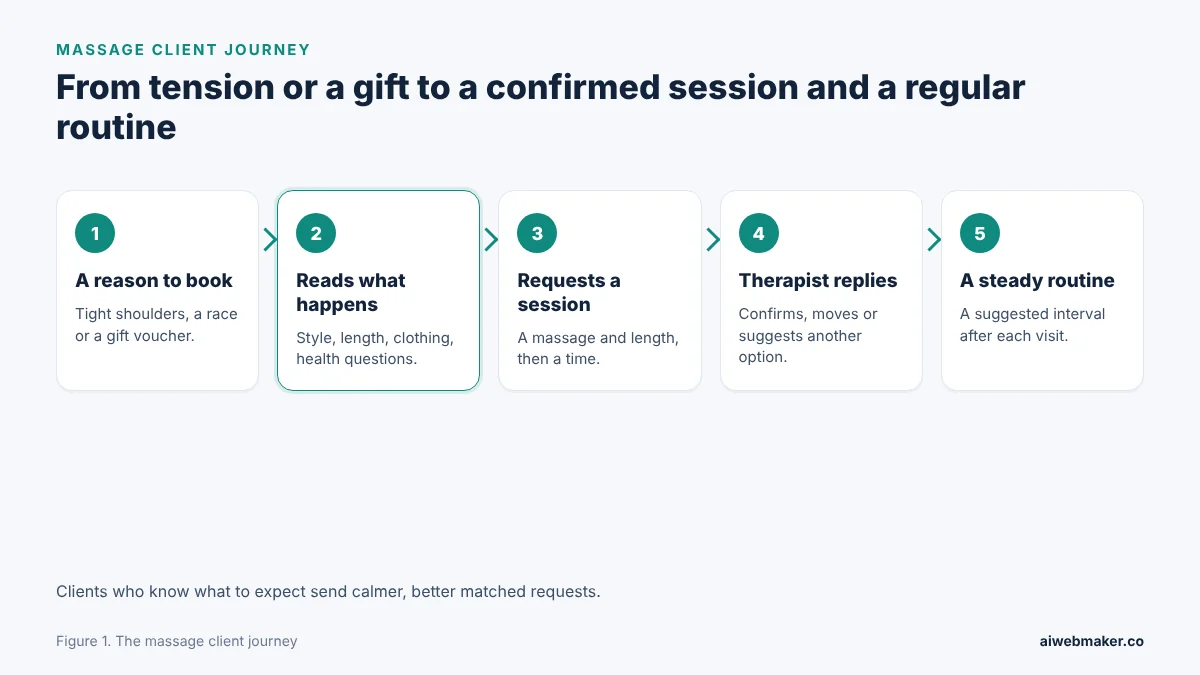
Tension, an event or a gift sets the path moving, and the highlighted second card decides whether a request is sent at all. A newcomer reads the type of massage, how long it lasts, what to wear and which health details the therapist will ask about. The therapist's reply confirms the session, suggests another hour or explains why a different treatment may suit better. After a good session, a suggested interval turns a single visit into a routine. Pages that answer the second step well tend to receive calmer, better matched requests.
Treatment list, first visit notes and policies: the pages a practice publishes
Only a few pages are needed for a massage practice, and each should remove one hesitation before a client commits to a time. The treatment list shows every massage by type and by length, with a price beside each length. From there the request page asks for the hour the client would like. A first visit page explains what happens from arrival to aftercare, and a separate answers page handles the questions clients feel awkward asking. Policies cover lateness, cancellations, age limits and conduct. Directions, parking and access details complete a set that lets a nervous first timer arrive knowing what to expect.
| Page or setting | What it holds | Why it matters |
|---|---|---|
| Home | Calm photo of the room, hours, request button | Sets the tone in seconds |
| Treatments | Each massage by type and length, with prices | Fixes how long the slot must be |
| Request page | Massage, length, preferred time, contact details | Turns a choice into a proposed session |
| First visit | Arrival, clothing, pressure, health questions | Removes the biggest worries |
| Answers | Common questions in plain words | Saves awkward calls |
| Policies | Lateness, cancellations, age, conduct | Sets terms before anyone books |
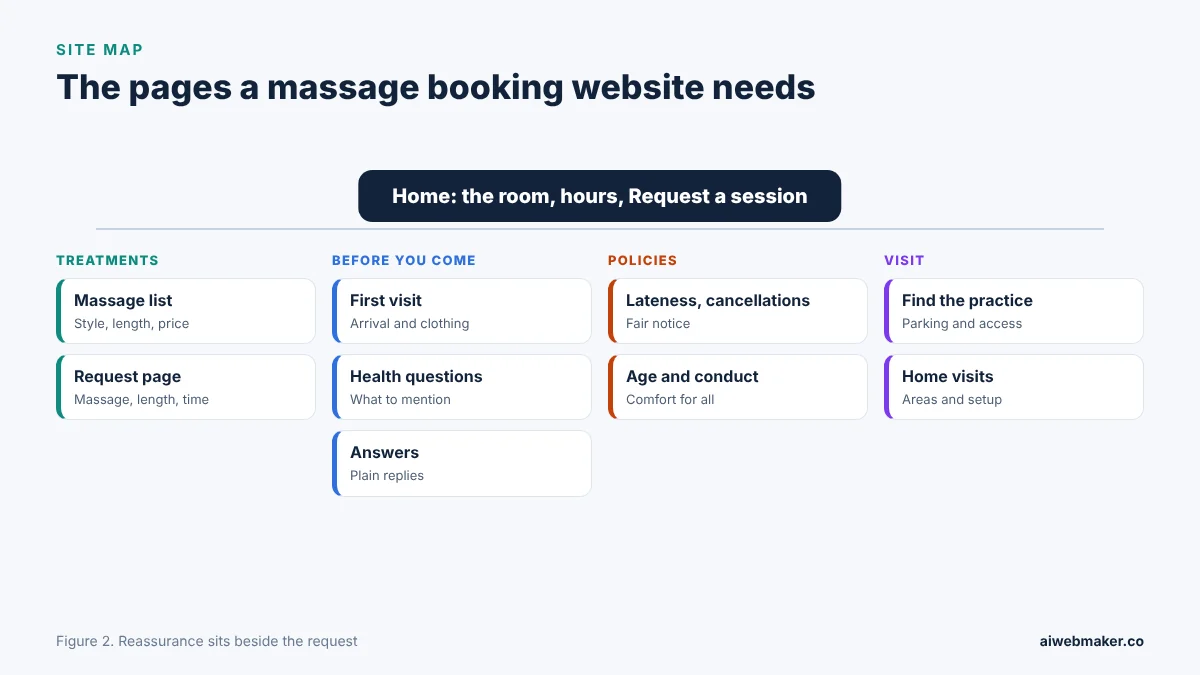
Four branches hold the massage site together, with the first visit and answers pages placed as near to the request as the treatments themselves. Treatments and the request page form the first branch, while the second gathers first visit notes, health questions and an answers page. Policies on lateness, cancellations and conduct make up the third, and directions with parking and access the fourth. Kneadwell Massage Therapy, one of the invented businesses in our samples, offers three massages clients can request and keeps its common questions on a page of their own. Opening the Kneadwell sample with three requestable massages and an answers page shows how a short treatment list and a page of plain answers support each other.
Describing each massage by type, pressure and length
A massage menu works best when every entry names the style, the pressure to expect and the length, so the client knows exactly what slot is being requested. Relaxation, deep tissue, sports, remedial and pregnancy massage differ in purpose, and a short line on who each suits prevents a gentle seeker from booking an intense session. Pressure words matter, because "firm" means something different to every client, so the description should say that pressure is agreed at the start and can change at any time. Each style should then appear at the lengths the practice actually offers, rather than every length for every style. A thirty minute deep tissue session on the whole body rarely works, so limiting it to back and shoulders keeps promises realistic. A menu built this way prevents clients requesting too short a session for what they need.
| Massage style | Lengths often offered | Who it tends to suit | What to state |
|---|---|---|---|
| Relaxation | 60 or 90 minutes | Stress, first timers | Gentle to medium pressure |
| Deep tissue | 45, 60 or 90 minutes | Persistent tight areas | Firmer work, possible soreness after |
| Sports | 30, 45 or 60 minutes | Training and events | Timing around competition |
| Back, neck and shoulders | 30 or 45 minutes | Desk workers | Focused area only |
| Pregnancy | 60 minutes | Expectant mothers | Trained therapist, positioning, health check |
Rooms, linen and changeover: the minutes a session really holds
A massage session occupies more of the diary than its stated length, and the website should be honest about which minutes the client receives. Some practices sell a "sixty minute massage" as sixty minutes on the table, while others include the consultation and dressing time within the hour. Between sessions the therapist changes linen, cleans the table and face cradle, notes the session and resets the room, which commonly takes ten to fifteen minutes. Hands and wrists also need rest, so many therapists cap how many hours of hands on work they take in a day. Building those limits into the times offered keeps both the therapist and the schedule healthy.
| Session sold | Hands on time | Before and after | Slot held in the diary |
|---|---|---|---|
| 30 minutes | 30 minutes | 10 minutes | 40 minutes |
| 60 minutes | 50 to 60 minutes | 15 minutes | 75 minutes |
| 90 minutes | 80 to 90 minutes | 15 minutes | 105 minutes |
| First visit, 60 minutes | 50 minutes | 10 minute consultation, 15 changeover | 85 minutes |
Requests, health questions and when a therapist suggests a doctor first
A massage request should travel with enough information for the therapist to decide whether the session is suitable before the client arrives. The request page can invite clients to mention pregnancy, recent surgery or injury, and any condition they think the therapist should know about, while saying that a fuller health conversation happens at the start of the first visit. Therapists commonly ask clients with a fever, an infection, a blood clotting condition, an unexplained lump or new and severe pain to check with a doctor before massage. This is general signposting rather than medical advice, and the practice should follow its own training, its professional body and the rules where it works. Licensing differs widely, because some countries and states license massage therapists while others leave the field to voluntary registers. A therapist who adapts, postpones or declines a session for safety reasons is doing the job properly, and the website can say so plainly.
The booking website builder where massage therapists accept, move or decline requests keeps that decision with the therapist. Clients choose a massage and its length and propose an hour, and the practice replies by agreeing, offering a nearby hour or declining with a reason. Payment for the session is arranged between client and practice directly, at the visit or by whatever means the practice prefers. The platform takes no fee from any session, so a full week costs the therapist nothing beyond hosting. Starting from a brief owner's note about the practice, the builder writes the treatment list, the answers page and the request page together.
Lateness, cancellations, age limits and conduct on the table
Massage policies protect the therapist's time and everyone's comfort, and they read more kindly when stated before a request than after it. A late arrival usually means a shorter session that still ends on time, because the next client is already waiting. Cancellation notice of about a day gives the therapist a realistic chance to fill the slot. Many practices ask that clients under a certain age come with written consent from a parent or guardian, who may also need to stay, and the age itself depends on local rules. A conduct statement explains that clients remain covered except for the area being worked on, that they can stop the session at any time, and that inappropriate behaviour ends it immediately. Clear policies make both first timers and therapists feel safer.
| Situation | A common approach | Wording that keeps it calm |
|---|---|---|
| Late arrival | Shorter session, same end time | The next client starts on schedule |
| Late cancellation or no show | A fee or a deposit next time, arranged by the practice | Unused room time cannot be resold |
| Clients under the local age limit | Guardian consent, guardian present | Rules depend on where the practice works |
| Conduct | Covered at all times, session can stop | Respect works in both directions |
| Gift vouchers, if sold | Mention the voucher in the request | The practice checks it before confirming |
First sessions, home visits and the rhythm of regular clients
A first massage feels less daunting when the website answers the questions people are shy to ask. Useful notes cover clothing, arriving a few minutes early, how the health conversation runs and the fact that pressure can be lighter or firmer at any point. A note on aftercare, such as gentle movement and some water, and on the mild soreness some people feel after deeper work, prevents worried messages the next day. Home and office visits need their own listings, with the areas covered, any travel charge, the space needed for a table and how long the setup takes. Regulars then need a gentle prompt, such as a suggested interval after each session, and some practices list a course of several sessions at its own price. A practice that prepares newcomers and invites regulars back fills its diary steadily.
Searches for a massage tonight, sports recovery or a voucher
Searchers usually type the style along with some sense of timing or place, such as sports massage near me, deep tissue massage tonight or massage gift voucher. Giving each style a heading in exactly those words lets search engines match the practice to the query. The map listing should show true opening hours and calm photos of the real room, and point straight at the request page for people deciding today. Reviews that mention a therapist's care, a relaxed room or relief after training help the next client choose. Helpful articles, such as a stretching routine for desk workers or how a first sports massage usually unfolds, bring readers in well before they book. These pieces together make a practice easy to find when someone is finally ready to ask.
The yearly hosting figure for a therapy room
Of everything on the practice's website bill, only hosting and the domain recur, and a busier diary leaves both unchanged. Choosing annual billing sets hosting at $119, and paying each month instead comes to $19 a time. Writing one aftercare or stretching article a month through AI credits adds roughly $0.65 each time. Changing a length, adding a style or adjusting a price comes at no further cost. A $189 tier is also listed below, only to set the two prices beside each other.
| Item | Yearly | Monthly |
|---|---|---|
| Hosting the practice pages | $119 | $228 over twelve months |
| Domain | Depends on the ending | Depends on the ending |
| Higher plan, for comparison | $189 a year | Not needed |
| Twelve aftercare and stretching articles at about $0.65 | About $7.80 | About $7.80 |
| New styles, lengths and prices | No charge | No charge |
| Year before the domain | About $126.80 | About $235.80 |
Doubts that stop a first timer from sending the request
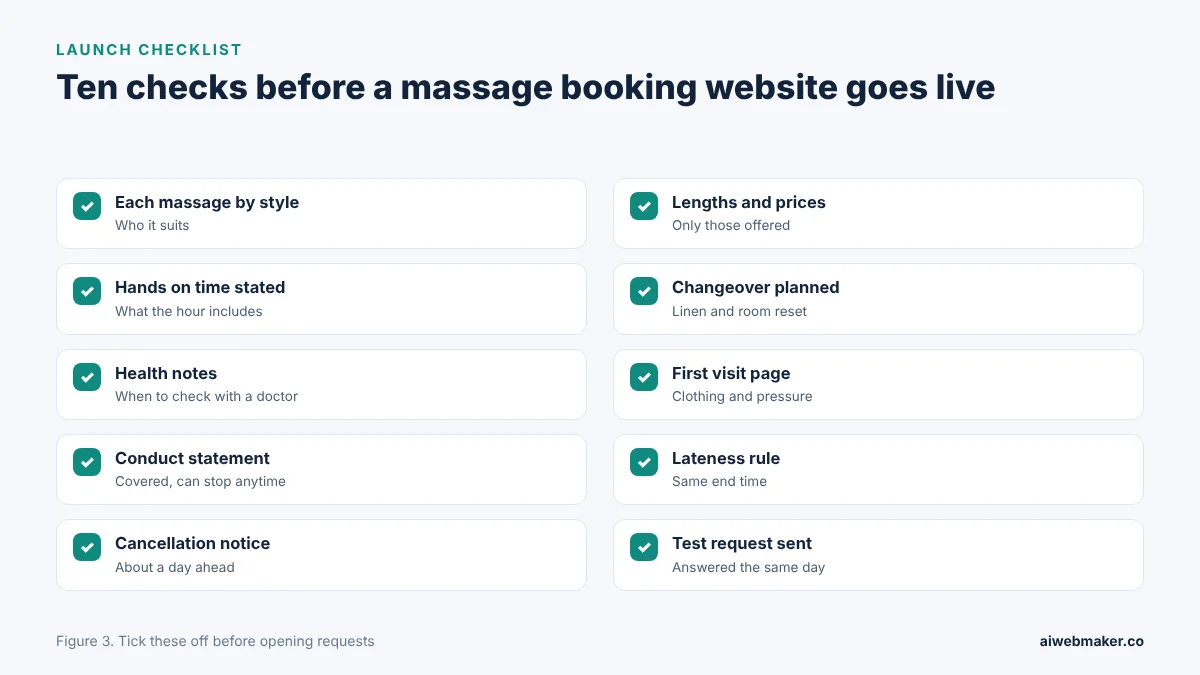
First time clients abandon a massage website when they cannot picture what will happen in the room. A list that says only "massage, one hour" leaves them guessing at the style, the pressure and whether the hour includes undressing. Silence about health questions worries anyone who is pregnant, injured or anxious about being touched. No mention of how they will be covered makes many people close the page. Hidden lateness and cancellation rules feel unfair when they appear only in the reply. Ten checks, shown in the next image, settle those doubts before the practice opens its requests.
Frequently asked questions
Does a sixty minute massage mean sixty minutes on the table?
That depends on the practice, which is why the treatment list should state its rule plainly. Some practices give the full sixty minutes of hands on work and hold extra time for the consultation and changeover. Others include dressing and a short chat inside the hour, leaving around fifty minutes of massage. Both are reasonable when clients are told in advance. Clarity here prevents the most common complaint in the treatment room.
Can a client request a couples massage online?
Listing a couples massage as a separate treatment means one request reserves the room and two therapists together. The practice should confirm both therapists are available before accepting, since one sick day affects the whole booking. Each person may want a different pressure or style, which the request can mention. Some practices also offer back to back sessions when the couples room is taken. Listing the option clearly avoids disappointment on an anniversary or birthday.
What should a therapist do when a request mentions a recent injury?
When a request mentions a recent injury, the therapist can reply before confirming, asking a few questions or suggesting the client checks with a doctor or physiotherapist first. Sports and remedial therapists often work with healing injuries, but only within their training and local rules. Swelling, severe pain or an injury that has not been assessed are common reasons to wait. A considered reply shows care and protects the client. The website can explain this so the question never feels like a rejection.
Is extra notice needed for a pregnancy massage?
A pregnancy massage is best requested with a little extra notice, so the practice can confirm a therapist trained in pregnancy work is available. Many therapists ask expectant mothers to mention any complications and, where advised, to speak with the professional looking after the pregnancy before the session. Positioning, cushions and session length are often adapted as the pregnancy progresses. The treatment description should say who performs it and how the session is arranged. Early, clear information helps the client feel comfortable from the moment she arrives.
Massages per month that keep the site paid for
Two or three standard sessions usually cover a full year of hosting, and a single session each month more than pays a monthly plan. A regular client returning every few weeks brings a dozen or more visits a year, with no booking fee on any of them. Honest lengths, careful health notes and calm policies keep those visits running smoothly. The therapist decides every request, which protects both the room and the client. Weighed against a week of sessions, a year online is a modest and quickly repaid cost.
Build your website in Minutes and get the AI Tools that work
Start Building Your Website →