First Consultations Booked Online, From Fit Calls to Paid Sessions
What a consultation booking website needs so a prospect can request a first meeting, know what it covers and move on to paid work. Twelve months of hosting are $119 and a single month is $19, the domain is bought on top, and there is no charge while the practice drafts and previews its pages.
- No coding required
- Live in minutes
- Blog, SEO and chatbot tools included
A consultation booking website lets a prospect request a first meeting with a professional online, instead of trading emails for a week to find a time. It serves coaches, consultants, financial and legal advisers, nutritionists, designers and counsellors, any practice where the first conversation decides whether paid work follows. The coaching website example shows that first step on a finished sample: an invented coaching practice, built with AI Web Maker, explaining its first sessions, formats and how it judges fit. A practice on AI Web Maker settles a $119 hosting invoice once a year, or a $19 invoice every month, and the domain is added to whichever rhythm suits it. Drafting the consultation pages and sending a test request in the preview costs nothing at all. The hard part is the first step itself, because prospects fear a sales pitch, a hidden fee or an hour that leads nowhere. The ground covered here runs from the first meeting and session lengths to request handling, regulated advice, cancellations, follow up, search and the arithmetic of a year online.
This article is part of our complete guide: Website Builder Comparison.
Who books a first consultation, and what holds prospects back?
Prospects who book a consultation usually arrive at a turning point, such as a career change, a tax deadline, a stalled company or a health goal. They research quietly at first, reading two or three websites and comparing approach, tone and fees. Many hesitate because they cannot tell whether the first meeting is a real conversation or a disguised sales call. Busy parents and managers often book in the evening, and clients abroad need the time zone spelled out. Referrals arrive warmer, yet they still check the website before committing. A page that answers these doubts plainly turns quiet research into a request.
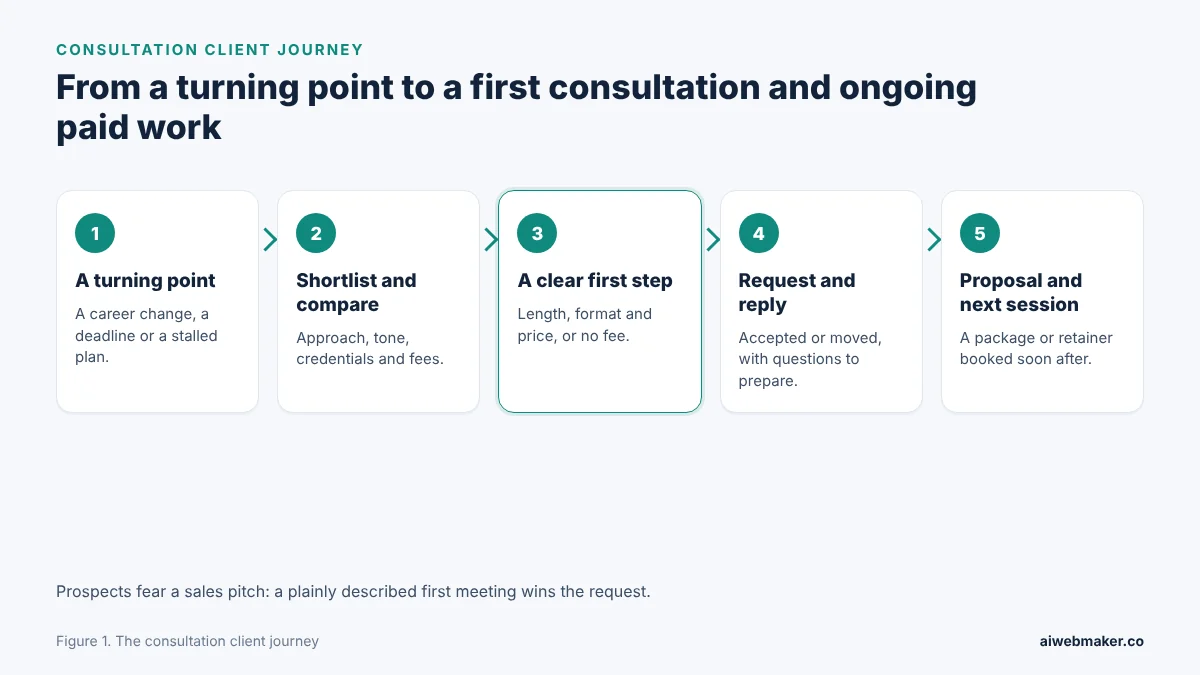
The third step is highlighted because a clearly described first meeting is what moves a prospect from reading to requesting. The first two steps happen out of sight, as the problem surfaces and the shortlist forms. A stated length, format and price, or a plain note that the call carries no fee, makes the commitment feel small. The fourth step depends on the professional, since a prompt reply with preparation questions shows that the meeting will be taken seriously. The last step, a proposal and a second booking, is where the practice actually earns its income. Each page of the site should push one of these steps forward.
Pages and settings a consultation practice needs
A consultation practice can run on a compact set of pages, provided every page settles a specific doubt. The first consultation deserves its own listing with a name, a length, a format and a price. Services and programmes show what comes after, each priced on its own line. Credentials and a page on how the work unfolds reassure cautious buyers. Preparation notes and terms keep the first meeting productive and fair.
| Page or setting | What it holds | The doubt it settles |
|---|---|---|
| First consultation | Name, length, format, price or no fee | What exactly is being agreed |
| Services and programmes | Each offer priced on its own line | What follows the first call |
| About and credentials | Background, qualifications, memberships | Whether the person is qualified |
| How it works | Stages from first call to finished work | How the work will unfold |
| Client outcomes | Stories shared with permission | Whether similar people were helped |
| Preparation and terms | What to bring, time zone, cancellation | How to get the most from the hour |
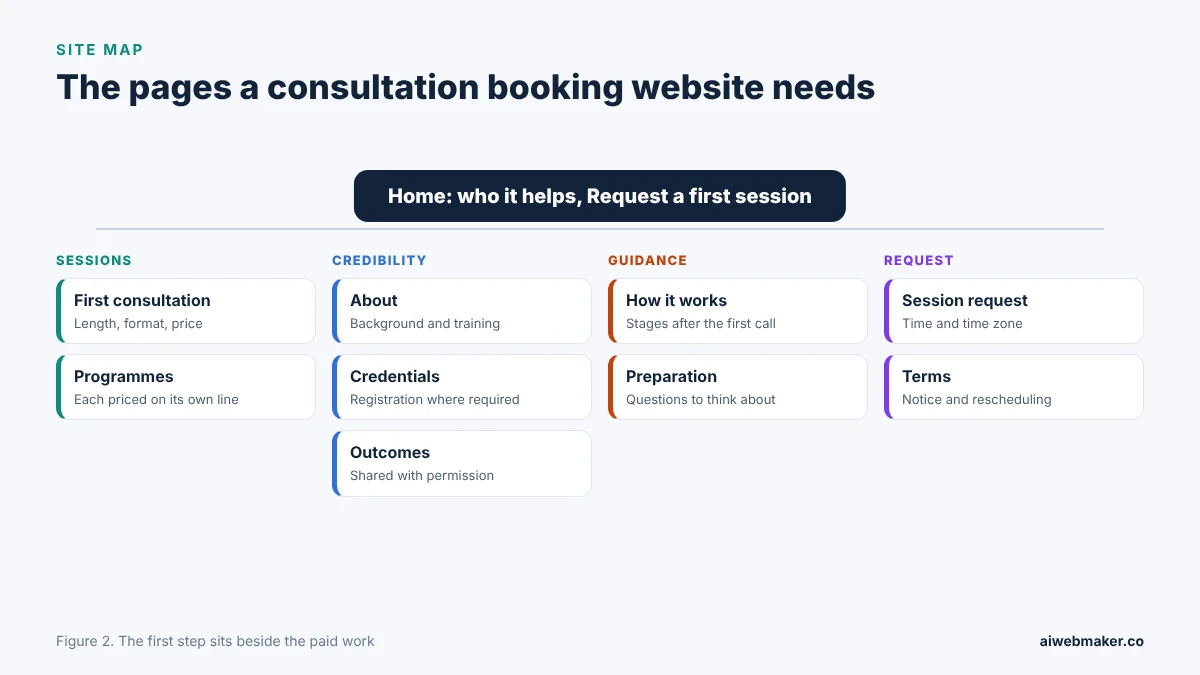
Sessions, credibility, guidance and the request each form a branch in this consultation layout, and the home page points every visitor to the opening session. The sessions branch keeps the first meeting beside the programmes that follow, so the path to paid work is visible from the start. Credibility pages carry the background, qualifications and client outcomes. Clearpath Coaching, one of our samples, lists an opening session next to its personal and online programmes, each priced on its own line, and surrounds them with the coach's background and the outcomes clients describe. The sample coaching site that lists an opening session beside its programmes shows how close the first step sits to everything after it. Keeping that distance short is what turns a single call into a client.
Paid, introductory or credited: designing the first meeting
The first meeting can be a short call with no fee, a paid session or a paid session credited against later work, and each model attracts different prospects. A short fit call suits coaching, design and consulting, where the main question is whether the two sides work well together. A paid first session suits advice that is useful at once, such as a financial review or a nutrition plan. Crediting the fee against a package rewards commitment without making the first step feel expensive. Firms buying consulting often expect a scoped diagnostic workshop instead of a quick chat. Whichever model is chosen, the page should state exactly what the prospect leaves with.
| First meeting model | How it works | Suits | Watch for |
|---|---|---|---|
| Short fit call | Fifteen to thirty minutes with no fee | Coaching, design, consulting | Calls that drift into unpaid advice |
| Paid first session | A full session with useful output | Financial reviews, nutrition plans | Prospects expecting a quick chat |
| Credited session | Paid, then deducted from a package | Programmes and retainers | Clear terms on when credit lapses |
| Diagnostic workshop | Half a day or more for a firm | Business consulting | Needs a written scope first |
Naming, length and format of each session
A session name should tell the prospect the outcome, the length and the format before they read a word of description. Career direction session, sixty minutes, video call says more than a branded title ever will. Fit calls usually run twenty to thirty minutes, while paid sessions often run sixty to ninety. Leaving a gap of fifteen minutes or so between bookings gives time for notes and prevents a late start for the next client. Many professionals also cap the number of consultations in a day, because the fifth call deserves the same attention as the first. Clear names and honest lengths make the whole diary easier to plan.
Answering a request and preparing for the call
Each request should be answered within one working day, because a prospect who waits longer often books someone else. On AI Web Maker the prospect sends a request for a session, and the professional accepts it, proposes a different time or declines with a polite note. Fees for paid sessions are collected by the practice in its own way, and no slice of them goes to the platform. Session listings, programme pages and the request page are all drafted by the booking website builder for first consultations and paid programmes once the professional outlines the practice in a few lines. A good reply then carries the video link or address, the time zone and two or three questions to think about. Prospects who arrive prepared get more from the hour and decide faster.
Regulated advice, confidentiality and knowing when to refer
Several consultation fields are regulated, and the rules change between countries and sometimes between regions, so each practice must check what applies where it works. Financial, legal and some health advice can usually be given only by registered or licensed people, and the page should show registration details where they exist. Claims about results deserve caution, because regulators in many places restrict promises in advertising. Coaching is not therapy, so a coach's page should say so and point anyone in crisis toward emergency services or a local helpline. Privacy laws also vary, which affects what notes may be kept and for how long. Honest boundaries reassure prospects more than any bold promise.
| Field | What is often regulated | What the page can show |
|---|---|---|
| Financial advice | Who may advise, how fees are disclosed | Registration where required, the fee basis |
| Legal advice | Who may advise, how fees are agreed | Admission details, engagement terms |
| Health and nutrition | Protected titles, treatment claims | Qualifications, no promise of cures |
| Counselling and therapy | Registration, confidentiality, supervision | Professional bodies, crisis signposting |
| Coaching | Rarely regulated as a title | Training, and what coaching is not |
Cancellations, lateness and time zones
A consultation diary loses value fast when people cancel late, so the terms belong on the booking page and in every reply. A notice period of one working day is common for paid sessions, with one reschedule allowed when notice is given. A video call that starts late should still end at the booked time, out of respect for the next client. Consumer rules on cancellation and refunds vary by country, especially for services bought at a distance, so the wording should be checked locally. Every time offered should name its time zone, because a client in another country may otherwise arrive an hour early or late. Clear terms protect the diary without souring the relationship.
From a first meeting to ongoing work
A consultation turns into income only when it ends with a clear proposal and an easy next booking. Packages listed on the site, such as a block of six sessions or a monthly retainer, make that proposal concrete. Sending a short written summary within a day, while the conversation is fresh, often matters more than any sales technique. Booking the next session before the call ends keeps momentum for clients who are ready. Demand often rises in January, at year end and around tax deadlines, so programmes can be refreshed before those peaks. A practice that follows up promptly and politely converts far more first meetings.
What prospects type before they book a consultation
Searches that end in a consultation usually name the problem, the type of professional and sometimes a format or a town. Typical phrases include career coach online, financial adviser first meeting, nutritionist consultation near the office and business consultant for a family company. Session names and headings built on that vocabulary let the matching page surface. Practices with a consulting room gain from a map listing pointing to the consultation page. Some professions face rules on testimonials in advertising, so reviews should be gathered within those rules. Articles that answer a prospect's real questions, such as what happens in a first session, bring readers who already trust the voice.
Dollars and cents of a consultation practice online
Only two lines make up the practice's bill, hosting and a domain, while twelve client question articles bought with credits come to about $7.80. A settled practice spends least when it pays for the whole year at once. A professional just setting up may prefer monthly payments while the first clients arrive. Editing session lengths, prices or programmes is covered by the hosting itself. Both routes appear below, and the $189 tier is included only to compare.
| Item | Yearly | Monthly |
|---|---|---|
| Hosting the consultation pages | $119 | $228 over twelve months |
| Domain | Depends on the ending | Depends on the ending |
| Higher plan, for comparison | $189 a year | Not needed |
| Twelve client question articles at about $0.65 | About $7.80 | About $7.80 |
| Session, price and programme changes | No charge | No charge |
| Year before the domain | About $126.80 | About $235.80 |
What stops a prospect from requesting the first call?
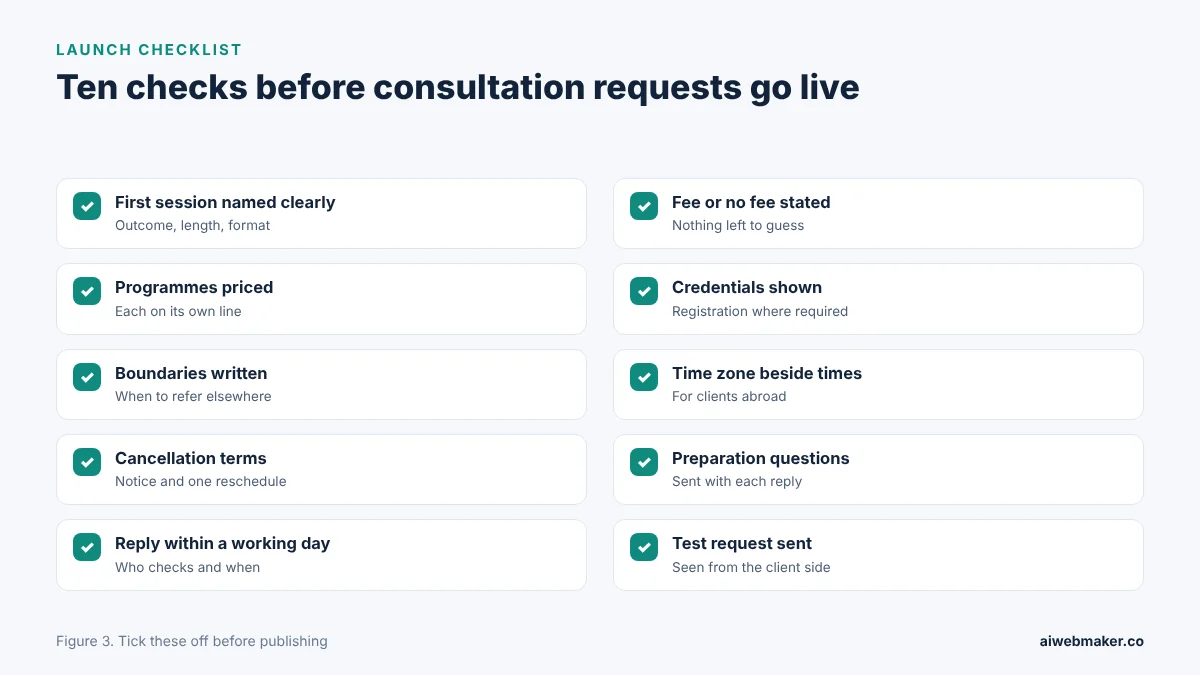
A prospect stops short of requesting a consultation when the first step looks vague, expensive or like a trap. A session with no length or format leaves people guessing how much time they are giving away. Missing credentials in a regulated field raise immediate doubt. A page with no fee information makes cautious buyers assume the worst. Times shown without a time zone confuse anyone abroad. Ten checks that remove these doubts before launch are gathered in the next image.
Frequently asked questions
Should a first consultation happen by video, phone or in person?
The best format depends on the work, the client's location and how much needs to be seen or shared. Video suits coaching, consulting and most advice, because it widens the market beyond the local area. Phone calls suit busy prospects and those uneasy with cameras. In person meetings suit design, property and some health work, where seeing the space or the person matters. The session listing should state the format so nobody arrives expecting a different one.
How much should a professional prepare before a first call?
A professional should prepare enough to avoid spending half the meeting on basic facts. Two or three questions sent with the confirming reply, such as what prompted the request and what a good outcome looks like, usually suffice. Reading any public information about a company client adds useful context. Preparation also reveals poor fits early, which saves both sides an awkward hour. A prepared first call often feels like a working session rather than an interview.
What if the prospect is not a good fit?
A poor fit should be told kindly and quickly, ideally with a suggestion of who might help instead. Declining a request with a short, courteous note is better than taking work the professional cannot do well. Some prospects need a specialist, a regulated adviser or a medical professional rather than a coach. Referring them on builds a reputation for honesty that brings future referrals back. A good decline protects the practice as much as the prospect.
Can testimonials appear on a consultation page?
Testimonials can appear in many fields, but some regulated professions face limits on them, and those rules vary by country. Where they are allowed, they should come from real clients who have given permission to be quoted. Describing the situation and the change, rather than promising a result, keeps them honest. Confidential work may call for anonymous summaries instead of names. Careful testimonials reassure prospects without breaking any professional rule.
One retained client against a year of hosting
A single client who books a short programme usually pays far more than the $119 hosting bill for the practice's whole year. On the monthly route, one paid hour can cover the $19 several times over. Every first meeting requested while the professional was busy or asleep is an opportunity the website captured. The habits that turn requests into clients are simple: a clear first step, honest lengths, prompt replies and a proposal soon after. Referrals then compound the effect, because satisfied clients send others to the same booking page. A diary with new first meetings every week shows the consultation pages are doing their job.
Build your website in Minutes and get the AI Tools that work
Start Building Your Website →