Counting the Booking Website Cost: Fees, Time and Empty Slots
This guide counts every cost behind a booking website, from the yearly fee to the owner's time, empty slots and policies, across many kinds of business. On AI Web Maker the bill is $119 per hosted year, or $19 for every month paid singly, plus the price of a domain ending.
- No coding required
- Live in minutes
- Blog, SEO and chatbot tools included
A booking website lets customers ask a business for a time without phoning, and it suits anyone who sells hours, sessions, tables or hire dates. One finished case to weigh these costs against is the hair salon website example, a sample that AI Web Maker put up for a made up salon offering colour, cuts and braids. On AI Web Maker the hosting bill is $119 when settled yearly, or $19 for each month on monthly billing, while the domain's price follows the ending it uses. Drafting the pages and trying the request flow in the preview are never billed, so money changes hands only when the site goes public. The fee is the easy part of the sum, because the larger cost of any booking setup is the owner's time spent answering requests, chasing no shows and filling gaps. A cheap site that brings muddled requests can cost more in lost hours than a dearer one that brings clear ones. What follows covers who books online, the pages and settings a booking site needs, the policies that protect the diary, the real yearly budget and the point where the site pays for itself.
This article is part of our complete guide: Website Builder Comparison.
Which businesses sell their time online, and how do their customers decide?
Any business whose income depends on a filled diary can take requests online, from a hairdresser or a physiotherapist to a tutor, a dog groomer or a party hire firm. Most look for a time late in the evening or during a break, usually on a phone, and they compare two or three businesses before choosing one. New customers read service descriptions, prices and policies with care, while regulars skip straight to the request page and ask for their usual slot. Urgent needs, such as a broken tooth or a last minute party, push people towards whoever answers fastest. A booking website therefore has two audiences to serve, the cautious newcomer and the impatient regular.
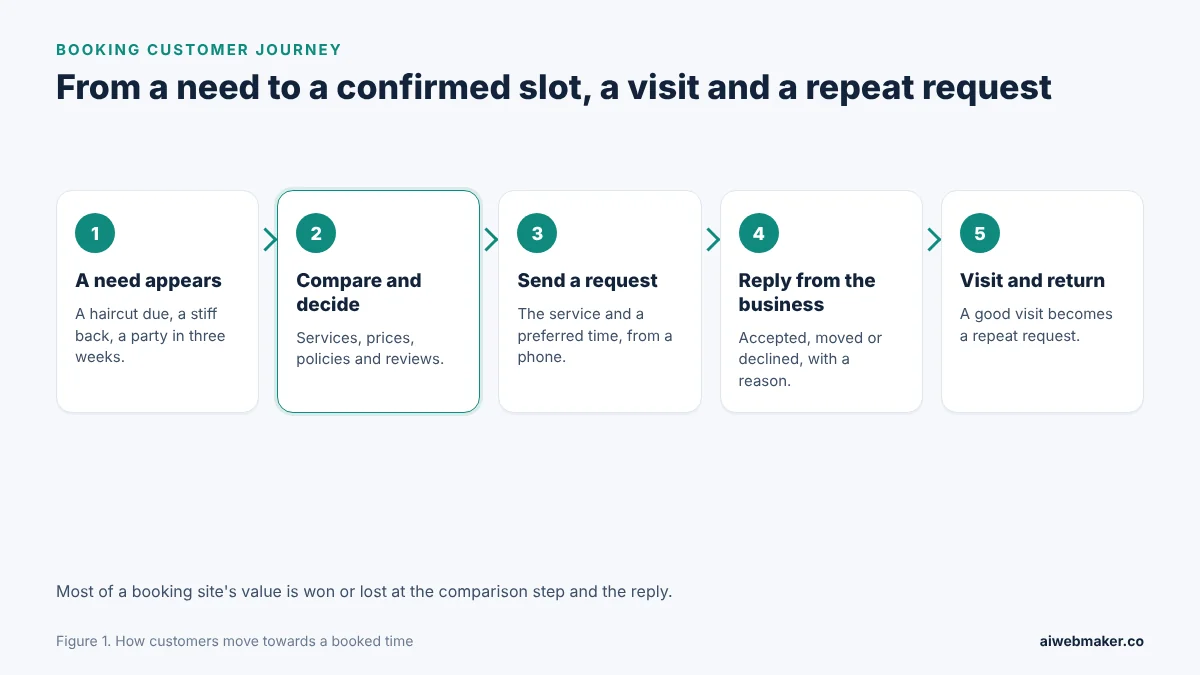
Five moments make up the journey pictured here, and the costs of a booking website gather around the middle one. A need appears first, such as overgrown hair, a stiff back or a birthday in three weeks. The customer then compares services, prices and policies, and this comparison is where most people decide whether to send a request or move on. The request itself has to be quick, while the reply from the business decides whether the customer feels looked after or forgotten. After the visit, a good experience turns into a repeat request, which costs the business nothing to win.
What must a booking site contain before it can take requests?
Before it opens, a booking site needs a few pages and settings that answer the customer's questions before they ask them by phone. Each line in the table below carries a cost in the owner's time rather than in money, since the builder drafts the pages and the owner checks and corrects them. Services and prices take the most care, because every later request depends on them. Policies come next, as they prevent the disputes that eat into an owner's week. Setting these out properly once is cheaper than explaining them on the phone a hundred times.
| Page or setting | What it settles for the customer | Effort for the owner |
|---|---|---|
| Services with prices | What is on offer and what it costs | Moderate: check every name and figure |
| Request page | How to ask for a time | Light: test it as a customer |
| Policies page | Notice, lateness, no shows, refunds | Moderate: decide the rules first |
| First visit notes | What to bring, how early to arrive | Light: a short page |
| About and team | Who will do the work | Light: photos and short profiles |
| Location and hours | Where to go and when | Light: keep holidays current |
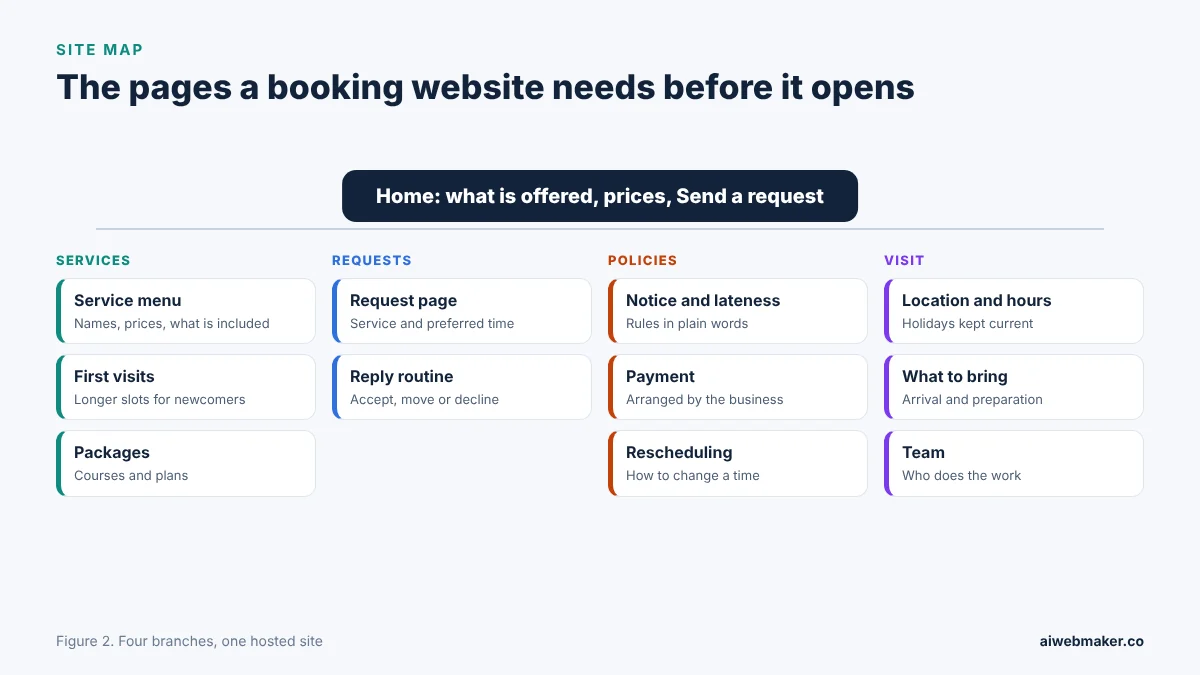
This map splits the site into four branches below the home page, and each one answers a different worry a customer has before asking for a time. The services branch holds the menu of bookable work with prices and short descriptions. The request branch holds the page where the visitor sends a request, which the business then accepts, moves or declines. The policies branch covers notice periods, lateness and payment arrangements, while the visit branch gathers directions, hours and first visit notes. Velvet Touch Beauty Salon, one of the sample businesses, lists four bookable treatments, and the beauty salon sample where four treatments take requests lets anyone try the flow from the client's side. Every branch is part of the same hosted site, so none of them adds a line to the bill.
Which hidden costs sit outside the hosting bill?
The costs that hurt a booking business rarely appear on an invoice, because they show up as unanswered messages, empty chairs and wasted mornings. A phone that rings during a treatment either interrupts the work or goes to voicemail, and some callers never try again. A request that lacks key details starts a chain of messages before anything is settled. A no show leaves an hour that cannot be sold twice, and a double booking can cost a customer for good. Marketplace listings often take a share of each booking or charge for visibility, which grows as the business grows. Counting these hidden costs honestly is what makes a website's yearly fee look small.
| Hidden cost | Where it comes from | What reduces it |
|---|---|---|
| Interrupted work | Calls taken during appointments | A request page open at all hours |
| Message chains | Requests missing key details | Clear service names and descriptions |
| Empty slots | No shows and late cancellations | A visible notice policy |
| Lost customers | Slow or missing replies | A daily routine for answering requests |
| Commission on repeat customers | Bookings routed through marketplaces | Regulars booking through the business's own site |
| Wrong length bookings | Vague services | Separate listings for each type of visit |
How does request handling shape the true cost of booking?
Request handling decides how much of the owner's time a booking website consumes, and the habit matters more than the software. On AI Web Maker the visitor sends a request, and the business then accepts it, declines it or shifts it to a different hour. Because nothing is fixed until the owner replies, clashes with holidays, staff absence or equipment repairs are caught before they reach the customer. Payment is arranged by the business directly, whether at the visit or through instructions sent with the reply, and the platform keeps nothing from what each customer spends. The AI booking website builder where every visitor request waits for an answer turns a brief outline of the trade into a first draft of every page. A routine of checking requests at fixed times each day keeps replies quick without letting them take over the day.
A clear response window is the second part of the habit, since customers wait more patiently when they know how long a reply takes. A line on the request page saying that requests are answered within the working day sets a fair expectation. Moving a request should come with a reason and a concrete alternative, because a vague refusal sends people elsewhere. Owners who reply in batches, for example at opening time and after lunch, often find the work takes minutes rather than hours. Good request handling turns the booking page from a chore into a quiet assistant.
What do no shows, lateness and cancellations cost a diary?
Each missed appointment costs the full value of the slot, because time that has passed cannot be sold again. Late arrivals cost more than they seem, since a short session squeezed by lateness can push the whole day behind. Cancellations with enough notice are harmless if the slot can be offered to someone else, which is why notice periods matter. A written policy on the website, repeated in the business's own reply, makes these rules feel fair rather than sudden. Rules on cancellation charges and deposits vary by country and sometimes by region, so a business should check what consumer law allows where it trades. A calm, visible policy usually prevents more lost hours than any penalty recovers.
| Policy | Common choice | What it protects |
|---|---|---|
| Notice to cancel | A set number of hours or days | Time to offer the slot again |
| Late arrival | Shortened session or a new time | The next customer's start |
| No show | A note on the record, then a deposit next time | Repeated lost slots |
| Deposit | Arranged directly by the business | Long or costly appointments |
| Rescheduling | Allowed once within the notice period | Goodwill with genuine clashes |
How should services and lengths be priced so the diary pays?
Services should be named, timed and priced so that each booked hour earns what the business needs, including setup and clearing time. A forty minute treatment that needs ten minutes of preparation really occupies fifty minutes, and its price should reflect that. Each bookable service can show its own price, so a short trim and a long colour session can sit side by side at different figures. Starting prices suit work where the final figure depends on what is found, as long as the description explains what moves the price. Gaps between appointments are part of the cost too, because a diary with scattered thirty minute holes cannot fit a long service. Thinking in occupied minutes rather than headline prices keeps the diary profitable.
| Pricing choice | Effect on the diary | Where it suits |
|---|---|---|
| One fixed price per service | Simple to choose, simple to plan | Haircuts, standard lessons, set hires |
| A starting price with a note | Honest when work varies | Repairs, colour work, assessments |
| A longer first visit at its own price | Covers forms and questions | Clinics, tutors, trainers |
| Packages of several sessions | Commits customers to return | Courses, treatment plans, coaching |
| Peak and quiet time prices | Moves demand to slow hours | Studios, hire firms, venues |
How do seasons and regular customers change the yearly sums?
Demand for almost every bookable service rises and falls with the calendar, and the website's job changes with it. Hairdressers and beauty salons fill before holidays and weddings, tutors before exams, and hire firms in the warmer months or the party season. In busy weeks the site saves the owner from the phone, while in quiet weeks it gives a place to announce offers, short courses or new services. Regular customers are the steadiest part of the diary, and a site that lets them request their usual time in seconds keeps them loyal. Planning the year around these rhythms spreads the site's value across every month.
Which search phrases lead customers to a bookable service?
People looking for a bookable service usually type the service, a place and an intention, such as massage near me, book a driving lesson or tutor available weekends. A service page whose heading carries those natural words has a fair chance of meeting that search. Map listings matter for any business customers visit, so the listing deserves accurate opening times, genuine photographs and the address of the request page. Articles answering the questions customers ask before a first visit, such as what to wear or how long a session lasts, bring steady visitors over months. Search rewards businesses that explain their services as clearly as they deliver them.
What does a booking website cost across a full year?
The yearly sum for a booking website is hosting plus a domain, with optional articles adding only a few dollars. Settling twelve months in one payment costs less than the monthly route. Monthly billing suits a business still testing demand or opening in a new area. Changing services, prices or policies adds nothing to the bill at any point. The $189 tier is listed only so the two plans can sit side by side.
| Item | Yearly | Monthly |
|---|---|---|
| Hosting the booking pages | $119 | $228 over twelve months |
| Domain | Depends on the ending | Depends on the ending |
| Higher plan, for comparison | $189 a year | Not needed |
| Twelve customer guide articles at about $0.65 | About $7.80 | About $7.80 |
| Service, price and policy updates | No charge | No charge |
| Year before the domain | About $126.80 | About $235.80 |
Why do visitors abandon a booking site before sending a request?
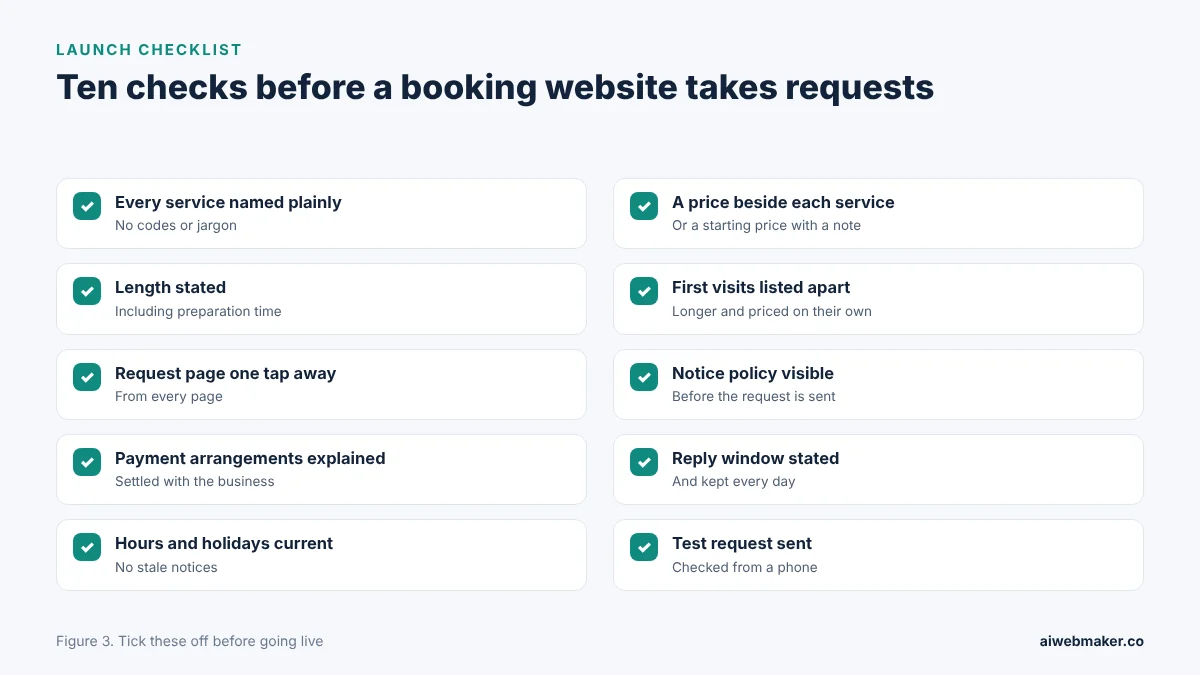
Visitors abandon a booking site when they cannot tell what a service includes, what it costs or how long it lasts. A request page buried three clicks deep loses impatient regulars who only wanted their usual slot. Missing policies make careful newcomers wonder what happens if they need to cancel. Old opening hours or a past holiday notice suggest nobody is minding the diary. Slow replies teach people that the website is a dead end, so they phone a rival instead. Ten quick checks, shown in the next figure, close these gaps before launch.
Frequently asked questions
Does the bill rise as more customers send requests?
The hosting bill stays the same whether a site receives a handful of requests or several every hour, because requests are not charged one by one. Busier months therefore cost exactly what quiet months cost. The platform takes no cut of any booking, since payment is arranged between the business and the customer. Growth shows up as more replies to send rather than a larger invoice. That fixed cost is one of the clearest differences from services that charge per booking.
Is a booking page worth it for a business with only a few slots each week?
A booking page is worth it even with few slots, because each slot then carries more value and a missed one hurts more. A specialist tutor or a craft workshop with a handful of places can still lose customers to an unanswered phone. The request page lets those customers ask at any hour without the owner needing to pick up. Clear descriptions also stop the wrong people from requesting time that suits someone else. Small diaries often gain the most from careful booking.
Does every bookable service need a visible price?
Showing a price for every standard service usually helps, because customers compare costs before they ever send a request. Where work varies, a starting price with a note on what moves the figure is more honest than a blank. Hidden prices make many visitors assume the worst and leave. A bespoke job can still show a typical range with a short explanation. Clear figures save the owner from answering the same price question all week.
When is a booking page the wrong choice?
A booking page is the wrong choice when every job needs a site visit or a quote before anyone can name a time. Roofers, builders and architects rarely know how long a job takes until they have seen it. Forcing those customers into a slot frustrates them and wastes the owner's diary. Some businesses mix the two, booking a consultation first and quoting the larger work afterwards. Matching the booking method to the work keeps the website useful.
How few bookings repay a year of hosting?
A single booking from a new customer often covers the full year, since $119 is less than the value of one appointment in many trades. On monthly billing, the $19 is usually earned back within the first request each month. Regulars who return several times a year multiply that figure without any extra effort from the owner. The larger saving lies in the calls, gaps and message chains that a clear booking site removes. Owners who keep their services, prices and policies accurate find that the website quietly fills the diary while they work. A steady flow of clear requests is the best measure that the money was well spent.
Build your website in Minutes and get the AI Tools that work
Start Building Your Website →