Tile Shop Website Cost, Box Counts, Batch Codes and the Grout Choice
Tile shops keep their product boards, box count notes and sundries online for $119 yearly, or $19 per separate month, plus a web address of their choosing. What follows turns to who buys, box pricing, counts by layout, batches, grout and sundries, slip ratings and fitters, search and annual spending.
- No coding required
- Live in minutes
- Blog, SEO and chatbot tools included
Tile shops keep their product boards, box count notes and sundries online with AI Web Maker for $119 over twelve months, or $19 for a single month, plus a domain. Every box card, grout swatch and trim can be drafted and checked through the preview before any bill is raised. Seven boxes of the sample's metro tiles for a 3 square metre splashback cost $133, which already passes the yearly hosting. The awkward truth of tile retail is that tiles are priced by the box, laid by the square metre and judged by batch, shade and grout. Many buyers therefore order too few boxes, forget the adhesive or discover that a second delivery does not match the first. This guide takes in who buys, box pricing, counts by layout, batches, grout and sundries, slip ratings, fitters, search and the yearly budget.
This article is part of our complete guide: Retail Website Design.
Splashbacks, shower walls and tilers at the trade counter: who buys from a tile shop
Tile shops serve two very different buyers, homeowners planning one room and tradespeople who buy every week. Homeowners refreshing a kitchen splashback or a shower wall want to see colours, sizes and prices before they visit. Couples planning a new floor compare porcelain, terracotta and wood look planks, often with a fitter already booked. Tilers and builders want stock levels, trade prices and early collection from a loading bay. Confident home improvers buy online once they know the box count and the sundries the job needs.
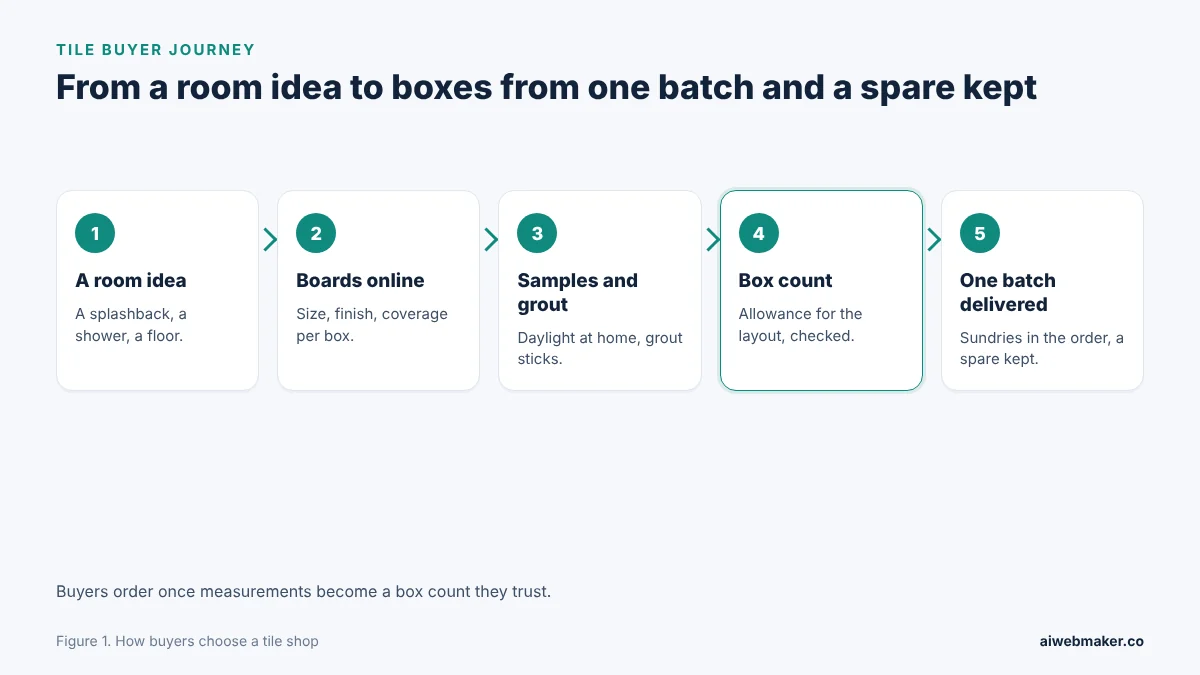
The fourth step is emphasised because a box count worked out from the buyer's measurements is what turns a liked tile into an order of the right size. A room idea starts the search, and boards on the website show colours, sizes and coverage per box. Samples seen at home in daylight narrow the choice to one tile and one grout. Measurements then become a box count with the allowance for the layout, checked by the counter. Boxes from a single batch arrive with the sundries, and a spare box kept for repairs saves trouble years later.
Boards, box counts, grout and sundries: what a tile shop site carries
A tile shop site has to turn boxes into square metres, explain why batches matter and sell the sundries that hold a tiled surface together. The home page should name the showroom, the sample offer and the box count service. A tile shop page lists each tile with its size, finish, coverage per box and options. Pages for box counts, grout and sundries answer the questions that stop orders, while a samples page explains cut pieces and loans. Fitters, trade accounts, delivery and returns complete the site.
| Page | Buyer's question | What it should hold |
|---|---|---|
| Home | Does this shop stock the look in mind? | Showroom boards, samples, box counts |
| Tiles | What does each box cover? | Size, finish, coverage, price per box |
| Box counts | How many boxes are needed? | Allowance by layout, a spare box |
| Grout | Which colour suits the tile? | Swatches, matching or contrasting |
| Sundries | What else goes in the order? | Adhesive, clips, trims, sealers |
| Samples | Can the tile be seen at home? | Cut samples, full tile loans |
| Fitters and trade | Who lays it, and can tilers buy on account? | Fitter names, trade accounts |
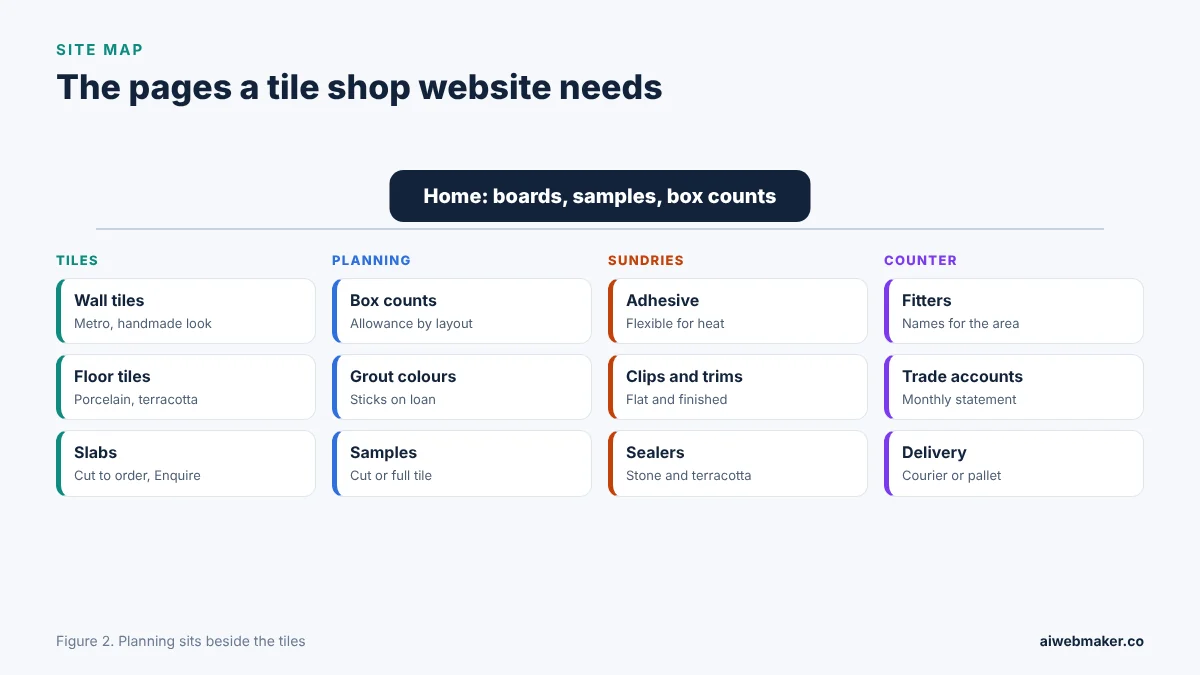
Tiles lead the map, and planning pages sit right beside them because a box count and a grout colour usually come before checkout. The sundries branch keeps adhesive, clips, trims and sealers within reach of every tile page. Grout and Glaze Tile Shop, the invented store in our tile shop website example with box counts and batch codes, sells a bevelled metro wall tile, a handmade look square tile, concrete look porcelain, a terracotta hexagon, a wood look porcelain plank and a large format slab cut to order. Its sundries include flexible adhesive, levelling clips, trims and edges and sealers. A measurement form at the end sends a box count back from the counter.
Priced by the box, judged by the square metre
Tiles are sold in boxes while buyers think in square metres, so each card should show coverage per box and the matching square metre price. A metro tile at $19 for a box covering half a square metre looks cheaper than a porcelain tile at $52 a box, yet the porcelain box covers almost three times the area. Showing both figures stops buyers comparing the wrong numbers. Stock and prices shift with each delivery, which is why the card should mention that the counter confirms both before packing. Clear coverage figures make the box count that follows far more accurate.
| Tile | Size and finish | Box covers | Price per box | Works out per m² |
|---|---|---|---|---|
| Bevelled metro wall tile | 7.5 x 15 cm gloss ceramic | 0.5 m² | $19 | $38 |
| Handmade look square tile | 13 x 13 cm, uneven glaze | 0.5 m² | $34 | $68 |
| Concrete look porcelain | 60 x 60 cm matt | 1.44 m² | $52 | About $36 |
| Terracotta hexagon | 20 cm across, unglazed | 0.5 m² | $41 | $82 |
| Wood look porcelain plank | 20 x 120 cm matt | 1.2 m² | $58 | About $48 |
Box counts with an allowance for each layout
A box count page prevents the two most expensive tile mistakes, running short and buying a stack of boxes that never get opened. The method is simple: measure each area, multiply length by width, add the allowance for cuts and round up to whole boxes. Straight layouts on most floors need about 10%, diagonal layouts about 15% and herringbone about 20%, figures the sample prints beside its worked examples. One spare box should then be kept for repairs, because the same batch may never be made again. Buyers working in square feet can multiply by 0.093 to reach square metres, a small note that saves many conversions at the counter.
| Job | Measured | Allowance | Order | Boxes |
|---|---|---|---|---|
| Kitchen splashback, metro tiles | 3 m² | 10% | 3.3 m² | 7 of 0.5 m² |
| Shower walls, square tiles | 9 m² | 10% | 9.9 m² | 20 of 0.5 m² |
| Hall floor, terracotta hexagons | 5 m² | 15% | 5.75 m² | 12 of 0.5 m² |
| Kitchen floor, 60 x 60 porcelain | 14 m² | 10% | 15.4 m² | 11 of 1.44 m² |
| Living room, planks in herringbone | 18 m² | 20% | 21.6 m² | 18 of 1.2 m² |
Batch codes, shade codes and the spare box
Tiles from different production runs can differ slightly in colour or size, so a tile shop's website should explain batches before a buyer learns about them the hard way. The sample promises that every box in one order comes from a single batch. Batch and shade codes are printed on each box, and buyers should keep a note of them in case they need more. If that batch is still in the warehouse the shop can hold it, but a new batch may not match exactly. Handmade look tiles vary from piece to piece by design, which is why the sample sends three from the same box as a sample.
Grout sticks, adhesive and trims: the rest of the trolley
A tiled surface fails at its adhesive, edges and grout long before the tile itself, so sundries deserve their own section and a place in every order. The online store builder for tile shops that sell by the box with sundries gives each tile its colour, glaze, shade, clay or tone options, a bag where adhesive, levelling clips, trims and sealers can join the boxes, and a checkout that puts the delivery fee on the order before anyone pays. Discount codes can reward trade customers or clear the last boxes of a discontinued glaze. A large format slab cut to order shows an Enquire button, since its price depends on the job. Grout colours matter as much as the tile, and the sample lends a set of grout sticks with its samples so buyers can hold a colour between two tiles. A buyer who leaves with the right adhesive and trims is far less likely to blame the tile later.
| Sundry | Sample price | What the page should explain |
|---|---|---|
| Flexible adhesive | From $24 a 20 kg bag | About 4 m² of floor at a 10 mm bed |
| Levelling clips | From $14 a bag of 100 | Keeps large porcelain flat, wedges reused |
| Trims and edges | From $7 a 2.5 m length | Depth matched to the tile |
| Sealers | From $22 a litre | Terracotta and stone, before and after grouting |
| Cutting service | From $6 a cut | Holes and long cuts on a wet saw |
| Pallet delivery | From $45 a pallet | To the kerb, someone in to sign |
Slip ratings, heated floors and the fitters the counter names
Floor tiles carry slip and wear ratings, and the systems used to test and label them differ between countries, for example between parts of Europe and the United States. The website should explain that many glossy wall tiles are too slippery and too soft for floors, and that the box shows the rating that applies locally. Porcelain and ceramic suit most heated floors when laid on a flexible adhesive, but the floor build up should be checked with the fitter and the heating supplier first. The sample does not fit tiles itself and passes on names of independent tilers, who quote, plan and guarantee their own work. Trade accounts with trade prices and a monthly statement keep those tilers coming back to the counter.
Metro tiles, porcelain floor tiles near me and other searches at the planning stage
Buyers search with phrases such as tile shop near me, metro tiles, porcelain floor tiles, terracotta floor tiles or how many tiles for a bathroom, often with a town. A tile card named after the tile's look and size catches those searches in the buyer's own words. Showroom boards, the loading bays and the early weekday opening that tilers rely on belong on the map listing. Customer reviews mentioning exact box counts, held batches and samples posted carefully set a shop apart from online sellers. Articles on choosing grout, tiling over a heated floor or planning a herringbone layout reach buyers well before they order.
Display boards, pallets and the price of staying online
Display boards, racking, a wet saw and pallets of stock outweigh the website many times over in a tile shop's year. Paying the $119 once a year works out cheapest, while a shop still in its opening season may choose twelve separate $19 months. Its domain costs whatever the chosen ending costs, from roughly 400. Twelve tiling articles add about $7.80 of credits, while new boards, price changes or a fresh batch of slabs cost nothing to publish. A $189 row is shown to compare, nothing more.
| Item | Yearly | Monthly |
|---|---|---|
| Hosting the tile shop pages | $119 | $228 over twelve months |
| Domain | Depends on the ending | Depends on the ending |
| Higher plan, for comparison | $189 a year | Not needed |
| Twelve tiling articles at about $0.65 | About $7.80 | About $7.80 |
| Board, price and stock updates | No charge | No charge |
| Year before the domain | About $126.80 | About $235.80 |
Boxes without coverage, no batch note and no sundries: why tile buyers walk out
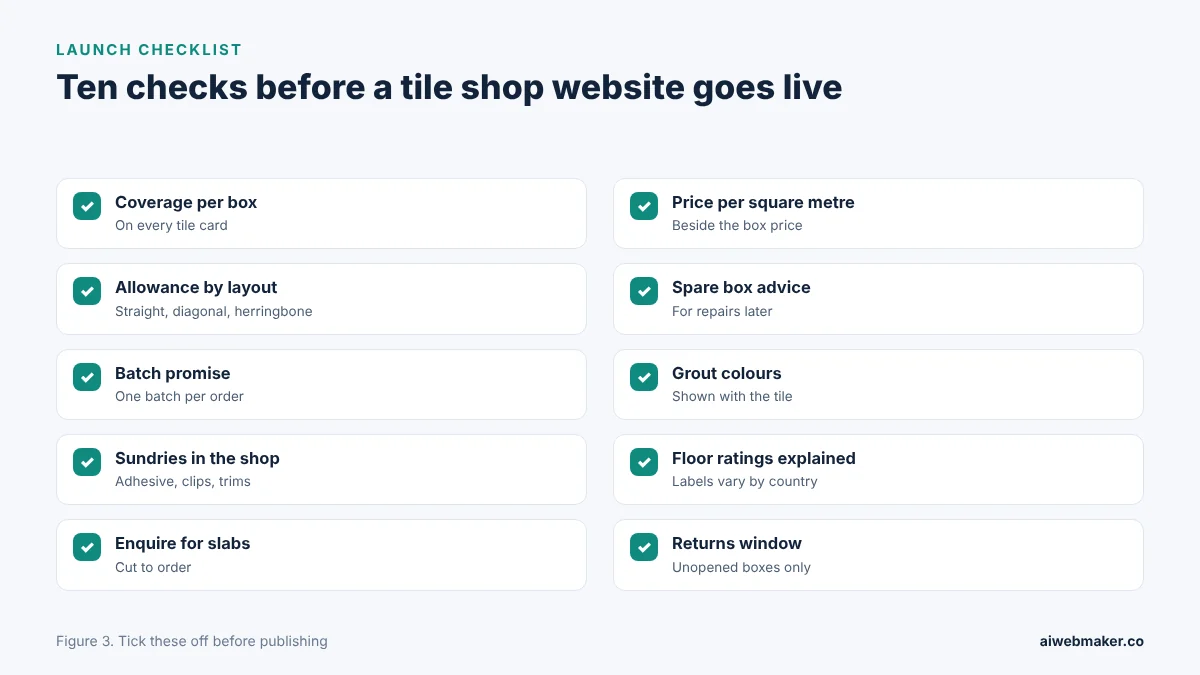
Tile buyers leave a shop's site that prices boxes without saying how much wall or floor each one covers. No guidance on allowances leaves them afraid of running short in the middle of a job. Silence about batches makes careful buyers wonder whether a second order will match. A shop that lists tiles but no adhesive, trims or grout sends them elsewhere for half the order. The ten checks pictured below turn each of those gaps into a line on the page.
Frequently asked questions
What if a tiling job runs short halfway through?
The buyer should quote the batch and shade codes printed on the boxes already used. If that batch is still in stock, the shop can hold the boxes needed. If it has sold out, a new batch may differ slightly in colour or size, which is why a spare box is recommended from the start. The website should explain this before the first order is placed. A little planning prevents a patch that never quite matches.
Can a glossy wall tile go on a floor?
Many glossy wall tiles are too slippery and too soft for floors, while most porcelain tiles work on floors and walls alike. Floor tiles carry slip and wear ratings on the box, and the labels used differ between countries. The website can mark which tiles suit floors and invite buyers to ask the counter when unsure. Wet areas and entrances need particular care. Choosing the right tile for each surface keeps a floor safe as well as attractive.
Which adhesive suits a heated floor?
A flexible adhesive is the usual choice for heated floors and timber backgrounds, because it copes with small movements. The sample sells it in 20 kg bags that cover roughly 4 m² of floor at a 10 mm bed. The floor build up should still be checked with the fitter and the heating supplier. The website can link each floor tile to the adhesive that suits it. Clear advice here prevents cracked grout and loose tiles later.
Will the shop take back boxes that were never opened?
Most tile shops take back unopened boxes for a limited time, provided the receipt comes with them, and the sample allows 30 days. Cut samples, opened boxes and slabs cut to order are normally excluded. Both the window and the exceptions deserve a line beside the shop. Knowing the rule encourages buyers to keep a spare box without worry. Clear returns terms make ordering the right quantity easier.
Twenty boxes for a shower and the hosting they cover
Twenty boxes of the sample's handmade look square tile for a shower, at $34 each, come to $680, enough for more than five years of $119 hosting. Paying monthly, a single bag of flexible adhesive at $24 covers a $19 month with change left. A tiler with a trade account who collects every week adds many years of hosting in a single season. Coverage per box, counts that allow for the layout and a word on batches win over buyers who fear running short. When orders reach the counter with adhesive, trims and a spare box already chosen, the pages have taught buyers what tilers know.
Build your website in Minutes and get the AI Tools that work
Start Building Your Website →