Pawn Shop Website Cost and the Plain Ticket Terms Borrowers Need
A pawn shop's hosting is $119 a year, or $19 a month, plus a domain. Inside: who comes to a pawnbroker online, the pages it needs, ticket terms in dollars, unpaid loans, licences and ID checks, pre owned stock, valuations, search and costs.
- No coding required
- Live in minutes
- Blog, SEO and chatbot tools included
A pawnbroker can host its loan steps, worked ticket and cases of watches with AI Web Maker, where twelve months cost $119 and a single month $19, plus a domain. Writing the loan pages, charges table and shop, then reviewing every ticket line in the preview, is a stage AI Web Maker leaves off the pawnbroker's bill. A single sale of a serviced watch or a tested camera from the cases covers the year's hosting. The real difficulty is trust, because most people walk into a pawn shop worried about the small print, and many expect to be pressured or misled. Pawnbroking is also regulated, and the rules on charges, holding periods and surplus money differ between countries and often between states. What follows covers who comes to a pawnbroker online, the pages a pawn shop needs, ticket terms in dollars, unpaid loans, licences and ID checks, pre owned stock, valuations, search and the yearly budget.
This article is part of our complete guide: Retail Website Design.
Borrowers, sellers and bargain hunters: who visits a pawnbroker's site
Visitors to a pawnbroker's website usually fall into three groups, and each needs different reassurance. Borrowers want short term money against something they own, and they look for the charge, the term and what happens if they cannot repay. Sellers ask whether the counter buys outright and how it reaches a figure. Buyers want tested pre owned goods at fair prices, with a receipt and some form of guarantee. A smaller group checks whether the shop is licensed and whether it refuses stolen goods, which matters to everyone else too. A pawnbroker's site that answers each group calmly turns a nervous visit into an informed one.
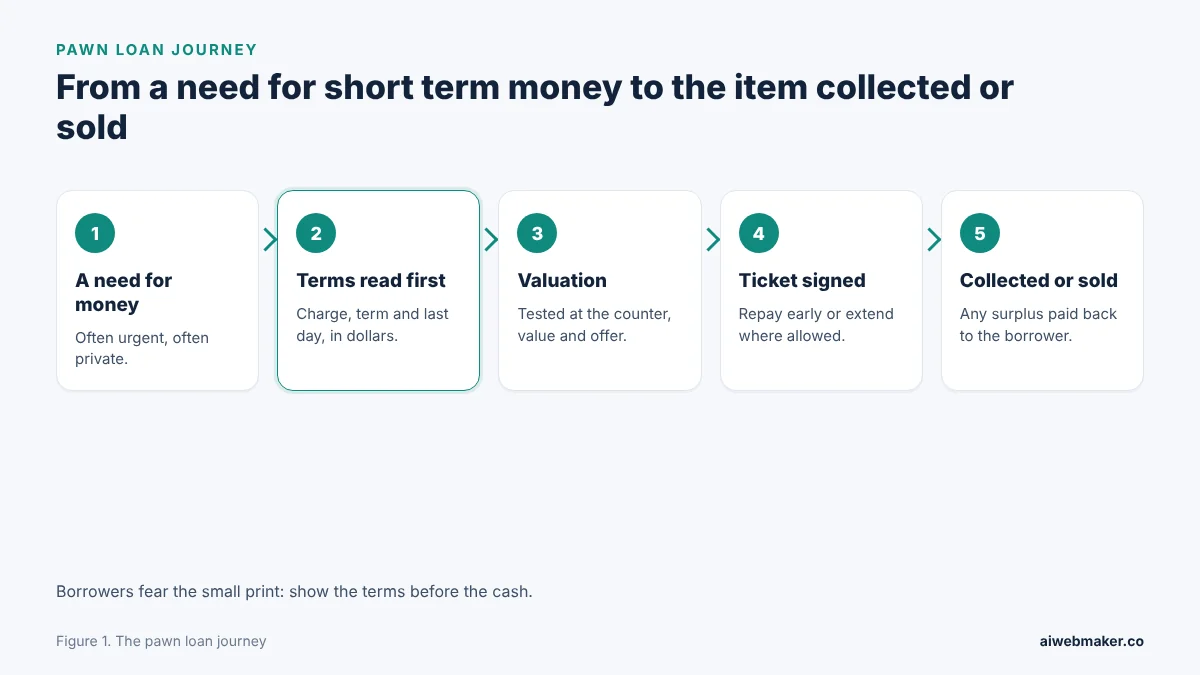
The first box holds a need for money, often urgent and often private. The highlighted step is reading the terms before signing, because a borrower who understands the charge, the term and the last day to repay is far less likely to feel misled. A valuation follows, with the item tested at the counter and both the value and the loan offer stated. The ticket is then signed, and the borrower can repay early or extend where the rules allow. The final step is collecting the item, or, if the loan goes unpaid, the sale and any surplus paid back. Every page of a pawn shop's site should make the terms step plain before anyone walks in.
Loan steps, worked tickets and cases: the pages a pawn shop needs
A pawn shop's site needs a page on how a pawn loan works and a worked example of the charges. It also needs a page on unpaid loans, a list of what the shop lends against and refuses, a shop for pre owned goods and a valuation request page. The loan page sets out each step in order, from valuation to collection. The worked example shows the loan, the charges and the total in dollars, which removes the arithmetic that frightens borrowers. The unpaid loans page answers the question every borrower has but few ask aloud. The shop page shows tested stock with prices, and the valuation page invites a description before the visit. Built like this, the site explains the hard parts first and lets the easier ones follow.
| Page | What the visitor checks | What it should include |
|---|---|---|
| How a pawn loan works | The steps and the term | Valuation, ticket, repay or extend, collect |
| Worked example | What it really costs | Loan, monthly charge, totals at set dates |
| If a loan is not repaid | The worst case | Letter, grace days, sale, surplus returned |
| What we lend against | Whether an item qualifies | Gold, watches, electronics, instruments |
| What we turn away | Honesty and safety | Stolen goods, altered serials, under 18 |
| Pre owned shop | Tested stock and prices | Test notes, options, receipt, guarantee |
| Valuation request | A rough range first | Item type, age, description, nothing binding |
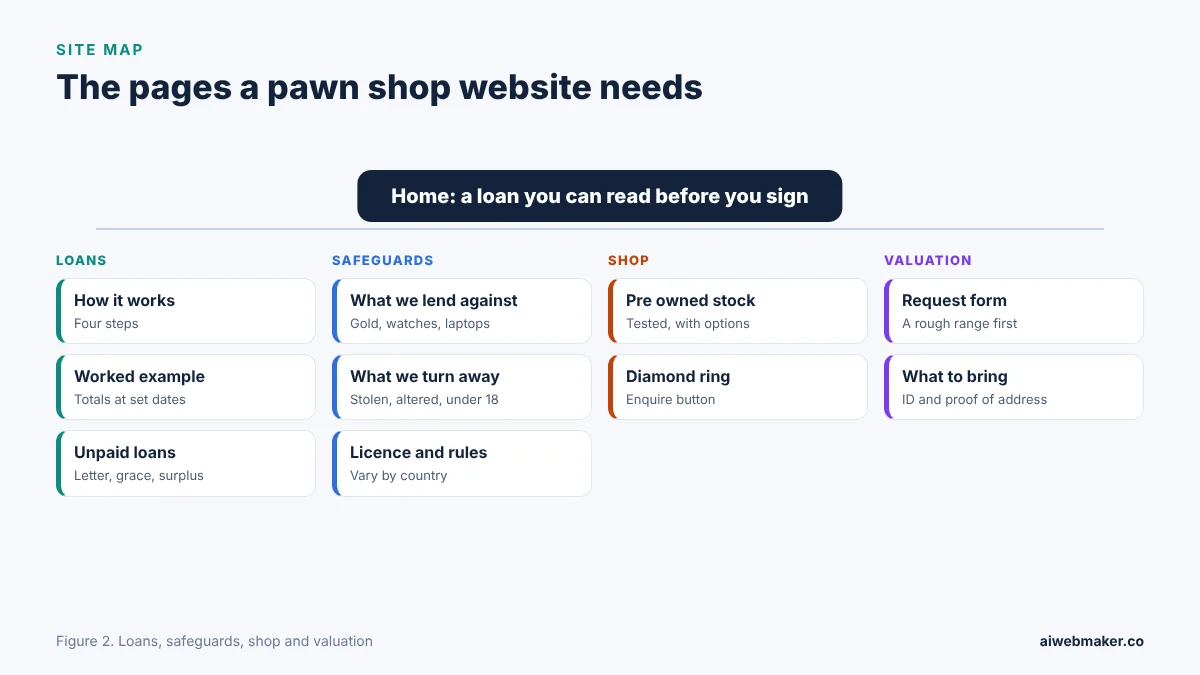
Beneath the home page, a pawn shop's site divides into the loan pages, the safeguards, the shop and the valuation route. Loan pages hold the steps, the worked example and the page on unpaid loans, safeguard pages hold the accepted items, the refusals and the regulation notes, the shop holds tested pre owned goods, and the valuation group holds the request form and the counter hours. Second Chance Pawnbrokers, the sample, sells a gold curb chain, an automatic wristwatch, a 14 inch laptop, a mirrorless camera and an acoustic guitar, while a diamond solitaire ring is viewed by appointment through an enquiry. Its page opens with a pawn ticket for a $300 loan and moves through four loan steps, a worked table, a section on loans that cannot be repaid, the shop, the items it lends against and refuses, counter photos, questions and a valuation form. The pawn shop website example with plain ticket terms and pre owned stock leads with the terms rather than the cash on offer. That choice is what makes the rest of the page believable to a cautious borrower.
Ticket terms in plain dollars, worked through a real example
Borrowers fear the small print more than the charge itself, so a pawn shop's site should show its terms in the same words the ticket uses. The sample's worked example is a $300 loan against a gold chain valued at $600, with a charge of 5% of the loan for each month or part of a month. A table then shows what the borrower pays to collect the chain after two weeks, three months and six months. The note beneath it admits that 5% a month comes to 60% over a year, far dearer than a bank loan, and says the counter tells borrowers so. Each shop's own charges will differ, and any legal limits on them depend on where it trades. Candour of this kind is rare in short term lending, and it is exactly what nervous borrowers need.
| Repaid after | Loan | Charges in the sample | To collect the chain |
|---|---|---|---|
| 2 weeks | $300 | $15 | $315 |
| 3 months | $300 | $45 | $345 |
| 6 months | $300 | $90 | $390 |
When a loan cannot be repaid: grace days, sale and surplus
Every borrower wonders what happens if the money is not there on the last day, and a good pawn shop answers before being asked. The sample asks borrowers to say early, because paying the charges so far can start a fresh term and paying part of the loan lowers the charge ahead. When a term ends with nothing paid, it writes to the borrower and holds the item for another 14 days before it may be sold. If the sale brings in more than was owed, the difference goes back to the borrower, and if it brings in less, the shop does not chase the rest. Holding periods and surplus rules are set by local law in many places, so each shop must state its own. A page that covers the hard outcome openly lets borrowers trust everything else the shop says.
Licences, ID checks and the goods a counter turns away
Most countries license pawnbrokers in some form, and the rules shift between nations and sometimes between states within one. Those rules can decide who may lend, how charges are shown, how long items are held and what happens to money left over from a sale. A pawn shop's site should mention its licence and say that its terms follow the rules where it trades, without claiming one rule applies everywhere. Checking who brings items in is just as important, and the sample asks for photo ID and proof of address on every loan and sale. It refuses anything it believes is stolen, items with altered serial numbers, devices locked to someone else's account, weapons and anything brought in by a person under 18. Serial checks against stolen property registers, where a country keeps them, protect honest customers and the shop alike.
| Item | Lent against in the sample | Note for the page |
|---|---|---|
| Gold and silver jewellery | Yes | Tested and weighed at the counter |
| Watches | Yes | Checked for working order |
| Laptops, tablets, cameras | Yes | Tested, and unlocked from any account |
| Instruments and power tools | Yes | In working order |
| Items with altered serials | No | Refused outright |
| Weapons of any kind | No | Refused outright |
Pre owned stock with options, receipts and an Enquire button
The shop side of a pawnbroker's site sells items that were bought from checked sellers or held past the end of a loan, and saying so builds confidence. The online store builder for pawnbrokers selling tested pre owned goods lets each piece carry a choice, such as a watch strap, a laptop guarantee length or a camera kit, collects the buyer's pieces in one bag and totals the delivery charge at checkout, where discount codes can help move slower stock. The sample's diamond solitaire ring has no listed price and shows an Enquire button, since valuable stones are viewed by appointment. Every card should note how the item was tested, and the sample gives each piece a receipt describing the checks. Its jewellery and watches can come back unworn within 14 days, and its electronics carry a 3 month guarantee of the shop's own. Clear provenance on every card turns a pawn shop's cases into a trusted place to buy.
Valuations by message, and pawning against selling outright
A valuation route lets people learn what an item might fetch before they decide to visit, which suits anyone embarrassed or unsure. The sample invites a description by message and replies with a rough range within one working day, while the firm offer is made at the counter once the item is tested. It explains that gold is valued on the day's gold price and other items on what they fetch second hand, and that it usually lends between a third and two thirds of the value. Selling outright is offered as a separate choice, usually at a higher figure than the loan, and the page stresses that a sale cannot be undone. Borrowers worried about debt should be pointed towards independent advice services, which many countries provide. A valuation page that presses nobody to decide on the spot earns repeat visits.
Searches for pawn loans, gold buying and pre owned goods
People looking for a pawnbroker type a need and often a place. Typical phrases are pawn shop near me, pawn loan on gold, sell a watch, pre owned laptops or how pawn loans work. Loan and shop pages that answer those phrases in plain language meet the search where it begins. The map listing should carry counter hours, the shopfront, a note on what to bring and a link to the worked example. Reviews that mention a clear ticket, an item returned in its sealed pouch or honest advice not to borrow more than needed carry real weight. Articles on how pawn loans are charged, what affects the value of gold or how to check a pre owned watch attract readers before they decide. Patient explainers like these mark the shop out as the straight dealing counter in town.
The pawnbroker's website bill in hosting and articles
A pawnbroker's site carries just two standing costs, hosting and a domain, while explainer articles drafted with credits cost less than a replacement ticket. Long established pawnbrokers usually pay for the year at the start, and a newly licensed shop may stay monthly while its first loans are repaid. Twelve explainer articles on loans and valuations come to roughly $7.80 in credits. Adding stock, updating the worked example or changing counter hours brings no extra fee. The counter's yearly and monthly options appear below, with the $189 tier noted purely to compare.
| Item | Yearly | Monthly |
|---|---|---|
| Hosting the loan, shop and valuation pages | $119 | $228 over twelve months |
| Domain | Depends on the ending | Depends on the ending |
| Higher plan, for comparison | $189 a year | Not needed |
| Twelve loan explainer articles at about $0.65 | About $7.80 | About $7.80 |
| New stock, worked examples and hours | No charge | No charge |
| Year before the domain | About $126.80 | About $235.80 |
What makes a borrower walk past a pawnbroker's door?
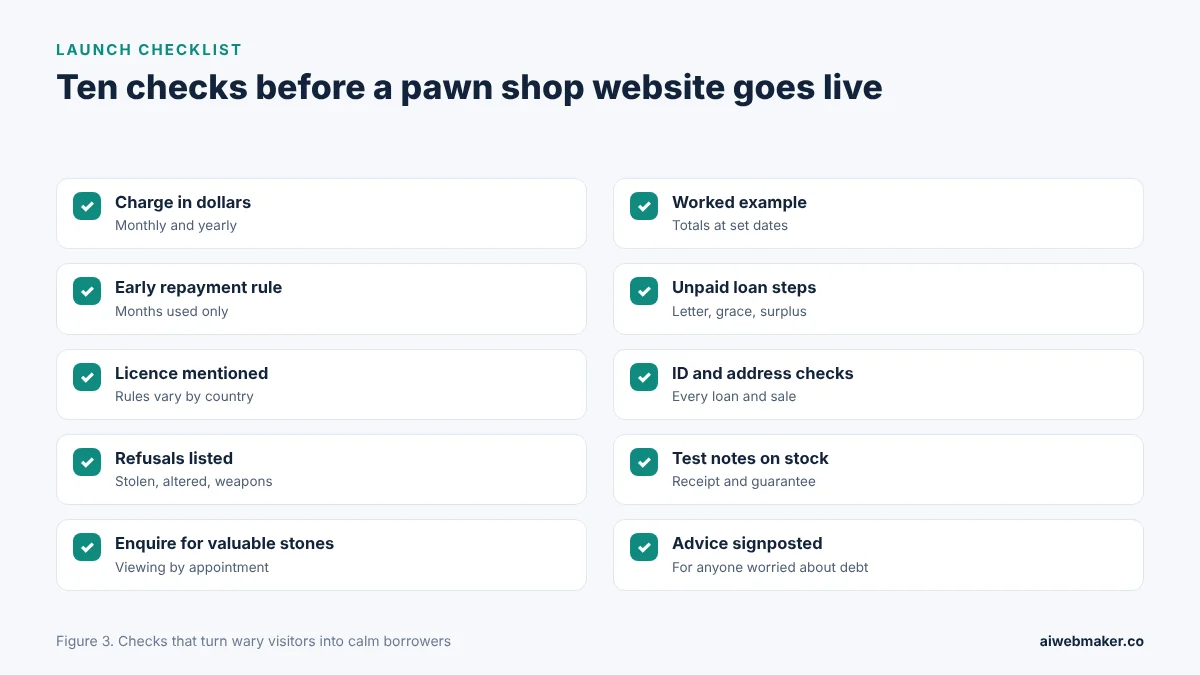
Borrowers walk past when a pawn shop's site promises fast cash but shows no charge, no term and no worked example. Silence about unpaid loans leaves them imagining the worst, from debts that keep growing to items sold without warning. No mention of a licence or ID checks makes careful people wonder whether the shop deals in stolen goods. Pre owned stock without test notes, receipts or a guarantee feels like a gamble. A valuation route that demands a visit before giving any idea of value puts off anyone embarrassed to ask. The ten pawnbroker checks drawn in the next picture address those fears one at a time.
Frequently asked questions
Is pawnbroking regulated?
Pawnbroking is regulated in many countries, though the rules vary between countries and sometimes between states. They can decide who may lend, how charges are shown, how long an item must be held and what happens to money left over from a sale. A pawn shop's website should mention its licence and say that its terms follow the rules where it trades. Borrowers can usually check a licence with the local regulator. Clear statements reassure people before they visit.
Can a pawn loan be repaid early?
In the sample, a loan can be repaid on any day within the term, in full or in part. The charge is worked out for each month or part of a month the loan ran, so repaying in the second month means two months of charges rather than six. Each shop's terms differ, and the website should explain its own rule clearly. A worked example with dates makes the saving easy to see. Early repayment is often the cheapest route for a borrower.
What should someone bring to pawn an item?
The sample asks for the item, photo ID such as a passport or driving licence and proof of address from the last three months. Chargers for laptops, tablets and cameras let the counter test them on the spot. Any box, receipt or certificate can help with the valuation. The website should list these items so nobody makes a wasted trip. Clear preparation saves time at the counter.
Is selling an item better than pawning it?
Selling outright usually brings a higher offer than a loan, but it cannot be undone. Pawning keeps the chance to collect the item later, at the cost of the monthly charges. The sample makes separate offers for each and lets the customer choose without pressure. Anyone unsure should take time and, if worried about debt, seek independent advice first. A website that explains both options fairly earns lasting trust.
A serviced wristwatch against the counter's twelve months online
Selling one serviced wristwatch from the cases earns a pawn shop more than its whole hosting bill for the year. A counter paying monthly meets its $19 with a fraction of one laptop sale. Every borrower who reads the worked example and walks in calm, rather than wary, is more likely to return and to recommend the counter. Plain ticket terms, an honest page on unpaid loans and clear refusals of stolen goods persuade people who expected to be misled. Pawnbrokers who keep their terms, stock and licence details current will see the website steady the counter's trade week after week.
Build your website in Minutes and get the AI Tools that work
Start Building Your Website →