Paint Store Website Cost: Tinted Tins, Sample Pots and Coverage
Paint shops pay $119 for a year of hosting, or $19 a month, plus a domain. Inside: who buys paint online, the pages a paint counter needs, tinting and sample pots, coverage, colour matching, preparation, safety, search and the yearly budget.
- No coding required
- Live in minutes
- Blog, SEO and chatbot tools included
A paint store puts its tins, sample pots and colour match form online with AI Web Maker hosting at $119 across a year, or $19 month by month, plus a domain. Laying out the colour cards, the coverage table and the trade counter page, and checking them in the preview, sits outside anything AI Web Maker invoices. One decorator's order of masonry paint and wall matt for a single house can pay for the year's hosting. Trouble starts because colour on a screen is never quite the colour on a wall, and a tinted tin mixed to the wrong shade cannot go back on the shelf. Buyers also misjudge how much paint a room needs and how long each coat must dry. What follows covers who buys paint online, the pages a paint counter needs, tinting and sample pots, coverage, colour matching, preparation, safety notes, search and the hosting budget.
This article is part of our complete guide: Retail Website Design.
Who buys paint from a website, and what are they unsure of?
Paint buyers include weekend decorators, landlords between tenants, professional painters and people trying to match a colour that is already on the wall. Home decorators want to see colours, buy a sample pot and work out how many tins a room will take. Landlords often want durable, washable finishes in neutral colours, bought quickly and delivered. Professional decorators care about trade prices, early opening and colours kept on file for touch ups. People matching an old colour want to know whether the counter can read a flake of paint or a tile and mix to it. A paint shop website that settles these doubts sends far fewer customers to the counter confused.
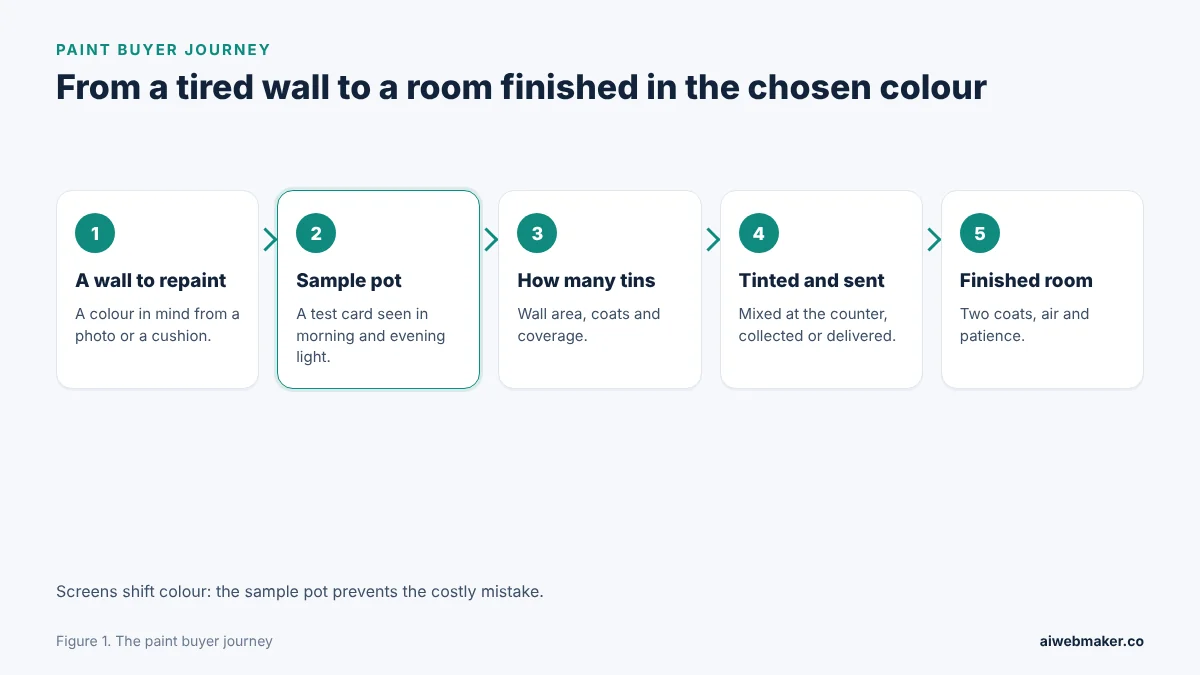
Moving through the five stages, a tired wall or a new room starts the path, often with a colour already in mind from a photo or a cushion. The highlighted stage is the sample pot, because painting a test card and looking at it in morning and evening light is what prevents an expensive mistake. Working out the quantity follows, and coverage figures turn wall measurements into a number of tins. Tinting and collection or delivery come next, and a quick tint at the counter suits buyers in a hurry. The finished room closes the path, and a colour that looks right at dusk is the one people remember and recommend. Each page of a paint site should help the buyer get from the sample stage to the right number of tins.
Colours, coverage and counter services: pages a paint shop needs
A paint shop's site works best with pages for interior paint, exterior paint, wood and metal finishes, sample pots, tools, colour matching, preparation advice and trade accounts. Product pages carry the paint, the size of the tin, the finish and the colours it can be tinted to. A coverage and drying page turns tin sizes into quantities and saves buyers from running short halfway up a wall. The colour matching page explains what to bring and how the counter checks a match before anything is mixed. Preparation and safety advice belongs on its own page, because most paint failures start with the surface rather than the tin. Organised this way, the site serves the quick buyer and the careful planner equally well.
| Page | What the buyer checks | What it should include |
|---|---|---|
| Interior paint | Finish, washability, colours | Tin size, sheen, colour options, price |
| Exterior paint | Weather resistance | Surfaces it suits, colours, drying conditions |
| Wood and metal | Finish for doors and radiators | Eggshell, satin or gloss, tin size |
| Sample pots | Trying a colour first | Pot size, colours, how to test |
| Tools and kits | Rollers, brushes, tape | Roller pile, kit contents |
| Colour matching | Matching an old wall | What to bring, test card, formula kept |
| Preparation and safety | Primers, lead, ventilation | Stages, warnings, local rules |
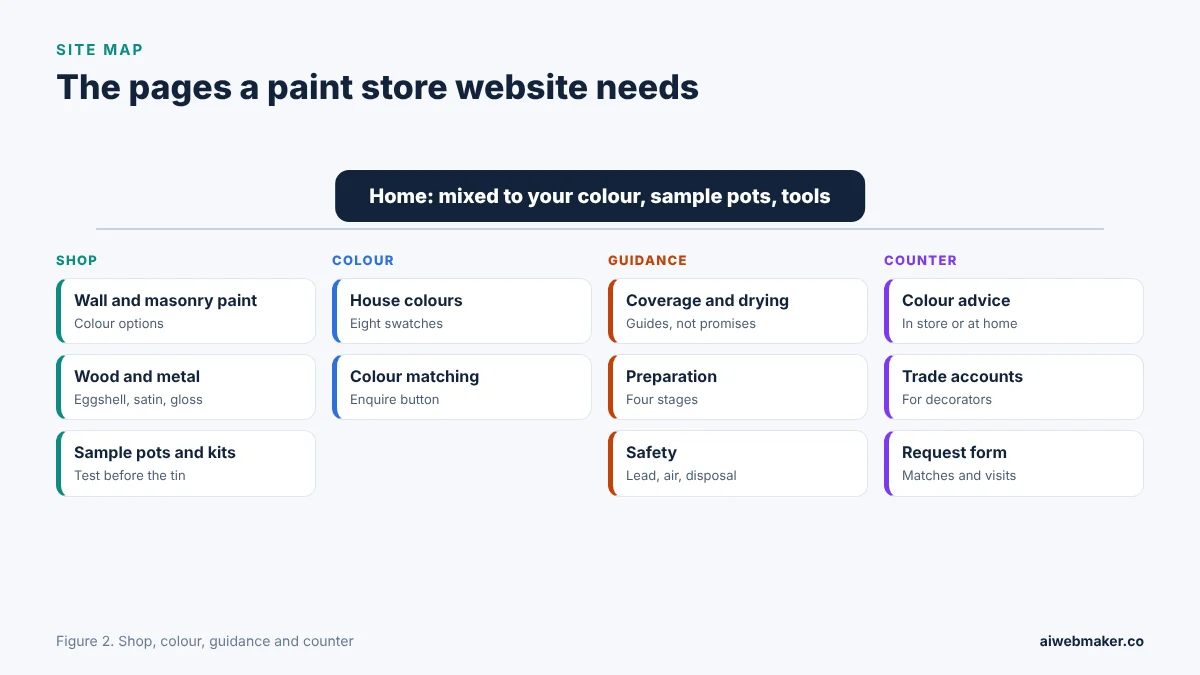
Branching out from the home page, the paint site splits into the shop, colour, guidance and counter groups. Shop pages hold wall and ceiling paint, masonry paint, wood and metal paint, sample pots and kits, colour pages hold the house colours and the matching service, guidance pages hold coverage, drying and preparation, and counter pages hold consultations, trade accounts and the request form. Colourmill Paints, the sample shop, sells wall and ceiling matt in 2.5 L tins, exterior masonry paint in 5 L, wood and metal paint in 750 ml, sample pots of 250 ml and a decorating kit, with colours matched from a customer's sample handled by enquiry. Its page also shows eight house colours as swatches, a coverage and drying table, four stages of preparation, counter photos, questions and a form for colour advice and matches. The paint store website example with tinted colours and sample pots opens with a promise to mix colours while the customer waits. That opening speaks straight to the decorator who needs a tin today.
Tinted to order: colour options, sample pots and final sales
Tinting sets a paint counter apart from a shelf of ready mixed tins, so the colour pages need to say how a tint is made and checked. Each paint can be offered in a set of house colours, and the sample lists eight, from chalk white to an ink blue black for woodwork. The online store builder for paint shops with colour and finish options gives every tin a colour or finish choice, drops tins and sample pots into one bag, and works out the delivery fee at checkout, with a box there for discount codes. A colour matched from a customer's chip has no fixed listing, so it appears with an Enquire button that opens the request form. Because a tinted tin is mixed for one buyer alone, the page should say that it cannot be returned unless faulty. Sample pots at a low price are the fair answer to that rule, and the sample sells them for $5 each.
Coverage, drying times and the number of tins a room needs
Coverage figures help buyers order the right number of tins, but they should always be presented as guides rather than promises. The quantity depends on the wall area, the number of coats and the surface, since porous plaster and rough render drink far more paint than smooth walls. A simple method is to measure the walls, subtract doors and windows, multiply by the number of coats and divide by the coverage on the tin. Drying and recoat times also vary with temperature and humidity, so cold, damp rooms take longer. The sample bases its figures on a smooth surface in a room at about 20 °C and tells buyers to follow the tin and its data sheet wherever they differ. Honest guidance like this prevents both wasted tins and a second trip halfway through a job.
| Paint in the sample | Covers per litre, one coat | Touch dry | Second coat after |
|---|---|---|---|
| Wall and ceiling matt | About 12 m² | 2 hours | 4 hours |
| Exterior masonry paint | About 5 to 7 m², less on rough render | 1 to 2 hours | 4 hours in dry weather |
| Water based eggshell | About 14 m² | 1 hour | 6 hours |
| Stain block primer | About 10 m² | 1 hour | 4 hours |
| Oil based gloss | About 15 m² | 6 hours | 16 hours |
Colour matching from a flake, a tile or a scrap of fabric
Matching a colour from an old wall brings in people who would never otherwise visit a paint counter. The page should explain what to bring, and the sample asks for a piece about the size of a coin, such as a flake of old paint, a tile or a cushion cover. The counter reads it with a colour reader, paints a test card and holds it beside the sample before anything goes into a tin. The page should also explain that sheen changes how a colour looks, so a match in matt can read differently from the same colour in gloss. Keeping the formula on file lets the customer, or their decorator, order another tin months later. A clear matching page turns a tricky request into a routine one.
Preparation, primers and the four stages behind a lasting finish
Most paint that fails was let down by the surface underneath, and a paint shop that says so earns trust. Preparation means filling cracks, sanding filler flat, washing greasy patches and masking the edges. Bare surfaces often need a primer, such as a thinned mist coat on new plaster, a wood primer on bare timber or a stain block over water marks. Two coats usually follow, with the recoat time on the tin respected between them. Ventilation and patience finish the job, because many finishes harden fully over days or weeks rather than hours. Advice in four plain stages helps beginners and reminds busy professionals what the tin expects.
| Stage | What to do | Why it matters |
|---|---|---|
| Prepare | Fill, sand, wash and mask | Paint follows every flaw beneath it |
| Prime what needs it | Mist coat, wood primer or stain block | Bare and stained surfaces absorb or bleed |
| Two coats | Cut in, roll in sections, wait for recoat | Even colour and full protection |
| Air and patience | Ventilate and handle gently at first | Finishes harden over days or weeks |
Lead paint, ventilation and disposal rules that vary by place
Safety notes belong on a paint site because the products are chemicals and older homes can hide old hazards. Homes painted many decades ago may have lead in the lower layers, and those layers should be tested before anyone sands or burns them. Testing and removal rules for lead are set nationally or locally, and a paint site should send readers to their local guidance instead of quoting a single rule. Every paint gives off some vapour while it dries, which is why rooms should be ventilated and children and pets kept out until the paint is dry. Liquid paint should never be poured down a drain or put in a household bin, and local authorities usually explain how they collect it. A paint shop that publishes these notes shows it cares about more than the sale.
The searches that bring decorators to a paint counter
Decorators and homeowners search with a colour, a surface or a place. Common phrases include masonry paint, paint colour matching, sample pots, paint shop open early or exterior paint for render. Product pages that name the finish, the surface and the tin size give those searches a precise answer. A map listing should show counter hours, the loading bay or parking, photos of the tinting machine and a link to the colour pages. Reviews that mention an exact match from a flake of old paint or advice on a mist coat persuade cautious buyers more than general praise. Articles on choosing a colour for a north facing room, painting new plaster or estimating paint for a hallway draw readers who are still planning. Practical writing like this keeps the shop in mind when the brushes come out.
The paint counter's website budget, line by line
Two standing charges, hosting and the domain, make up a paint counter's website budget, and colour articles cost less in credits than a single sample pot. A counter with decorators on account usually pays annually, while a newly opened paint shop might keep to the monthly plan through its first spring and summer. Twelve decorating articles use about $7.80 of credits across the year. Changing colours, tin prices or counter hours adds no fee. The two payment routes for a paint counter are set out below, with the $189 tier present only to compare.
| Item | Yearly | Monthly |
|---|---|---|
| Hosting the paint, colour and counter pages | $119 | $228 over twelve months |
| Domain | Depends on the ending | Depends on the ending |
| Higher plan, for comparison | $189 a year | Not needed |
| Twelve decorating articles at about $0.65 | About $7.80 | About $7.80 |
| New colours, tin prices and hours | No charge | No charge |
| Year before the domain | About $126.80 | About $235.80 |
Why do decorators leave a paint shop's site?
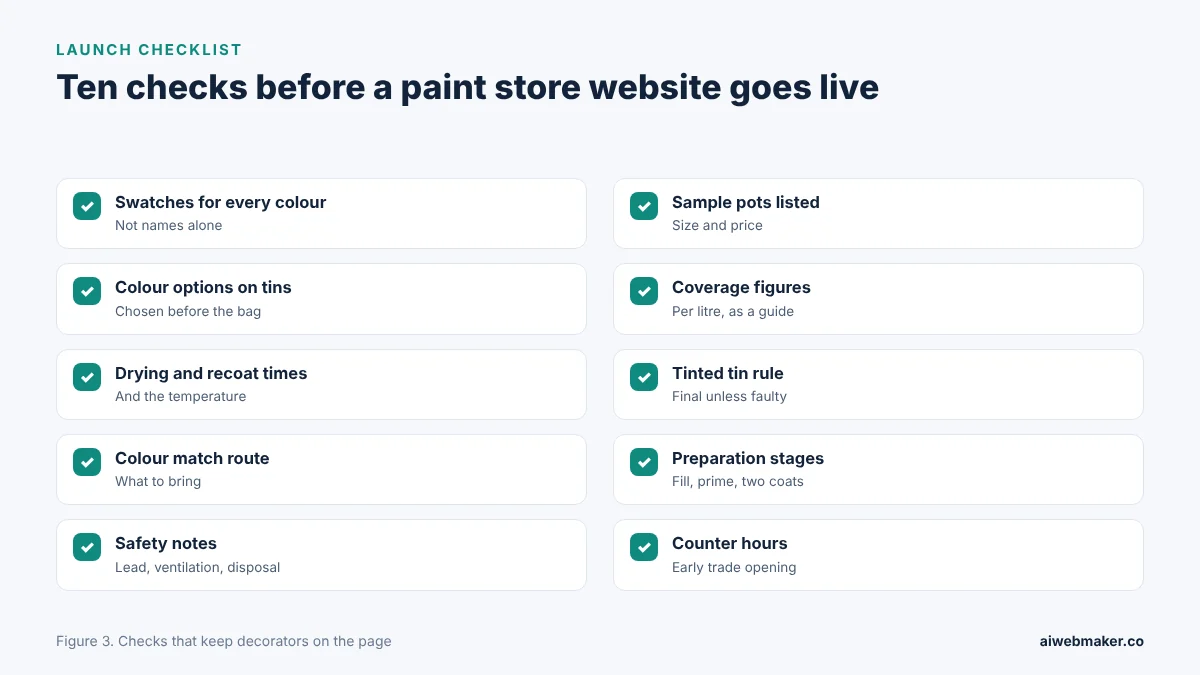
Decorators leave a paint shop's site when colours appear only as names, with no swatches or sample pots to try them. Missing coverage figures leave buyers guessing how many tins to order and fearing a second trip. A returns policy that hides the rule on tinted tins creates arguments at the counter later. No word on colour matching sends people with an old flake of paint to a competitor. Silence about preparation and safety makes the shop look like a warehouse rather than an adviser. Ten paint counter checks, shown in the image below, answer those faults in turn.
Frequently asked questions
Will a paint counter take back a tinted tin?
Most paint shops cannot take back tinted tins, because each one is mixed for a single customer and cannot be resold. Colourmill takes back unopened tins of white and ready mixed stock for 30 days with the receipt, a common approach among paint counters. The website should state both rules clearly on the product pages. Sample pots let buyers test a colour before committing to a full tin. Local consumer law may give further rights if a tin is faulty.
How many sample pots should a buyer try?
Two or three sample pots of close colours usually show the difference better than one. Each should be painted onto a large card rather than straight onto the wall, so that the card can be moved around the room. Looking at the cards in morning and evening light shows how the colour changes through the day. The sample's 250 ml pots are enough for two coats on a large test card. Careful testing prevents the cost of repainting a room.
Is paint safe to use around children and pets?
Water based paints are generally low in solvents, but every paint gives off some vapour while it dries. Rooms should be ventilated, and children and pets kept out until the paint has dried. Safety notes on the tin follow the rules where the paint is sold, and buyers should read them. Old paint that may contain lead should be tested before sanding, following local guidance. A short safety page helps buyers act sensibly.
When is it too cold or wet to paint outside?
Exterior paint needs dry weather and a surface warmer than the minimum stated on the tin, which the sample notes is often around 5 °C. Rain before the coat dries can wash it off or spoil the finish. Morning dew and late frost are common problems in cooler seasons. The website can suggest checking the forecast and the tin before starting. Good timing gives an exterior finish its best chance to last.
A house of masonry paint against a year of the paint counter's hosting
A single exterior job, with masonry paint for a whole house, usually brings in more than a paint shop spends on hosting for twelve months. Paying monthly instead, a counter covers its $19 with one tin of wall matt and a sample pot or two. A decorator who spots the 7 am trade counter on the site and opens an account can keep ordering week after week for years. Swatches, honest coverage figures and a clear rule on tinted tins persuade buyers who would otherwise hesitate. Paint shops that keep their colours and safety notes current will see the website send people to the counter ready to mix.
Build your website in Minutes and get the AI Tools that work
Start Building Your Website →