Optical Store Website Cost, With the Eye Test Before the Frame
An optical store hosts its frames and lens pages for $119 a year, or $19 a month, plus a domain. Inside: how buyers choose, the pages an optician needs, frame sizes, lenses, prescription rules, eye tests, repairs, search and the yearly budget.
- No coding required
- Live in minutes
- Blog, SEO and chatbot tools included
An optical store keeps its frames, lenses and eye test page online at $119 per year on AI Web Maker, or $19 per monthly bill, plus a domain. No invoice arrives for drafting the frame cards, the lens table and the request form, or for checking how each one looks in the preview. A single frame with its lenses outsells the annual hosting fee on its own. What makes the job hard is that glasses are part fashion and part medical device, and a website that sells them like shoes skips the prescription, the measurements and the fitting that make them comfortable. What follows covers how glasses buyers choose, the pages an optician needs, frame measurements, lens options, prescription and contact lens rules, eye tests, repairs, search and the money involved.
This article is part of our complete guide: Retail Website Design.
How do glasses wearers pick a frame and an optician?
Glasses wearers arrive in a few distinct groups, and each brings its own worry to the optician's website. People whose sight has changed want an eye test first, so they look for who carries it out, how long it takes and what it costs. Wearers holding a recent prescription from elsewhere want to know whether the shop will glaze lenses to it and how soon the pair will be ready. Fashion buyers care about shape, colour and how a frame sits on the face. Contact lens wearers look for their usual lenses and a quick way to reorder, while parents look for a calm testing room and frames that survive a playground. Speaking to each group in its own terms keeps every one of them moving towards the optician's counter.
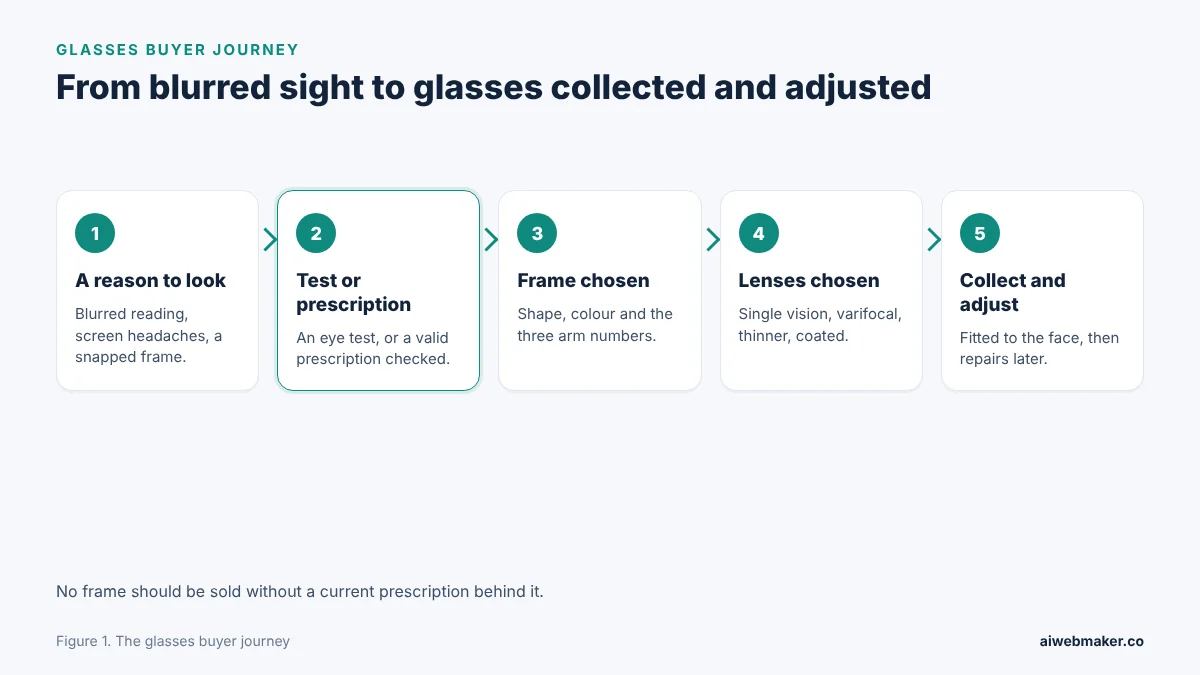
Reading the five steps in order, the path starts with a trigger such as blurred reading, headaches at a screen or a frame snapped in a bag. The highlighted step is the prescription, because no frame sale should go ahead without a current and valid one behind it. Frames come next, chosen by shape, colour and the three numbers printed inside the arm. Lens choices follow, and buyers hesitate there more than anywhere, since thinner lenses, coatings and varifocals each change the price. Collection and a fitting adjustment close the path, and that last visit often decides whether the wearer comes back two years later. Every page on an optician's site should settle the worry that belongs to its own step.
Shop, testing room, lens table: what an optician's site carries
An optician's website needs a shop for frames and sunglasses, a lens page, an eye test page and short pages on fitting, repairs and returns. The shop holds the products a buyer can choose alone, such as a frame in a chosen colour or a pair of non prescription sunglasses. The lens page covers the choices that need guidance. The eye test page names who tests, how long a test takes and what it costs, because many sales begin in the testing room rather than at the frame wall. Contact lenses deserve a short page of their own, since the rules around fittings differ from those for glasses. Arranged like this, an optician's site lets simple purchases close online and sends harder choices to the fitting table.
| Page | What the buyer checks | What it should show |
|---|---|---|
| Frames and sunglasses | Shape, colour, size and price | Colour options, the three arm numbers, Add to bag |
| Lenses | Which lens suits the prescription | Lens types, thinner options, coatings, starting prices |
| Eye tests | Who tests and what it costs | The optometrist's role, test length, fee |
| Contact lenses | Reorders and fitting rules | Box sizes, the need for a current fitting |
| Fitting and collection | How long the pair takes | Measuring, glazing time, adjustments |
| Repairs and returns | What happens when something goes wrong | Counter repairs, return period for unworn frames |
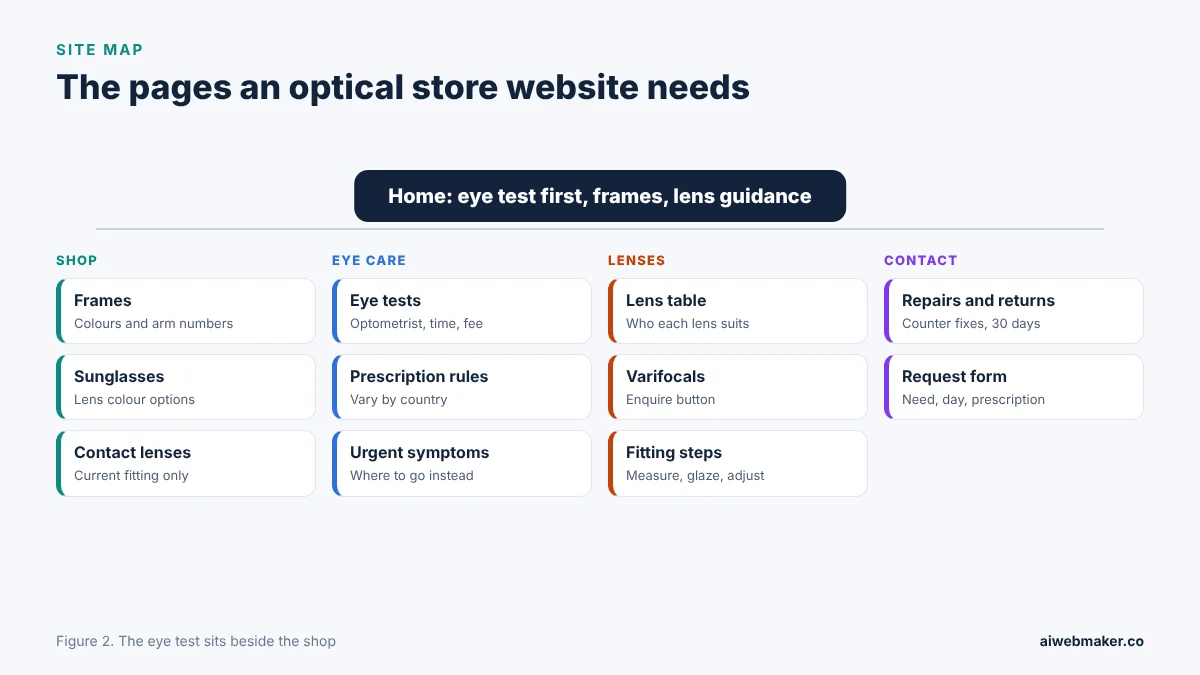
Under the optician's home page sit four groups of pages, and each one answers a different stage of buying glasses. The shop branch holds frames, sunglasses and contact lenses, the eye care branch holds tests and prescription rules, the lens branch holds the table and the fitting steps, and the contact branch holds repairs, returns and the request form. Our sample optician, Frame and Lens Eyewear, sells a round acetate frame, a thin steel rectangle frame, polarised sunglasses, single vision lenses, daily contact lenses in a box of 30 and varifocal lenses priced only after an eye test. Its page moves from the shop to an eye test section, a lens table, four fitting steps, shop photos, questions and a request form that asks what the visitor needs and whether they hold a prescription. The optical store website example with frame options and an eye test request puts the eye test promise in the opening line, ahead of any frame. That order suits most opticians, because it tells buyers the shop cares about their sight before it asks for their money.
Frame sizes and the three numbers printed inside the arm
Frame size is the detail most eyewear sites leave out, yet it decides whether a pair pinches, slides or sits right. Almost every frame carries three numbers inside one arm, giving the lens width, the bridge and the arm length in millimetres. A buyer can compare those numbers with the pair already on their nose. The sample prints them on each card, such as 48 20 145 for the round acetate frame and 53 17 145 for the steel rectangle. Pupil distance and fitting height are different measurements, taken in the shop so that the centre of each lens sits in front of the eye. Explaining these numbers on the frame page saves returns and builds the confidence to order.
| Measurement | Where it comes from | What it tells the buyer |
|---|---|---|
| Lens width | First number inside the arm | How wide each lens opening is |
| Bridge | Second number inside the arm | How the frame sits on the nose |
| Arm length | Third number inside the arm | Whether the arms reach the ears comfortably |
| Pupil distance | Measured in the shop | Where the optical centre of each lens goes |
| Fitting height | Measured with the chosen frame | Essential for varifocals and office lenses |
Lens choices, thinner index and an Enquire button for varifocals
Lenses decide how comfortable a pair of glasses feels, yet few buyers can tell a varifocal from an office lens without help. A short table naming each lens, who it suits and a starting price settles most questions before anyone phones. The sample's own table starts single vision lenses at $60 and varifocals at $220, with thinner index, anti reflection, light reactive and prescription sun lenses priced as additions. The online store builder for opticians selling frames and lens options lets each frame or lens carry its options, such as a colour or a thickness; the chosen pairs gather in the bag, checkout totals them with the delivery fee, and a discount code box sits on the same screen. Varifocals and specialist lenses depend on the prescription and the fitting measurements, so they carry an Enquire button rather than a price. That mix lets simple orders finish online while complex lenses stay in expert hands.
| Lens or extra | Who it suits | Sample starting price |
|---|---|---|
| Single vision | One distance: reading, far or the screen | $60 a pair |
| Varifocal | Near, middle and far in one lens | $220, confirmed after measuring |
| Office lenses | Desk and screen distances | $150 |
| Thinner index | Stronger prescriptions | Add $40 |
| Anti reflection coating | Screen glare and night driving | Add $35 |
| Light reactive | Darkening outdoors, clear indoors | Add $70 |
Prescriptions, contact lens fittings and rules that vary by country
Optical sales are regulated in many countries, and the rules differ enough that a website should never present one country's law as universal. Some countries set an expiry date on a glasses prescription, while others leave the interval to the optometrist. Many require a separate contact lens fitting before lenses can be sold, because a lens sits directly on the eye. Some restrict who may dispense glasses to children, for example in the United Kingdom. The sample handles this by stating that glasses are glazed only to a valid, in date prescription and that contact lenses go only to wearers with a current fitting. A plain statement like that protects buyers and keeps the shop on the right side of its own regulator.
| Product | What the page should state | Why it matters |
|---|---|---|
| Prescription glasses | Glazed only to a valid prescription | Lenses must match the eye, and rules on validity vary |
| Contact lenses | Sold only after a current fitting | A poor fit can harm the eye |
| Non prescription sunglasses | UV protection and lens colour | Buyers compare protection, not only style |
| Outside prescriptions | Accepted if still valid where the buyer lives | Avoids lenses made to an expired test |
The eye test page, and when to send someone elsewhere
An eye test page should say who carries out the test, what it checks and how much it costs, because the test is where trust begins. The sample names a qualified optometrist, a test of about 30 minutes and a fee starting at $35, with a written prescription the patient keeps. Equally important is a short line on symptoms that should never wait for a shop appointment, such as a painful or red eye, a sudden change in sight, flashes or a shadow across the vision. Those visitors should be told plainly to seek urgent medical care through their local services. A test page that knows its limits earns more respect than one that promises to handle everything.
Repairs, adjustments and returns on glazed lenses
Repairs and returns need clear wording, because glasses are personal and lenses are made for one wearer. Loose screws, worn nose pads and bent arms are usually fixed at the counter on the spot, and saying so brings people back through the door. Snapped acetate and broken hinges can sometimes be mended, with the price agreed before work starts. Unworn frames are often accepted back for a stated number of days, and Frame and Lens Eyewear gives 30. Lenses cut to a prescription cannot be resold, so the returns page should say that they are not returnable unless the shop made an error. Local consumer law may give buyers more than any shop policy, and the page should acknowledge that where it applies.
Searches for an eye test, varifocals or a frame repair nearby
People look for an optician by what they need and where they are. They type phrases such as optician near me, eye test this week, varifocal glasses, prescription sunglasses or glasses repair. A lens page that names varifocals, office lenses and thinner lenses in everyday words gives those searches a real answer to land on. The map listing should carry testing hours, the shop entrance, photos of the frame wall and a link to the site. Reviews that mention a patient optometrist, a careful fitting or a quick repair persuade far better than vague praise. Articles on how often to have eyes tested, choosing a frame for a face shape or getting used to varifocals attract readers long before they need a pair.
The yearly bill for an optician's online shop
Three lines make up an optician's yearly website spend: hosting, a domain and a few credits for articles. Long established practices usually clear the year in a single payment, while a newly opened optician may spread it over twelve monthly bills. Twelve articles on lenses, frames and eye health drafted with credits come to roughly $7.80. Adding frames, changing lens prices or updating test fees adds nothing. The table lines up yearly against monthly billing for an optician, with the $189 tier listed purely as a reference point.
| Item | Yearly | Monthly |
|---|---|---|
| Hosting the frames, lenses and test pages | $119 | $228 over twelve months |
| Domain | Depends on the ending | Depends on the ending |
| Higher plan, for comparison | $189 a year | Not needed |
| Twelve eye care articles at about $0.65 | About $7.80 | About $7.80 |
| New frames, lens prices and test fees | No charge | No charge |
| Year before the domain | About $126.80 | About $235.80 |
Why do glasses buyers abandon an optician's site?
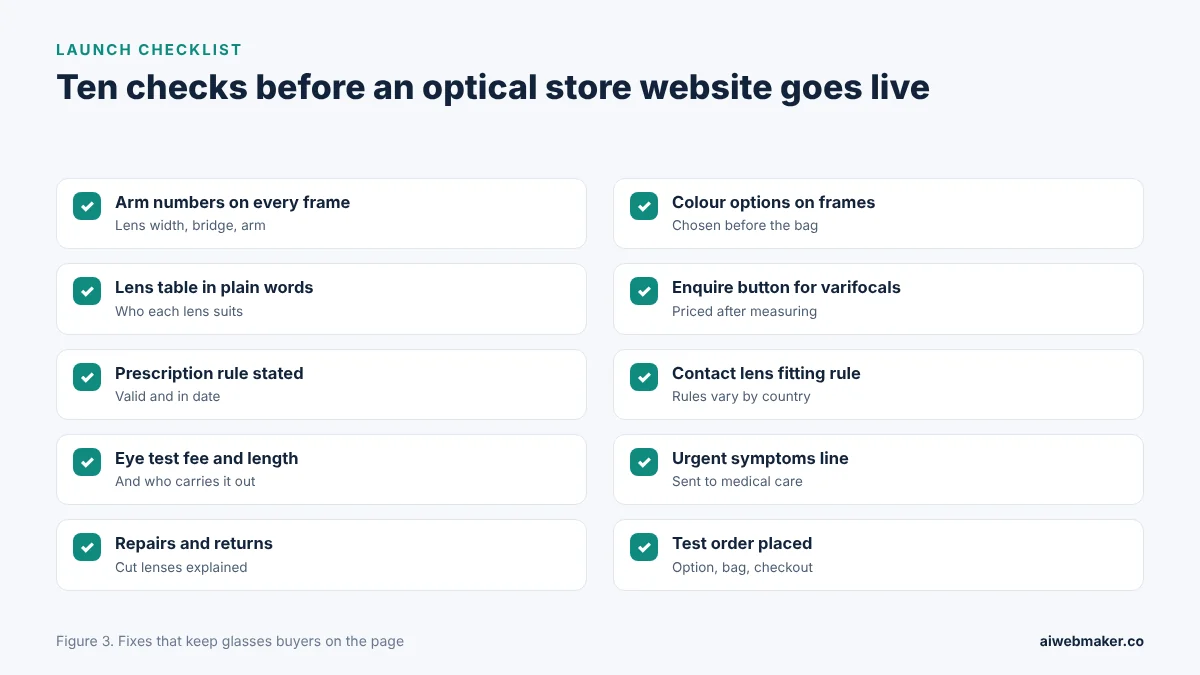
Glasses buyers abandon an optician's site when frame cards show no size and the only way to judge fit is a trip to the shop. A lens page that lists technical names without saying who each lens suits leaves people guessing at what each upgrade buys. Silence about prescriptions or contact lens fittings makes careful buyers wonder whether the shop takes eye health seriously. Missing test fees, unclear glazing times and no word on repairs push visitors to the practice down the road. Stock photos of models in sunglasses say nothing about a real testing room or a real frame wall. Ten optician checks in the next image answer those gaps, starting with frame sizes.
Frequently asked questions
Is an in store eye test needed before glasses are ordered online?
Glasses can usually be sold to a buyer who holds a current, valid prescription from a qualified eye care professional, though the rules vary by country. The shop should read the prescription carefully and still take the measurements it needs, such as pupil distance. Varifocals in particular need a fitting height measured with the chosen frame. Buyers without a recent prescription should be invited to book a test first. That approach keeps online sales safe and accurate.
Should lens prices appear on the website?
Starting prices for common lenses help buyers judge whether a pair fits their budget before they visit. Single vision lenses and popular extras such as thinner index or anti reflection coatings can be priced as clear additions. Varifocals and specialist lenses depend on the prescription and measurements, so an Enquire button is the honest choice there. Buyers can then plan the visit around a budget they already know. Clear figures build trust long before the fitting table.
Can contact lenses be sold through the shop?
Contact lenses can be sold online in many countries, but usually only to wearers with a current contact lens fitting or specification. The product page should say so plainly and explain that the rules differ from place to place. Box sizes, such as one, three or six boxes, work well as product options. First time wearers should be directed to a fitting with a qualified professional. Clear rules keep the shop and its customers safe.
How many working days does glazing a new pair take?
Most single vision glasses are ready within one to two weeks, and the sample states 7 to 10 working days. Varifocals, high index lenses and specialist coatings can take longer because they are often made in a separate laboratory. The website should give typical times for each lens type and explain that a final check is made before collection. Buyers appreciate a call when the pair is ready. Honest timings prevent disappointment at the counter.
How many pairs of glasses repay an optician's website?
Selling one pair of prescription glasses normally earns an optician more than its site costs to host for twelve months. On monthly billing, one pair of non prescription sunglasses outweighs the $19 several times over. Every buyer who books an eye test after reading the test page may return for years of frames, lenses and contact lenses. Frame sizes on every card, an honest lens table and clear prescription rules persuade careful buyers to choose one shop over another. A testing diary that fills from the request form shows the site is earning its keep.
Build your website in Minutes and get the AI Tools that work
Start Building Your Website →