Lighting Store Website Cost: Pendants, Bulb Caps and Room Advice
A lighting store's showroom pages cost $119 a year to host, or $19 a month, plus a domain. Inside: who buys lights online, the pages a showroom needs, bulb boxes, room advice, options, wiring rules, trade accounts, search and costs.
- No coding required
- Live in minutes
- Blog, SEO and chatbot tools included
Pendants, bulbs and a trade form go online for a lighting store at $119 for the whole year with AI Web Maker, or at $19 in any single month, plus the domain. Drafting fitting cards and room guides, and flicking between pendants and lanterns in the preview, puts nothing on the showroom's AI Web Maker bill. One floor lamp and a pair of wall lights, sold to a single household, already outweigh twelve months of hosting. The hard part is that light is bought for how it looks when switched on, yet a screen shows a fitting switched off on a white background. Shoppers also stumble over caps, lumens and colour temperatures, and many buy a bulb that will not fit or a white that feels cold. What follows covers who shops for lights online, the pages a showroom needs, reading the bulb box, room advice, product options, wiring and IP ratings, trade accounts, search and the running costs.
This article is part of our complete guide: Retail Website Design.
Who shops for lamps and fittings online, and what puzzles them?
People shopping for lights online fall into a handful of groups, and each is puzzled by something different. Homeowners redoing a kitchen or a hall want fittings that suit the room and advice on how many they need. Renters want plug in lamps that work straight from the box, with no wiring and no landlord to ask. Someone replacing a bulb mostly wants to know which cap fits and which white will match the rest of the room. Electricians, interior designers and builders buy for other people's homes, so they look for trade prices, delivery to site and stock they can rely on. A lighting website that answers each group in plain words keeps them from guessing and returning the wrong thing.
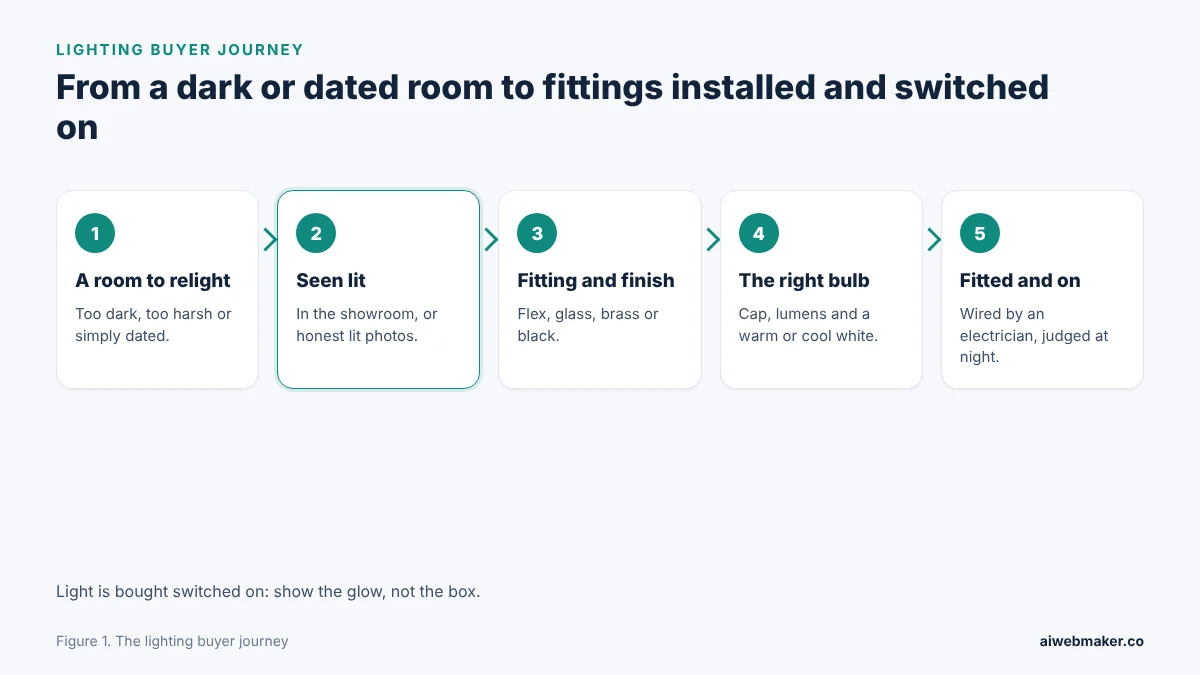
Following the five boxes from the left, the path begins with a room that feels too dark, too harsh or simply dated. The highlighted box is the moment the buyer sees the light lit, whether in a showroom on a late evening or through honest photos and a clear note of the warmth and brightness. A choice of fitting and finish follows, and then the bulb, where the cap and the kelvin figure decide whether the light works at all. Installation comes next, and any fitting wired into the mains needs a qualified electrician. The final box is the room switched on in the evening, which is when people decide whether to recommend the shop. Each page on a lighting site should help the buyer picture the light lit rather than boxed.
Fittings, bulbs and room guides: the pages a showroom site needs
A showroom's website needs fitting and bulb pages, a bulb box guide, room advice and a trade page. Short pages on delivery, returns and the showroom itself complete it. Fitting pages carry pendants, wall lights, lamps and outdoor lanterns, each with its finish, its cap and the brightest bulb it takes. The bulb guide explains lumens, kelvin, colour rendering and caps, which removes the most common reason for a return. Room pages turn a catalogue into advice, because buyers think in rooms rather than in product types. A trade page speaks to the electricians and designers who often buy most of the stock. Arranged like this, the site sells to both the household and the professional without confusing either.
| Page | What the buyer looks for | What it should include |
|---|---|---|
| Pendants and ceiling lights | Size, glass, finish | Diameter, cap, flex or finish options, price |
| Wall lights and lamps | Glow and switching | Plug in or wired, dimmer notes, shade options |
| Outdoor lights | Weather protection | IP rating, finish, where it may be fitted |
| Bulbs | The right cap and white | Cap, lumens, kelvin, dimmable or not |
| Room guides | What a room needs | Layers of light, heights, warmth for each room |
| Trade accounts | Prices and delivery to site | How to apply, terms once approved, bulk bulbs |
| Advice and visits | Help with a whole house | Showroom advice, home visits, made to measure work |
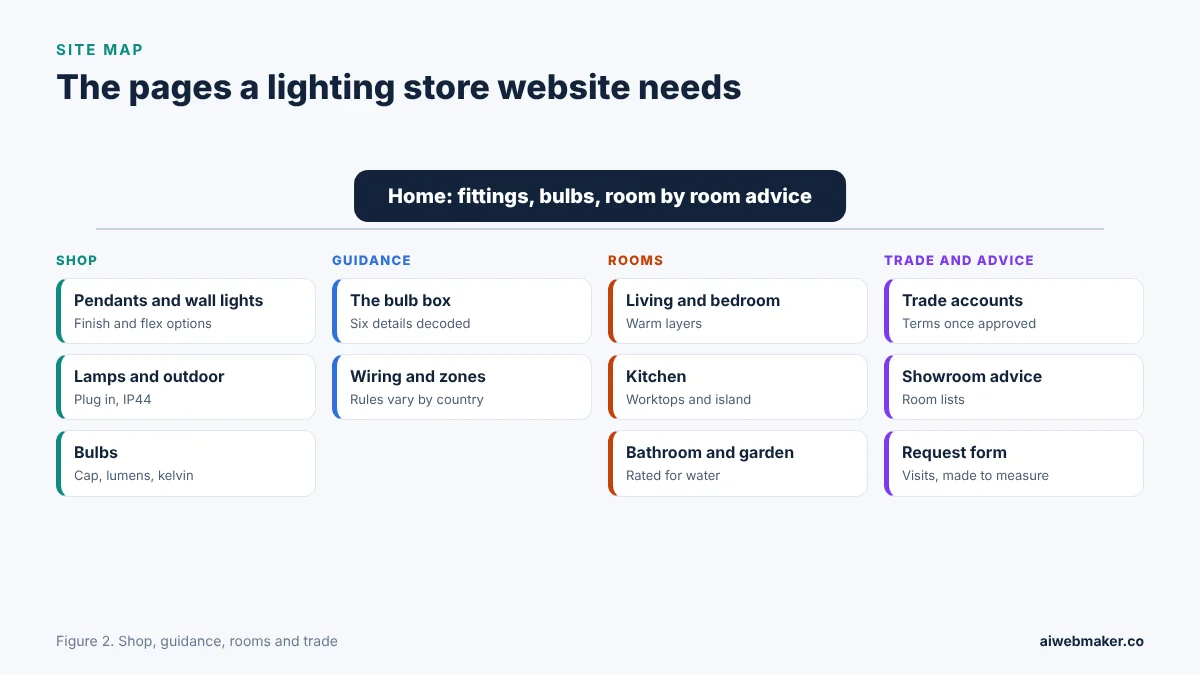
Hanging from the home page, the lighting site divides into the shop, the guidance pages, the room pages and the trade and advice pages. The shop holds fittings, outdoor lights and bulbs, the guidance pages decode the bulb box and the wiring rules, the room pages cover the main rooms of a house, and the last group holds trade accounts, showroom advice and the request form. Our sample showroom, Lumenhouse Lighting, sells an opal globe pendant of 30 cm, a ribbed glass wall light, a linen drum floor lamp, an outdoor wall lantern rated IP44 and a dimmable LED filament bulb, with a cluster pendant for a stairwell made to measure. Its room guides cover the living room, kitchen, bedroom, bathroom, hall and stairs, and garden and porch. The lighting store website example with bulb caps and room by room advice also has a table that decodes the bulb box, a trade accounts section, showroom photos, questions and a form for advice, visits and made to measure pendants. That order mirrors a good showroom visit, where the fittings come first and the advice follows close behind.
Reading the bulb box: lumens, kelvin, colour rendering and caps
The bulb box causes more wrong orders than any fitting, so a lighting site should translate it line by line. Lumens describe how much light a bulb gives, which matters far more than the old habit of judging brightness by watts. Kelvin describes how warm or cool the white looks, and the sample suggests 2700 K for living rooms and bedrooms and a cooler white for kitchens and desks. Colour rendering, shown as CRI, says how true colours look under the light, which matters where people cook, dress or paint. The cap must match the lamp holder, and confusing a screw cap with a bayonet is the classic mistake. A short table on every bulb and fitting page heads off these errors before they reach the returns shelf.
| On the box | What it means | A sensible starting point |
|---|---|---|
| Lumens | How much light the bulb gives | About 800 for a reading lamp or single pendant |
| Kelvin (K) | How warm or cool the white looks | 2700 K in living rooms, cooler for kitchens and desks |
| CRI | How true colours look, out of 100 | 90 or above where colour matters |
| Cap | The base that fits the holder | Match the fitting: E27, B22, E14 or GU10 are common |
| Dimmable | Whether it works on a dimmer | Pair with a dimmer made for LED |
| IP rating | Protection from dust and water | Higher ratings outdoors and near water, by local rules |
Room by room advice that turns a catalogue into a plan
Room guides are where a lighting store shows its expertise, because most rooms need layers of light rather than one bright fitting. A living room usually wants a general glow, a reading light by the chair and a lamp or two for the evening. Kitchens need worktops lit from in front so that cooks do not work in their own shadow, and the sample suggests island pendants hung about 75 cm above the top. Bedrooms want warm, soft light with a switch reachable from the bed. Halls and stairs need every tread lit clearly, with a switch at the top and the bottom. Advice set out room by room gives buyers a lighting plan instead of a catalogue to wade through.
| Room | What to light | Warmth or rating to start from |
|---|---|---|
| Living room | A general glow, reading, evening lamps | Around 2700 K, on dimmers |
| Kitchen | Worktops from in front, an island | 3000 K or so, high CRI |
| Bedroom | Soft light, a reading lamp, a reachable switch | Very warm whites |
| Bathroom | Mirror and general light near water | A suitable IP rating for each zone |
| Hall and stairs | Every tread and the front door | Switches at top and bottom |
| Garden and porch | The path, the step and the door | Outdoor rated, aimed downward |
Finish options, bulb caps and an Enquire button for made to measure pendants
Product options matter more in lighting than in most shops, because the same pendant can come with different flexes, finishes or caps. The online store builder for lighting shops with finish and cap options lets each fitting carry a choice such as a black braid flex or a brushed brass finish, and lets each bulb carry its cap, so the right version lands in the bag. Checkout then adds the delivery fee, and discount codes can be entered on the same page. A made to measure cluster pendant, built for one stairwell, has no fixed price and shows an Enquire button that leads to the request form. The fitting page should still name the cap and the brightest bulb each fitting takes, so that the bulb added alongside is one that fits. Options, honest specifications and an enquiry route together cut wrong orders to a minimum.
Wiring, bathroom zones and when a qualified electrician is needed
A lighting store should be clear that any fitting wired into the mains is a job for a qualified electrician, following the rules where the buyer lives. Electrical rules differ between countries, and some limit what a householder may install without certification. Bathrooms and outdoor spaces carry extra rules about which fittings may go where, often expressed as zones and IP ratings. The sample sells and advises but does not wire, and it says so in its questions. Plug in lamps are the exception, since they work straight from the box. A plain safety note on every wired fitting protects buyers and keeps the shop out of advice it should not give.
Trade accounts for electricians and interior designers
Electricians, designers, builders and property managers often buy far more light than households, so a trade page deserves care. The sample offers trade prices on fittings and bulbs, 30 day account terms once approved, bulbs by the box of ten, delivery to site and sample fittings on loan for client meetings. It also lets trade buyers share room lists with their clients, which saves both sides time. Lumenhouse states how to apply and says most accounts open within two working days, which is exactly the detail a busy electrician scans for. A clear trade route brings in steady repeat orders that a household shop alone could not match. Professionals who find these details quickly tend to come back for every new job.
How do people find a lighting showroom online?
People looking for lights type phrases such as pendant lights for a kitchen island, dimmable LED bulb, outdoor wall lantern, lighting shop near me or bathroom ceiling light. Headings on product and room pages that echo those words catch the search at its source. A map listing with late opening hours, photos of lit fittings and a link to the room guides helps people who want to see lamps after dark. Reviews that mention a lighting list for a whole kitchen or a floor lamp chosen at night carry real weight with new buyers. Articles on choosing a warm white, lighting a staircase or picking a dimmer for LED attract readers who are still planning. Writing of this kind makes the shop the first stop when a room needs relighting.
Hosting, a domain and articles: the showroom's yearly spend
Only two lines recur on a lighting showroom's website budget, hosting and the domain, while articles on lamps and bulbs are drafted for a few cents each. Showrooms with a settled trade base often choose annual billing, and a newly opened shop can stay monthly through its first seasons. Twelve lighting articles use roughly $7.80 in credits across the year. New fittings, revised prices and extra room guides are added without any further charge. The two billing columns sit below, with the $189 tier listed as a comparison only.
| Item | Yearly | Monthly |
|---|---|---|
| Hosting the fittings, bulbs and room guides | $119 | $228 over twelve months |
| Domain | Depends on the ending | Depends on the ending |
| Higher plan, for comparison | $189 a year | Not needed |
| Twelve lighting articles at about $0.65 | About $7.80 | About $7.80 |
| New fittings, prices and room guides | No charge | No charge |
| Year before the domain | About $126.80 | About $235.80 |
What sends a lamp buyer to another showroom?
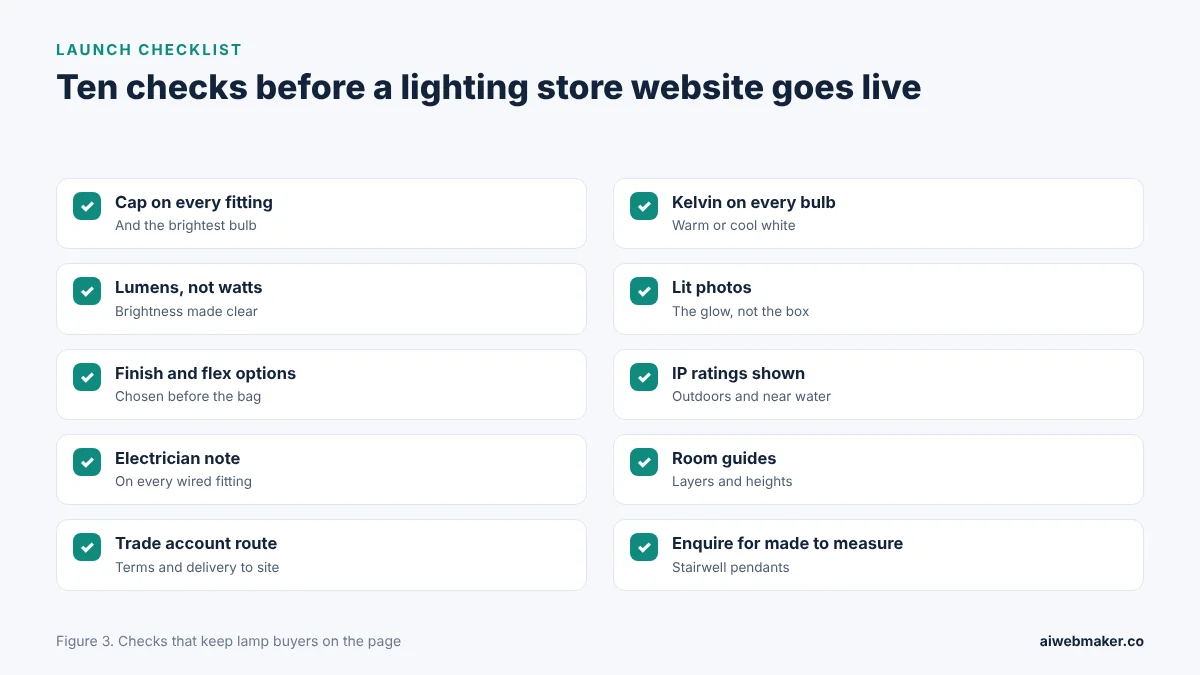
Lamp buyers leave a lighting site when a fitting shows no cap and no limit on bulb brightness, which makes the right bulb a guess. Photos of fittings switched off give no sense of the glow they cast in a real room. Missing kelvin figures leave buyers fearing a cold white in a warm living room. Outdoor and bathroom lights without IP ratings make careful buyers wonder whether the shop understands safety. Silence about made to measure work and trade accounts sends designers and electricians elsewhere. Ten lighting checks, pictured below, put right each fault on that list.
Frequently asked questions
Can a lighting shop sell fittings that need wiring?
A lighting shop can sell wired fittings, but the product page should state clearly that installation needs a qualified electrician. Rules on who may carry out electrical work differ between countries, and some require certification for new circuits. Bathroom and outdoor fittings carry extra rules about zones and protection. Plug in lamps can be used straight from the box. Clear notes keep buyers safe and the shop honest.
Which bulb details should appear on a fitting page?
Each fitting page should name the cap it takes and the highest output or wattage it allows. A suggested bulb with a matching cap, a sensible lumen figure and a warm or cool white helps buyers choose in one step. If the fitting suits a dimmer, the page should say so and recommend dimmable bulbs. Outdoor and bathroom fittings should also show their IP rating. These details prevent most wrong bulb orders.
Why does an LED bulb flicker on a dimmer?
Older dimmers were designed for filament bulbs and often clash with LED bulbs. A dimmer made for LED, paired with bulbs marked dimmable, usually cures the problem. The website can explain this in a short note on bulb and dimmer pages. An electrician can check which dimmer is fitted and replace it if needed. Simple guidance saves many frustrated calls to the shop.
What returns policy suits a lighting store?
Lighting stores commonly take back unused fittings still in their boxes for a fixed number of days, and Lumenhouse allows 30. Made to measure pendants are built for one space and are usually final. Bulbs may come back only if faulty, since used bulbs cannot be resold. Glass shades need careful packing, so the page can explain how returns should be boxed. Local consumer law may give buyers further rights in some countries.
Pendants over the island, and the hosting they repay
A single kitchen lighting list, with pendants, worktop lights and bulbs, usually earns more than the showroom spends on hosting for twelve months. A showroom on monthly billing finds its $19 smaller than the till receipt for one box of filament bulbs. Every electrician who opens a trade account after reading the trade page adds orders job after job. Clear caps, honest kelvin figures and room guides persuade buyers who would otherwise wander between three showrooms. Lighting shops that keep their room guides and stock current will see the site bring people to the showroom ready to switch things on.
Build your website in Minutes and get the AI Tools that work
Start Building Your Website →