Farm Shop Website Cost, With Every Label Saying Who Grew It
Farm shop hosting is $119 a year, or $19 a month, plus a domain. Inside: who buys from a farm online, the pages a farm shop needs, provenance labels, cuts and options, seasonal boxes, cold delivery and food rules, the cafe, search and the yearly sums.
- No coding required
- Live in minutes
- Blog, SEO and chatbot tools included
A farm shop's eggs, meat and seasonal boxes can sell from an AI Web Maker site hosted at $119 across a farming year or $19 in a monthly plan, plus a domain. AI Web Maker makes no charge for drafting the shelf cards, the provenance table and the box pages, or for checking them in the preview. Half a lamb cut to one family's list, or a month of family boxes, comes close to paying for the hosting on its own. The real test for a farm shop online is honesty, because shoppers choose it to buy from the farm, and a shelf that blurs the farm's own produce with bought in goods loses that trust quickly. Seasons add a second difficulty, since what the fields offer changes from week to week. What follows covers who buys from a farm online, the pages a farm shop needs, provenance labels, cuts and options, seasonal boxes, cold delivery and food rules, the cafe, search and the hosting figures.
This article is part of our complete guide: Retail Website Design.
Weekly shoppers, box customers and day trippers: who visits a farm shop online
Farm shop customers come for different reasons, but most share a wish to know where their food was grown. Local households do a weekly shop for eggs, meat and vegetables and like to check the week's shelves before driving up the lane. Box customers want a weekly delivery or collection that follows the season without the effort of choosing. Families buying meat in bulk want a cutting list followed exactly and a date they can plan around. Day trippers look for the cafe, opening hours, parking and whether children and dogs are welcome. Answering each of them plainly online fills both the shelves and the cafe tables.
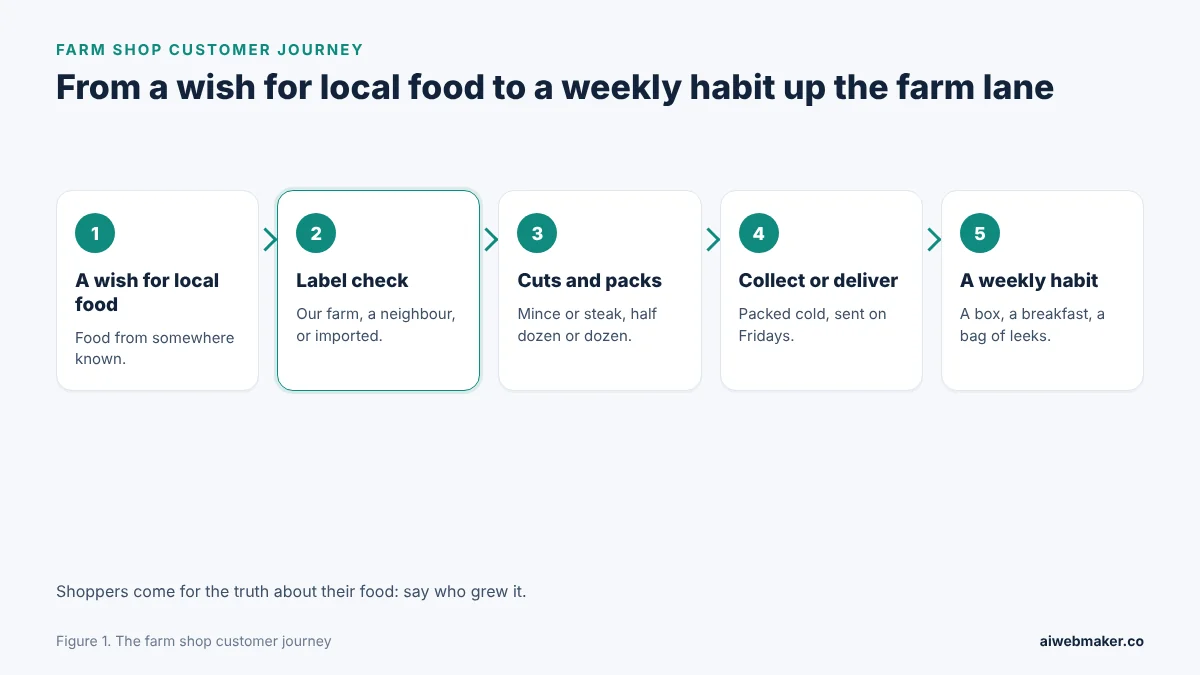
Moving along the row, the journey starts with a wish for food that comes from somewhere known, often after a disappointing supermarket shop. The highlighted step is the label check, because shoppers want to see whether an item is the farm's own, a neighbour's or imported. Choosing cuts, packs and sizes comes next, then collection from the shop or a cold delivery on the set day. The final step is the weekly habit, a box every Friday or a Saturday breakfast in the barn followed by a bag of leeks. That habit is what keeps a farm shop busy through the quieter months. Each page of the site should make the provenance step clear and quick to read.
Shelves, provenance and boxes: the pages a farm shop needs
A farm shop's site needs shelf pages for eggs, meat, vegetables and neighbours' produce. Alongside them sit a provenance page, a box page, a bulk meat page, a cafe page and a visiting page. Shelf pages carry the item, the pack or cut, the price and a clear label saying who grew it. The provenance page sets out where each shelf comes from and how far it travels. The box page lists the sizes, the weekly prices and how to skip or stop. The cafe and visiting pages cover hours, menus, allergens, parking, children and dogs. Pages arranged like that sell the week's food and still give people a reason to drive out.
| Page | What the shopper checks | What it should include |
|---|---|---|
| Eggs and meat | Cut, pack, price, origin | Cuts and packs as options, own farm label |
| Vegetables and fruit | What is in season | Weekly availability, farm or bought in |
| Neighbours' produce | Who made it | The neighbour named, distance travelled |
| Provenance | Where each shelf comes from | Own, neighbouring or imported, by season |
| Seasonal boxes | Size, price, flexibility | Weekly prices, skip and stop rules, delivery area |
| Bulk meat | Half a lamb or a beef box | Cutting list, lead time, cold packing |
| Cafe and visiting | Hours, menu, access | Allergens, parking, children, dogs |
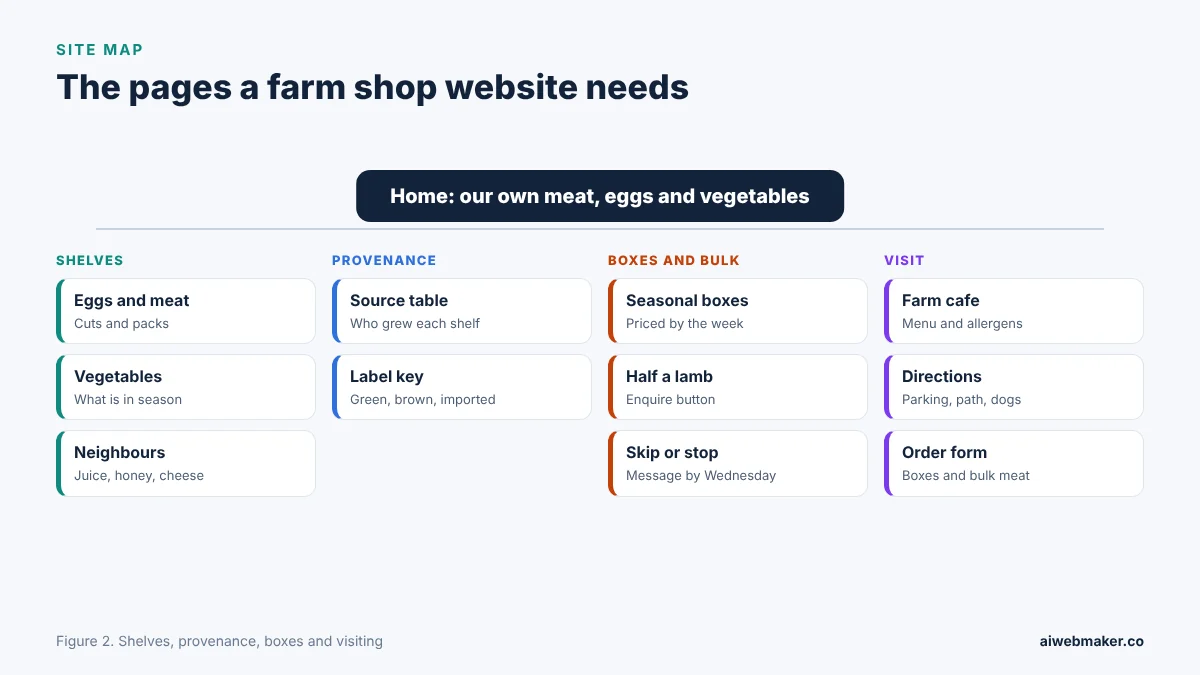
Spreading out from the home page, a farm shop's site falls into the shelves, the provenance pages, the boxes and bulk meat, and the visit pages. The shelves hold eggs, meat and neighbours' produce, the provenance pages hold the source table and the label key, the boxes group holds the three weekly boxes and bulk meat orders, and the visit group holds the cafe, directions and the order form. Hedgerow Farm Shop, the sample, sells eggs from its own hens, beef mince and steaks, a rolled lamb shoulder, cloudy apple juice and hedgerow honey, while half a lamb cut to the buyer's list is handled by enquiry. Its boxes are a small vegetable box, a family box and a meat and vegetable box, and its cafe serves a farm breakfast. The farm shop website example with provenance labels and seasonal boxes also shows a source table, a section on what the farm grows and buys in, the cafe menu, farm photos, questions and a form for boxes and bulk meat. That layout leads with honesty, which is the reason most people choose a farm shop in the first place.
Green labels, brown labels and an honest source table
Provenance is the heart of a farm shop's website, and the sample handles it with a simple label system. A green label means an item came off the farm, a brown label names the neighbour who grew or made it, and imported goods are labelled as imported. A source table then lists each shelf, who produced it and roughly how far it travelled. The sample also admits that its own vegetables run thin from late winter into spring, when more of the shelf comes from neighbours and the wholesaler. Owning up to that gap, often called the hungry gap, builds more trust than pretending the fields produce all year. Clear labels let shoppers buy with confidence and come back knowing nothing was hidden.
| Shelf in the sample | Grown or made by | How far it travels |
|---|---|---|
| Beef and lamb | The farm's own herd and flock | Raised on the farm, small abattoir 12 miles away |
| Eggs | The farm's own hens | Laid on the farm |
| Root and leaf vegetables | The farm's own fields | Picked on the farm |
| Apples and juice | An orchard two villages over | About 6 miles |
| Milk, butter and cheese | A dairy farm over the hill | About 3 miles |
| Lemons, rice and coffee | A wholesaler | Imported, and labelled that way |
Cuts, packs and jar sizes as options, and bulk meat by enquiry
Farm produce comes in many cuts and packs, so product options keep orders accurate. Eggs in the sample come as a half dozen or a dozen, beef as mince, rib eye or braising steak, lamb shoulder in two sizes and honey in two jars. The online store builder for farm shops selling cuts and packs attaches those choices to each card and lets the shopper fill one bag, after which checkout adds the delivery fee and takes any discount code. Half a lamb or a beef box, butchered to the buyer's cutting list and ready on a set date, goes on the card with an Enquire button and no figure. The meat page should state how long the meat is hung and how it is packed, since those details matter to careful cooks. Options for the everyday shelf and enquiries for bulk orders keep both kinds of buyer happy.
Seasonal boxes, skip weeks and the Friday round
Seasonal boxes give a farm shop steady weekly income, and the page should make them easy to understand. The sample offers three boxes, each priced by the week and packed on Friday mornings with what the fields are giving. Customers can skip a week or stop with a message by Wednesday, and they can say which vegetables they never want. Each box comes with a list of what is the farm's own and what is not, which keeps the honesty of the shelves running through the boxes. Boxes are collected from the shop on Friday afternoon or delivered within ten miles, and the sample arranges each box through its order form with payment settled directly. A clear box page turns occasional shoppers into weekly regulars.
| Sample box | Price a week, from | What it usually holds |
|---|---|---|
| Small vegetable box | $22 | Six or seven vegetables for two, mostly the farm's own |
| Family box | $34 | Vegetables and fruit for four, with half a dozen eggs |
| Meat and vegetable box | $58 | A family box plus two or three cuts of beef or lamb |
Cold packing, delivery days and food rules that vary by country
Selling meat and eggs online brings food safety duties, and the website should explain how food reaches the customer in good condition. The sample packs meat cold and sends it out on Fridays only, with collection from the shop adding nothing to the bill. Food labelling and safety rules differ between countries, including what must appear on a label and how chilled food must travel. Claims such as organic are usually protected by certification rules, and the sample says plainly that it is not certified and so does not use the word. Allergen information for the cafe sits on the counter board, and visitors are asked to speak to the team if anything worries them. A farm shop that follows its local rules and says so earns lasting confidence.
The farm cafe, children, dogs and the walk past the hens
The cafe often brings first time visitors who later become shop regulars, so it deserves its own page with a menu and prices. The sample's barn cafe cooks with what the shop sells that morning, from a farm breakfast to soup of the day and a ploughman's lunch, with a children's plate as well. A visiting page should cover parking, a level path to the door, opening hours and the cafe's serving times. It should also answer the questions families ask most, such as whether children can see the animals and whether dogs are welcome. The sample allows dogs on leads in the yard and at outside tables, with only assistance dogs inside, and asks visitors to keep to the fenced path. Details like these turn a day out into a reason to come back.
How people search for a farm shop and its boxes
People looking for a farm shop type the food, the format or the place. Typical phrases are farm shop near me, local meat box, eggs from a farm, vegetable box delivery or farm cafe for breakfast. Shelf and box pages that name the cut, the box size and the delivery area answer those searches closely. The map listing should carry shop and cafe hours, directions from the nearest crossroads, photos of the hens and the shelves, and a link to the boxes. Reviews that mention a cutting list followed exactly or an honest box list in March persuade new shoppers strongly. Articles on cooking a lamb shoulder, what grows in each month or how the hens move round the orchard attract readers long before they visit. Steady, honest writing makes the farm a name people trust for their weekly food.
What the farm gate's website costs from one harvest to the next
Hosting and a domain are the farm shop's yearly website outgoings, and a seasonal article costs less in credits than half a dozen eggs. Farms with a settled box round tend to settle annually, while a newly opened farm shop may pay monthly through its first full season. Twelve months of seasonal articles add up to roughly $7.80. Adding new cuts, changing box prices or posting the week's vegetables costs nothing further. Annual against monthly billing for the farm shop follows, the $189 tier sitting there purely as a comparison.
| Item | Yearly | Monthly |
|---|---|---|
| Hosting the shelves, boxes and cafe pages | $119 | $228 over twelve months |
| Domain | Depends on the ending | Depends on the ending |
| Higher plan, for comparison | $189 a year | Not needed |
| Twelve seasonal farm articles at about $0.65 | About $7.80 | About $7.80 |
| New cuts, box prices and weekly lists | No charge | No charge |
| Year before the domain | About $126.80 | About $235.80 |
What makes shoppers drive past a farm shop's gate?
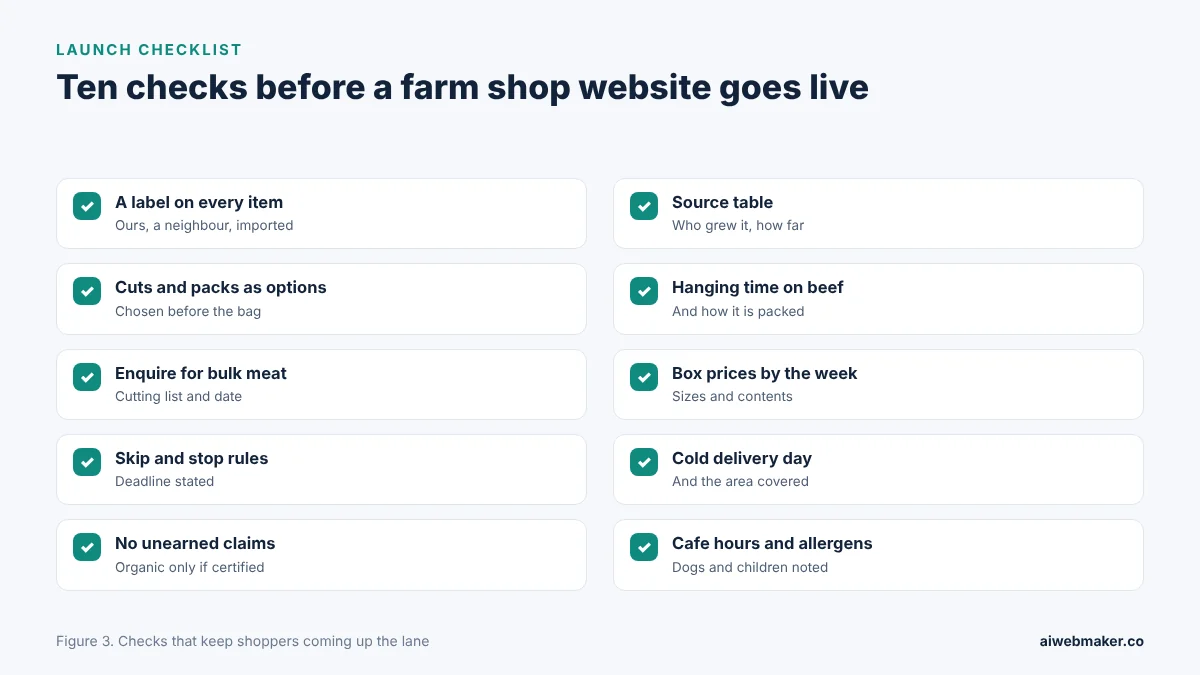
Shoppers pass a farm shop by when the site lists produce without saying which items the farm grew and which it bought in. Meat cards with no cut, weight or hanging time leave cooks unsure what they are paying for. Box pages without weekly prices or skip rules make a regular order feel like a trap. Missing cafe hours, menus or allergen notes send families to another stop on their day out. No word on cold packing or delivery days worries anyone ordering meat. Ten farm shop checks follow in the picture below, starting with the labels.
Frequently asked questions
Should a farm shop say which products it buys in?
A farm shop should say clearly which products it grows and which it buys in, because provenance is why most customers choose it. The sample uses a green label for its own produce, a brown label naming the neighbour and an imported label for goods from further away. A source table on a separate page adds detail. Owning up to seasonal gaps, when bought in produce fills the shelves, builds trust rather than losing it. Honest labelling is a farm shop's strongest selling point.
Can a farm shop call its meat organic?
Organic is a legally protected word in many countries, reserved for producers certified under a recognised scheme. A farm that is not certified should avoid the word, as the sample does, even if its methods are traditional. The page can describe how the animals are raised, such as grazing the farm's fields and eating its own hay in winter. Rules on food claims vary between countries, so shops should check what applies locally. Accurate wording protects both the farm and its customers.
How does ordering half a lamb work?
In the sample, the buyer sends the order form with their cutting wishes and receives a date, usually two or three weeks ahead. The meat is then butchered to the list, labelled joint by joint and packed cold for collection or delivery. The website should explain the lead time, how the cuts are chosen and how payment is arranged with the shop. A short guide to common cuts helps first time buyers. Clear steps make a large order feel simple.
Can seasonal box contents be changed?
Most farm shops let box customers name vegetables they never want, while the rest of the box follows the season. The sample asks for changes, skips or stops by message by Wednesday, ahead of Friday packing. The box page should state the deadline and the delivery area clearly. A weekly list of what is in the box, and what is the farm's own, keeps customers informed. Flexible rules help boxes become a long term habit.
Half a lamb, a box round and the hosting they repay
One order of half a lamb usually brings in more than the farm shop spends on hosting for the year. On monthly billing, a single family box each week outweighs the $19 by a wide margin. Every household that starts a seasonal box after reading the box page may stay for years, and every cafe visitor who leaves with eggs and honey adds to the till. Honest labels, clear cuts and plain box rules persuade shoppers who came to the farm for the truth about their food. Farm shops that keep their weekly lists and labels current will see the website bring cars up the lane every Friday.
Build your website in Minutes and get the AI Tools that work
Start Building Your Website →