Fabric Store Website Cost for Cloth Sold by the Metre, Swatch First
A fabric store can run its cloth shop online for $119 a year, or $19 a month, plus a domain. Inside: who buys cloth online, the pages a fabric shop needs, cut lengths, shrinkage, swatches, upholstery rules, classes, search and costs.
- No coding required
- Live in minutes
- Blog, SEO and chatbot tools included
A fabric store can show its bolts, swatches and sewing classes through AI Web Maker for $119 a full year or $19 a month at a time, plus a domain. No charge from AI Web Maker applies to writing the cloth cards, the shrinkage table and the class pages, or for trying them out in the preview. Three metres of upholstery velvet sold to one chair maker can repay the year of hosting in a single order. The real difficulty is that cloth is bought by touch and by eye, and neither travels well through a screen. A dressmaker cannot feel the drape of wool crepe or see how a linen shrinks, so the site has to describe what the hand would normally learn at the counter. This guide covers who buys cloth online, the pages a fabric shop needs, cut lengths and widths, shrinkage, swatches and returns, upholstery rules, classes, search and what the site costs to run.
This article is part of our complete guide: Retail Website Design.
Who orders cloth online, and what makes them hesitate?
Cloth buyers range from first time sewers to professional upholsterers, and almost all of them hesitate over the same thing: whether the fabric will look and behave as they hope. Home dressmakers want the width, the fibre, the weight and a care note before they commit to a few metres. Upholsterers and curtain makers care about durability, fire safety and whether a full roll can be ordered. Costume makers and theatre workrooms often need unusual colours in long lengths, usually against a deadline. Beginners look for classes, because a shop that teaches them to sew becomes the shop where they buy every future length. When the site answers each of these makers in their own terms, a hesitant visit ends in a cut length or a swatch card.
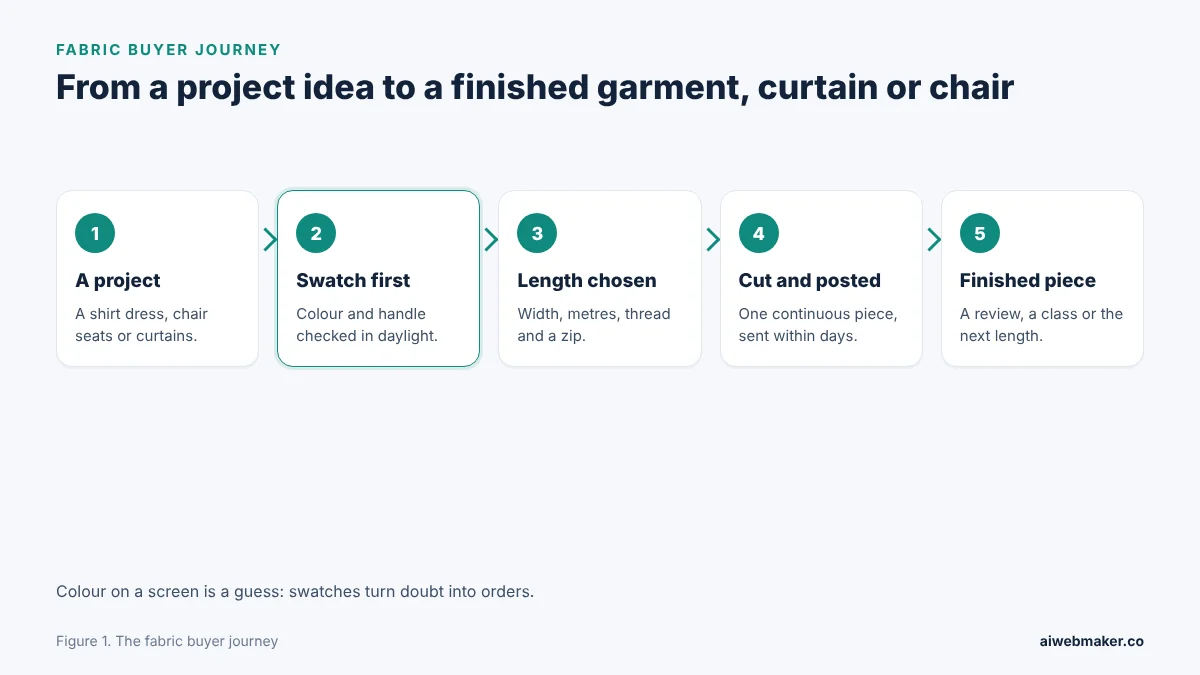
Across the five stages, the path starts with a project, such as a shirt dress, two dining chair seats or curtains for a bay window. The highlighted stage is the swatch, because colour on a screen is a guess and handle cannot be seen at all. Once the swatch has settled the choice, the buyer picks a length and adds the finishing pieces, such as matched thread and a zip. Cutting and posting follow, and a promise of a cut within a set number of days removes another worry. The finished piece closes the path, and that is the moment a satisfied maker leaves a review or books a class. Helping buyers through the swatch stage sells more cloth than any clever headline.
Bolts, swatches and classes: the pages a fabric shop runs
Each family of cloth deserves its own page on a fabric shop's site, alongside pages for swatches, care, haberdashery, classes and trade lengths. Fabric pages carry the products, each with its width, fibre, weight and price per metre. The care page explains shrinkage and washing, which most buyers want to know before cutting. A swatch page lets people order small pieces before committing to a length. Classes deserve their own page with dates, group sizes and prices, because they bring in a steady stream of new sewers. Grouped like this, the site lets confident buyers order cloth directly and gives cautious ones a route to feel it first.
| Page | What the buyer checks | What it should state |
|---|---|---|
| Dressmaking fabrics | Drape, weight, width, price | Fibre, width in cm, price per metre, length option |
| Upholstery fabrics | Durability and safety | Fire tests passed, cleaning, colour options |
| Haberdashery | Pieces to finish the job | Thread, zips, interfacing, buttons |
| Care and shrinkage | What happens in the wash | Typical shrinkage by fibre, prewash advice |
| Swatches | Colour and handle before buying | Number of swatches, price, posting time |
| Classes | Learning to sew | Dates, group size, price, what to bring |
| Trade lengths | Full rolls and long cuts | How to ask, how quickly prices come back |
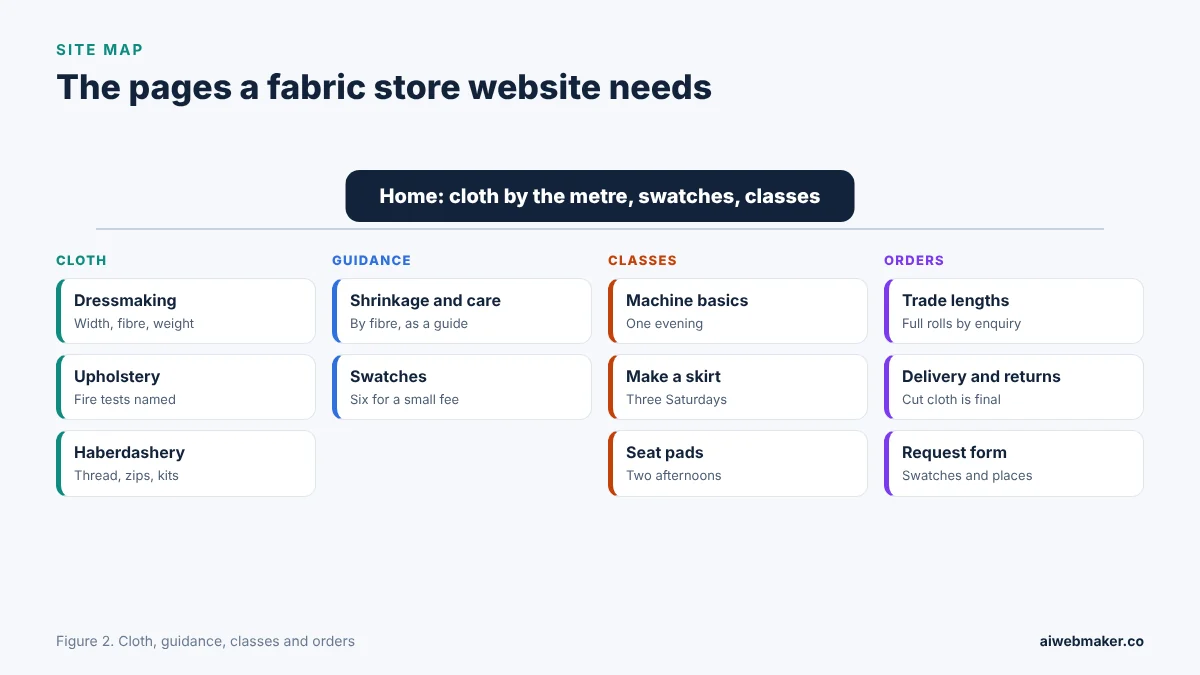
From the home page, a fabric shop's site splits into four families: cloth, guidance, classes and orders. Cloth pages hold dressmaking fabrics, upholstery fabrics and haberdashery, guidance pages hold the care table and the swatch service, class pages hold the courses, and order pages hold trade lengths, delivery and the request form. Our sample shop, Weft and Warp Fabrics, sells washed linen, a small floral cotton lawn, wool crepe, upholstery velvet and a finishing kit, with full rolls and trade lengths offered by enquiry. It also teaches machine basics in one evening, a skirt over three Saturdays and seat pads with a footstool over two afternoons. The fabric store website example with cut lengths and swatches by post adds a shrinkage table, a swatch section, shop photos, questions and a form for swatches, class places and full rolls. That sequence follows the way a maker actually shops, from cloth to care to the finishing pieces.
Selling cloth by the metre: lengths, widths and one continuous piece
Selling by the metre needs more explanation than selling a boxed product, because the buyer chooses an amount rather than an item. The page should state the smallest cut and the steps above it, and the sample cuts from 50 cm and then in steps of 10 cm. Width matters as much as length, since a pattern asks for different amounts for cloth 115, 140 or 150 cm wide. Buyers also need to know that a chosen length arrives as one continuous piece rather than several shorter ones. The online store builder for fabric shops selling cut lengths gives each cloth a length or colour option, holds the chosen pieces in the bag, adds the delivery fee during checkout and accepts discount codes there too. Full rolls and trade lengths carry an Enquire button, since their price depends on the quantity and the bolt in stock.
| Sample fabric | Width | Price per metre | Suits |
|---|---|---|---|
| Washed linen | 150 cm | $22 | Shirts, dresses, trousers |
| Cotton lawn, small floral | 140 cm | $16 | Light shirts and linings |
| Wool crepe | 150 cm | $34 | Dresses and soft tailoring |
| Upholstery velvet | 140 cm | $48 | Chairs and cushions |
| Full rolls and trade lengths | Varies | By enquiry | Upholsterers, costume and curtain workrooms |
Shrinkage, fibre care and the extra ten centimetres
Shrinkage is the question that decides whether a finished garment fits, so a fabric shop should answer it honestly on every card. Natural fibres such as linen and cotton often shrink in the first wash, while viscose can shrink more and wool can felt if washed too hot. The sample washes a 50 cm test square from every new bolt and measures it again, putting the result on the product card. Its advice is to buy an extra 10 cm for every metre of a fibre that shrinks and to prewash before cutting. Figures like these should always be framed as a guide, because every bolt differs. Care advice of this kind saves makers from the disappointment of a garment that no longer fits.
| Fibre | How it usually behaves | Care to suggest |
|---|---|---|
| Linen, unwashed | Shrinks noticeably in the first wash | Prewash at the heat that will be used, press while damp |
| Linen, prewashed at the mill | Shrinks very little | Cool wash, iron slightly damp |
| Cotton lawn and poplin | Shrinks a little | Prewash, warm wash, medium iron |
| Viscose | Can shrink a lot | Cool hand wash, dry flat, never tumble |
| Wool crepe | Felts if washed hot | Steam to preshrink, cool hand wash or dry clean |
| Upholstery velvet | Not made for washing | Vacuum, spot clean, professional cleaning |
Swatches before scissors, and why cut cloth is usually final
Swatches are the fabric shop's answer to the screen problem, and they deserve a prominent place on the site. The sample posts up to six swatches for $4, each on a card with the width, fibre, weight and care written on the back. For upholstery, a larger piece shows the texture and colour across a seat far better than a small square. Swatches also make the returns policy fair, because cut lengths are made to order and usually come back only if the cloth is faulty. The returns page should say this plainly and point buyers towards swatches whenever colour or handle matters. Statutory rights for shoppers differ between countries, and where they go further than the shop's own rule, they win.
Upholstery fabric and fire safety rules that differ by country
Upholstery fabric carries a responsibility that dressmaking cloth does not, because furniture must meet fire safety rules where it is used. Those rules differ between countries, and some require specific tests for the cover fabric, the filling or both, for example in the United Kingdom. Each upholstery card should name the tests the cloth has passed and state where it is intended for use. The sample does this and adds that an upholsterer can advise on interliners where they are needed. Durability ratings, cleaning advice and colour options also help, since a chair cover has to survive years of use. A careful upholstery page protects the buyer, the upholsterer and the shop.
| Upholstery detail | What the card should state |
|---|---|
| Fire tests | Which tests the cloth has passed, and for which uses |
| Durability | Any abrasion rating the maker provides |
| Fibre and weight | What it is made of and how heavy it feels |
| Cleaning | Vacuuming, spot cleaning, professional cleaning |
| Colour options | Each shade, ideally with a swatch on request |
Sewing classes at the cutting table
Classes turn a fabric shop into a place people return to, because every new sewer needs cloth for every new project. The sample runs classes in groups of six, with machines, irons and cutting mats provided. Machine basics takes one Thursday evening for $45, making a skirt takes three Saturday mornings for $160, and seat pads with a footstool take two afternoons for $240. Each class page should state the dates, the group size, the price, the skill level and what is included. Fabric for a project can be bought in the shop, often at a class discount, which links the classes straight back to the shelves. Class places are arranged through the request form, so the page should explain how a place is confirmed and how payment is settled with the shop.
What do sewers type when they look for cloth?
Sewers looking for cloth usually type a fibre, a use or a place. Typical phrases include linen fabric by the metre, upholstery velvet, cotton lawn, fabric shop near me or sewing classes for beginners. Product pages that name the fibre, the width and the weight match those searches more closely than a page simply titled fabrics. A map listing for a fabric shop works best with its opening hours, a line about the lift or entrance, pictures of the bolt wall and a link through to the cloth pages. Reviews that mention accurate shrinkage notes, quick swatches or patient teaching carry real weight with cautious buyers. Articles on choosing fabric for a first dress, prewashing linen or measuring for chair seats attract makers before they buy. Pages like these make the shop the name sewers trust for their next project.
What the bolt wall's web pages cost across a year
Hosting and a domain are the two fixed costs for a fabric shop's pages, while a run of sewing articles adds loose change in credits. Long running shops with loyal makers tend to settle annually, whereas a newly opened cloth shop could stay monthly until its swatch requests turn into steady cutting. A year of monthly sewing articles uses about $7.80 of AI credits. New bolts, revised prices per metre and fresh class dates are added at no cost. Annual and monthly billing for the cloth shop stand next to each other here, and the $189 row is a reference point rather than a recommendation.
| Item | Yearly | Monthly |
|---|---|---|
| Hosting the fabric, swatch and class pages | $119 | $228 over twelve months |
| Domain | Depends on the ending | Depends on the ending |
| Higher plan, for comparison | $189 a year | Not needed |
| Twelve sewing articles at about $0.65 | About $7.80 | About $7.80 |
| New bolts, prices and class dates | No charge | No charge |
| Year before the domain | About $126.80 | About $235.80 |
Why do makers close a fabric site without ordering?
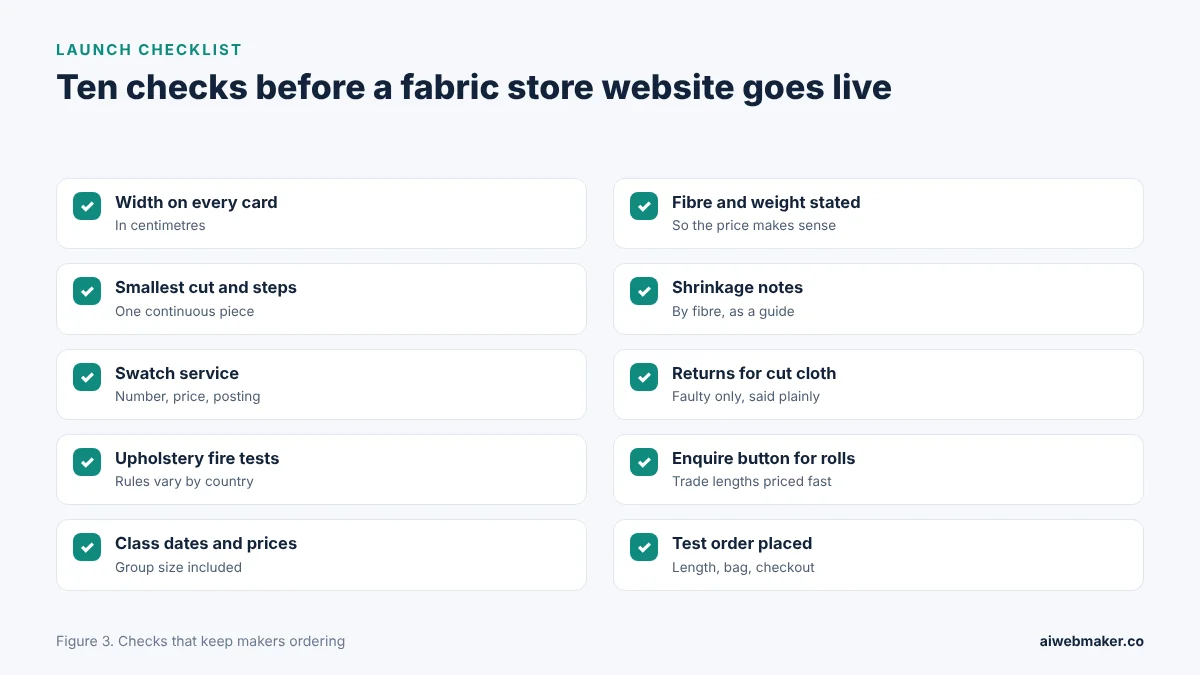
Makers close a fabric site when the cards give a price but no width, fibre or weight, which makes the price per metre impossible to judge. A missing shrinkage note leaves them fearing a garment that will not fit after its first wash. No swatch service means a large order rests on a screen colour, and many careful buyers will not take that risk. Upholstery cloth without fire information makes professionals look elsewhere at once. Classes listed without dates or prices feel like a promise rather than a plan. The ten fabric shop checks shown next settle every one of those worries.
Frequently asked questions
What is the smallest length a fabric shop should cut?
Many fabric shops cut from half a metre and then in steps of ten centimetres, which is what the sample offers. The website should state the smallest cut and the steps clearly on every fabric card. Longer lengths should be cut as one continuous piece, and the page can say so. If a bolt runs short, the shop should call the buyer before cutting rather than send two pieces. Clear cutting rules prevent disappointment when the parcel arrives.
Can fabric cut to length be returned?
Cut lengths are made to order, so most fabric shops accept them back only if the cloth is faulty. That is why swatches matter so much, and the returns page should point buyers towards them. Unopened haberdashery, such as zips and thread, can often be returned within a set period. In some countries the law grants shoppers more than a shop's own policy does. Stating the policy plainly saves awkward conversations later.
Should a shop prewash fabric before selling it?
Some fabrics, such as the sample's washed linen, are prewashed at the mill, which reduces later shrinkage. Most cloth is sold unwashed, and buyers are advised to prewash it themselves in the way they will wash the finished piece. The card should say which applies to each fabric. Dry clean only cloth can often be steamed to preshrink instead. Honest notes help makers plan their lengths with confidence.
How should sewing classes be priced on the site?
Each class should show a price per place, the number of sessions, the group size and what the price includes. The sample lists machine basics at $45, a skirt course at $160 and an upholstery course at $240. Notes on machines provided, skill level and any class discount on fabric help people decide. Dates should be kept current so visitors never ask for a class that has already run. Clear class pages fill places without endless questions.
A few metres of cloth against a year of hosting
One upholstery order of a few metres of velvet usually brings in more than the shop's year of hosting. On monthly billing, a single cut of linen for a dress outweighs the $19 comfortably. Every maker who learns to sew in a class may come back for cloth for years, and every swatch that leads to a full order shows the system working. Honest widths, shrinkage notes and fire information persuade careful buyers far better than polished slogans. Shops that keep their cards and class dates current will find the website quietly filling the cutting table.
Build your website in Minutes and get the AI Tools that work
Start Building Your Website →