Craft Store Website Cost, Yarn Weights, Dye Lots and Workshop Seats
A craft store's yarn, kits and workshop pages cost $119 a year to host, or $19 a month, plus a domain. Inside: who buys, the pages a craft shop needs, yarn weights, dye lots, kits and ages, workshops, group orders, search and the budget.
- No coding required
- Live in minutes
- Blog, SEO and chatbot tools included
For roughly the price of eleven balls of merino, $119, AI Web Maker hosts a craft store's yarn, kits and workshop seats for a year, or $19 monthly, plus a domain. Drafting the product cards, the yarn weight table and the workshop pages, then checking each one in the preview, goes unbilled by AI Web Maker. A single school order of matching kits can cover the year's hosting several times. The harder job is that crafters buy for a project they can already picture, and the wrong yarn weight, a missing dye lot or a kit too fiddly for a child spoils it. Craft supplies also span knitting, paper, paint and embroidery, so the site has to speak to several hobbies at once. What follows covers who shops for craft supplies, the pages a craft store needs, yarn weights, dye lots and options, kits and age labels, workshops, group orders, search and the yearly sums.
This article is part of our complete guide: Retail Website Design.
Knitters, card makers and parents: who shops for craft supplies
Craft shoppers arrive with a project in mind, and each hobby brings its own questions. Knitters want the yarn weight, the metres per ball, the fibre and enough balls from one dye lot to finish a jumper. Paper crafters want sheet sizes, weights in grams per square metre and colour mixes. Painters want to know how many colours a set holds and whether the paints suit a beginner or a working artist. Parents, teachers and club leaders look for kits that are safe for a given age and can be bought in matching sets. Beginners of every age look for workshops, because learning a craft in a group is far easier than learning it alone. A craft website that answers each hobby in its own language keeps every maker on the page.
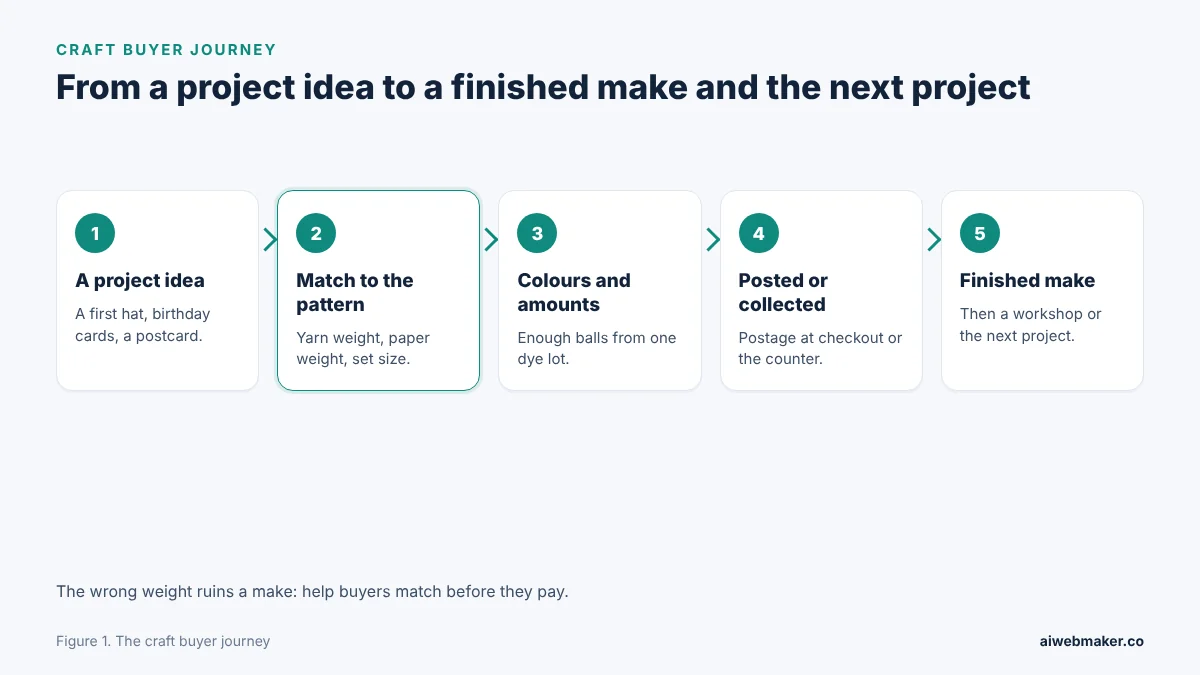
Left to right, the journey starts with a project idea, such as a first hat, a set of birthday cards or a watercolour postcard. The highlighted step is matching the materials to the pattern, because a yarn of the wrong weight or a paper too thin for the job ruins the result. Choosing colours and quantities follows, and for yarn that includes buying enough from a single dye lot. Delivery or collection comes next, with postage added at checkout or a counter pickup. The finished make closes the loop, and many crafters then book a workshop or start the next project straight away. Each page on a craft site should help the buyer get past the matching step with confidence.
Shelves, guides and the workshop table: pages a craft store needs
A craft store's site needs shelf pages for yarn, paper, paint and kits, a yarn guide, a workshops page, a group kit page and pages for delivery and returns. Yarn pages carry the weight, the fibre, the metres per ball and the colours. Paper and paint pages carry sizes, weights and set contents. The yarn guide translates weight names between countries, which is where many online buyers get stuck. Workshop and group kit pages bring in income beyond the shelves and introduce new makers to the shop. A layout like this lets each hobbyist head straight for the shelf they need.
| Page | What the maker checks | What it should include |
|---|---|---|
| Yarn | Weight, fibre, length per ball | Colour options, dye lot note, care |
| Paper and card | Size and weight | Sheet sizes, grams per square metre, pack count |
| Paints and brushes | Colours and quality | Set size, beginner or artist range |
| Kits | What is inside and for whom | Contents, age label, project sheet |
| Yarn guide | Matching a pattern | Weight names by country, needle sizes |
| Workshops | Learning at the table | Length, ages, group size, price |
| Group kits | Classes, clubs, parties | How to ask, numbers, dates |
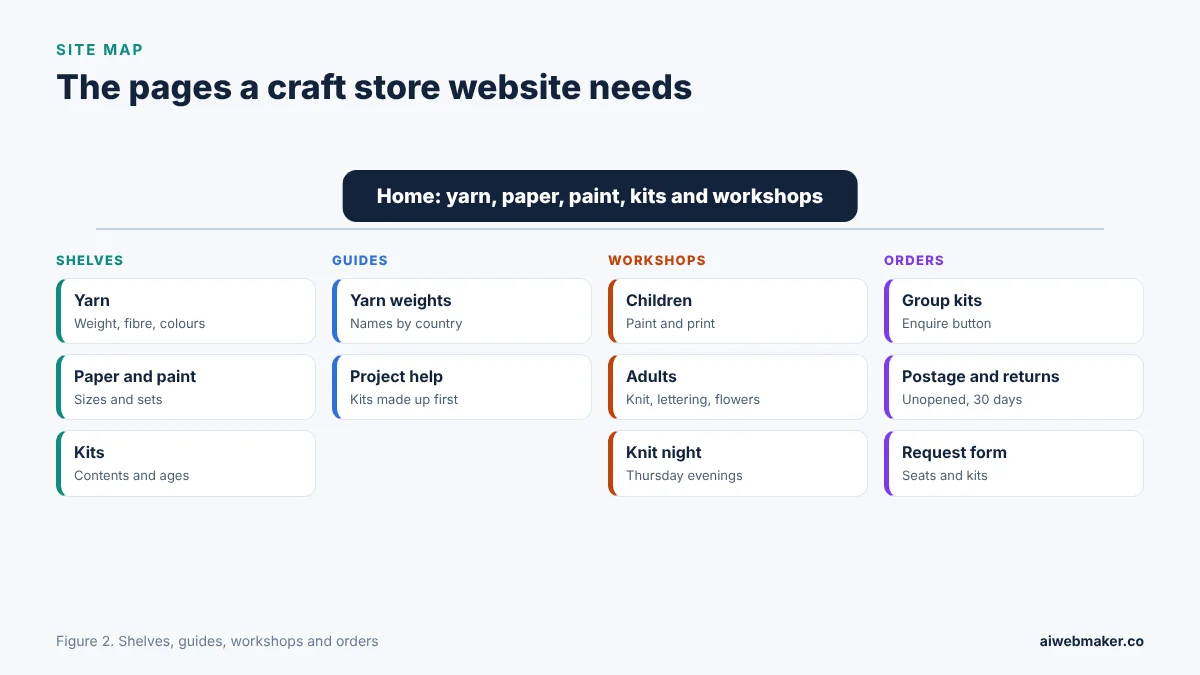
The craft site's home page fans out into shelves, guides, workshops and orders, mirroring the way the shop floor is laid out. Shelves hold yarn, paper, paints and kits, guides hold the yarn weight table and the project help, workshops hold the classes for children and adults, and orders hold group kits, postage and returns. Makers Corner Crafts, the sample store, sells merino yarn in DK weight, a watercolour pan set, a cardstock pack, a beginner knitting kit and an embroidery hoop kit, with class or party kits packed to order by enquiry. Its workshops are kids' paint and print, first knit, brush lettering and paper flowers. The craft store website example with yarn weights and workshop seats also includes a yarn weight table, a project help section, this season's merino colours, photos from the long table, questions and a form for workshops and group kits. That sequence starts with the shelves and ends at the workshop table, which is how a regular customer grows.
Yarn weights, ply names and the needle sizes behind them
Yarn weights cause more confusion online than any other craft detail, because the same yarn goes by different names in different countries. A yarn called DK in one place may be sold as 8 ply or light worsted in another. Needle sizes help, but they are a starting point, since the pattern and the knitter's own tension decide the final size. The sample's table lists each weight with its other names, typical needle sizes and good first projects. It also invites makers who are unsure to bring a pattern to the counter, where staff compare the metres per 100 g. A clear yarn table prevents the most common wrong order in a craft shop.
| Weight | Also called | Needles | Good for |
|---|---|---|---|
| Lace | 1 ply, 2 ply | 2 to 3.25 mm | Shawls and fine edgings |
| Fingering | 4 ply, sock | 2.25 to 3.5 mm | Socks and baby clothes |
| DK | 8 ply, light worsted | 3.75 to 4.5 mm | Jumpers, hats, blankets |
| Worsted and aran | 10 ply | 4.5 to 5.5 mm | Cables and cosy jumpers |
| Chunky | 12 ply, bulky | 6 to 8 mm | Quick hats and scarves |
| Super chunky | 14 ply and up | 9 mm and up | Arm knitting, fast blankets |
Dye lots, colour choices and the bag
Dye lots matter because hand dyed and small batch yarns vary from one lot to the next, and a jumper knitted from two lots can show a visible line. The sample dyes its own merino colours in small lots and tells buyers to buy enough for the whole project from one lot. The online store builder for craft shops selling yarn by colour lets each ball, pan set or paper pack carry its colour, size or design as an option, collects the maker's picks in the bag and adds postage at checkout, where discount codes can be entered as well. Group and party kits, priced by the number of makers, show an Enquire button instead of a fixed figure. A note beside each yarn on how many balls a typical project needs helps buyers order in one go. Options and lot notes together keep the colour even from the first row to the last.
Kits made up before they go on sale, and honest age labels
Kits are where a craft store's reputation is won or lost, because a kit that cannot be finished leaves a disappointed maker. The sample makes up every kit in the shop before it goes on sale, so the project sheet has been followed by real hands, and rewrites the sheet when a step trips people up. Age labels matter just as much, since kits often hold needles, beads and other small parts. The sample labels its kits for ages 8 and up unless an adult is making alongside, and points younger makers to the kids' paint range or a supervised workshop. Toy and craft safety rules differ between countries, so a shop should check what applies where it sells. Honest labels and tested sheets protect children and keep parents coming back.
Workshop seats, ages and group sizes at the long table
Workshops give a craft store income beyond the shelves and turn beginners into regulars. The sample runs groups of eight or fewer, with every material laid out before people arrive, and children under 12 come with an adult who stays. Each workshop page should state the length, the age range, the price per seat and what makers take home. A seat in the sample is held once the shop replies to a request, and payment is settled with the shop when the place is confirmed. Dates go up each month, so the page should say where new dates appear. Clear details fill seats without endless questions.
| Sample workshop | Length | Ages | Price per seat |
|---|---|---|---|
| Kids' paint and print | 90 minutes | 6 to 11 | $18 |
| First knit | 2 hours | 12 and up | $38 |
| Brush lettering | 2 hours | Adults | $42 |
| Paper flowers | 2.5 hours | 14 and up | $45 |
Class kits, club orders and party tables packed to order
Group kits are a valuable line for a craft store, because a single school or club order can equal a week of shelf sales. The page should ask for the number of makers, their ages and the date the kits are needed. The sample packs matching kits in named bags for classrooms, clubs and birthday tables, and replies with a price. A note on lead times helps organisers order early enough. Reviews from teachers and party hosts carry real weight here, since organisers worry about missing pieces. A clear group kit route brings in large orders that the shelves alone could never match.
How crafters search for yarn, kits and workshops
Crafters search with a material and a detail, typing phrases such as merino DK yarn, watercolour pan set, beginner knitting kit, craft shop near me or kids' craft workshop. Product pages that name the weight, the fibre, the sheet size or the age range give those searches a page that fits them exactly. The map listing should carry knit night hours, photos of the yarn wall and a link to the workshop page, for makers who like to squeeze the yarn before buying. Reviews that mention a pattern matched at the counter or a calm children's session carry weight with new visitors. Articles on choosing a first yarn, reading a dye lot label or planning a craft party attract readers before they shop. Useful pages like these make the store the local home of making.
What a craft store's site costs once hosting and articles are counted
Year on year, a craft store's site needs only hosting and a domain, and a knitting pattern article uses only a sliver of a dollar in credits. Shops with a busy workshop calendar often prefer annual billing, and a store in its opening months can pay monthly while knit night finds its regulars. Twelve knit, paint and paper articles across the year come to about $7.80. Adding yarn colours, new kits or workshop dates costs nothing extra. The yarn shop's two billing routes are laid out below, and the $189 tier is shown so the gap is clear.
| Item | Yearly | Monthly |
|---|---|---|
| Hosting the shelves, guides and workshop pages | $119 | $228 over twelve months |
| Domain | Depends on the ending | Depends on the ending |
| Higher plan, for comparison | $189 a year | Not needed |
| Twelve project articles at about $0.65 | About $7.80 | About $7.80 |
| New colours, kits and workshop dates | No charge | No charge |
| Year before the domain | About $126.80 | About $235.80 |
Why do makers leave a craft shop's site empty handed?
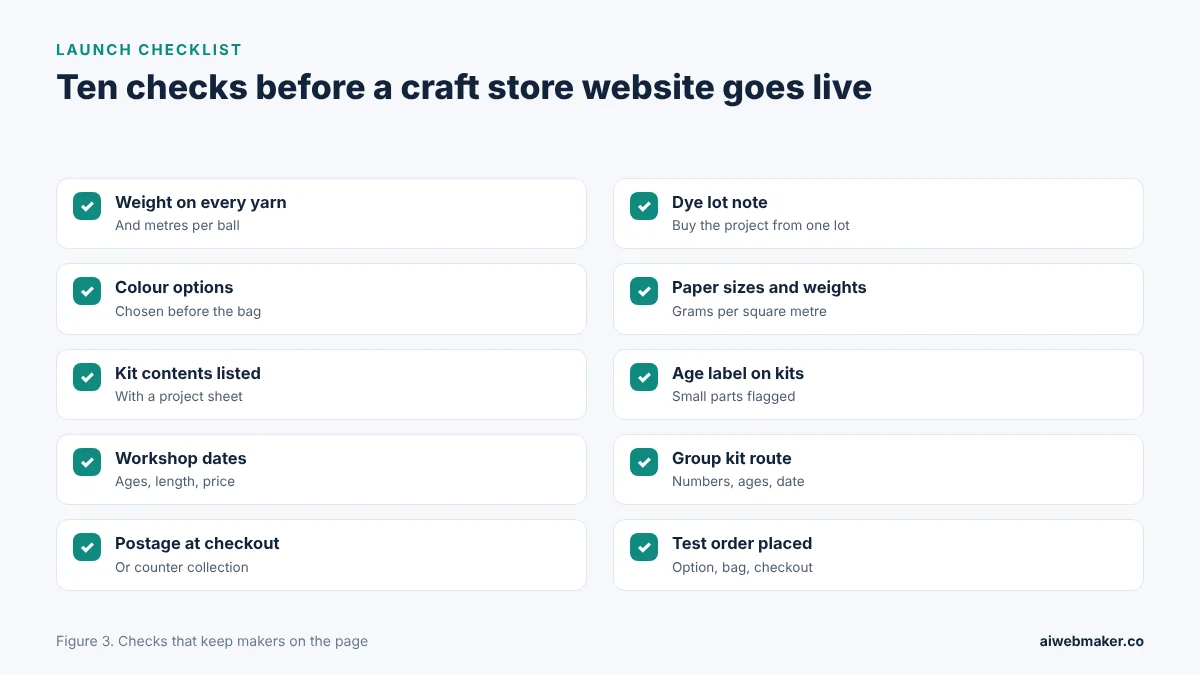
Makers leave a craft site when a yarn card gives a colour and a price but no weight, length or fibre. A missing dye lot note leaves knitters afraid of a striped jumper they never wanted. Kits without an age label or a list of contents make parents and teachers hesitate. Workshops listed without dates, ages or prices feel too vague to plan around. No route for group kits sends schools and clubs to a wholesaler. Ten craft store checks follow in the next image, covering those gaps and several others besides.
Frequently asked questions
Can a craft shop match yarn to a pattern written for another brand?
Yes, a knowledgeable craft shop can usually suggest a yarn with the same weight, length per ball and fibre as the one a pattern asks for. The sample invites makers to share those details and suggests knitting a small swatch first. Two yarns of the same weight can still knit up differently, so tension should be checked. The website can explain this on the yarn guide page. A good match saves a project from frustration.
How much yarn should a knitter buy for a project?
The pattern usually gives the amount in metres or yards rather than balls, so the shop page should show metres per ball. Buying the whole amount from one dye lot, plus a spare ball, avoids colour changes halfway through. The sample accepts unopened spare balls back within 30 days. Bigger sizes and long sleeves need more yarn than the smallest size in a pattern. Clear guidance helps knitters buy once and finish happily.
Are craft kits safe for young children?
Many craft kits contain needles, beads or small parts, so they are usually labelled for older children unless an adult helps. The sample labels its kits for ages 8 and up and offers a kids' paint range and supervised workshops for younger makers. Parents should always check the age label on the pack. Safety rules for toys and craft products vary between countries. Honest labels protect children and the shop alike.
How do workshop places work on a craft store website?
A workshop page can invite makers to send a request naming the workshop and the date they would like. The shop then replies to hold a seat or suggest another date, and payment is settled with the shop once the place is confirmed. The page should state group sizes, ages and what is included. Monthly dates should be kept current so nobody asks for a session that has already run. Clear workshop pages fill the table with little effort.
Balls of merino, class kits and the hosting they cover
Ten balls of merino for one jumper bring in close to the whole year of hosting for a craft shop. On the monthly plan, two workshop seats more than meet the $19. Every school that orders class kits after finding the group kit page may return term after term. Clear yarn weights, honest dye lot notes and tested kits persuade makers who would otherwise buy from a faceless warehouse. Keep the workshop dates and merino colours current, and the site keeps sending makers to both the shelves and the long table.
Build your website in Minutes and get the AI Tools that work
Start Building Your Website →