Car Parts Website Cost When Every Order Must Fit the Right Vehicle
A car parts store pays $119 a year to host its shop, or $19 a month, plus a domain. Inside: who buys parts, fitment checks, product options and the Enquire button, returns and cores, counter services, trade runs, search and costs.
- No coding required
- Live in minutes
- Blog, SEO and chatbot tools included
A car parts counter hosts its shop on AI Web Maker for $119 each year, or $19 in any trading month, and its domain is priced by the letters after the dot. Product cards, options and the fitment page can be set up and tested in the preview without any invoice, so the counter sees the shop running before paying a cent. One brake job's worth of pads and discs, sold once, already covers the hosting bill. The wrong part is the real enemy, because every return costs postage, handling time and the buyer's trust in the counter. Two cars of the same model and year can leave the factory with different brakes, filters or sensors, and buyers rarely know which one they have. What follows covers who buys parts online, fitment checks, options and the bag, returns and cores, counter services, trade accounts, search and the money involved.
This article is part of our complete guide: Retail Website Design.
Who buys car parts online, and what do they fear?
Car parts buyers range from weekend home mechanics to busy garages, and all of them share one fear: paying for a part that does not fit. Home mechanics want clear prices, a simple way to confirm fitment and a returns policy they can trust. Mobile mechanics and independent garages want speed, trade prices and delivery runs that keep their ramps moving. Fleet operators care about accounts, statements and consistent stock. Owners of older or imported cars often struggle to find parts at all, so they value a counter that reads old part numbers and orders in. A parts website that removes the fear of the wrong part wins every one of these buyers.
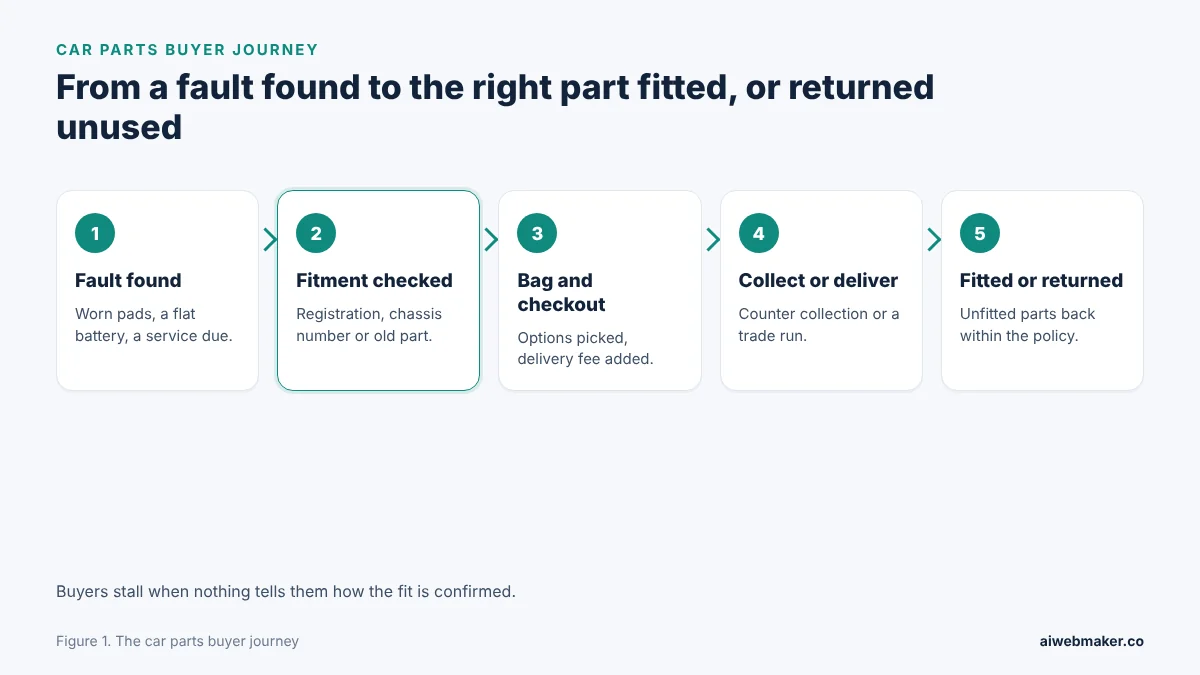
Reading across, the journey starts with a fault found on the drive or the ramp and ends with a part fitted or, occasionally, returned unused. The marked step is the fitment check, because buyers stall there when the site gives them no way to confirm the match. Options and the bag follow, where the buyer picks the axle, the diameter or the oil grade before checkout adds the delivery fee. Collection at the counter or a delivery run comes next, and speed matters most to trade buyers. A clear returns policy closes the path, and it often decides whether a cautious buyer orders at all. Each step needs a page or a section that answers the buyer's next worry before it is asked.
Shop, fitment, counter: pages a parts store needs
A parts store needs a shop, a fitment page and a few service pages, each written for buyers who are under time pressure. The shop pages carry the products, grouped by system such as brakes, service parts, electrical and body. The fitment page explains how the counter confirms a match, which is the reassurance every buyer needs before paying. Counter services, delivery and returns each need only a short page. A part enquiry route catches everything the shop does not list. Built this way, the site sells common parts directly and turns unusual requests into calls the counter can answer.
| Page | What the buyer checks | What it should include |
|---|---|---|
| Shop by system | Price and the right version | Options by vehicle, price, Add to bag |
| Fitment check | Whether it fits this car | Registration, chassis number, engine, old part number |
| Counter services | What can be done on the spot | Battery testing, paint mixing, brake pipes, bulbs |
| Delivery and collection | How soon it arrives | Collection time, delivery runs, fee at checkout |
| Returns | What happens if it is wrong | Unfitted parts, electrical parts, exchange cores |
| Part enquiry | Parts not listed online | Vehicle, part, registration or chassis number |
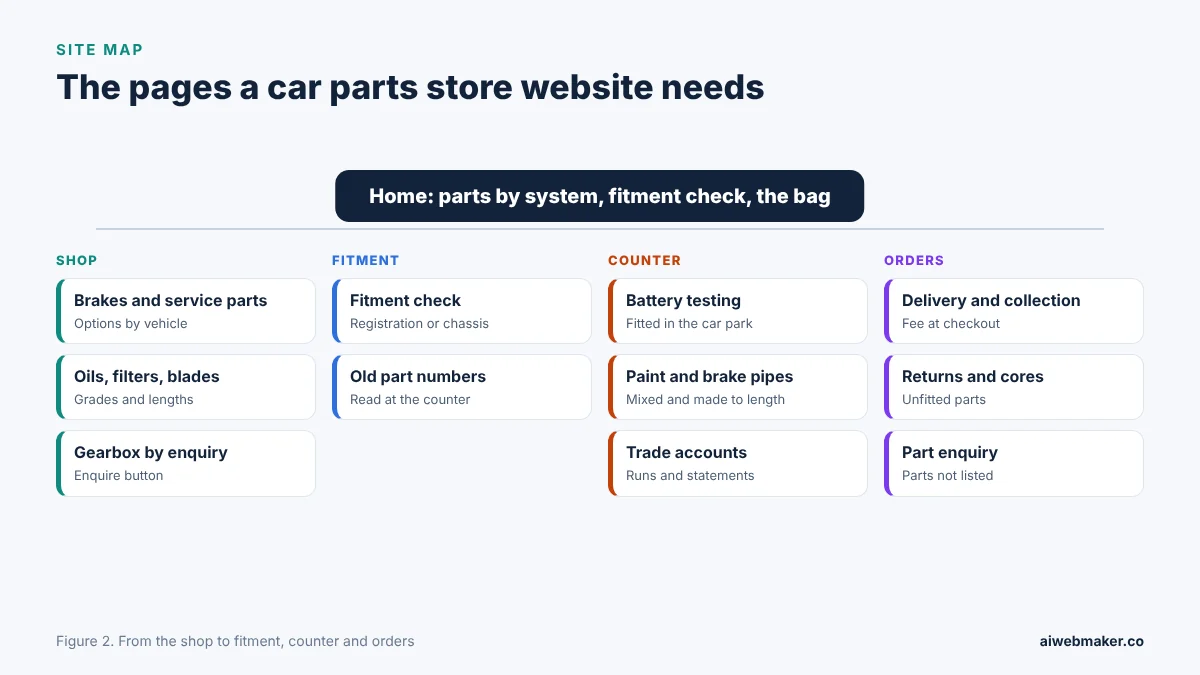
Grouped under the home page, the four branches here run from the shop to fitment, counter services and orders. Shop pages hold brakes, service parts and items priced by enquiry, fitment pages hold the vehicle details and old part numbers, counter pages hold batteries, paint, brake pipes and trade accounts, and order pages hold delivery, returns and the enquiry form. Our sample store, Gearbox Auto Parts, sells a brake pad set, a brake disc pair, engine oil in 5 litre cans, a service filter kit and a flat wiper blade pair, with a reconditioned gearbox listed by enquiry. Its counter services cover battery testing and fitting, paint mixed to a colour code, brake pipes made to length, and bulbs and wiper blades fitted. The car parts website example with fitment checks and a parts bag ends with ordering steps, store photos, reviews, questions and a form for parts not listed. That sequence suits most counters, because it starts where buyers start, with the part they need.
Registration, chassis number and the old part: confirming fitment
Fitment is confirmed by matching the vehicle's details to the part, and the website should explain which details the counter uses and why. A registration number allows a quick lookup in countries where national records permit it, but that lookup does not exist everywhere. The chassis number, often called the VIN, identifies the factory build wherever the car was first sold, which helps with imports. Engine size, fuel, gearbox type and drive narrow the choice for filters, clutches and driveshafts. The number cast or stamped on the old part is often the surest match of all. A page that sets out these details turns a nervous buyer into a confident one.
| Detail | What it settles | When it matters most |
|---|---|---|
| Registration number | The exact build, where lookups exist | Everyday cars in many countries |
| Chassis number (VIN) | The factory specification | Imports and countries without lookups |
| Engine, fuel and year | Service parts and engine family | Filters, belts, plugs |
| Gearbox and drive | Manual or automatic, two or four wheel drive | Clutches, driveshafts, gearbox oil |
| Number on the old part | A direct match to the original | Calipers, pumps, sensors |
Options, the bag and the Enquire button for unpriced parts
Product options are where a parts shop prevents most wrong orders, because the buyer must choose the version before adding to the bag. Brake pads can carry a front or rear axle option, discs a diameter, oil a grade and filter kits an engine range. The online store builder for parts counters that sell by vehicle option gives each product options like these, collects the chosen parts in a bag and finishes with a checkout where the delivery fee is added and discount codes can be entered. Where no fixed price exists, as with a reconditioned gearbox that depends on the gearbox code, the product shows an Enquire button so the counter can quote by code. Fitment should still be confirmed by the counter before packing, and the shop page should say so plainly. Options and enquiries together let the shop sell common parts quickly while keeping unusual ones under expert control.
| Product | Option the buyer picks | Why it matters |
|---|---|---|
| Brake pad set | Front or rear axle | Pads differ by axle and caliper |
| Brake disc pair | Disc diameter | Several sizes fit the same model |
| Engine oil | Viscosity grade | Must match the handbook |
| Service filter kit | Engine size and fuel | Filters change with the engine |
| Wiper blade pair | Blade lengths | Driver and passenger sides differ |
| Reconditioned gearbox | Enquire, no fixed price | Priced once the gearbox code is known |
Returns, exchange cores and connected electrical parts
A parts store's returns policy must be clear, because buyers worry about being stuck with a part that does not fit. Most stores accept unfitted parts in their original packaging within a set period, and the sample allows 30 days. Electrical parts that have been connected are often refused, since they cannot be resold safely, so buyers should check with the counter first. Exchange units, such as rebuilt calipers or gearboxes, often carry a core charge refunded when the old unit comes back. Consumer rights are not identical everywhere, and where local law gives buyers more than the store policy, the law applies. A plain returns page builds the confidence that makes the first order possible.
| Situation | Usual policy | What the page should say |
|---|---|---|
| Unfitted part, original packaging | Returned within the stated period | The period and the condition required |
| Counter's fitment check was wrong | Exchange or refund, delivery included | That the store takes responsibility |
| Electrical part already connected | Often not returnable | Check with the counter before fitting |
| Exchange unit with a core charge | Charge refunded on return of the old unit | What counts as an acceptable core |
Counter services: batteries, paint, brake pipes and bulbs
Counter services bring steady income and footfall, and the website should list them with starting prices and clear limits. Battery testing and fitting in the car park helps drivers who are stranded with a flat battery, and the old battery can be taken back for recycling. Paint mixed to the colour code on the body plate lets drivers repair stone chips and scratches at home. Brake pipes made to length save mechanics a trip across town. Bulbs and wiper blades can often be fitted on collection, while brakes, clutches and engine work belong in a workshop. A page that draws these lines honestly protects customers and the counter alike.
Trade accounts and delivery runs for garages
Garages and mobile mechanics often provide most of a parts counter's income, so trade accounts deserve their own section. The page should explain how to apply, that accounts are subject to approval and what the account offers, such as trade prices and a monthly statement. Delivery runs matter even more, because a garage with a car on the ramp needs the part within hours. Order cut off times and the area covered by each run should be stated clearly. A note that parts not in stock can be ordered for the next working day reassures trade buyers. Clear trade terms turn occasional garage orders into a daily habit.
Searches that start with a part name and a vehicle
Parts buyers search with a part name and a vehicle, such as brake pads for a particular model or an oil filter for a given engine. Others type car parts near me or motor factors open on Sunday. Product pages that name the systems, the options and the vehicles they fit match these searches better than vague category pages. A map listing with counter hours, parking at the door and photos of the counter helps drivers who need a part today. Reviews that mention the right part first time and quick collections carry real persuasive force. Articles on choosing an oil grade, recognising worn brake discs or reading a paint code attract buyers before they order. Useful pages like these make the counter the name drivers trust.
Hosting, credits and the domain behind a parts counter's shop
A parts shop's website costs little to keep: hosting at the yearly or monthly rate and a domain whose ending sets its price. Counters with an established trade list often settle twelve months in one go, and a store that has just opened can stay on monthly billing until orders build. AI credits for twelve maintenance articles total roughly $7.80. Editing options, adding parts or changing prices brings no extra fee. Below, yearly and monthly billing for a parts counter are set out in two columns, and the $189 tier is a benchmark only.
| Item | Yearly | Monthly |
|---|---|---|
| Hosting the parts shop | $119 | $228 over twelve months |
| Domain | Depends on the ending | Depends on the ending |
| Higher plan, for comparison | $189 a year | Not needed |
| Twelve maintenance articles at about $0.65 | About $7.80 | About $7.80 |
| New parts, prices and options | No charge | No charge |
| Year before the domain | About $126.80 | About $235.80 |
Why do drivers abandon a parts shop before checkout?
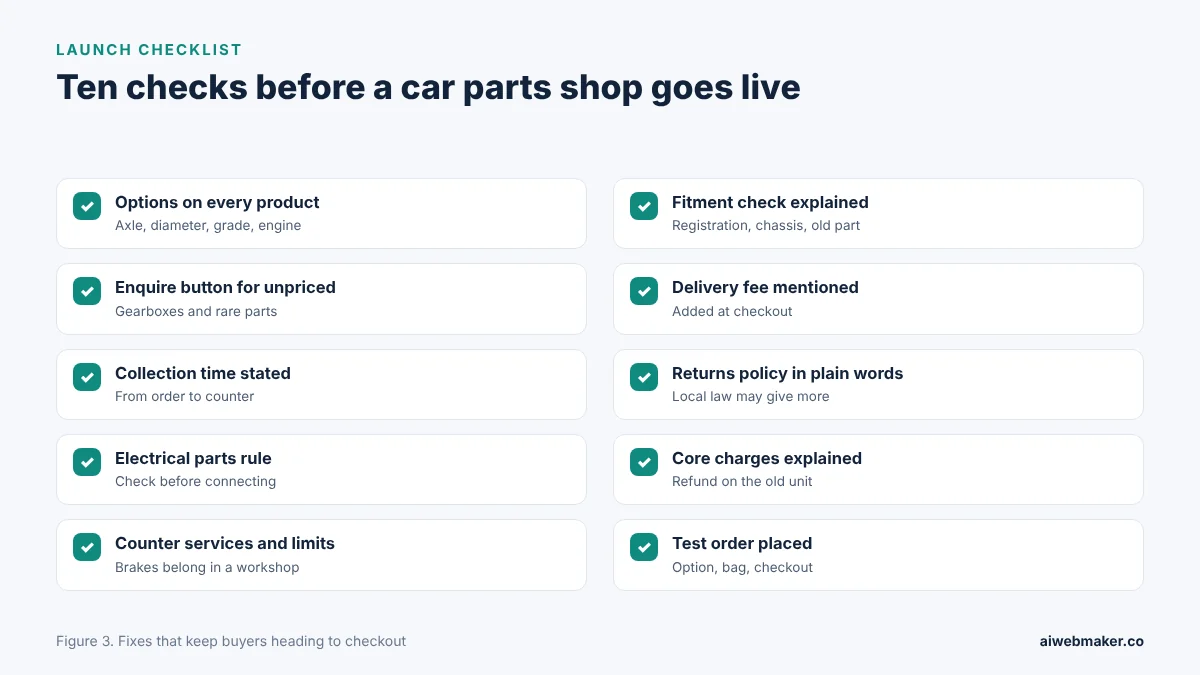
Drivers abandon a parts shop when products carry no options and no explanation of how fitment is confirmed. A returns policy that is missing or vague makes buyers fear being stuck with the wrong part. Delivery fees that only appear at the very end, without any note on the product page, feel like a surprise. Parts that are not listed, with no enquiry route, send buyers straight to a competitor. Stock photos of generic parts give no sense of a real counter behind the shop. The figure lists ten fixes that keep buyers moving towards checkout.
Frequently asked questions
What if the part arrives and does not fit?
If the counter checked the part against the vehicle details and it still does not fit, the store should exchange or refund it, including any delivery fee. If the buyer chose the wrong option without a check, the normal returns policy usually applies to unfitted parts in their packaging. The website should explain both cases clearly. Buyers should never fit a part that looks different from the old one, because fitted parts are often harder to return. Clear rules make buyers more willing to order online.
Is the registration number enough to find the right part?
In many countries a registration lookup identifies the exact build of a car, but the records are not available everywhere. Imported cars and older vehicles may not appear in lookups at all. The chassis number is a reliable alternative because it identifies the factory build. The number on the old part can settle remaining doubts, especially for calipers, sensors and pumps. A website that asks for these details in order helps every buyer find the right match.
Can a parts shop fit brakes in the car park?
Most parts shops fit only simple items, such as batteries, bulbs and wiper blades, where these can be reached without stripping trim. Brakes, clutches and engine work need a workshop with lifts, tools and trained mechanics. Brakes are safety critical, so poor fitting can have serious consequences. The website should say clearly what the counter fits and suggest nearby garages for bigger jobs. Honest limits protect drivers and the store's reputation.
What is a core charge on an exchange part?
A core charge is an extra amount paid when buying a rebuilt or exchange part, such as a caliper, starter motor or gearbox. It is refunded when the old unit is returned in a condition the rebuilder accepts. The charge encourages buyers to return old units so they can be rebuilt again. The website should explain what condition the old unit must be in and how long the buyer has to return it. Clear terms prevent disputes over refunds.
A single brake job against a full year of hosting
One set of brake pads and discs, sold to a home mechanic, usually brings in more than twelve months of hosting. Billed monthly instead, a few oil and filter orders outweigh the $19 several times. Every garage that opens a trade account after finding the delivery runs online adds orders every week. Clear options, an honest fitment check and plain returns rules persuade buyers who would otherwise phone three counters. Trade vans leaving full on both daily runs show the shop is doing its share of the selling.
Build your website in Minutes and get the AI Tools that work
Start Building Your Website →