Selling Candles Online: Website Cost, Scent Notes and Safe Labels
A candle shop stays hosted on $119 a year, or on $19 monthly payments, and its domain cost follows the ending picked. Covered: who buys, the pages, scent notes, wax and burn details, safety labels, photos, custom orders, shipping, search and the yearly budget.
- No coding required
- Live in minutes
- Blog, SEO and chatbot tools included
A candle maker's online shop sits on hosting that costs $119 per year, with a monthly route at $19, while the price of the domain depends on the ending chosen. While the shop takes shape and gets previewed, the maker owes AI Web Maker nothing, so every scent note and photo can be rewritten until it feels right. It can help to read the scent notes on the candle making business website AI Web Maker produced as a sample for a fictional chandler, where burn times and gift ideas are written out plainly. A handful of gift orders before a holiday season covers the whole year of hosting. The real challenge is that shoppers cannot smell a candle through a screen, so words and photos must do the work a sniff does in a shop. Candles are also an open flame in someone's home, which brings warning labels and rules that differ from country to country. This article walks through buyers, pages, scent notes, wax and burn details, labelling, photos, custom and wholesale orders, shipping, search and the annual budget.
This article is part of our complete guide: Retail Website Design.
Who buys handmade candles online, and what tips them into checkout?
Handmade candles are bought by several kinds of shopper, and each one is moved by something different. Gift buyers want a lovely jar, a scent that is hard to dislike and delivery in time for a birthday or holiday. Self treaters buy for mood, choosing a scent that matches a season, a room or a ritual such as a long bath. Event buyers, such as couples planning a wedding or companies sending client gifts, want matching candles in quantity with personalised labels. Shop owners looking for stock want wholesale terms, consistent batches and reliable lead times. A candle site that serves all of these shoppers, not only the first, sells all year round.
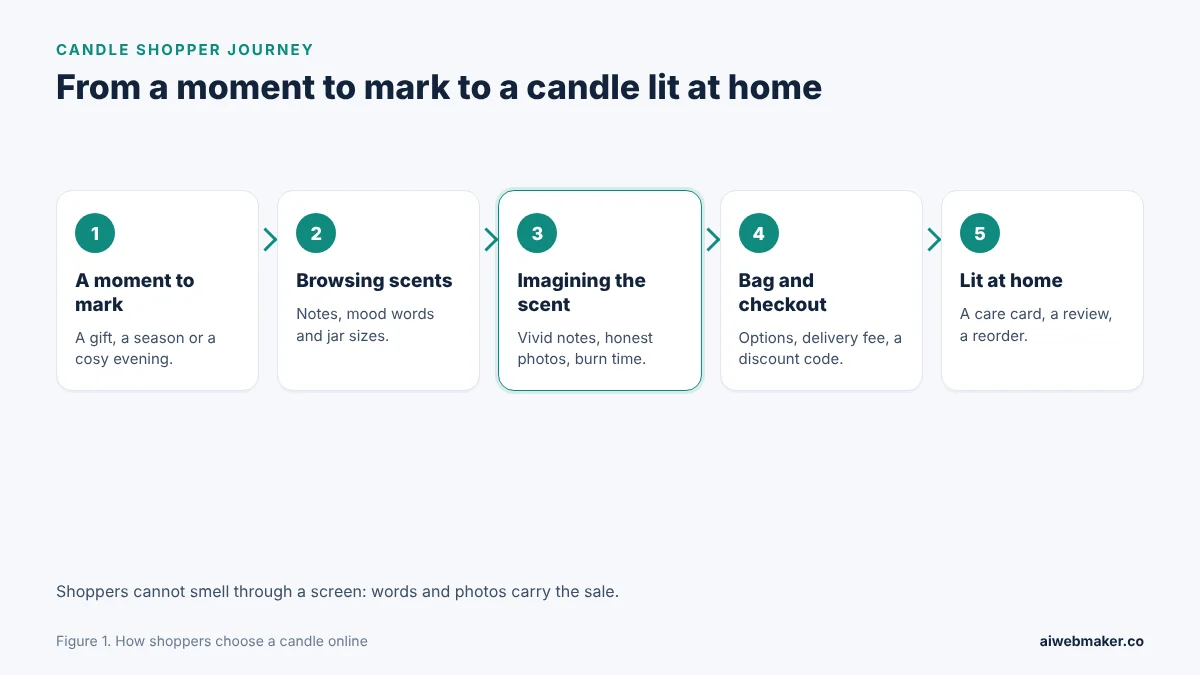
Candle sales are won or lost at the third, highlighted step, because a shopper has to imagine a scent they cannot test. Before that, a moment to mark sets the budget and the deadline, whether a friend's birthday or the first cold evening of autumn. Browsing is quick, guided by scent families, jar sizes and prices. Imagining the scent depends on vivid notes, honest photos and practical details such as burn time. Checkout must then feel simple, and the experience at home decides whether a review and a reorder follow. Every product page should help the shopper across that third step with confidence.
Which pages turn a candle studio into a working shop?
A candle website needs a shop at its heart, supported by pages that explain why these candles are worth their price. The shop lists each candle with its scent, size, burn time and options. A story page explains the wax, wicks and fragrance, who pours the candles and how each batch is made. A custom orders page handles weddings, corporate gifts and personalised labels, while a care and safety page answers questions about burning well. Contact and delivery details close the set. Few pages, each doing one job well, keep shoppers moving towards checkout.
| Page | What shoppers want | What it should show |
|---|---|---|
| Shop | Find a scent and buy it | Scent notes, size, burn time, price |
| Candle pages | Imagine the scent | Notes, mood words, photos lit and unlit |
| Story | Why handmade costs more | Wax, wicks, fragrance, pouring and curing |
| Custom orders | Matching candles for an event | What can be personalised, lead times |
| Care and safety | Burn it well and safely | First burn, wick trimming, warnings |
| Delivery and contact | When it will arrive | Delivery areas, times, fees, contact |
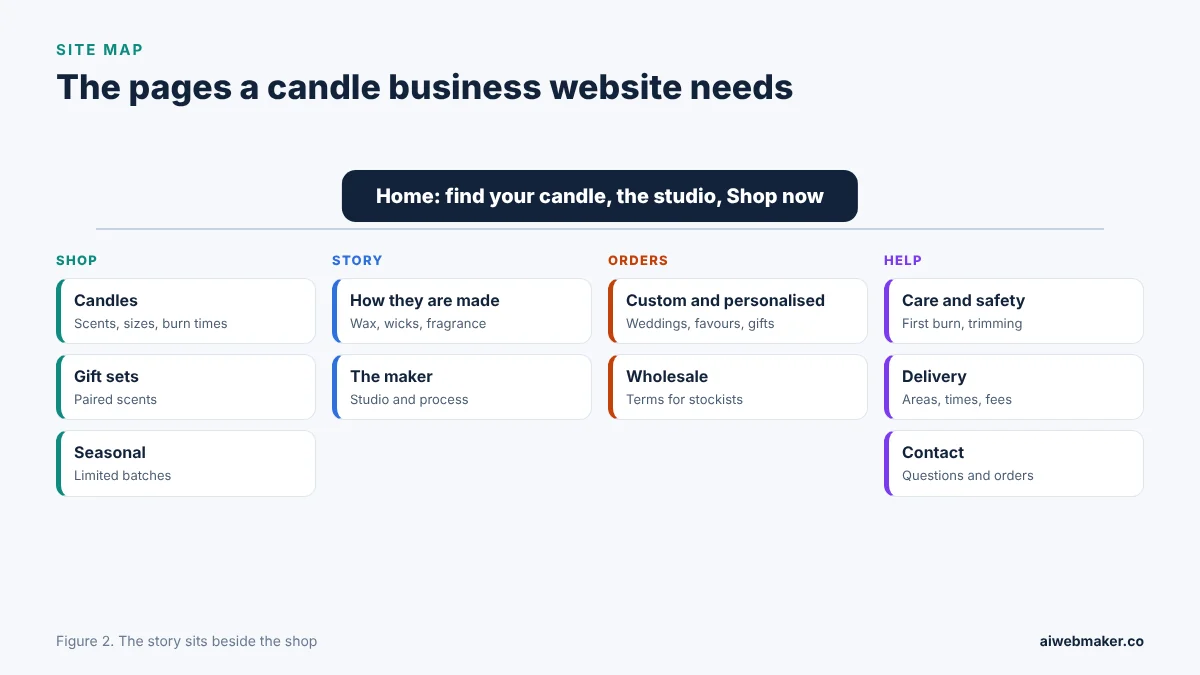
This plan keeps the shop and the story next to each other, because shoppers paying more for a handmade candle want to know why it is worth it. Ember and Wick Candle Co, the sample studio, sells three candles in its shop, and its home page invites visitors to find their candle and see what the studio makes. A story page tells how the studio began, what goes into each candle and who the maker is, supported by a home page section called Made with care, not in a hurry. The custom orders page explains what can be personalised and how the enquiry process works, then points anyone needing something sooner to the ready made candles. The candle business website example with a shop and a custom order page was generated in 65 seconds, covering the shop and four further pages. Its home page closes with News from Ember and Wick, a natural place to announce new scents.
Top, heart and base: describing a scent nobody can smell
Perfumers describe a fragrance in three layers, and candle makers can borrow the structure to help shoppers imagine a scent. Top notes give the first impression, often bright citrus or herbs, while heart notes form the main character and base notes such as woods, vanilla or musk linger longest. Makers also separate the cold throw, the scent of the unlit candle, from the hot throw that fills a room once it burns. Linking notes to a place or moment, such as a pine forest after rain, helps far more than abstract adjectives. Scent strength deserves an honest line, since a strong candle can overwhelm a small room. Layered descriptions sell candles to shoppers who will never smell them first.
| Scent family | Example notes | Mood words shoppers respond to |
|---|---|---|
| Fresh and citrus | Lemon, bergamot, grapefruit | Bright, clean, morning |
| Floral | Rose, jasmine, lavender | Soft, calm, romantic |
| Woody | Cedar, sandalwood, vetiver | Grounded, warm, evening |
| Gourmand | Vanilla, caramel, coffee | Cosy, sweet, comforting |
| Herbal and green | Fig leaf, basil, tomato leaf | Garden, fresh, airy |
| Spiced | Cinnamon, clove, cardamom | Festive, warming, rich |
What should each product page say about wax, wick and burn time?
Each product page should state the wax, the wick, the size and an estimated burn time based on the maker's own testing. Soy, rapeseed, coconut blends, beeswax and paraffin behave differently, and shoppers increasingly ask which is used. Cotton or wooden wicks change both the look and the sound of the flame, which some buyers love. Burn time should be described as an estimate under normal conditions, because draughts and long sessions shorten it. Net weight, jar material and whether the vessel can be reused answer the remaining practical questions. Precise details tell shoppers that every candle has been properly tested.
| Product detail | What to state | Why it matters |
|---|---|---|
| Wax | Type or blend used | Shoppers compare waxes |
| Wick | Cotton, wooden or other | Flame look and sound |
| Burn time | A tested estimate | Value for money |
| Size | Net weight and jar size | Comparing prices fairly |
| Fragrance | Scent notes and strength | Suitability for room size |
| Vessel | Material, lid, reuse ideas | Gift appeal |
Which warning labels and claims do candle makers need to get right?
Candles are an open flame, so safety warnings belong on the jar, the listing and the care page, and the exact rules depend on where the candles are sold. Under European Union and British rules, for example, scented candles can fall under hazard labelling for chemical mixtures, which may require specific symbols and statements. In the United States, makers widely follow a voluntary fire safety labelling standard. Fragrance and wax suppliers usually provide the safety data that labelling depends on, and it should be kept on file. Claims such as clean burning, nontoxic or air purifying are hard to support and can breach advertising rules. Makers who check the rules for each country they ship to avoid costly mistakes.
How do photos show scale, colour and a lit flame?
Photos have to stand in for touch and scent, so they need to show scale, texture, colour and the candle in use. A shot beside a hand, a book or a cup shows size more honestly than any number. A lit candle in a dim room shows the glow, while an unlit shot in daylight shows the true colour of the wax and jar. Close shots of the label, lid and wick answer questions about quality and gifting. Consistent backgrounds across the range make the shop look curated rather than random. Honest photos also cut returns, because the candle that arrives matches the picture.
How do personalised, wedding and wholesale orders work alongside the shop?
Personalised and wholesale orders often outweigh weeks of shop sales, so they deserve a clear route beside the shop rather than inside it. Wedding favours, corporate gifts and custom labels need details such as quantity, scent, label wording and the date required. Lead times must allow for pouring, curing and labelling, and a minimum quantity protects the maker from small, complex jobs. The online store builder for candle makers selling scents and gift sets lists each candle with options such as size or scent, gathers choices in a bag and adds the delivery fee at checkout. Discount codes suit launches or returning customers, and personalised favours, priced only after a conversation, can display an Enquire button. Wholesale terms work best on their own page, with minimums and how stockists apply.
How should glass candles be packed and shipped in every season?
Glass jars and soft wax make candles fragile in the post, so packing deserves as much thought as pouring. Each jar should be wrapped and held firmly so it cannot move, with lids secured and labels protected from scuffs. Container wax can soften or sweat in summer heat, so some makers pause shipping during heatwaves or choose faster services. The website should state delivery areas, times and fees, and explain what happens if a jar arrives broken. Some carriers restrict candles or fragrance, with rules that vary by country and service. Careful packing turns the unboxing into the first part of the gift.
Which scent and gift searches bring buyers to a candle shop?
Candle buyers search by scent, occasion and material, with phrases such as soy candles, vanilla candle gift, personalised wedding candles, candle gift set or hand poured candles. Product and collection pages headed with those words meet each search directly. Makers who sell at markets or from a studio gain from a map listing with photos and the shop's address. Reviews describing the scent in a room, the burn and the packaging help other shoppers imagine their own candle. Articles on the first burn, pairing scents with rooms or choosing a candle as a gift draw readers who are close to buying. Writing that helps people enjoy candles makes the shop the one they remember.
Which costs sit behind the candle shop each year?
Behind the candle shop sit only hosting and a domain as fixed costs, plus a dozen articles on scents and care that credits draft for about $7.80 in total. Studios selling steadily all year usually choose the annual payment. A maker testing the market before the holiday season might prefer monthly billing. Adding a scent, a seasonal collection or fresh photos is included, with nothing extra to pay. The yearly and monthly columns sit next to the $189 tier, shown only for comparison.
| Item | Yearly | Monthly |
|---|---|---|
| Hosting the candle shop | $119 | $228 over twelve months |
| Domain | Depends on the ending | Depends on the ending |
| Higher plan, for comparison | $189 a year | Not needed |
| Twelve scent and care articles at about $0.65 | About $7.80 | About $7.80 |
| New scents, collections and photos | No charge | No charge |
| Year before the domain | About $126.80 | About $235.80 |
Why do shoppers abandon a candle page before the bag?
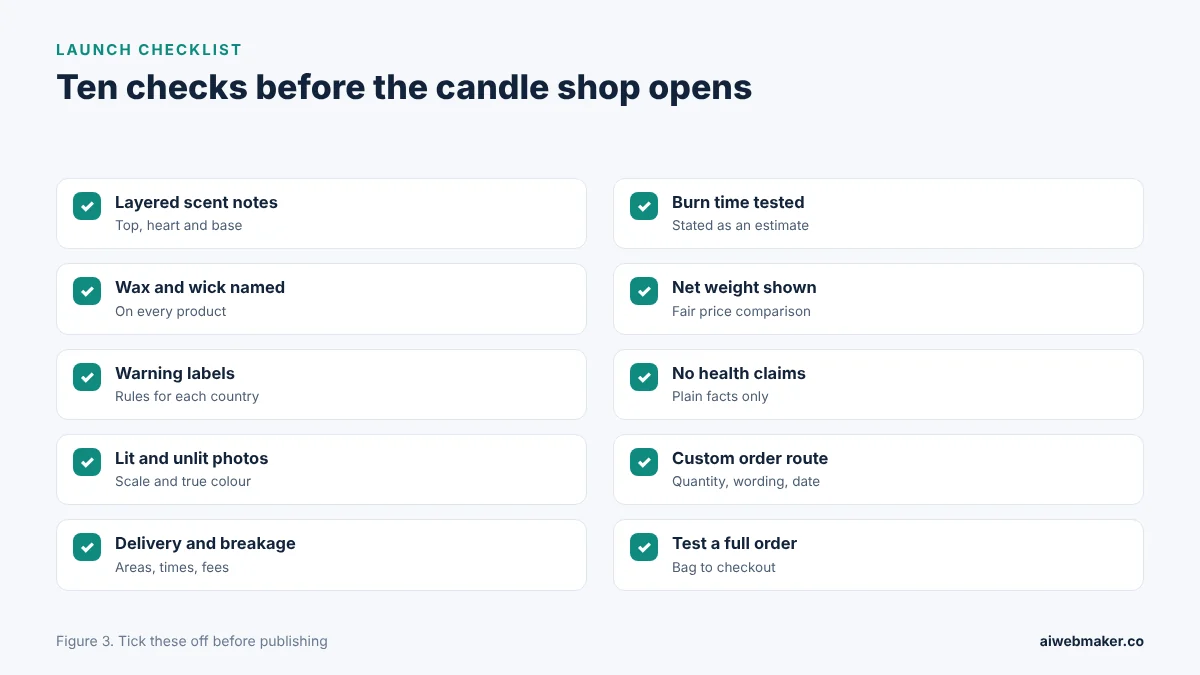
Shoppers abandon a candle page when the scent description is a single vague word, because they cannot judge whether they will like it. Missing burn times and sizes make prices impossible to compare. Photos that show only a styled jar, never the flame or the scale, leave doubts about what will arrive. No word on delivery times before a holiday sends gift buyers to a shop that states them. Health claims that seem implausible make careful buyers suspicious of everything else. The pictured checklist turns each of these problems into a task to finish before launch.
Frequently asked questions
How long should handmade candles cure before they are sold?
Many makers let candles cure for days or weeks before sale, because the wax and fragrance need time to settle and the scent throw usually improves. The right time depends on the wax, the fragrance load and the maker's own testing. Soy and other plant waxes are often given longer than paraffin. A note on the story page about curing explains why custom orders need a lead time. Patience at this stage shows in every candle that leaves the studio.
Can a candle be described as clean burning or nontoxic?
Claims such as clean burning, nontoxic or air purifying are risky, because they are hard to prove and can mislead shoppers. Advertising and consumer protection rules in many countries require claims to be backed by evidence. Every candle produces some soot and combustion products, so absolute claims are rarely accurate. Plain facts, such as the wax type, the wick material and the supplier's safety data, are more honest. Careful wording protects the maker and earns the trust of informed buyers.
What care advice belongs with every candle?
Every candle should come with care advice covering the first burn, wick trimming and safe burning. The first burn should usually continue until the melted wax reaches the edge of the jar, which helps prevent tunnelling. Wicks are commonly trimmed before each lighting, and candles should never be left unattended or burned near anything flammable. The same advice can appear on the product page, the care page and a card in the parcel. Customers who get the full burn time from a candle are far more likely to buy another.
When should seasonal collections launch?
Seasonal collections are best launched well before the season they celebrate, because gift buyers plan ahead and makers need time to pour and cure. An autumn range can appear as summer ends, and winter holiday scents often sell from early autumn. Limited batches give shoppers a reason to buy now rather than later. Telling past buyers first, by whatever mailing method the studio already uses, rewards loyal customers. Early, well planned launches spread the workload and avoid a frantic December.
How many gift orders repay a year of the candle shop?
A few gift orders in a single week usually repay the $119 of hosting that keeps the candle shop open online all year. With monthly billing, one or two candles sold generally cover the $19. One wedding favour order can match many weeks of ordinary shop sales, and every repeat buyer adds income on a site already paid for. Vivid scent notes, honest photos and careful safety information persuade more shoppers than any discount. Studios that keep the shop stocked with seasonal scents give returning buyers a reason to come back. Repeat orders from last year's gift buyers show the shop doing its job.
Build your website in Minutes and get the AI Tools that work
Start Building Your Website →