Beauty Supply Website Cost, From the Shade Ring to the Trade Hour
Hosting a beauty supply shop on AI Web Maker is $119 a year, or $19 a month, plus a domain. Inside: who buys, the pages a supply store needs, shade options, extensions and wigs, skin tests, trade accounts, returns, search and the yearly sums.
- No coding required
- Live in minutes
- Blog, SEO and chatbot tools included
Hosting a beauty supply store with AI Web Maker is $19 on a monthly plan, or $119 for shampoo, shade ring and trade pages kept up all year, plus a domain. Product cards, the shade ring and the trade account page can be drafted and previewed with no AI Web Maker charge at any point. One set of clip in extensions, or a single back bar order from a salon, is enough to repay the year. The difficult part is that hair colour, extensions and nail products are bought by shade, length and texture, and a wrong shade is expensive for the buyer and hard to resell for the shop. Many of the products are also strong chemicals, so the site must carry skin test advice without sounding like a warning label. What follows covers who buys beauty supplies online, the pages a store needs, shade and size options, extensions and wigs, skin tests, trade accounts, returns, search and the hosting sums.
This article is part of our complete guide: Retail Website Design.
Salon owners, home users and wig wearers: who buys and why
Beauty supply shoppers split between professionals stocking a salon and people caring for their own hair, nails and skin at home. Salon owners, barbers and nail technicians want salon sizes, case prices and a quick way to reorder before the first client of the day. Home users want the right shampoo for dry or textured hair, a dye in the right shade and clear instructions on how to use it safely. Extension and wig wearers care most about colour match, length and how the hair is attached. Some shoppers arrive worried about thinning hair, and an honest shop points them towards a doctor rather than a miracle bottle. A supply site that serves each of these groups clearly keeps both the salon trade and the home buyer coming back.
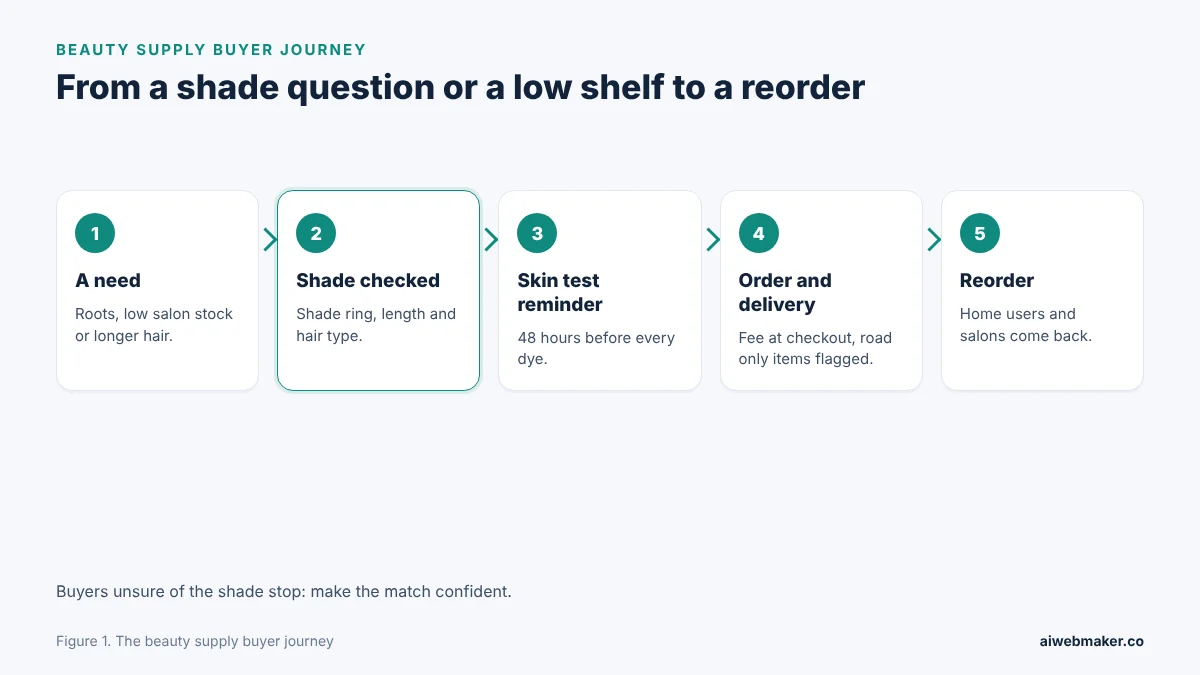
Starting at the left, the path opens with a need, such as grown out roots, a salon short of developer or a wish for longer hair. The highlighted step is the shade check, because a buyer who is unsure of the shade stops right there. A skin test reminder follows for any dye or relaxer, and it should appear before checkout rather than in small print afterwards. Ordering and delivery come next, with the delivery fee shown at checkout and any road only items flagged. The final step is the reorder, which is where a supply store earns its steady income. Pages that make the shade step confident do more for sales than any discount banner.
Shelves, shade ring and trade page: a supply store's site plan
A beauty supply store's site needs product pages for hair care, colour, extensions, wigs, nails and skin. A shade guide, a safety page, a trade page and a delivery and returns page complete it. Hair care and colour pages carry sizes, shades and short notes on hair type. Extension and wig pages need the attachment method, the hair type and the length, since these decide how a piece is worn. The shade guide shows the numbering used across much of the hair trade, which helps buyers order online. The trade page explains who may open an account and what it offers, while the safety page explains skin and strand tests. A plan like this lets a home buyer and a salon owner each find their own path through the same shop.
| Page | What the buyer checks | What it should include |
|---|---|---|
| Hair care | Hair type and size | Sizes, hair type notes, what it is made without |
| Hair colour | Shade and mixing | Shade numbers, developer note, gloves, skin test |
| Extensions and wigs | Shade, length, attachment | Shade ring, lengths, method, hair type |
| Nails and skin | Colour and curing | Lamp type, colours, contact warnings |
| Shade guide | Matching a colour online | Shade numbers and daylight matching |
| Trade accounts | Salon prices and licence | Who qualifies, case prices, trade hour |
| Delivery and returns | Hygiene and shipping limits | Sealed packs, road only items, collection |
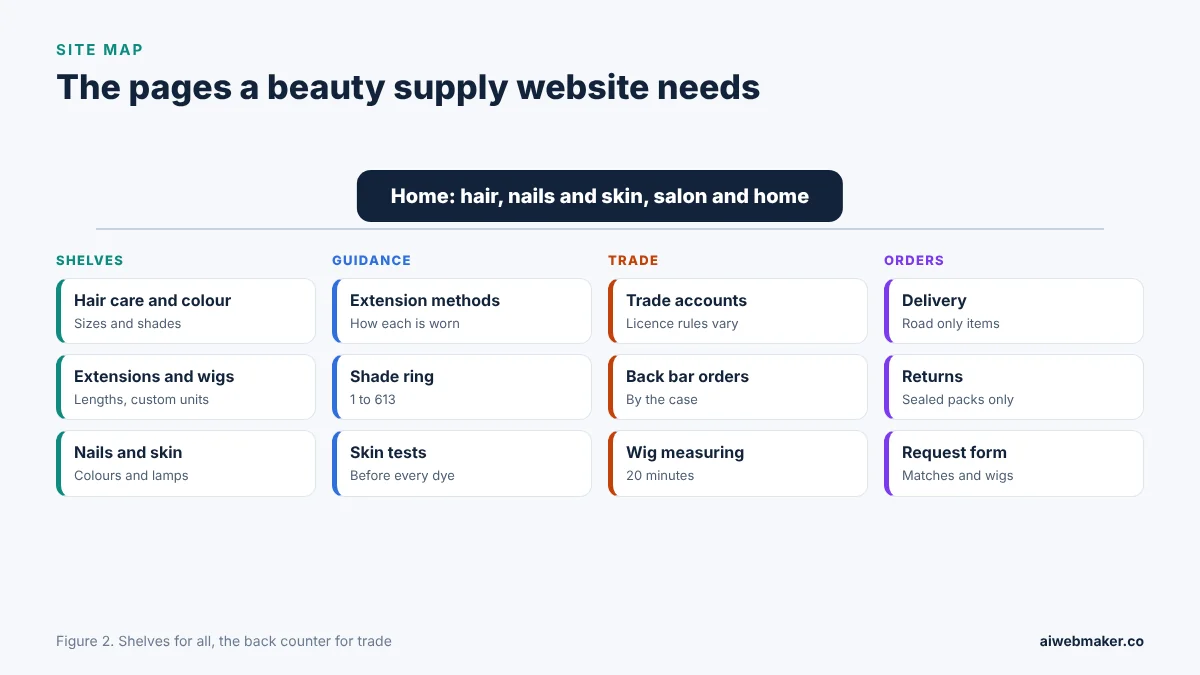
A supply store's home page leads into four clusters: the shelves, the guidance, the trade services and the order pages. Hair care, colour, extensions and nails fill the shelves; the extension table, shade ring and skin test advice make up the guidance; accounts, back bar orders and wig measuring serve the trade; and delivery, returns and the request form close the order side. Glow Supply Co, the sample shop, sells clip in hair extensions, a moisturising shampoo, gel nail polish, permanent hair colour and a leave in conditioner, with a custom wig unit made to order by enquiry. Its services are a trade account, shade matching, back bar orders and wig measuring. The beauty supply website example with a shade ring and trade accounts adds an extension table, a patch test section, a gallery of the shelves, a set of counter questions and a form covering trade accounts, shade matches and custom wigs. That layout reflects how the shop really works, with the shelves for everyone and the back counter for the trade.
Shade, length and size as product options before the bag
Beauty supplies are almost always sold in variants, so product options do most of the work of preventing wrong orders. Extensions come in lengths, such as 14, 18 or 22 inches in the sample, and in shades matched from the ring. Hair colour comes in numbered shades, nail polish in named colours and shampoo in a home size or a salon litre. The online store builder for beauty supply shops selling by shade and size asks the buyer to pick each of these before adding the product to the bag, then adds the delivery fee at checkout, where discount codes can also be used. A custom wig unit, made on the buyer's own measurements, carries an Enquire button because its price depends on the hair and density chosen. Clear options mean the salon gets the litre it wanted and the home buyer gets the shade she matched.
Extensions and wigs: attachment methods explained plainly
Extensions and wigs need more explanation than any other product in a supply store, because the method of attachment changes how long they last and who should fit them. Clip ins can be fitted at home and removed at night, while tape ins and sewn in wefts are usually fitted and removed by a trained stylist. Lace front wigs are worn over flat braids or a wig cap and should come off at night to rest the scalp. Braids that are too tight pull on the hairline, so the page should say that methods bonding or sewing hair in are best left to a professional. Human hair can usually be heat styled and carefully coloured, while synthetic hair melts under hot tools unless it is labelled heat resistant. A table setting this out saves buyers from choosing a method that does not suit their hair.
| Type | How it is attached | Usually worn | Good to know |
|---|---|---|---|
| Clip in | Clips into the wearer's hair | For the day, out at night | Easy to fit at home |
| Tape in | Bonded in thin sections | Several weeks, then moved up | Fitted and removed by a stylist |
| Sew in weave | Sewn onto a braided base | Several weeks | Tight braids strain the hairline |
| Ponytail wrap | Clip or drawstring around a bun | For an event or a day | Quick length, nothing bonded |
| Lace front wig | Over flat braids or a wig cap | Daily, off for sleep | Rest the scalp at night |
Skin tests, strand tests and nail product allergies
Hair dyes, bleach, relaxers and gel polish can all cause reactions, so a supply store should place safety notes where buyers will read them. Most permanent dye makers ask for a skin test 48 hours before every use, because an allergy can begin after years without a problem. A strand test before bleach or a relaxer shows how the hair will react before the whole head is treated. Gel polish should be kept off the skin, since repeated contact can lead to an allergy. The sample adds that a sore or broken scalp should heal before any chemical treatment, and that anyone with a severe reaction should seek medical help. Notes like these protect customers and show that the shop understands the products it sells.
| Product | Safety note to show | Where it belongs |
|---|---|---|
| Permanent hair colour | Skin test 48 hours before each use | Product card and the pack instructions |
| Bleach and relaxers | Strand test first, never on a sore scalp | Product card and safety page |
| Gel nail polish | Keep off the skin | Product card |
| Developers and lighteners | Follow the maker's timings | Product card |
| Hair loss worries | See a doctor, no regrowth claims | Questions page |
Trade accounts, back bar orders and licence rules
Salons, barbers and nail technicians often buy in cases rather than bottles, which makes the trade page a quiet earner for the store. The sample offers trade prices on salon sizes to licensed professionals and asks them to show the licence or registration their own country requires. Licensing rules for hair and beauty work differ widely between countries and regions, so the page should invite applicants to say what applies where they work. Back bar orders, such as shampoo, developer, foils and gloves by the case, can be packed for a single delivery to the salon. An early trade hour, which the sample runs from 8:00 to 9:00 on weekdays, lets salon owners collect stock before their first client. Clear trade terms turn occasional salon orders into regular ones.
Returns on opened hair, hygiene rules and road only items
Returns in a beauty supply store are shaped by hygiene, because opened hair and used products cannot be resold. The sample accepts unopened extension packs with the seal intact within 14 days and asks buyers to request a shade match before breaking the seal. Hair colour, nail polish and skin products are usually returnable only if unopened. Some items, such as aerosols and certain colour products, may only travel by road, so a few products may be collection only for some addresses. The delivery page should explain these limits before checkout rather than after. Consumer law in some countries gives buyers rights beyond the shop's policy, and the returns page should not pretend otherwise.
Search phrases for extensions, hair colour and salon supplies
People looking for beauty supplies type a product and a detail. Typical searches are clip in extensions shade 4, hair colour for dark hair, gel polish supplies, wig shop near me or salon supplies trade account. Product pages that carry the shade number, the length and the hair type match those searches far more closely than general category names. A map listing with the trade hour, opening times, photos of the extension wall and a link to the shade guide helps shoppers who want to match in person. Reviews that mention an exact shade match, a quick trade account or straight advice on a relaxer carry real weight. Articles on caring for curls and coils, choosing an extension method or running a skin test attract readers before they buy. Steady, honest writing of this kind builds the shop's name among both salons and home users.
Hosting, a domain and a year of articles for the supply store
A beauty supply store's website budget rests on hosting and the domain, and haircare articles drafted through credits barely register beside a single bottle of shampoo. Stores with an established salon trade usually pick annual billing, whereas a new shop may stay on monthly payments while its first trade accounts open. Twelve articles on hair care and colour use roughly $7.80 of credits. Adding shades, changing case prices or listing new extensions costs nothing more. Next come the annual and monthly figures for the supply store, and the $189 row is there to compare, nothing more.
| Item | Yearly | Monthly |
|---|---|---|
| Hosting the shelves, shade ring and trade pages | $119 | $228 over twelve months |
| Domain | Depends on the ending | Depends on the ending |
| Higher plan, for comparison | $189 a year | Not needed |
| Twelve hair care articles at about $0.65 | About $7.80 | About $7.80 |
| New shades, sizes and case prices | No charge | No charge |
| Year before the domain | About $126.80 | About $235.80 |
What sends salon buyers and home users elsewhere?
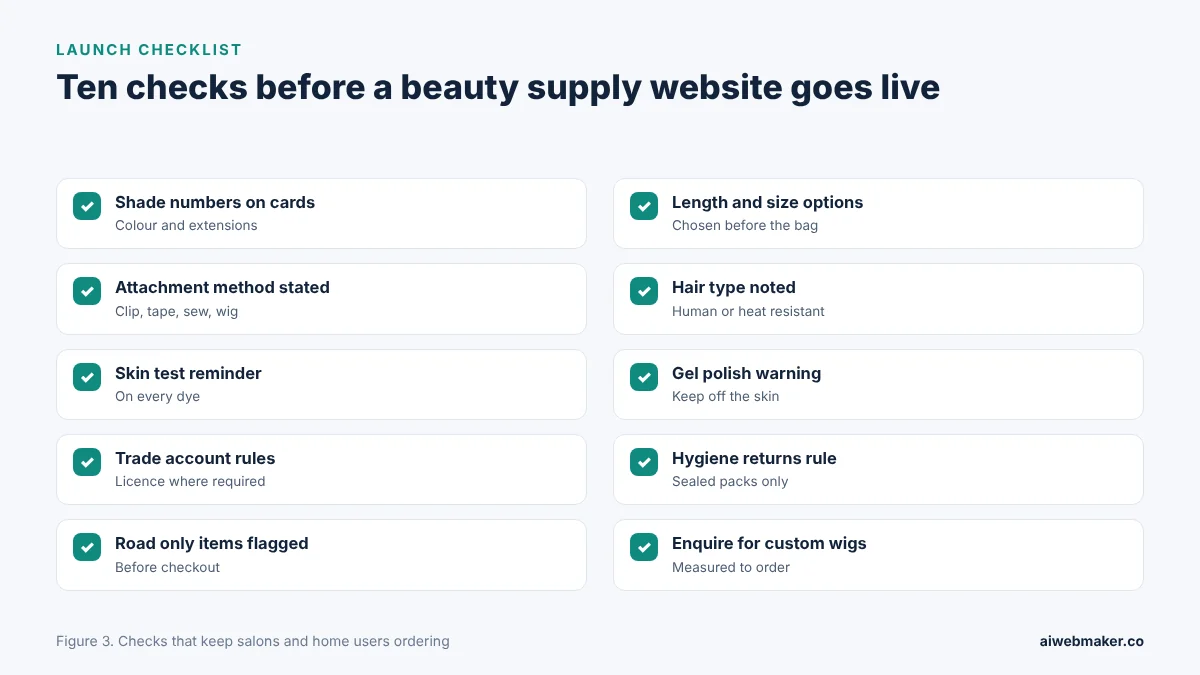
Salon buyers and home users leave a supply site when products show a name and a price but no shade number, length or size. Dyes without a skin test note suggest the shop does not take safety seriously. Extensions without an attachment method or hair type leave buyers unsure whether a piece will suit them. A trade account with no explanation of who qualifies sends professionals to a wholesaler instead. Returns rules that only appear after checkout cause disputes that a clear page would have avoided. The ten supply store checks pictured below tackle that list of faults directly.
Frequently asked questions
Is a skin test needed before every hair colour?
Most hair dye makers ask for a skin test 48 hours before each use, even with a shade used many times before. An allergy can start after years without a problem, which is why the test is repeated. The product page should remind buyers and point them to the instructions in the pack. Anyone whose test area itches, reddens or swells should not use the colour. A clear reminder protects customers and the shop.
Can opened extensions be returned?
Opened hair usually cannot be returned, because it cannot be resold for hygiene reasons. Glow Supply Co accepts sealed packs back for 14 days, and many supply stores use a similar window. That is why a shade match before opening is so useful, whether in store or by describing the hair in the request form. The returns page should state the rule clearly before checkout. Clear rules prevent disappointment for both sides.
Who can open a trade account at a beauty supply store?
Trade accounts are usually open to salons, barbers, nail technicians and stylists who hold whatever licence or registration their country requires. Because licensing for hair and nail work is local, the application should let each salon state which licence it holds. Trade accounts often bring salon sizes, case prices and an early collection hour. The sample opens accounts at no charge once the details are checked. A clear route encourages professionals to apply.
Should a supply store sell products that promise hair growth?
A careful supply store avoids products that claim to regrow hair or cure hair loss, and the sample states that it does not sell them. Thinning hair or bald patches can have many causes, so a doctor is the right first stop. The shop can still sell gentle care products for fragile hair, described honestly. Avoiding miracle claims protects customers and the shop's reputation. Honest boundaries build lasting trust.
Clip ins, back bar cases and the hosting they repay
One set of clip in extensions usually earns more than the shop spends on hosting for the whole year. A supply store on monthly billing can cover its $19 with a single salon's weekly shampoo order. A three chair salon won over by the trade terms could restock its back bar from the shop for years. Shade numbers, clear attachment methods and honest skin test notes persuade buyers who would otherwise shop by guesswork. Stores that keep their shade ring and trade terms current will watch the website bring salons and home users back to the same shelves.
Build your website in Minutes and get the AI Tools that work
Start Building Your Website →