Real Estate Photography Website Cost and the Packages Agents Rebook
Listing photographers can host a booking site on a flat $119 annual fee, or pay $19 monthly while agent accounts build up, with a domain added. The guide then covers who books, the pages, packages, add ons, turnaround and requests, licences, drones and honest edits, search and the yearly figures.
- No coding required
- Live in minutes
- Blog, SEO and chatbot tools included
Listing photographers can host a booking site on a flat $119 annual fee, or pay $19 monthly while agent accounts build up, with a domain added. Package cards, the turnaround table and the shoot request page can be reshaped in the preview again and again, and AI Web Maker raises no charge for any of it. A single flat shoot pays for the whole hosting year. The real business lives elsewhere: most income comes from agents who book every week and drop a photographer the moment files arrive late or verticals lean. Owners selling privately book once and compare prices closely, while drone rules, image licences and honest editing standards shape every package. Covered here: who books, the pages, packages and add ons, turnaround and requests, licences, drones and virtual staging, search and the twelve month sums.
This article is part of our complete guide: Real Estate Website Builder.
Who books a listing photographer, and how often do they come back?
Listing photography has two very different customers, and the site must serve both without confusing either. Sales and letting agents book repeatedly, sometimes several shoots a week, and judge a photographer by turnaround, consistency and how easily a shoot can be requested. Owners selling or letting privately book once, often comparing two or three photographers on price and what each package includes. Developers and landlords need show homes, new builds and commercial floors shot to a brief. Some short stay hosts also want interiors that make a listing stand out. For every group, the photographs exist to fill viewings, so the site should talk about viewings rather than art.
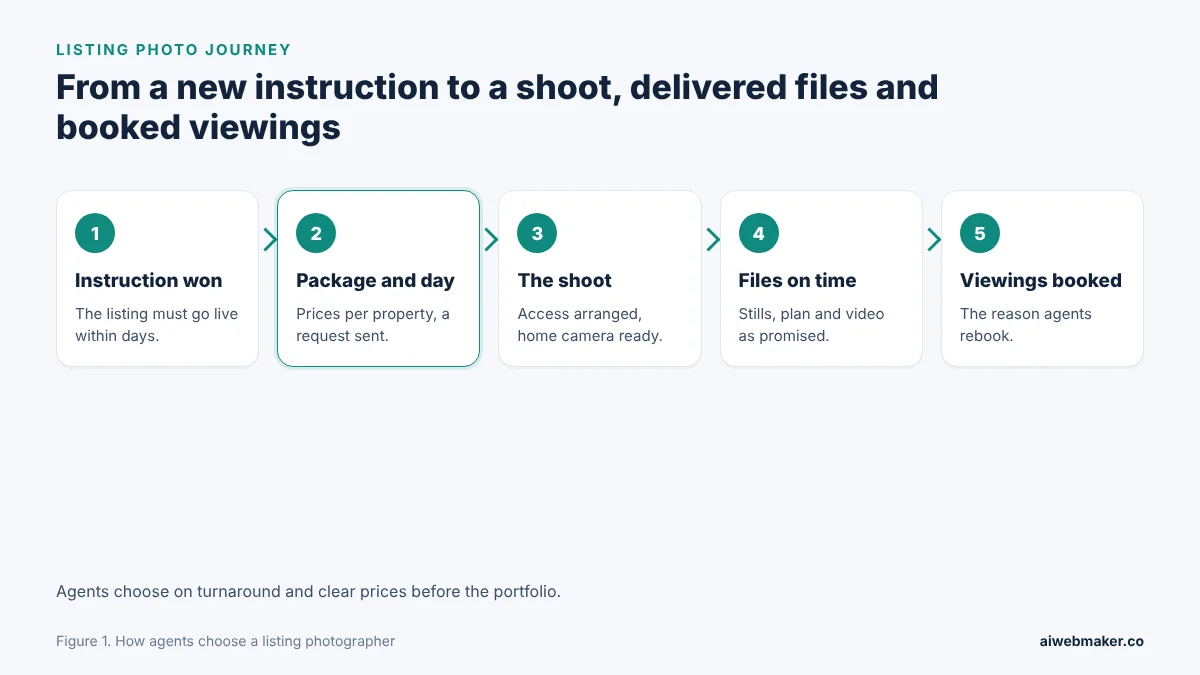
An agent winning an instruction starts this five step path. The coloured second step, choosing a package and a day, is where a photographer's site wins or loses the booking. The agent usually needs the property live within days, so a clear package list and an easy request matter more than a long portfolio. The shoot itself depends on access, weather and a home that has been prepared. Files then arrive by the time promised, or the agent's listing slips. A listing that books viewings is the final step and the reason agents rebook. A site that shortens the second step for a busy agent earns the next instruction too.
Which packages and pages does a listing photographer need?
A listing photographer's site works best when it reads like a menu, because agents book from it between valuations. Three or four packages, priced per property and tied to size and travel, form the core. Add ons such as twilight fronts, drone stills and floor plans sit beside them. A turnaround page states when each kind of file arrives, and a preparation page tells owners how to get a home camera ready. A request page with a package, a day, an arrival window and access notes completes the set.
| Page | Main reader | What it should state |
|---|---|---|
| Packages | Agents and owners | What arrives, priced per property and size |
| Add ons | Agents | Twilight, drone, staging, plans, clips |
| Turnaround | Agents | Working days for each file type |
| Floor plans | Agents and buyers | Measured in the room, method stated |
| Camera ready list | Owners and tenants | Lights, blinds, cars, bins, clutter |
| Request a shoot | Everyone | Package, day, window, property, access |
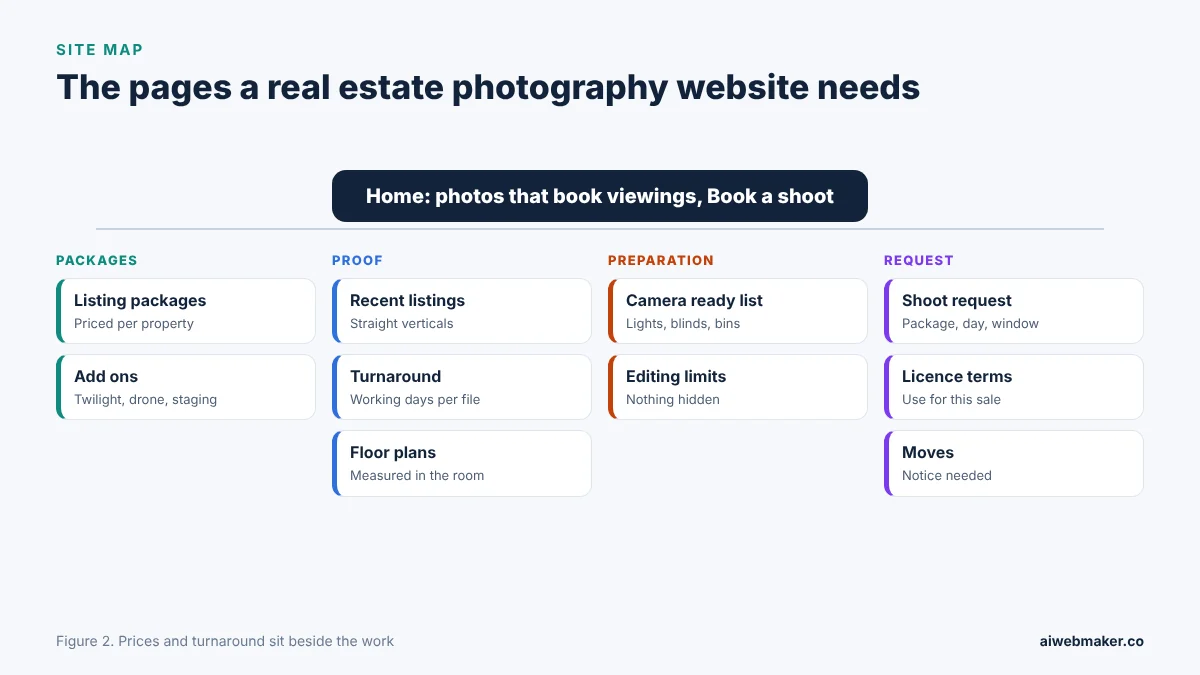
Packages, proof, preparation and the shoot request divide this plan into four lanes. Squarefoot Property Media, the made up studio in the real estate photography website example with packages and shoot requests, promises listing photos that get the viewing booked. Three packages lead the page: Listing Essentials, Listing and Plan, and Full Walkthrough, each priced per property with its time on site and number of stills. Six extras follow, namely a twilight front, drone stills, virtual staging, a vertical clip, a plan without photos and stills the same evening. A table sets out when each file arrives, a section explains floor plans measured in the room, and a list tells owners how to make the home camera ready. The request form asks for the package, whether the client is an agent, owner or developer, the property type, size, preferred day and arrival window. An agent can book a shoot from a phone between appointments.
How should packages be priced per property?
Packages should be priced per property, with clear limits on size and travel, because agents need to know the cost before they promise a vendor anything. A small flat package might cover an hour on site and a modest number of edited stills, while a family home package adds a measured floor plan. A walkthrough package for larger homes or commercial space adds video and sometimes aerial stills. Prices should state the floor area and distance they cover, with larger homes and longer trips quoted before booking. Agents who book every week often expect account rates, and the site can invite them to ask. Sales tax, where it applies, should be mentioned so invoices hold no surprise.
| Package type | Usually includes | Priced by |
|---|---|---|
| Small listing | Interiors and exteriors, edited stills | Property, up to a size limit |
| Listing with plan | More stills and a measured floor plan | Property and size band |
| Full walkthrough | Stills, plan, video, aerial where allowed | Property, size and travel |
| Plan only | A measured plan without photographs | Floor area |
| Agent account | Regular weekly shoots | Volume agreed in writing |
Which add ons lift the value of each booking?
Add ons raise the average booking because each one solves a specific listing problem rather than adding decoration. A twilight front with every light on makes a home stand out in a crowded search grid, though it depends on an evening the sky allows. Drone stills show the plot, the street and what lies nearby, which matters for larger homes, land and anything near water or parks. Virtual staging furnishes empty rooms, while a vertical clip suits phone screens and social feeds. A plan without photos serves owners who already have good pictures, and same evening stills rescue an urgent launch. Each add on should carry its own price and any conditions, so agents can build the right order in one request.
| Add on | When it helps | Condition to state |
|---|---|---|
| Twilight front | Homes competing in busy areas | Weather allowing, booked evening |
| Drone stills | Large plots, views, nearby amenities | Licensed pilot, airspace rules |
| Virtual staging | Empty rooms | Labelled on the image |
| Vertical clip | Phone and social viewing | Cut from the walkthrough |
| Same evening stills | Urgent launches | Shoot finished by midday |
Why does turnaround sell more shoots than the portfolio?
Turnaround sells more shoots than the portfolio because an agent's listing date depends on it, and one late delivery can cost a photographer the account. The site should state when each file arrives in working days, from edited stills and floor plans to video and twilight sets. It should also say what happens when weather or a heavy week threatens a deadline, such as a message before the deadline rather than after. Cancellation terms belong beside the turnaround promise, since a slot lost the morning of a shoot cannot be resold. The booking website builder for property photographers and the agents who book them lets an agent or owner send a shoot request for a chosen package and day, and the photographer confirms it, proposes another day or turns it down. Invoicing and settlement are handled by the photographer directly with each client, with no percentage going to AI Web Maker.
Who owns listing photographs, and for how long may agents use them?
Listing photographs are usually owned by the photographer, who licenses the agent and the owner to use them to market that property for the sale or letting. Using them later for something else, such as a developer's brochure or another agent's listing of the same home, normally needs a separate licence. Copyright law differs between countries, so the licence terms should be written down and sent with every booking. The website can summarise the standard licence in plain words and invite questions about wider use. Disputes often arise when a home is relisted with a new agent, so the site should explain how that case is handled. Clear licensing protects the photographer's income without frustrating the agents who pay it.
How should drone flights and virtual staging be handled honestly?
Drone flights and virtual staging both carry rules that a photographer's site should take seriously. Commercial drone work usually needs a licensed or certified pilot and permission for certain airspace, under rules set by national aviation authorities, for example in the United States and the European Union, and some sites near airports or dense city centres cannot be flown at all. Virtual staging should be labelled on each image, with the empty version supplied too, because advertising rules in many places treat unlabelled staging as misleading. Removing a bin or a parked car is usually fine, but removing damp, cracks or a pylon is not. A sky may be replaced on request, but nothing a buyer would find on a visit should change. Honest editing protects agents from complaints and keeps the photographer's name clean.
What do agents and owners type when they need listing photos?
Agents and owners search for the service and the place together. Typical phrases are real estate photographer near a named town, property photography for estate agents, floor plans for listings or drone photos for a house sale. Package pages titled with those words and naming the region served meet those searches directly. On the map listing, studio hours, the shoot days and the request link deserve attention, because agents often book from a phone. Reviews from agents that mention reliable turnaround and straight verticals carry more weight than any award. Articles on preparing a home for photos, why floor plans matter or when a twilight shot is worth it attract owners and agents alike. Useful guides put the studio's name in an agent's head before the next instruction lands.
How many shoots does the hosting bill equal?
A photographer's website bill boils down to hosting plus a web address, while a monthly preparation or floor plan guide drafted with AI credits adds about $7.80 a year. A studio with steady agent accounts pays least by settling the hosting annually. A photographer starting out might keep to monthly billing until the first accounts are signed. Changing package prices, adding extras or updating turnaround times never changes the bill. Yearly and monthly columns appear in the table, while the $189 tier gets a single comparison row.
| Item | Yearly | Monthly |
|---|---|---|
| Hosting the photography and request pages | $119 | $228 over twelve months |
| Domain | Depends on the ending | Depends on the ending |
| Higher plan, for comparison | $189 a year | Not needed |
| Twelve listing preparation articles at about $0.65 | About $7.80 | About $7.80 |
| Package, extra and turnaround updates | No charge | No charge |
| Year before the domain | About $126.80 | About $235.80 |
Why does a busy agent book a different photographer?
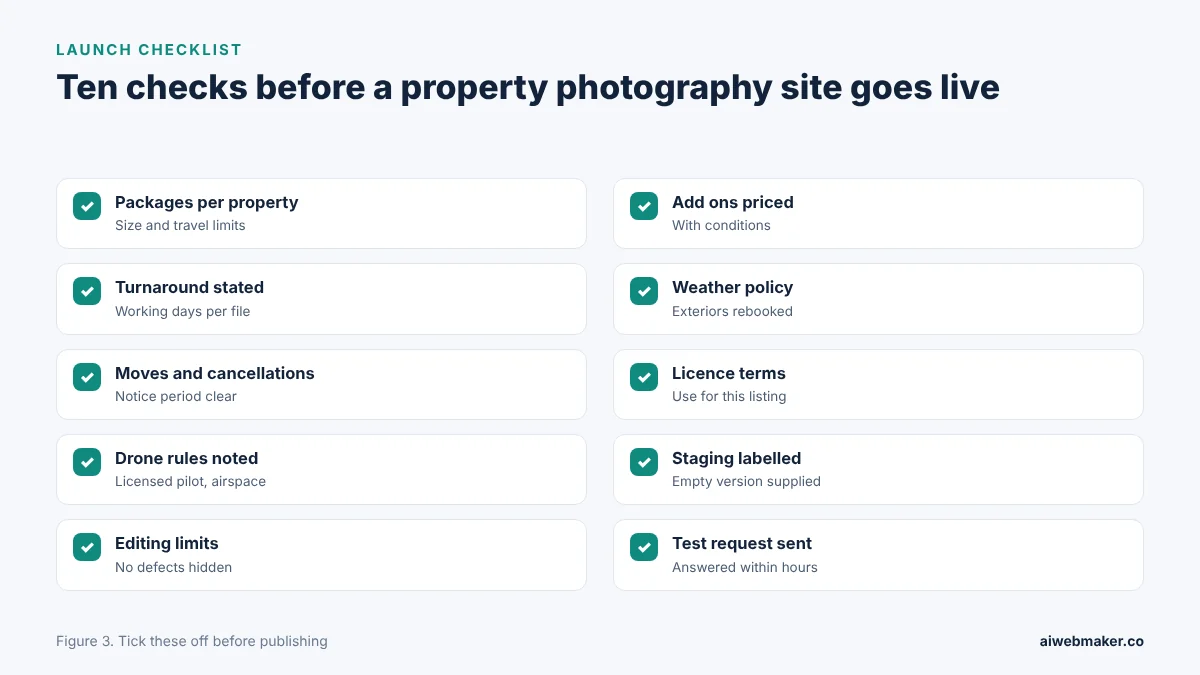
A busy agent books a different photographer when the site hides prices behind a contact form, because the agent needs to tell a vendor the cost today. A portfolio with no turnaround times leaves the listing date uncertain. Packages that do not say what size of home they cover lead to awkward invoices. Heavily edited images, with skies and views that do not match the property, worry agents who answer to vendors and regulators. A request page that cannot take an arrival window or access notes means more calls back and forth. The ten checks drawn in the graphic below fix each of those reasons to switch.
Frequently asked questions
Can an agent reuse listing photos when the home is sold again?
That depends on the licence agreed when the photographs were taken, and most licences cover only the original sale or letting. A later sale, a different agent or a developer's brochure normally needs a fresh licence or a new shoot. The photographer's site should explain this in plain words and offer a simple way to request wider use. Copyright rules differ between countries, so the written terms matter most. Clear terms avoid awkward conversations when a home returns to the market.
What happens when rain stops an exterior shoot?
Interiors can usually go ahead in almost any weather, while exteriors and aerial stills often need a dry sky and calm air. A sensible policy is to shoot the inside as booked and return for the outside on the next suitable day. The website should say whether that return visit is charged. Agents appreciate knowing the rule before they promise a vendor a launch date. A fair weather policy is one of the easiest ways to keep accounts loyal.
Can a grey sky or clutter be removed in editing?
Small distractions such as a bin, a hose or a parked car can usually be removed, and a grey sky can be replaced on request. Anything a buyer would find on a visit, such as damp, cracks, a nearby pylon or a busy road, should never be edited away. Advertising and consumer rules in many countries treat misleading property images seriously. A photographer's site that states its editing limits protects agents as well as buyers. Honest pictures lead to viewings that end in offers rather than complaints.
Must the vendor be present while the photographer works?
The vendor does not usually need to be home, as long as someone can let the photographer in and the agent says which rooms to leave out. Most shoots take between one and three hours, depending on the package. Owners or tenants who are present should know how to prepare the home beforehand. Pets are best kept out of the way for the hour. Simple arrangements on the request page keep the day running smoothly.
How many agent shoots repay a year of photography hosting?
The fee for one small flat shoot normally tops the $119 that keeps a property photographer's booking pages live. A single twilight front add on clears the $19 monthly charge with room to spare. Each agent who books weekly after finding clear packages and turnaround times is worth dozens of shoots a year. Prices per property, honest editing rules and promises kept on delivery persuade agents who cannot afford a late listing. Photographers who keep their packages and turnaround table current become the first call when instructions arrive. Requests that land with the package, day, arrival window and access notes already filled in show the booking page is saving everyone time.
Build your website in Minutes and get the AI Tools that work
Start Building Your Website →