Web Design Studio Website Cost When the Showcase Is the Pitch
A studio's own showcase costs $119 in yearly hosting, $19 if billed monthly, plus the domain. Covered: buyers, pages, pricing, phases, case studies, handover, enquiries, search and the year's figures.
- No coding required
- Live in minutes
- Blog, SEO and chatbot tools included
Hosting a web design studio's own showcase on AI Web Maker comes in at $119 for a year, or $19 per month, before the domain. Draft pages can be rewritten in the studio's own voice and examined in the preview, and that phase is not billed. A useful yardstick while drafting is our sample web design business website, a fictional studio's showcase put together in full with AI Web Maker, which walks a prospect through launch, handover and aftercare. One modest project covers that sum many times. The awkward truth is that studios neglect their own sites, because every hour spent on the showcase is an hour not billed to a client. Meanwhile, prospects judge the studio by that very site, by its speed, its clarity and the work it shows. What comes next covers who hires a studio, the pages a showcase needs, pricing models, project phases, case studies, handover and ownership, enquiries, search and the yearly sums.
This article is part of our complete guide: Professional Services Website Builder.
Founders, marketing managers and nonprofits: who hires a web design studio?
Web design buyers range from founders with no technical background to marketing managers who have commissioned several sites before. Founders replacing a homemade site want guidance, a fixed price and someone who will explain each step. Marketing managers at growing companies want a partner who meets deadlines, respects brand rules and works with their internal team. Online shops look for experience with product pages and checkout flows, while nonprofits need value, accessibility and approval from a board. Professional firms in regulated sectors want a studio that understands their compliance limits. Every one of them studies the portfolio, the process, the price range and the studio's own site before sending an enquiry.
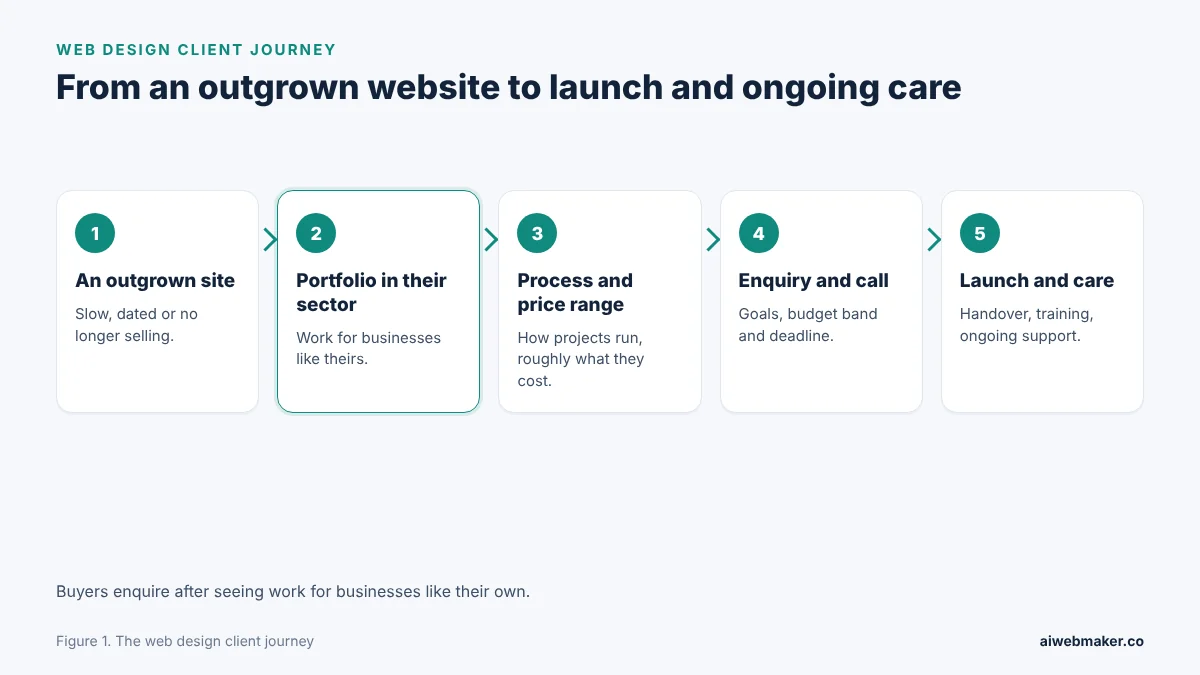
An outgrown website starts this journey, usually one that is slow, dated or no longer bringing enquiries. The highlighted stage is the portfolio, because buyers look for work done for businesses like theirs and rarely enquire without it. Process and price range come next, since buyers want to know how a project runs and roughly what it might cost before any call. An enquiry and a discovery call then turn interest into a brief with goals, a budget band and a deadline. Launch and care decide whether the client returns for the next phase and recommends the studio. Studios whose own pages serve each stage turn more visits into well qualified calls.
Services, portfolio, process and contact: the pages that carry a studio
A studio's showcase can be small, but every page has to work as hard as the sites it builds for clients. The services page says precisely what the studio does and does not do. The portfolio presents case studies rather than a wall of screenshots. Process and pricing pages answer the two questions every buyer asks before calling. An about page and a contact page with a clear enquiry route complete the set.
| Page | What the buyer asks | What to include |
|---|---|---|
| Home | Can this studio solve our problem? | An outcome led headline, best work, the process, enquiry button |
| Services | What exactly is offered? | Design, build, content, online shops, care plans |
| Portfolio | Has it done work like ours? | Case studies with problem, approach and result |
| About | Who will we work with? | Team, roles, how the studio works |
| Process | How does a project run? | Phases, timelines, client input |
| Pricing | Roughly what will it cost? | Starting points or bands, what drives cost |
| Contact | How do we start? | Project enquiry, budget bands, reply times |
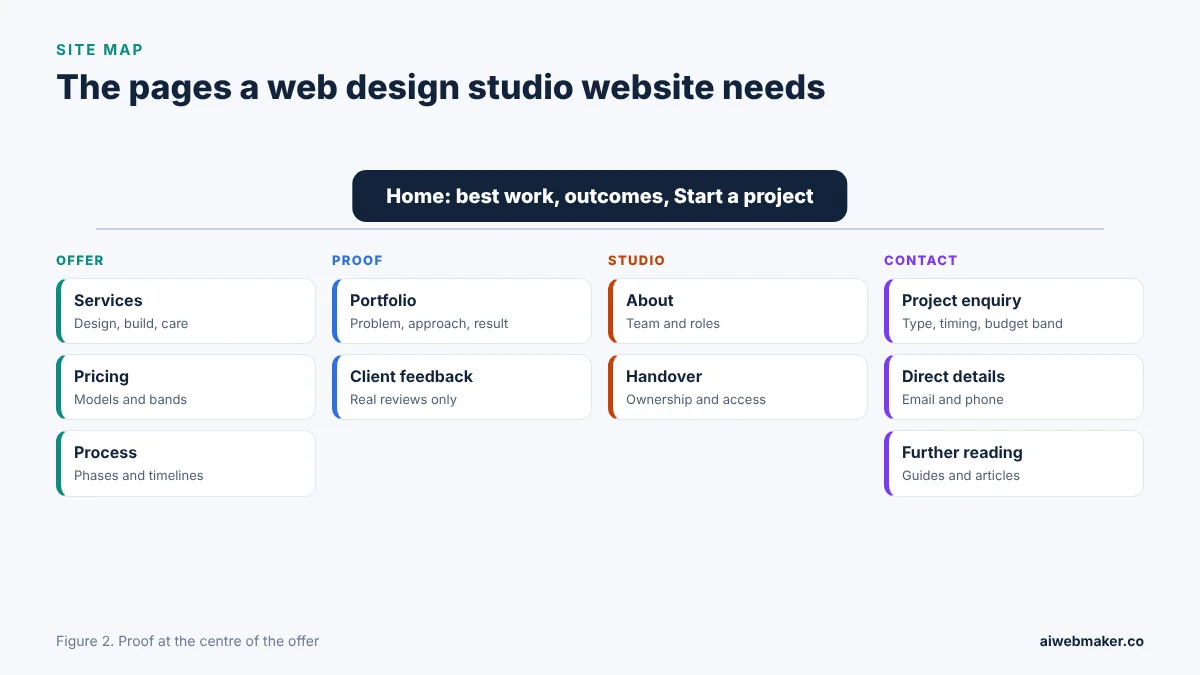
Proof sits at the centre of this studio site map, with services and process arranged around the case studies that prove them. Offer pages hold services, pricing and the process. Proof pages hold the portfolio, real client feedback and results. Studio pages describe the team and how it works, while the contact page carries the enquiry route and direct details. Pixelcraft Studio, the sample, runs on four pages, services, portfolio, about and a contact page with a project enquiry form, and its home page lays out four clear steps that the services page expands into how a typical project works; the web design studio website example with case studies and a project enquiry form was built in 40 seconds. On its portfolio page the studio's work is followed by client feedback marked as example reviews, and its contact page pairs the enquiry form with direct contact details and links for visitors who want to read more first.
Fixed scopes, day rates and care plans: how should a studio price its work?
Pricing models should be explained even when exact prices are not published, because buyers want to know how the studio thinks about cost. A fixed price works for clearly defined sites, provided the scope and the count of revision rounds are agreed in writing. Day or hourly rates suit open ended work, such as improvements to an existing site. Many studios charge for a short discovery phase first, which produces a scope and a firm quote for the rest. Monthly care plans for updates, backups and small changes give clients peace of mind and the studio steady income. Starting points or budget bands on the pricing page filter out mismatched enquiries before anyone spends time on a call.
| Model | How it works | Often suits | What the page should state |
|---|---|---|---|
| Fixed price project | One price for an agreed scope | New sites with clear needs | Scope, revision rounds, what is extra |
| Day or hourly rate | Time charged as it is used | Improvements, open ended work | Rate basis and how estimates are given |
| Paid discovery | A short phase that produces the scope | Complex or uncertain projects | Its length, output and price basis |
| Monthly care plan | Updates, backups, small changes | Clients without an internal team | What each month covers |
| Ongoing retainer | A set number of days each month | Growing sites needing steady work | Hours, priorities, notice period |
Discovery to launch: which project phases should the site show?
Project phases should be shown with what each one delivers and what the client must provide, because late content and slow feedback cause most delays. Discovery clarifies goals, audiences and success measures. Content and structure follow, with a page plan and wireframes agreed before visual design begins. Build and testing cover devices, browsers, speed and accessibility, and the client reviews a staging version before launch. Launch includes redirects from old addresses, analytics and a handover session. Buyers who see the phases in advance plan their own time and keep the project on schedule.
| Phase | What the studio delivers | What the client provides |
|---|---|---|
| Discovery | Goals, audiences, success measures | Access to stakeholders and data |
| Content and structure | Page plan, wireframes | Text, images, approvals |
| Visual design | Page designs and a style guide | Feedback within agreed rounds |
| Build | A working staging site | Final content and sign off |
| Testing | Devices, speed, accessibility checks | A review of the staging site |
| Launch and handover | Go live, redirects, training | Domain access and approvals |
Case studies that speak in outcomes, not typefaces
A convincing case study explains the client's problem, the studio's approach and the outcome in terms a business owner understands. Owners care far less about frameworks and typefaces than about enquiries, sales, bookings or hours saved. Figures should appear only with the client's permission and with context, such as the period measured and other changes made at the same time. A short quote from the client, in their own words, adds weight that no description can. Studios should avoid claiming credit for results driven by advertising spend or market changes outside their work. Three honest case studies persuade more than a gallery of twenty screenshots with no explanation.
Ownership, handover and accessibility: what should a studio promise?
Buyers increasingly ask who owns the domain, the content and the accounts, and a studio that answers before being asked earns trust quickly. The domain should normally be registered in the client's name, and logins should be handed over at launch. Content, images and design files should be covered by clear terms, including licences for any stock imagery. Accessibility deserves a stated commitment, often measured against the Web Content Accessibility Guidelines, though legal requirements vary by country and sector. Clear handover terms prevent the situation clients dread most, a site they cannot change because a former supplier holds the keys. A studio that promises a clean handover signals confidence in its own service.
| Item | Who should normally hold it | What the page should say |
|---|---|---|
| Domain | The client, in their own name | Who registers and renews it |
| Admin logins | The client, with studio access as agreed | Handed over at launch |
| Content and images | The client, with licences recorded | Stock licences and their terms |
| Design files | As set out in the contract | Whether source files are included |
| Analytics account | The client | Set up under the client's ownership |
Budget bands, minimum projects and the reply to an enquiry
A good project enquiry asks for the type of site, the timescale and a budget band, because prospects who cannot name a number can usually pick a range. A note on any minimum project size avoids awkward calls with prospects whose budgets sit far below it. The portfolio website builder that drafts a web studio's own pages turns a brief summary of the studio's services into a first draft of the showcase, which suits a team whose billable hours belong to clients. A prompt answer that proposes a call and asks one or two sharp questions shows the organisation clients are paying for. Declining politely when a project is a poor fit, perhaps with a referral, protects the studio's reputation. Well handled enquiries are the first sample of the service a buyer will receive.
Which searches lead businesses to a web design studio?
Businesses search for phrases such as web designer near me, web design agency, ecommerce website design, website redesign or web designer for restaurants, often with a city. Service pages and case studies that use those words, and niche pages for sectors the studio knows well, match the way buyers search. Local businesses often find a team through its map listing, which should give the studio address or service area, show recent work and link to the portfolio. Reviews that mention deadlines met, clear communication and support after launch carry particular weight. Articles on preparing content for a redesign, choosing between templates and custom builds or what a care plan covers reach buyers early. A studio that ranks well for its own services also proves its skill in the most direct way possible.
How much of the studio's overheads does its own site take?
Software subscriptions, equipment and insurance all outweigh what a studio spends on hosting its own site. Studios with a full pipeline keep the cost lowest on annual billing. A new studio may prefer monthly billing until retainers settle. A year of monthly planning articles, drafted with credits, adds roughly $7.80. Each line sits in the next table, with the $189 tier listed so the plans can be compared.
| Item | Yearly | Monthly |
|---|---|---|
| Hosting the studio's own pages | $119 | $228 over twelve months |
| Domain | Depends on the ending | Depends on the ending |
| Higher plan, for comparison | $189 a year | Not needed |
| Twelve website planning articles at about $0.65 | About $7.80 | About $7.80 |
| New case studies and service changes | No charge | No charge |
| Year before the domain | About $126.80 | About $235.80 |
What makes a buyer doubt a studio after visiting its own site?
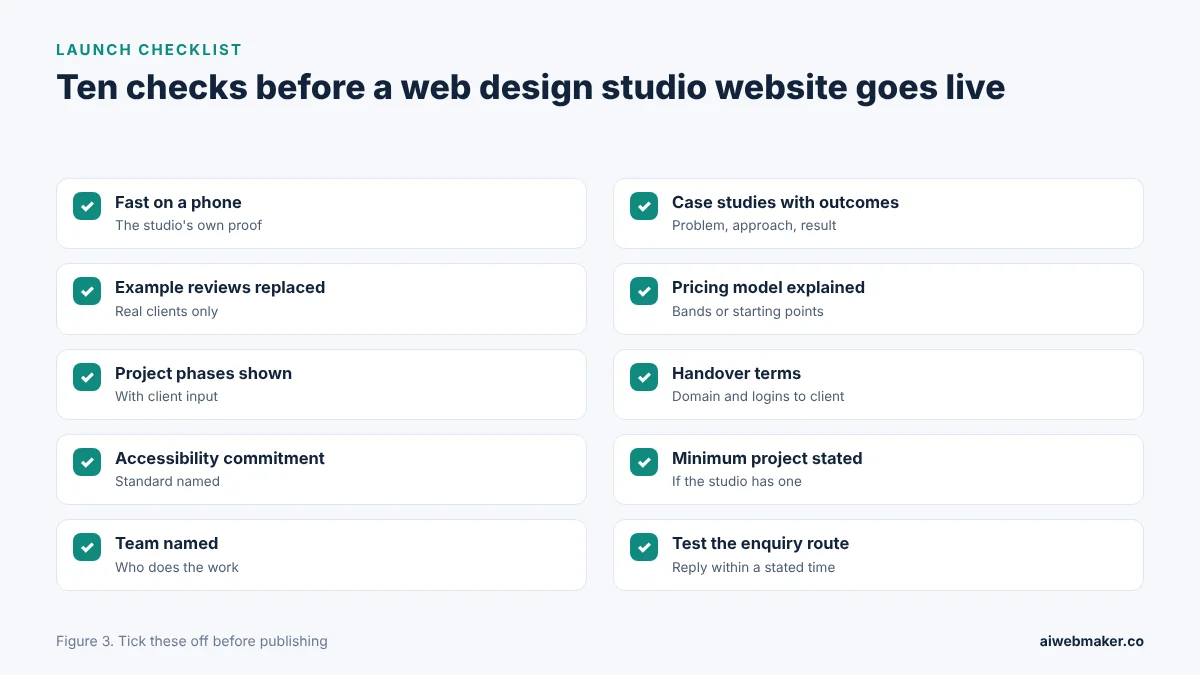
Buyers doubt a studio when its own site contradicts what it sells. A slow home page on a phone undermines every claim about performance. Mockups without results suggest the studio designs pictures rather than websites that work. No hint of price or process leaves buyers fearing an expensive surprise. A portfolio that stopped years ago, or example reviews left in place, makes the studio look inactive or careless. The figure that comes next lists ten checks to run before launch.
Frequently asked questions
Is it odd for a studio to start its own site from a builder draft?
Many studios find their own site is the project that never gets finished, so starting from a draft can be practical rather than odd. What prospects judge is the clarity of the offer, the quality of the case studies and the speed of the pages. The studio can still build client sites in whatever way suits each project. Time saved on the showcase can go into writing better case studies. A finished, honest showcase beats an ambitious one that stays unpublished.
Should example reviews be replaced before launch?
Example reviews must always be replaced or removed before launch, because invented testimonials mislead visitors and breach consumer rules in many countries. The sample labels its feedback as example reviews precisely so a real studio knows to swap them. Asking two or three recent clients for a short quote is usually enough to begin. If no reviews exist yet, the section can stay hidden until real ones arrive. Genuine feedback, even a little of it, carries far more weight than polished invention.
How many case studies does a studio need?
Three to six strong case studies usually serve better than a long gallery, as long as each one explains the problem, the approach and the outcome. Variety across sectors or project types helps more buyers see themselves in the work. Older projects can be retired once newer, stronger ones replace them. A case study for each service the studio wants to sell keeps the portfolio aligned with its goals. Depth persuades where volume only impresses.
Should a studio list a minimum project size?
A studio with a genuine minimum should state it, because doing so saves time for prospects and for the team. The figure can sit on the pricing page or beside the enquiry route. Studios without a fixed minimum can describe typical project sizes instead. Smaller prospects can be pointed to a lighter service, such as a consultation or a care plan. Honesty about size builds goodwill even with people the studio cannot serve.
How many signed projects does a studio's showcase need each year?
One signed project, even a small one, earns many times the $119 a web design studio pays to host its own pages for a year. Paying $19 a month instead costs less than one billable hour. Clients who return for new phases and care plans are worth far more than any hosting bill over the years. Honest case studies, clear pricing models and visible process are what turn a prospect's visit into a qualified enquiry. Studios that add each finished project promptly show buyers a team that is busy and current. A discovery call booked by a buyer who already understands the process is the return worth measuring.
Build your website in Minutes and get the AI Tools that work
Start Building Your Website →