Travel Agency Website Cost, From Itineraries to Booking Requests
A travel agency's trip pages are hosted for a yearly $119, or $19 a month through quiet seasons, plus the web address. Covered: who uses an agent, trip pages, pace and inclusions, booking requests, payment terms, financial protection, entry rules, search and the budget.
- No coding required
- Live in minutes
- Blog, SEO and chatbot tools included
On AI Web Maker, a travel agency's trip pages are hosted for a yearly $119, or $19 a month through quiet seasons, and the web address costs whatever its ending commands. Itineraries can be drafted, priced and walked through in the preview before anything is owed, which suits a business that revises trips every season. Where those itineraries end up is clearer on the travel agency website example, which shows an invented agency's mountain tours as bookable trips, all on one sample site AI Web Maker generated in full. A single booked trip usually earns far more than the year's hosting. The challenge is that travellers can book flights and hotels themselves in minutes, so an agency has to show what self booking cannot offer, namely expert planning, tailored routes and help when plans fall apart. Travellers also pay large sums in advance, and they want to know their money is protected under schemes that differ between countries. The route through this article covers who still uses an agent, the pages, trip design, booking requests, payment terms, protection, travel advice, search and the budget.
This article is part of our complete guide: Professional Services Website Builder.
Who still books through a travel agency, and why?
People still book through an agency when a trip is complex, expensive or emotionally important. Honeymooners want every detail right and someone to call if a transfer goes wrong. Families need rooms that fit, activities for different ages and realistic travel days. Older travellers value guided trips, steady pacing and help with documents. Adventure travellers look for local knowledge on routes, permits and guides that a booking engine cannot provide, while group organisers want one point of contact for many people. All of them choose an agency whose site proves it knows the destination and stands behind the trip.
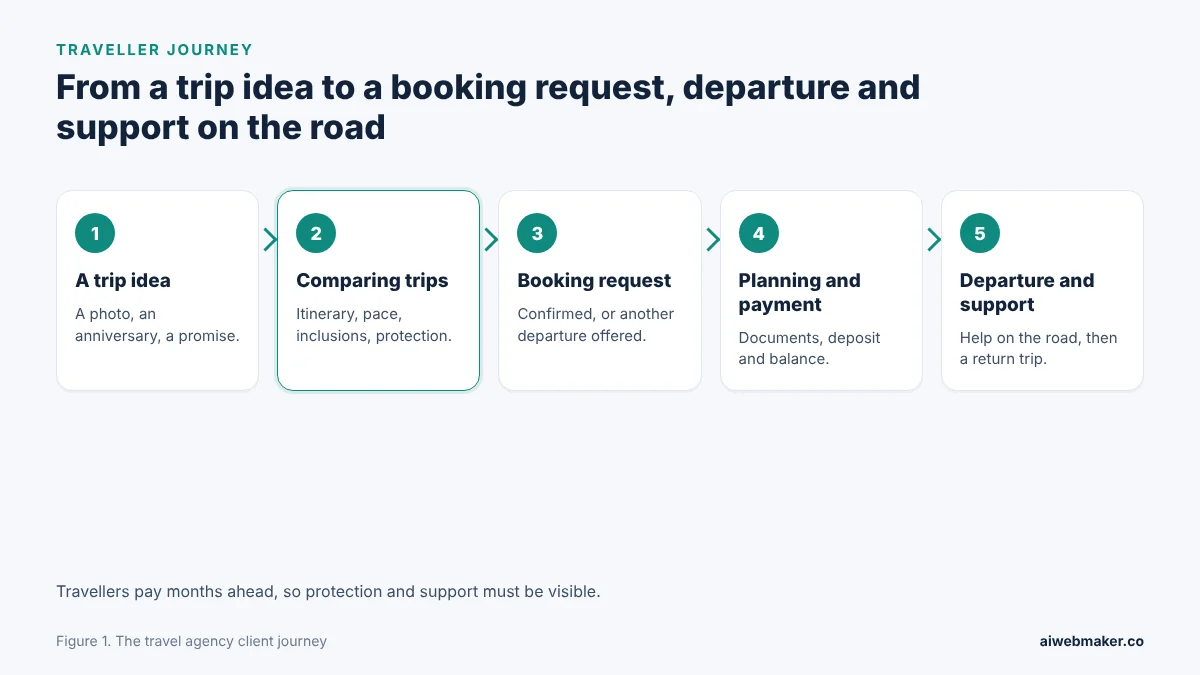
The journey begins with an idea, often sparked by a photo, an anniversary or a long promised holiday. Comparison is the highlighted step, as travellers line up itineraries, inclusions, pace and protection from several agencies. A booking request or a tailoring enquiry follows, and the agency replies with confirmation or a suggested alternative. Planning, documents and the agency's own payment schedule fill the weeks before departure. Support during the trip, and a follow up afterwards, turn a single booking into a client who returns and recommends. Each stage has a page that either builds confidence or quietly loses the traveller to a booking engine.
What should sit on each page between inspiration and departure?
A travel agency site needs trip pages that can be compared at a glance, plus pages that explain how planning, payment and support work. A trip page has to hold the route, the pace, the inclusions, the price and the way to request it. A planning page explains the path from enquiry to departure, how tailoring works and what happens if plans change. A protection section names any licences, bonds or schemes that safeguard the traveller's money. The about page introduces the team and their first hand knowledge of the destinations. Contact details should include a way to reach the agency during a trip, not only before it.
| Page | Traveller question | What it should state |
|---|---|---|
| Trip pages | Is this the right trip for us? | Itinerary, pace, inclusions, price, dates |
| Tailor made | Can it be changed to suit us? | What can be adjusted and how quotes follow |
| Planning and payment | How does booking work? | Request, confirmation, deposit and balance terms |
| Protection | Is our money safe? | Licences, bonds or schemes that apply |
| Before you go | What do we need to prepare? | Documents and the official sources to check |
| About | Who are these people? | Team, destination experience, memberships |
| Support | Who helps if something goes wrong? | Contact details during the trip |
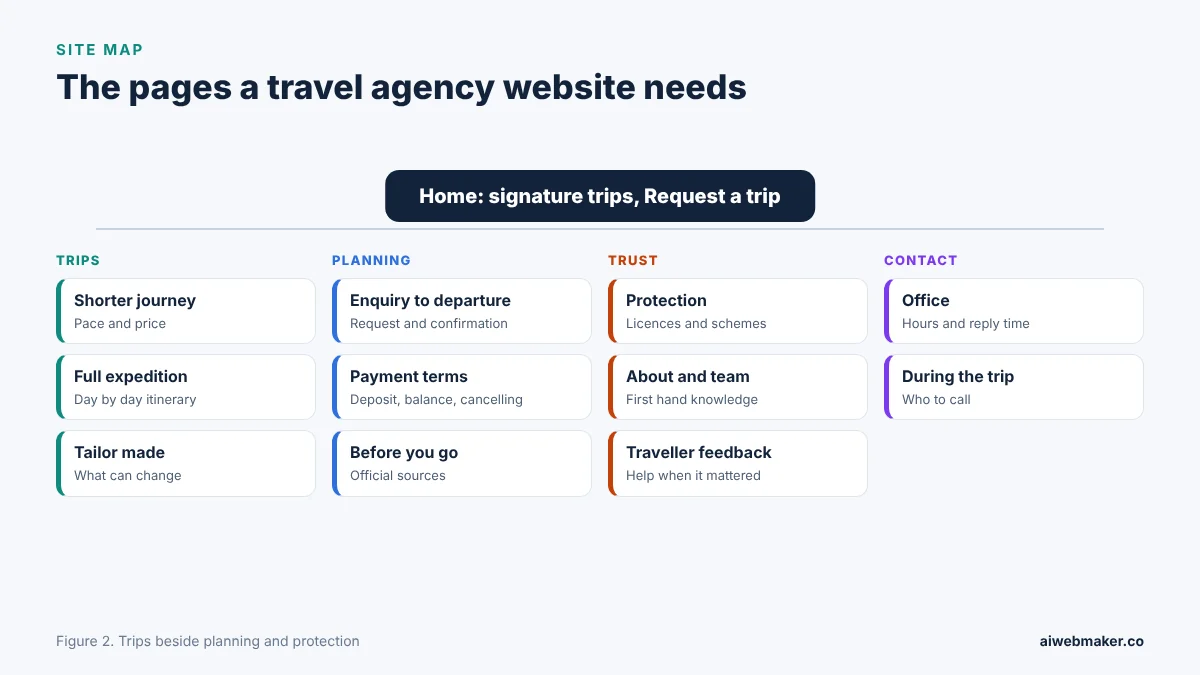
In the structure pictured, trips sit beside planning and protection, because travellers flick between them before committing. Trip pages carry the itinerary and pace, while planning pages explain requests, tailoring and support on the road. Our sample agency, Horizon Trails Travel, offers three bookable trips at different lengths and paces, from a shorter journey to a full expedition, each with its own price. Its trips page includes destination highlights and a section on trip length and pace, and its process page explains the path from enquiry to departure, how tailoring and changes work, and the support given before and during the trip. The about page covers memberships, accreditations and traveller feedback beside the agency's story and team, and the travel agency website example with three bookable trips produced its trips, process, about and contact pages in 45 seconds.
How should a trip page describe pace, inclusions and fitness?
A trip page should let a traveller judge in a minute whether the journey suits their energy, comfort and budget. A day by day itinerary shows how long each travel day is and where rest days fall. An honest activity level, such as gentle walking or long days at altitude, prevents the most common complaints. Inclusions and exclusions belong side by side, because flights, visas, insurance and tips are where surprises usually hide. The price basis, such as per person sharing with a single supplement, should be stated next to the figure. Clear, honest trip pages reduce cancellations and lead to better reviews.
| Trip page element | What to include |
|---|---|
| Itinerary | Each day's route, travel time and highlights |
| Pace and activity | Typical hours on foot or on the road, rest days |
| Accommodation | Standard and style, with any nights camping |
| Group size | Small group, private or a mix |
| Included | Guides, transfers, meals, entry fees |
| Not included | Flights, visas, insurance, tips, personal costs |
| Price basis | Per person sharing, single supplement, dates |
How does a booking request work for a trip?
A booking request lets a traveller pick a trip and send a request, after which the agency checks availability before anything is confirmed. The agency then confirms the request, proposes a different departure or declines it if the trip is full or unsuitable. Payment is arranged by the agency directly with the traveller under its own terms, and the platform takes nothing from the trip price. The booking website builder for travel agencies taking trip requests drafts the trip pages and the request route once the agency outlines its trips in a short paragraph. Around each request, travellers should read how soon the agency replies, what confirmation looks like and when travel documents follow. A clear request path suits trips that need a human check of dates, rooms and suppliers before they are confirmed.
What should travellers know about deposits, balances and cancellations?
Travellers should know every payment date and cancellation charge before they commit, because disputes in travel almost always start with terms nobody read. The agency's own booking conditions should explain the deposit, the date the balance is due and the charges that apply if a traveller cancels at different points before departure. Changes made by the traveller, and changes forced by suppliers or events, should be covered separately. Consumer law and package travel rules give travellers rights in some regions, and those rights vary, so the conditions should be reviewed by someone who knows the local rules. Advising every traveller to take out suitable travel insurance as soon as they book is standard practice. Plain terms, linked from every trip page, protect both the traveller and the agency.
| Term | What the page should explain |
|---|---|
| Deposit | How much secures a place, and when it is paid |
| Balance | The date the remaining amount is due |
| Cancellation by the traveller | Charges at different points before departure |
| Changes by the traveller | Whether amendments carry a fee |
| Changes or cancellation by the agency | Alternatives offered and refunds due |
| Travel insurance | That suitable cover should be arranged at booking |
How is a traveller's money protected?
Financial protection reassures travellers who pay large sums months in advance, and the schemes that provide it vary by jurisdiction. In the European Union, for example, package travel rules require organisers to protect travellers' payments against insolvency. Flight inclusive trips fall under dedicated licensing in some countries, while several American states ask sellers of travel to register. Membership of a recognised trade association, where accurate, adds further reassurance. The about page or a dedicated protection page should name each scheme or licence that applies, with numbers travellers can verify. Clear protection details often decide whether a careful traveller books at all.
What travel advice can an agency give, and where should it point instead?
An agency can share practical knowledge about destinations, but entry rules, health precautions and safety advice should point to official sources that are kept up to date. Passport validity and visa rules change, so the site should direct travellers to government or embassy sources and remind them that checking is their responsibility. Vaccinations and health precautions are a matter for a doctor or travel clinic, never for a trip page. Government travel advisories cover safety and should be checked before booking and before departure. Insurance should be arranged with a licensed provider, with cover checked against the activities in the trip. Pointing travellers to the right sources protects them and keeps the agency within its competence.
| Topic | Where to point travellers |
|---|---|
| Passports and visas | Official government or embassy sources |
| Vaccinations and health | A doctor or travel clinic |
| Safety | Government travel advice for the destination |
| Insurance | A licensed provider, cover checked against the trip |
Which searches carry dreamers to a specialist agency?
Travellers search for phrases such as tailor made safari, honeymoon travel agent, walking holidays in a named region or small group tours of a particular country. Destination and trip type pages built around those phrases reach people while they are still dreaming. A map listing with the office and a link to the trips page helps travellers who want to meet an agent in person. Reviews that describe how the agency helped during a delay or a missed connection carry more weight than reviews about scenery. Articles on the best time to visit, packing for a trek or what a typical day on the trip looks like attract readers months before they book. Knowledgeable, first hand writing is the strongest signal that the agency has actually been there.
What does a year of trip pages cost the agency?
The agency's fixed web cost is hosting and a domain, and each destination article drafted with AI credits adds roughly sixty five cents. An agency whose departures are already selling saves most by clearing the hosting for all four seasons at once. A new agency building its first departures may prefer the monthly route through the opening seasons. Adding trips, updating prices or changing departure dates is not charged. Both ways of paying for the trip pages appear below, the $189 tier shown only to make the comparison complete.
| Item | Yearly | Monthly |
|---|---|---|
| Hosting the trip pages | $119 | $228 over twelve months |
| Domain | Depends on the ending | Depends on the ending |
| Higher plan, for comparison | $189 a year | Not needed |
| Twelve destination articles at about $0.65 | About $7.80 | About $7.80 |
| Trip, price and date updates | No charge | No charge |
| Year before the domain | About $126.80 | About $235.80 |
What sends a would be traveller back to a booking engine?
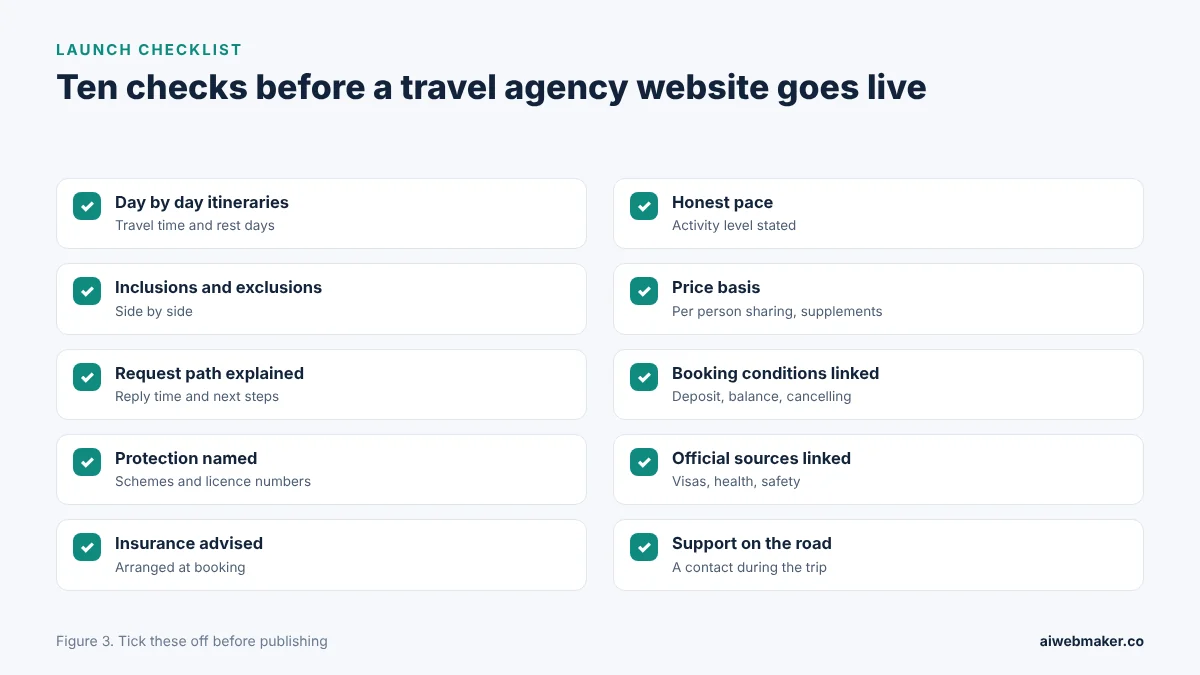
Would be travellers return to booking engines when trip pages hide what is included until the last step. Missing protection details make them wonder what happens to their money if the agency fails. Vague pacing leaves families and older travellers unsure whether a trip suits them. Without any word on help during the trip, the strongest argument for an agent disappears. A request path that never says when a reply will arrive makes them book elsewhere while they wait. Ten fixes for exactly those doubts are pictured in the launch list that comes next.
Frequently asked questions
What is usually included in a trip price?
What a trip price includes varies by agency and trip, so each trip page should list inclusions and exclusions side by side. Accommodation, guides, ground transport and some meals are commonly included in organised trips. International flights, visas, travel insurance, tips and personal spending are commonly excluded. The price basis, such as per person sharing, should be stated beside the figure. Complete lists prevent the disputes that follow hidden extras.
What happens if a traveller has to cancel?
The consequences depend on the agency's booking conditions and on when the traveller cancels. Many agencies charge more as departure approaches, because supplier costs become committed. Travel insurance may cover cancellation for certain reasons, which is why it should be arranged at the time of booking. Consumer rights in some regions add further protections. Clear conditions, linked from every trip page, let travellers decide with full information.
Who checks passport and visa requirements?
Travellers are responsible for meeting passport and visa requirements, although a good agency reminds them and points to official sources. Rules depend on nationality, destination and sometimes the route taken, and they can change at short notice. The website should link travellers to government or embassy guidance rather than state rules that may become outdated. A reminder at booking and again before departure is good practice. Careful signposting prevents ruined departures at the airport.
Can a fixed itinerary be tailored?
Many agencies tailor fixed itineraries by adding nights, upgrading rooms or changing the pace. The planning page should explain what can usually be adjusted and how a revised quote follows. Tailored trips often need more time to confirm, because each supplier must be checked. Fixed trips act as proven starting points rather than limits. Offering both serves travellers who want certainty and those who want something personal.
How many booked trips repay the agency's website?
A single departure sold through the site normally clears the $119 hosting bill with plenty left. On the monthly plan, one traveller's booking margin covers the $19 for many months. Every couple or family who compares the itinerary, checks the protection details and sends a request can return for years and recommend the agency to friends. Honest trip pages, clear payment terms and visible support beat glossy photos alone. Agencies that keep departures, prices and stories current find their trips filling with travellers they have never met. Requests arriving for next season while this season's travellers are still on the road show the pages are earning their keep.
Build your website in Minutes and get the AI Tools that work
Start Building Your Website →