Executive Coach Website Cost, Programmes and the Sponsor Who Pays
Programme pages for an executive coach need hosting that costs $119 per twelve month term, or $19 a calendar month, plus a domain of the coach's choosing. Covered: managers, founders and sponsors, pages, programme pricing, three way contracting, confidentiality, the therapy line, requests, search and the budget.
- No coding required
- Live in minutes
- Blog, SEO and chatbot tools included
An executive coach's programme pages ride on AI Web Maker hosting, $119 for a full year or a $19 payment as each month opens, and the practice buys its domain on top. Shaping the programme table, the sponsor rules and the chemistry call request is unbilled, and so is every pass through the preview. A single six session programme repays the year many times, so hosting never stands in the way. What complicates things is that two parties are often involved, a manager who wants privacy and an employer who pays and wants evidence, and both read the site before agreeing. Coaching is also unregulated in most countries, so buyers look hard for signs of training, supervision and honest limits. Next come the managers and sponsors, pages, programme pricing, three way contracting, confidentiality, the therapy line, requests, search and the budget.
This article is part of our complete guide: Professional Services Website Builder.
New managers, founders and the HR partner who signs the purchase order
Executive coaching is usually bought by one person and used by another, so every page is read twice, once by each of them. A manager newly promoted over former peers, a founder whose company has outgrown their habits and a senior leader preparing for a board role are typical clients. Their employer, often through a human resources partner or a learning budget, frequently pays and wants to know what the money buys. Founders tend to pay for themselves and care more about discretion and flexible timing. A site that speaks to the client's private concerns and the sponsor's practical ones wins the chemistry call.
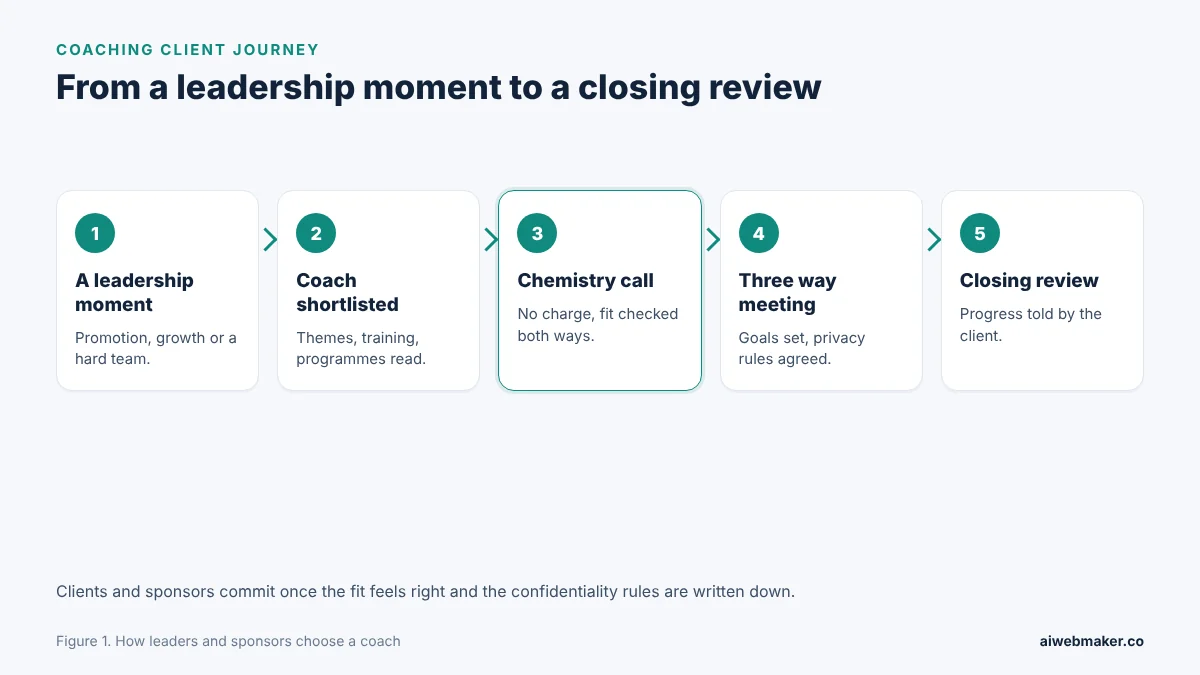
The chemistry call is highlighted because coaching depends on the fit between two people, and both sides need to test it before money changes hands. The journey starts with a leadership moment, such as a promotion, a growth spurt or a team that has stopped working. Shortlisting happens online, through the themes a coach works on, the training listed and the programme prices. When an employer pays, a three way meeting sets goals and agrees what the sponsor will and will not hear. A closing review, led by the client, decides whether the sponsor buys coaching for other managers.
Programmes, themes, sponsor rules, privacy and the chemistry call
An executive coach's site needs pages for the client and pages for the sponsor, and the two sets should never contradict each other. The home page introduces the coach, the kinds of leader served and the formats, such as in person, video or walking sessions. A programmes page shows the six and twelve session options and any founder arrangement, priced in full. A privacy page and a page of rules for sponsors answer the questions that stall many purchase orders. Themes, the process from first call to closing review and a request for a chemistry call complete the set.
| Page | Main reader | What it should show |
|---|---|---|
| Home | Client and sponsor | The coach, the leaders served, session formats |
| Programmes | Both | Sessions, length, the full price, invoicing |
| Themes | Client | Peers turned reports, decisions, teams, boards |
| Privacy | Client | Notes, recordings, what the employer never hears |
| For sponsors | Sponsor | Three way meeting, what is shared, progress reviews |
| Chemistry call request | Client | Programme, format, preferred day, a sentence on goals |
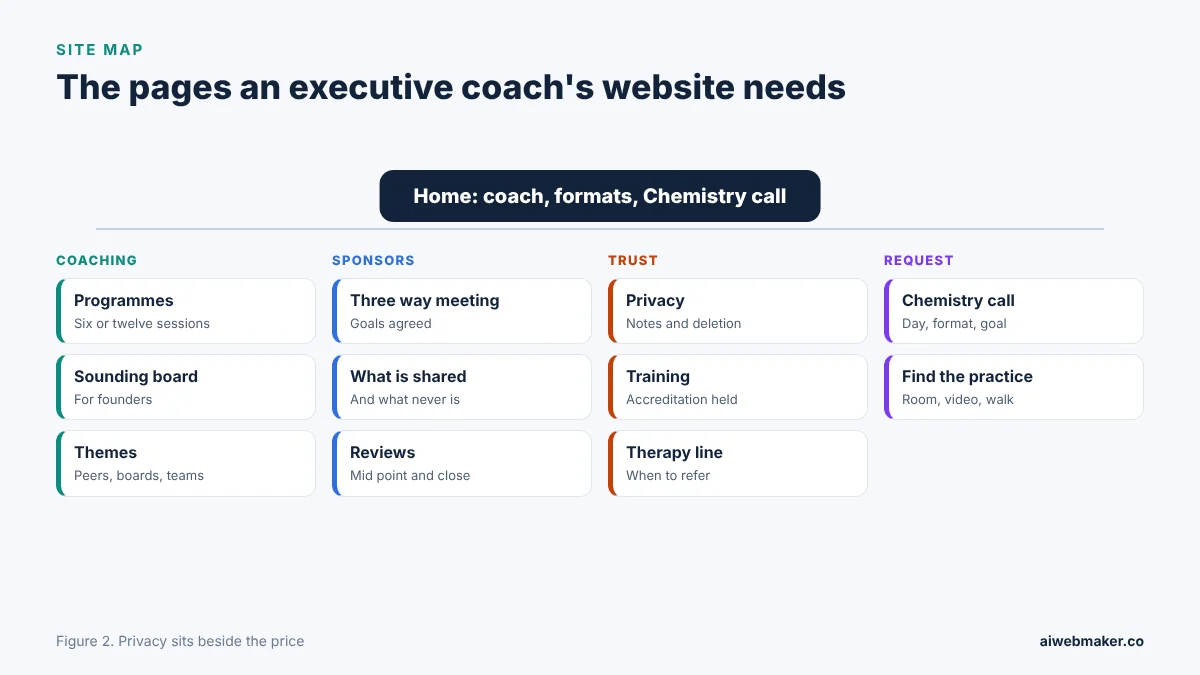
Privacy sits beside the programmes in this plan, because a client weighing a price is also weighing how much to reveal. The coaching group covers programmes and themes, the sponsor group holds the three way rules and progress reviews, and the trust group carries privacy, training and the therapy line. Summit Leadership Coaching, the invented practice behind our sample, sells a Six session programme, a Twelve session programme and a Founder sounding board. It lists Leading people who were your peers, Deciding with half the facts, Building a leadership team, Hard conversations, Workload and delegation and Boards and investors as starting themes, after a section on what stays private. The executive coach website example with confidential programmes and sponsor rules closes with a chemistry call request and directions to the practice.
Programmes priced in full: six sessions, twelve sessions and the sounding board
Executive coaching sells best as a programme with a whole price, because sponsors budget for change over months rather than for single hours. Six sessions often suit one transition, such as a promotion, while twelve suit broader change and leave room for feedback interviews. A founder retainer works differently, offering regular sessions and some contact between them for as long as it helps. Prices should include the coach's preparation and notes, so nobody wonders whether time between sessions is billed separately. Invoicing in two halves, at the start and at the mid point, spreads the cost and gives both sides a natural moment to review.
| Format | How it is usually priced | Suits | What the price should include |
|---|---|---|---|
| Six session programme | A single fee | One clear transition | Preparation, notes, a mid point review |
| Twelve session programme | A larger single fee | Broader change over months | Feedback interviews and reviews |
| Founder sounding board | A monthly or quarterly retainer | Founders wanting a regular thinking partner | Session count, contact between sessions |
| Team session | Per session or per day | Leadership teams | Preparation and follow up |
| Extra session | Per session | Top ups after a programme | Notice needed to arrange it |
The three way meeting: what the sponsor hears and what it never does
When an employer pays, the most important document is the agreement about what the sponsor will learn, and the site should publish its outline. A three way meeting at the start sets goals that client and sponsor both accept, then the sponsor steps back. Attendance and progress reports usually come from the client rather than the coach, which keeps trust intact. Feedback interviews with colleagues can sharpen goals, but their themes are shared only with the client's consent and never attributed. Agreeing these lines before session one stops the slow worry that whatever is said will reach the boss.
| Topic | Shared with the sponsor | Kept between coach and client |
|---|---|---|
| Programme goals | Agreed together at the start | Personal reasons behind them |
| Attendance | Sessions held or missed | What was discussed |
| Progress | Reported by the client at reviews | Session notes |
| Feedback interviews | Themes, with the client's consent | Who said what |
| Career plans | Only if the client chooses | Everything else |
| Safety concerns | Raised as the contract sets out | Within the limits of the law |
Session notes, recordings and how long anything is kept
Confidentiality is the promise clients test hardest, and vague assurances do not survive a careful reader. The page can state where notes are kept, that they are never sent to the employer, whether sessions are ever recorded and when notes are deleted after a programme ends. Retention periods and a client's rights over their own notes should follow the data protection law where the coach practises, which is not the same everywhere. The limits of confidentiality also need stating, such as a serious risk of harm or a legal duty to disclose, and these depend on where the coach practises. Clear limits make the promise more believable, not less.
Coaching, therapy and when to refer
Coaching works on goals, choices and behaviour at work, and it is not a treatment for anxiety, depression, burnout or trauma. A responsible coach watches for signs that a client needs a doctor, a psychologist or another licensed professional, and refers them kindly when that happens. Coaching may continue alongside treatment if the clinician agrees, or pause until the client is ready. The site can explain this boundary in plain terms and point readers in distress towards local emergency services or crisis lines. Saying where coaching ends reassures sponsors as much as clients.
Chemistry calls and the request that starts a programme
A chemistry call request should be short and should never ask for confidential detail, since one sentence on what the client wants to work on is enough. The booking website builder for executive coaches and their chemistry calls sets out the programme pages with a way to request a call after the coach outlines the themes, formats and prices. A client sends a request with a preferred day and format, and the coach confirms it, proposes another time or explains that the diary is full. Programme fees are invoiced and settled directly between the coach and the client or sponsor, and AI Web Maker takes no portion of them. A route this plain suits senior people who decide quickly once the fit seems right.
Leadership coaching and the phrases senior people search
Senior people and sponsors search with phrases such as executive coach, leadership coaching for new managers, coaching for founders or coach for a first time leader, often with a city. Human resources teams also search for coaching providers for managers and compare several before a purchase. Pages that use the client's own words, such as leading former peers or working with a board, answer the leader and the buyer alike. Photos of the room on a map listing help clients who want sessions in person. Articles on delegating, running a hard conversation or preparing for a first board meeting reach leaders long before they look for a coach.
Supervision, accreditation fees and the website: the coach's yearly figures
Supervision, accreditation renewals, professional insurance and continuing training all cost an executive coach more each year than the website. For hosting, AI Web Maker charges coaches who settle annually $119, and those who pay as each month begins $19, while the domain's price varies with its ending. Twelve articles on delegation, boards and hard conversations, written with AI credits costing about $0.65 per article, total about $7.80. Editing programme prices or the sponsor rules is not billed. One more row lists the $189 tier, there purely for contrast.
| Item | Yearly | Monthly |
|---|---|---|
| Hosting the programme pages | $119 | $228 over twelve months |
| Domain | Depends on the ending | Depends on the ending |
| Higher plan, for comparison | $189 a year | Not needed |
| Twelve leadership articles at about $0.65 | About $7.80 | About $7.80 |
| Programme and sponsor rule edits | No charge | No charge |
| Year before the domain | About $126.80 | About $235.80 |
Vague privacy, hidden prices and other reasons leaders hesitate
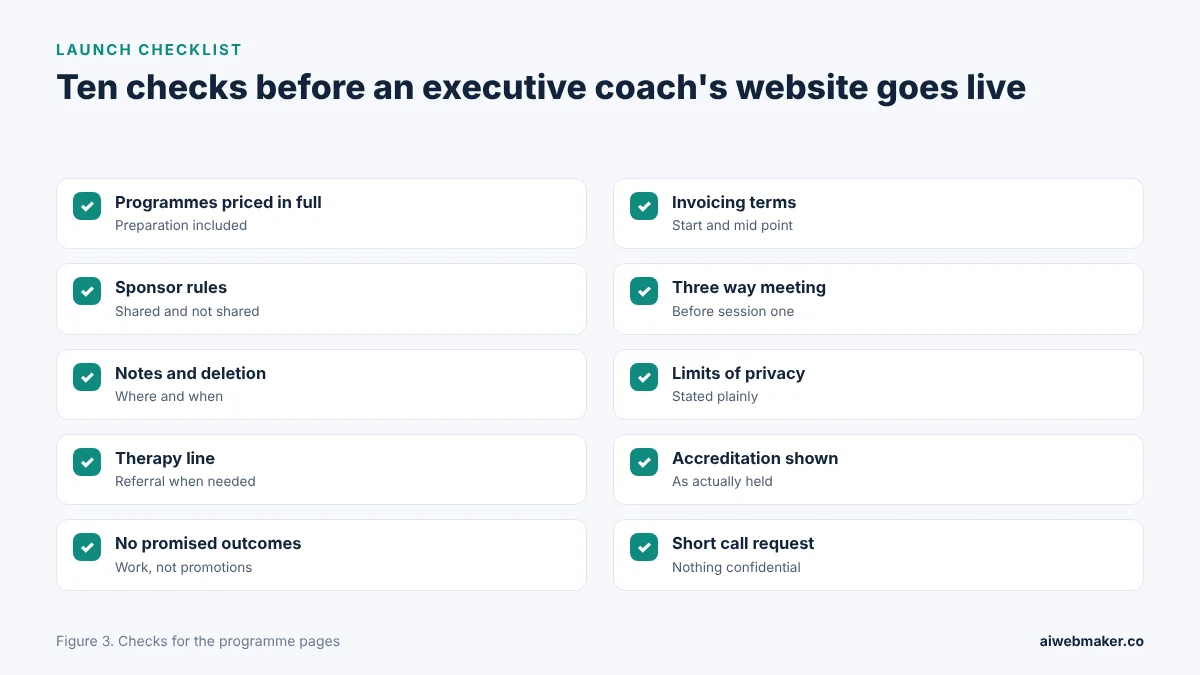
Leaders hesitate when a coaching site says nothing concrete about what the employer will hear, because that fear outweighs price. Missing programme prices force sponsors into a sales call before they can even budget. Promises of promotion, transformation or guaranteed results sound hollow to experienced managers. No mention of training or supervision makes careful buyers wonder who they are hiring. These four gaps, joined by six more, make up the checklist pictured after this paragraph.
Frequently asked questions
Will coaching get a manager promoted?
No coach can promise a promotion, a pay rise or any other outcome, because those decisions belong to the employer and depend on much more than coaching. Coaching can help a manager think more clearly, act more deliberately and prepare for the conversations that shape a career. Goals agreed at the three way meeting give the work a direction without turning it into a guarantee. Sponsors generally respect a coach who refuses to promise results. Honest framing on the site attracts clients who want to do the work.
What does the employer hear about the sessions?
Under a typical agreement, the employer hears that sessions took place and whatever the client chooses to share at progress reviews, and nothing more. Session content, notes and anything said about colleagues stay between coach and client. Feedback gathered from colleagues goes to the client and travels further only if the client agrees. The limits, such as a serious safety concern, should be written into the contract at the start. Publishing this outline lets clients agree to coaching without fearing a leak.
Which accreditation should an executive coach hold?
Coaching is unregulated in most countries, so no accreditation is required by law, though many sponsors prefer a coach accredited by a recognised professional body. Two of the best known are the International Coaching Federation and the European Mentoring and Coaching Council. Accreditation usually involves approved training, logged coaching hours and an assessment, with ongoing education to renew it. Membership commits the coach to an ethics code with a complaints route, which matters to buyers. Supervision and experience as a leader add to the picture. The site should state what is held and avoid suggesting a licence where none exists.
Can sessions happen by video or on a walk?
Many coaches offer sessions in a room, by video and walking outdoors, and each format suits different people and moments. Video works well for leaders who travel or work across time zones, while walking sessions help some people think more openly. Walking sessions need a quiet route and a plan for bad weather, and confidentiality still applies in a public park. Clients can usually mix formats across a programme. Stating the options and any differences in price helps clients picture the sessions before they book.
The six session programme that covers years of hosting
Any six session programme earns an executive coach many times the $119 spent on a year of hosting. Even paid monthly, twelve charges of $19 add up to far less than one session. Each sponsor who reads the rules page and signs without a long negotiation saves weeks of email. Clients who arrive already reassured about privacy start the real work in the first session. Repeat programmes for other managers in the same company, ordered after a sponsor reads the closing review, show the site has paid its way.
Build your website in Minutes and get the AI Tools that work
Start Building Your Website →