Coaching Website Cost and a First Session Clients Can Request
Coaches pay $119 per year for hosting or, while a practice finds its feet, $19 per month, with the domain alongside. Topics: who hires a coach, the pages, niches, formats and packages, first session requests, the line with therapy, honest results, search and the budget.
- No coding required
- Live in minutes
- Blog, SEO and chatbot tools included
Coaches hosting with AI Web Maker pay $119 per year or, while a practice finds its feet, $19 per month, with the domain chosen and paid for alongside. Writing the session pages, the coach's story and the request route, then rehearsing them in the preview, is not billed. A coach's story, formats and first session route are arranged on our coaching business website sample, an imaginary practice made with AI Web Maker to show how visitors judge fit. One coaching package, and often a couple of first sessions, covers that sum for the whole year. The difficulty is that the product is a relationship, and visitors cannot judge chemistry or method from a price list. In most countries anyone may call themselves a coach, so careful visitors look for training, ethics and real results before they commit. Ahead are the people who hire coaches, the pages, niches, formats and packages, first session requests, the line between coaching and therapy, results, search and the budget.
This article is part of our complete guide: Professional Services Website Builder.
Who hires a coach, and what makes them pick one?
Coaching clients usually arrive at a turning point, and the turning point shapes what they look for. A professional weighing a career change wants someone who understands their industry and the job market. A newly promoted manager wants help leading former peers, often with the employer paying. Founders look for a sounding board who has seen businesses grow, while people rebuilding routines after a life change want steady accountability. Many visitors have tried books, courses or apps and now want a person who will hold them to their word. Across these groups the decision rests on fit, meaning a clear niche, a method that makes sense and evidence that past clients moved forward.
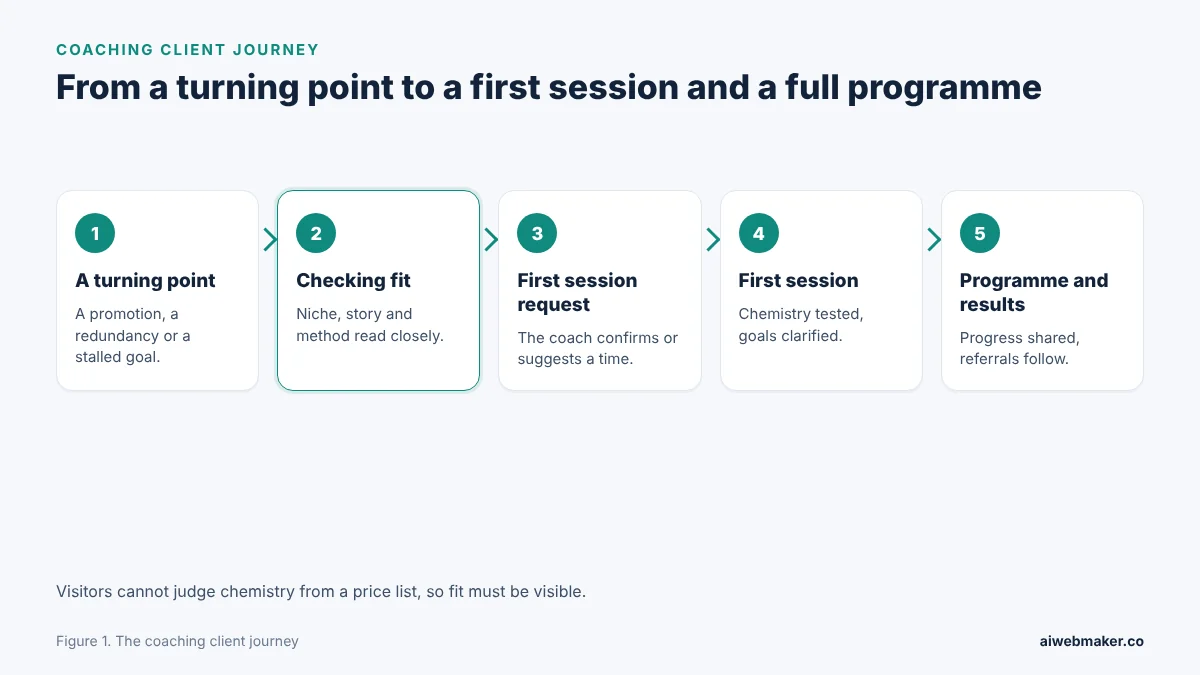
The journey opens with a turning point, such as a promotion, a redundancy or a goal that keeps slipping. Visitors then check fit, and that highlighted step is where the niche, the coach's story and the method are read closely. A first session request follows, which the coach answers by confirming a time or suggesting another. The first session tests the chemistry and clarifies goals, and a clear proposal for a programme comes after it. Progress through the programme, and the results the client later shares, bring referrals that feed the next cycle. Every page has a part in moving someone from curiosity to commitment.
Which pages turn a curious reader into a first session request?
A coaching website needs few pages, but each must sound like the coach and answer one question a cautious visitor brings. The home page states who the coaching is for and the change it helps people make. A page describing the coaching sets out the method, the session formats and what happens between sessions. The about page holds the coach's story, training and philosophy. A results page gathers client comments, shared with permission and without promising the same outcome to everyone. The sessions page lists what can be requested with prices, so a visitor can ask for a first session without a long email exchange.
| Page | Question it answers | What it should include |
|---|---|---|
| Home | Is this coach for someone like me? | Niche, the change on offer, a first session route |
| The coaching | How does it actually work? | Method, formats, length, support between sessions |
| Sessions and prices | What can be requested, and at what price? | First session, single sessions, packages |
| About | Who is this person? | Story, training, philosophy, ethics code followed |
| Results | Has it worked for people in a similar place? | Client comments with consent, measured wording |
| Contact | How does a conversation start? | A short goals message and the reply time |
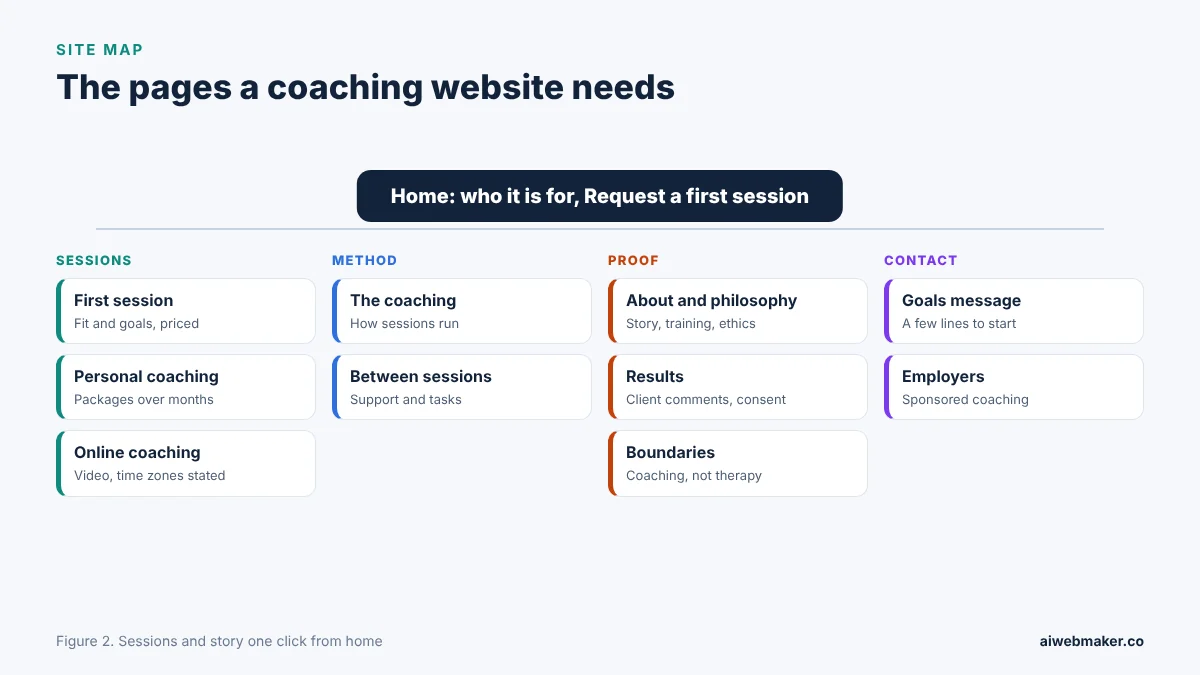
In this plan the sessions and the coach's story sit one click from the home page, because those are the two things visitors check first. Session pages hold the first session, ongoing coaching and online options, each with a price. Proof pages hold the story, the philosophy and client results. Our sample coach, Clearpath Coaching, offers a first session beside personal coaching and online coaching, each priced separately, with online coaching set slightly below the in person rate. Its pages describe the coaching, the coach's story and philosophy and client results, where client comments end with an invitation to start, while the contact page asks visitors about their goals. The coaching website example with three bookable sessions was assembled in 48 seconds.
Why does a narrow niche win more clients than a broad promise?
A narrow niche wins because visitors look for a coach who already understands their particular situation, not one who promises to help everyone with everything. Life coaching, career coaching, executive coaching and leadership coaching attract different people with different budgets and expectations. Within each, a sharper focus, such as first time managers in technology or parents returning to work, makes the home page instantly recognisable to the right reader. A niche also shapes the vocabulary of every page, which helps search engines match the site to specific searches. Coaches worry that a niche will shrink their market, yet in practice it tends to make referrals easier because people know exactly whom to send. A clear focus turns a generic coaching site into the obvious choice for one kind of client.
How should sessions, packages and formats be arranged?
Sessions are easiest to buy when the options are few, clearly priced and arranged as a path from a first meeting to a longer commitment. A first session at a modest price lets both sides test the fit. Packages of several sessions over a set period suit clients working towards a defined goal, and they give the coach steadier income. Ongoing monthly arrangements suit leaders who want a regular thinking partner. Online sessions remove travel and widen the market across cities and time zones, while in person sessions suit clients who value the room. Each option should state its length, its format and what happens between sessions, so visitors can compare without asking.
| Format | How it runs | Suits |
|---|---|---|
| First session | One meeting to clarify goals and test the fit | Every new client |
| Single sessions | Booked as needed | Clients with a specific decision to make |
| Package | A set number of sessions over a few months | A defined goal, such as a career move |
| Ongoing arrangement | Regular sessions with no fixed end | Leaders wanting a thinking partner |
| Online | Video sessions, time zones stated | Clients in other cities or countries |
| Employer sponsored | A three way agreement on goals and confidentiality | Managers whose company pays |
What happens once someone asks for a first session?
A first session request works best when sending it takes a visitor less than a minute, with the session named and the price already visible. The coach then reviews each request and confirms it, proposes a different time or turns it down if the fit looks wrong. Coach and client settle the fee between themselves by the coach's usual method, and no commission on it goes to AI Web Maker. Drafts of the session pages and the request route come from the booking website builder for coaches taking first session requests once the coach describes the practice in a few sentences. The page around it should explain how long the session lasts, what happens during it and the coach's own policy on rescheduling. Clear expectations make the first meeting feel like a conversation rather than a sales call.
Where does coaching end and therapy begin?
Coaching focuses on goals, decisions and action in the present, while therapy treats mental health conditions and is delivered by licensed professionals under rules that vary by country. A responsible coaching site states this boundary plainly, because some visitors arrive carrying problems a coach should not take on. When a client describes symptoms that suggest a mental health condition, a coach should encourage them to see a doctor or a licensed therapist. In an emergency, the right step is always local emergency services or a crisis line. Coaching itself is unregulated in most countries, although voluntary bodies such as the International Coaching Federation publish codes of ethics that many coaches follow. Naming the code followed and the limits of confidentiality shows a professionalism that untrained competitors cannot match.
| What the client brings | Where it belongs |
|---|---|
| Career direction, leadership, habits, goals | Coaching |
| Ongoing stress that disrupts sleep or work | A doctor or licensed therapist, with coaching alongside only if appropriate |
| Grief, trauma or a diagnosed condition | A licensed therapist or counsellor |
| Thoughts of harming themselves | Emergency services or a crisis line, straight away |
| Legal, tax or financial questions | A qualified adviser in that field |
How can client results be shown without overpromising?
Client results persuade only when they sound real, so quotes should describe a specific change in the client's own words, shared with written consent. A story about someone who moved into a new role or rebuilt a morning routine carries more weight than general praise. Outcomes depend heavily on the client's own effort, so the site should never promise income figures, promotions or guaranteed transformations. Consumer protection rules in several countries treat testimonials as advertising claims, so selective or invented stories can create legal risk as well as distrust. Clients who prefer privacy can be quoted by role and sector instead of by name. Measured, specific results build the kind of trust that bold claims destroy.
Which search phrases lead goal setters to a coach rather than an app?
Goal setters ready for help search for career coach for teachers, leadership coach online, executive coach in a named city or accountability coach. Pages built around each niche, using those exact words in their headings, meet the visitor halfway. Coaches who also meet clients in person benefit from a map listing that links back to the sessions page. Reviews describing the change clients experienced, rather than generic praise, persuade the most. Articles on preparing for a first session, questions to ask a coach before hiring or how coaching differs from mentoring bring readers who are close to deciding. Writing in the coach's own voice also lets readers sample the chemistry before they ever meet.
What does a coaching practice spend on hosting, domain and articles?
A coach's yearly outlay stops at hosting and a domain, with each article on goals or leadership adding about sixty five cents in AI credits. A coach whose diary is already full gets the lowest total from the single annual payment. A coach in the first months of practice may prefer twelve smaller payments while the client list grows. Adding sessions, adjusting prices or publishing new results costs nothing extra. Annual and monthly billing for a coaching practice follow in the table, the $189 tier included purely as a benchmark.
| Item | Yearly | Monthly |
|---|---|---|
| Hosting the coaching pages | $119 | $228 over twelve months |
| Domain | Depends on the ending | Depends on the ending |
| Higher plan, for comparison | $189 a year | Not needed |
| Twelve goal setting articles at about $0.65 | About $7.80 | About $7.80 |
| Session, price and results updates | No charge | No charge |
| Year before the domain | About $126.80 | About $235.80 |
What makes a would be client close the tab before asking for a session?
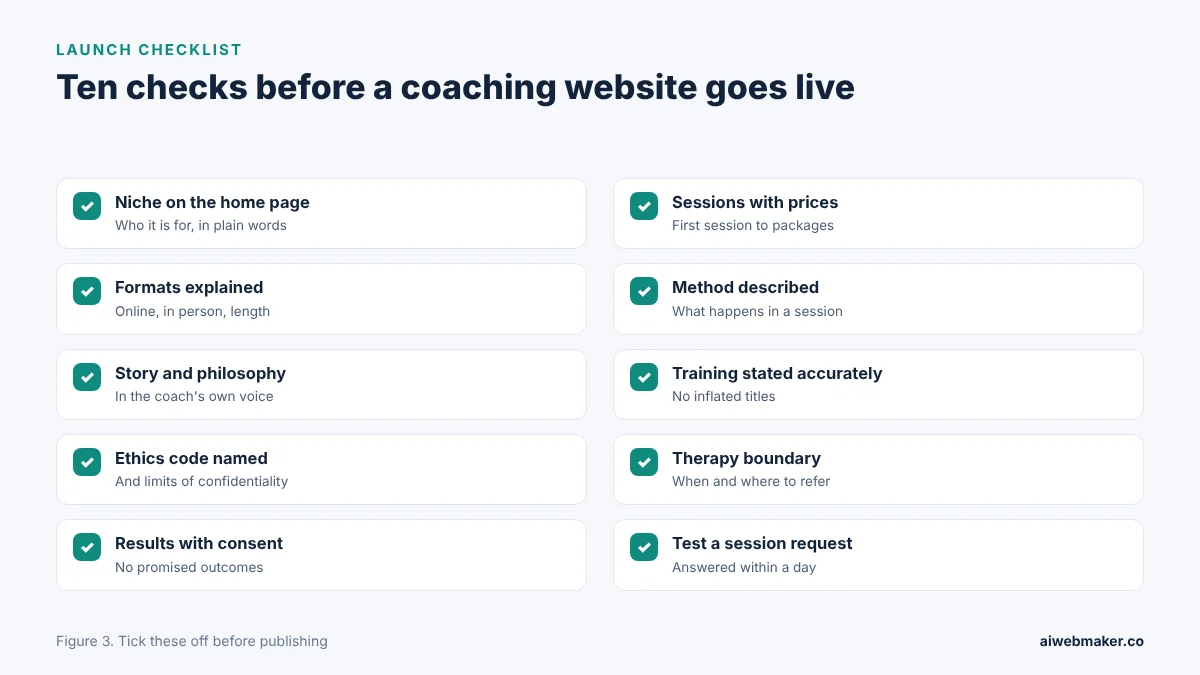
Would be clients close the tab when the home page could describe any coach, because a vague promise gives them nothing to recognise. No prices or session formats leave them guessing about commitment and cost. A thin about page with no training or ethics code makes them wonder who they would be confiding in. Results that sound too good to be true trigger suspicion rather than hope. A request route buried behind a long form makes the first step feel like hard work. The ten point launch list in the next picture is built around exactly those hesitations.
Frequently asked questions
What length of engagement do coaching clients usually sign up for?
Coaching engagements commonly run for a few months, often as a package of sessions spaced every week or two, though the right length depends on the goal. A focused career decision may need only a handful of sessions, while leadership development can continue for a year or longer. The website can describe typical lengths for each kind of client without fixing a rule. Clients appreciate knowing what they are committing to before the first session. Clear expectations reduce the number of engagements that fade away halfway.
Can an employer pay for an employee's coaching?
Many employers pay for coaching, particularly for new managers and senior leaders. In these arrangements, the coach, the client and the employer usually agree the goals together at the start. The page should explain what the employer will and will not hear, because confidentiality is what makes the sessions useful. Invoicing the company directly, and sending progress summaries only with the client's agreement, are common practices. A clear section for employers opens a steady source of well funded clients.
What happens in a first coaching session?
A first session usually explores where the client is now, what they want to change and what has stood in the way so far. The coach explains how the coaching works, and both sides judge whether they want to continue. Some coaches send a short questionnaire beforehand, which the page can mention if it applies. It should close with an agreed next step, whether a proposed package or an honest referral elsewhere. Describing this openly makes requesting a first session feel low risk.
Does a coach need a qualification to practise?
In most countries coaching is not a regulated profession, so no qualification is legally required to practise. Training programmes and accreditation from voluntary professional bodies show that a coach has studied the craft and agreed to a code of ethics. Coaches working in areas close to health, finance or law must take extra care to stay within their competence. The website should state any training and accreditation accurately, without inflating them. Honest credentials reassure visitors in a field where anyone can use the title.
How many sessions repay a year of the coaching website?
A couple of first sessions, or a single package, usually covers the $119 that keeps a coaching site online for twelve months. Coaches on monthly billing recoup the $19 from part of one session. Each visitor who recognises their own situation in the niche, reads honest results and requests a first session can become a client for months. A clear niche, transparent formats and a careful boundary with therapy persuade more people than any slogan. Coaches who keep adding real client stories find that referred visitors read the results page before making contact. When first session requests arrive from people the coach has never met, the site has already repaid its year.
Build your website in Minutes and get the AI Tools that work
Start Building Your Website →