Architect Website Cost and the Project Stages Clients Need Explained
Architects can host a practice website for $119 across a year, or pay $19 in monthly instalments, and register a domain alongside. Covered: clients, pages, work stages, fees, registration, project stories, approvals, enquiries, search and the annual budget.
- No coding required
- Live in minutes
- Blog, SEO and chatbot tools included
Architects can host a practice website on AI Web Maker for $119 across a year, or pay $19 in monthly instalments, and register a domain alongside. Drafting the project pages and refining every paragraph in the preview costs the practice nothing on the AI Web Maker side. Project pages of that kind are on view in our sample architecture firm website design, an invented practice AI Web Maker built to show planning stages alongside finished buildings. A single small commission covers the year many times over. The real difficulty is that most private clients have never hired an architect and do not know what the work involves, how it is charged or how long it takes. Briefs arrive vague, budgets arrive unrealistic, and practices spend hours explaining basics before any design begins. Ahead are the clients who commission architects, the pages a practice needs, work stages, fees, registration, project pages, approvals, enquiries, search and the yearly figures.
This article is part of our complete guide: Professional Services Website Builder.
Extensions, new builds and public buildings: who commissions an architect?
Architects serve clients with very different levels of experience, and the website has to welcome the first timer without boring the seasoned developer. Homeowners planning an extension, a loft or barn conversion, or a new house are often the least prepared and the most anxious about cost. Developers want evidence of housing or mixed use schemes delivered to budget and approved. Businesses look for workplaces, shops and workshops that support how they operate. Schools, charities, faith groups and community organisations need architects who can work with committees and funding deadlines. All of them look for buildings like their own, registration where the project sits, a clear process and a practice whose thinking they share.
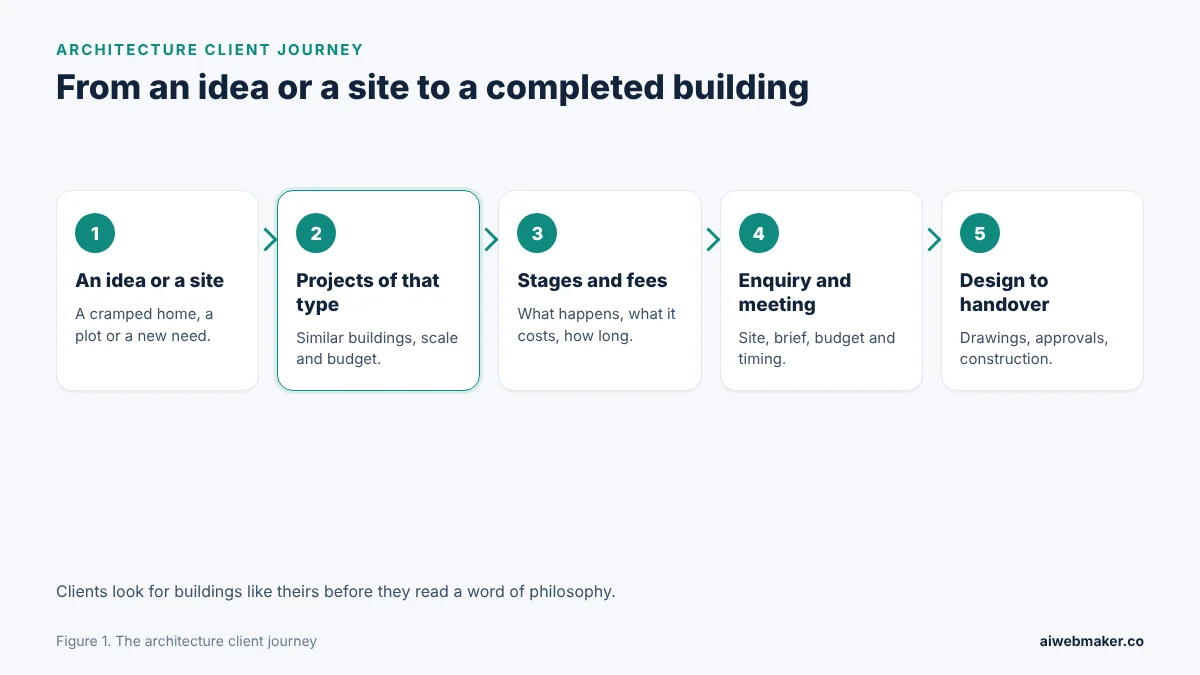
Architecture clients move slowly from an idea to a signed appointment, and the second stage of this journey is where most practices win or lose them. An idea or a site starts it, whether a cramped family home, a plot of land or a new building need. Clients then look for projects of the same type, at a similar scale and budget, and they leave when they find only grand public buildings or only small extensions. Stages and fees come next, since many clients fear an open ended cost. An enquiry and a first meeting turn the idea into a brief, before design, approvals, construction and handover follow over months or years. Practices that answer the early questions online receive better prepared clients at the first meeting.
Projects, services, practice and contact: the pages an architect's site needs
An architect's website needs fewer pages than its portfolio might suggest, but each one carries a heavy explanatory load. Project pages tell the story of each building, from brief to outcome. A services page explains the stages of work, and a fees page sets out how the practice charges. A practice page describes the philosophy, the team and registration. A page on where the practice works and a contact page that guides enquiries complete the site.
| Page | What the client asks | What to include |
|---|---|---|
| Home | Does this practice design buildings like ours? | A strong project photo, building types, enquiry route |
| Projects | What has it built, and why? | Brief, site, constraints and outcome for each project |
| Services and stages | What does an architect actually do? | Stages from feasibility to completion |
| Fees | How will the work be charged? | Fee basis and what each stage includes |
| Practice | How does it think about design? | Philosophy, team, registration, insurance |
| Where it works | Will it take a project here? | Regions, countries, collaboration with local partners |
| Contact | How does a project start? | What to include, reply times, phone, email |
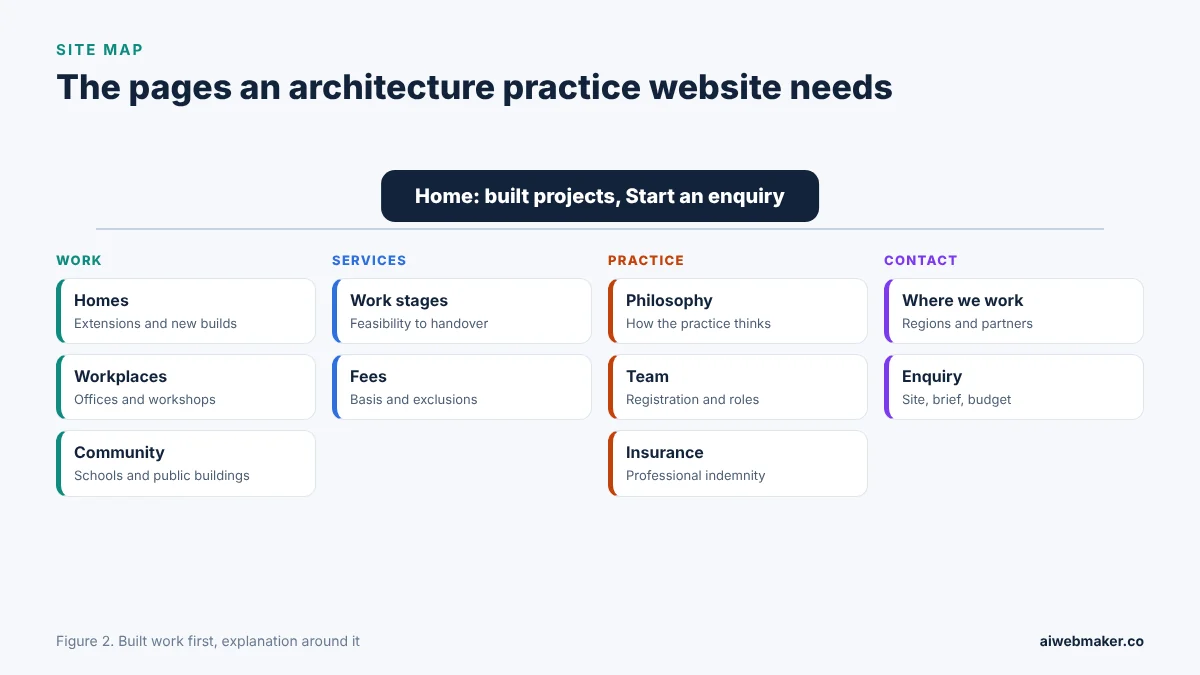
Projects lead this architecture site map, and every other branch exists to explain how those buildings were made. Work pages hold the projects grouped by type, such as homes, workplaces and community buildings. Services pages explain the stages and the fee basis. Practice pages carry the story, the philosophy and the team, while contact pages state where the practice works and how to begin. Northlight Architects, the sample practice, describes its services from first brief to completion and explains how a project moves forward, and its projects page groups selected work before closing with an invitation to visitors who have a project in mind; the architecture firm website example with project pages and a design philosophy took 46 seconds to build. Its about page has sections on the practice's story, its design philosophy and its team, and its contact page gives where the practice works a section of its own beside phone and email details and an enquiry form.
From feasibility to completion: how should work stages be described?
Work stages should be described in plain language, with what the architect does and what the client decides at each one. Professional bodies publish stage frameworks, such as the RIBA Plan of Work in the United Kingdom, and practices elsewhere follow their own national or practice models. Naming the framework helps experienced clients, while plain descriptions help first timers. Each stage can carry a typical duration range and the main decisions asked of the client. Practices that offer only part of the service, such as design up to approval, should say so clearly. A well explained sequence turns a mysterious profession into a process clients feel able to manage.
| Stage | What the architect does | What the client provides or decides |
|---|---|---|
| Feasibility and brief | Tests what the site and budget allow | Needs, budget, timescale |
| Concept design | Sketches, massing, early options | Choose a direction |
| Developed design and approvals | Refined drawings and applications | Approve the scheme for submission |
| Technical design | Detailed drawings and specifications | Finishes, systems, final choices |
| Tender and contractor selection | Prepares documents, compares bids | Choose the builder |
| Construction | Site visits, queries, contract administration | Decisions on changes |
| Completion and handover | Inspections, defect lists, records | Accept the building |
Percentage, fixed or hourly: how are architects' fees set?
Architects set fees in several ways, and clients plan far better when the basis is explained before the first meeting. A percentage of construction cost links the fee to the size and complexity of the building. Fixed fees per stage give certainty for well defined work, such as drawings for an approval application. Hourly or day rates suit early advice and uncertain scopes. The page should also say which costs sit outside the architect's fee, such as structural engineers, surveyors, application charges and the building work itself. Clear fee information prevents the misunderstandings that sour many client relationships.
| Fee basis | How it works | Often used for |
|---|---|---|
| Percentage of construction cost | A share of the building budget | Full service on larger projects |
| Fixed fee per stage | A set price for each stage | Defined scopes and smaller projects |
| Hourly or day rate | Time charged as it is spent | Early advice, uncertain briefs |
| Lump sum for a set service | One price for a defined package | Approval drawings only |
| Paid first consultation | A meeting on site with written notes | Testing ideas before committing |
Registration, insurance and the protected title
In many countries, including the United Kingdom and the United States, only people on an official register may call themselves architects. The register, its rules and the route to qualification differ from place to place, so the website should name the register and give the registration number. Professional indemnity insurance protects clients if a design error causes loss, and stating that cover is held reassures larger clients. Membership of a professional institute is often separate from statutory registration, and the two should not be confused. Practices working abroad usually need local registration or a local partner, which belongs on the page about where the practice works. Verifiable credentials separate a registered architect from an unqualified designer using similar words.
How should a project page tell the story of a building?
A project page should trace a building from brief to finished result, because clients want the thinking as well as the photographs. The brief, the site and its constraints explain why the building looks the way it does. Drawings, sketches and model photos show the design process, while photographs of the finished building in use show the outcome. Facts such as general location, size and completion year help clients compare, and budget bands can appear only with the client's agreement. The portfolio website builder that drafts architecture practice pages prepares a first set of pages after the practice describes its work in a few sentences. Each project told this way shows clients that the practice listens before it draws.
| Element | What it shows |
|---|---|
| Brief | What the client needed and why |
| Site and context | Orientation, slope, neighbours, heritage |
| Constraints | Budget, approvals, access, ground conditions |
| Design response | The key decisions and the reasoning |
| Drawings and models | Plans, sections, sketches, model photos |
| Photographs | The finished building, ideally in use |
| Credits and facts | Team, consultants, size, completion year, with permission |
Planning approval, building rules and the wider consultant team
Approvals and building rules shape almost every project, and the website should explain them honestly without promising an outcome. Planning or zoning approval, where it applies, decides what may be built, while building regulations or codes decide how it must be built. Rules, timescales and application fees can change from one authority to the next, let alone between countries. Architects prepare drawings and applications, but no practice can guarantee approval, and the page should say so. Most projects also need other consultants, such as structural engineers, services engineers and surveyors, appointed by the client or through the architect. Clients who understand this wider team budget more realistically from the start.
Extension architect, passive house, barn conversion: what do clients type?
Clients search for phrases such as architect near me, extension architect, house architect, passive house architect, barn conversion architect or commercial architect, often with a county or city. Project categories that use those words, and project titles that name the building type and general area, match the way people search. Local clients often meet the practice first on a map listing, so it should carry the studio address, photographs of finished buildings and a link to the projects page. Reviews from clients who mention clear communication and buildings delivered as promised are especially persuasive. Articles on what a feasibility study involves, how long approvals usually take locally or whether to extend or move reach clients at the very beginning. Patient, expert writing gives first time clients a reason to call this practice rather than another.
Licences, insurance, registration fees: how does hosting compare?
Software licences, insurance, registration fees and printing all cost a practice more than its website. A practice with a steady flow of commissions pays least on yearly billing. A newly founded practice may spread the cost monthly while its first projects come in. Twelve articles on design and approvals, drafted with credits, add about $7.80 in a year. Each figure is tabled next, and the $189 tier appears purely for comparison.
| Item | Yearly | Monthly |
|---|---|---|
| Hosting the architecture practice pages | $119 | $228 over twelve months |
| Domain | Depends on the ending | Depends on the ending |
| Higher plan, for comparison | $189 a year | Not needed |
| Twelve design and approvals articles at about $0.65 | About $7.80 | About $7.80 |
| New projects, drawings and team updates | No charge | No charge |
| Year before the domain | About $126.80 | About $235.80 |
Which gaps leave a prospective client unconvinced?
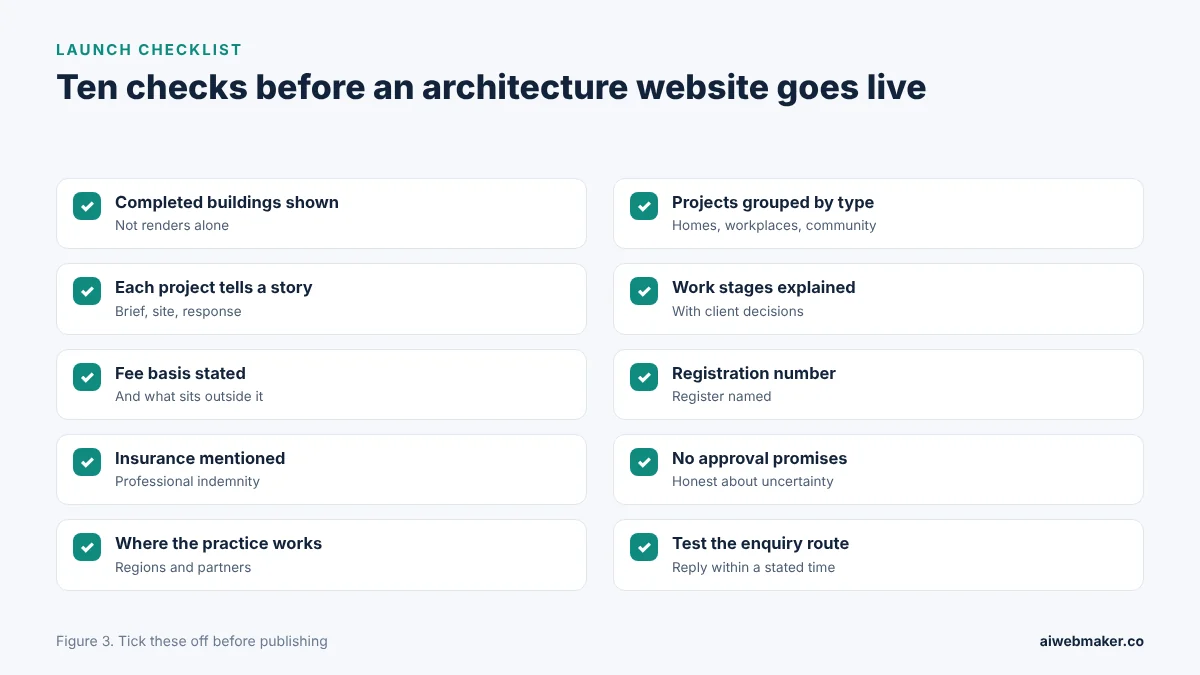
Prospective clients leave unconvinced when an architecture site shows beautiful images but answers none of their practical questions. Renders without completed buildings suggest the practice has little built work. A philosophy written in dense jargon makes the practice feel distant from ordinary clients. No word on fees, stages or registration leaves people fearing an open ended commitment. Silence on where the practice works wastes the time of clients in other regions. Ten practical fixes for these gaps appear in the image that comes next.
Frequently asked questions
When should an architect be brought into a project?
An architect is most useful early, ideally before buying a site or committing to a builder, because early decisions shape cost and approval chances. A feasibility study can test whether an idea is realistic before money is spent elsewhere. Clients who arrive with a finished plan from someone else often face costly redesigns. The website can explain what an early meeting covers and what it costs. Early involvement usually saves money and stress later.
Does an architect manage the builder during construction?
It depends on the agreed scope of service, which the website should spell out. Some architects administer the building contract, visiting the site, answering queries and certifying payments to the builder. Others hand over after approvals or technical drawings and leave the client to manage construction. The level of involvement affects both the fee and the quality of the finished building. Clear options let clients choose the support they actually need.
Can an architect guarantee planning approval?
No architect can guarantee approval, because decisions rest with the authority and depend on local policy, objections and the site itself. An experienced architect can improve the chances by understanding local rules and preparing a strong application. Some practices offer pre application advice or discussions with officials where these are available. The website should be honest about this uncertainty and explain how the practice manages it. Honest expectations build trust that survives a difficult decision.
What is a measured survey, and who pays for it?
A measured survey records the existing building or site accurately, producing the drawings the design is based on. It is usually paid for by the client, carried out either by the practice or by a specialist surveyor. Accurate surveys prevent costly errors later, such as walls that are not where the drawings assume. The fees page can explain whether surveys are included or charged separately. Clarity at this stage avoids surprises once design begins.
Does a single brief repay an architecture practice's website?
One small commission, or even a paid feasibility study, usually earns many times the $119 an architecture practice spends on a year of hosting. The $19 monthly alternative amounts to a fraction of one hour of design time. Clients who return for a second building, or recommend the practice to neighbours and colleagues, are worth decades of hosting. Clear stages, honest fees, verifiable registration and well told projects are what give first time clients the confidence to enquire. Practices that add each completed building with its story build a portfolio that keeps working for years. A brief that arrives well prepared because the client read the site first is the clearest return of all.
Build your website in Minutes and get the AI Tools that work
Start Building Your Website →