Dog Daycare Club Website Cost: Temperament Checks and Day Packs
Pass cards, play groups and pick up rounds cost a daycare $119 when the hosting is settled yearly, or $19 per club month, plus the domain. Topics: owners, pages, the temperament check, passes, groups and ratios, rest, pick up rounds, vaccination rules, search and the club's yearly costs.
- No coding required
- Live in minutes
- Blog, SEO and chatbot tools included
A dog daycare puts its pages online for $119 per twelve months, or $19 for any lone month, with the domain ending costed on top. Drafting the pass cards, the play group descriptions and the place request in preview is not something AI Web Maker bills for. One ten day pack sold to a new family covers the hosting more than twice over. The real challenge for a daycare is the room itself, because every dog admitted changes the mood of a group, so the pages must draw in the right dogs and gently turn away the wrong ones. Owners, meanwhile, are handing over a family member for nine hours and want to know exactly who is watching. Ahead come the owners, the pages, the temperament check, passes and packs, groups and ratios, rest, pick up rounds, health rules, search and the yearly budget.
This article is part of our complete guide: Pet Business Website Builder.
Chewed skirting boards and long shifts: the owners who look for daycare
Owners look for daycare when a dog's day alone has started to cost them, in chewed furniture, complaints from neighbours or guilt during a long shift. Young, energetic dogs are the most common arrivals, because a walk before work barely touches their need to play. Puppy owners want company and manners for a dog that cannot yet be left for long. Owners of older or anxious dogs want something quieter, and they read every word about groups and rest before trusting anyone. All of them compare the same things: who watches, how many dogs share a room, what the day looks like and how the dog gets there.
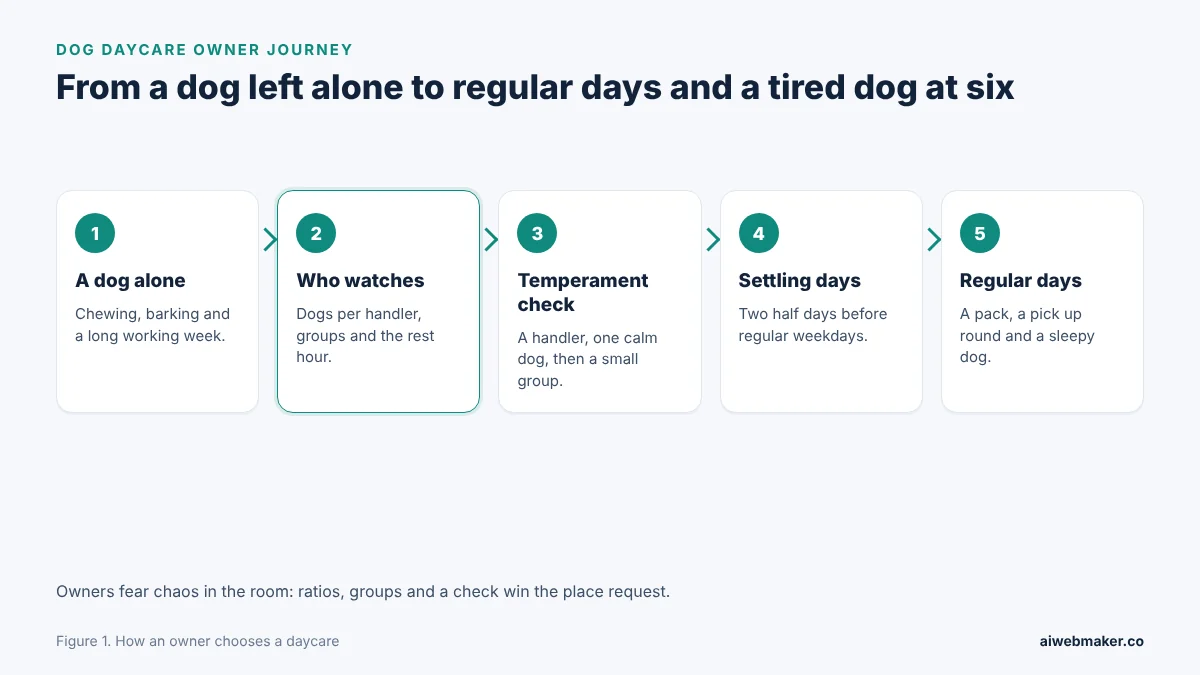
Ratios and routine carry the second step of this path, which is where a careful owner decides whether to send a request at all. In the highlighted step, the owner reads how many dogs each handler watches, how groups are sorted and when the room rests. The temperament check follows, then two half days that let the noise and routine arrive gradually. Regular days, a pick up round and a tired dog at the door complete the path. A club that makes each of those stages visible on its pages admits calmer dogs and keeps their owners for years.
Joining steps, passes, groups and the van: the pages a daycare club needs
A daycare's pages should follow the order in which an owner's trust is built, starting with how a dog gets in rather than how much a day costs. The joining page explains the check and the settling days, which shows that no dog is accepted on sight. Passes come next, with everything a day includes written beside each price. The play group page tells owners who their dog will spend the day with and how many dogs share a room. Rest, pick up and health rules each need a page or a clear section, because those are the questions asked at the gate.
| Page | Owner's question | What it should state |
|---|---|---|
| Joining | How does a new dog start | Steps from form to regular days, the check's price |
| Passes | What a day costs | Half day, day pass, packs and what each includes |
| Play groups | Who the dog plays with | Groups by size and style, group caps, the ratio |
| Rest and feeding | Whether the day is chaos | Rest hours, pens for dogs who rest alone, feeding rules |
| Pick up | Whether the dog can be collected | Rounds, windows, prices, handover rules |
| Health rules | What the club requires | Vaccinations, parasites, illness, seasons, medicines |
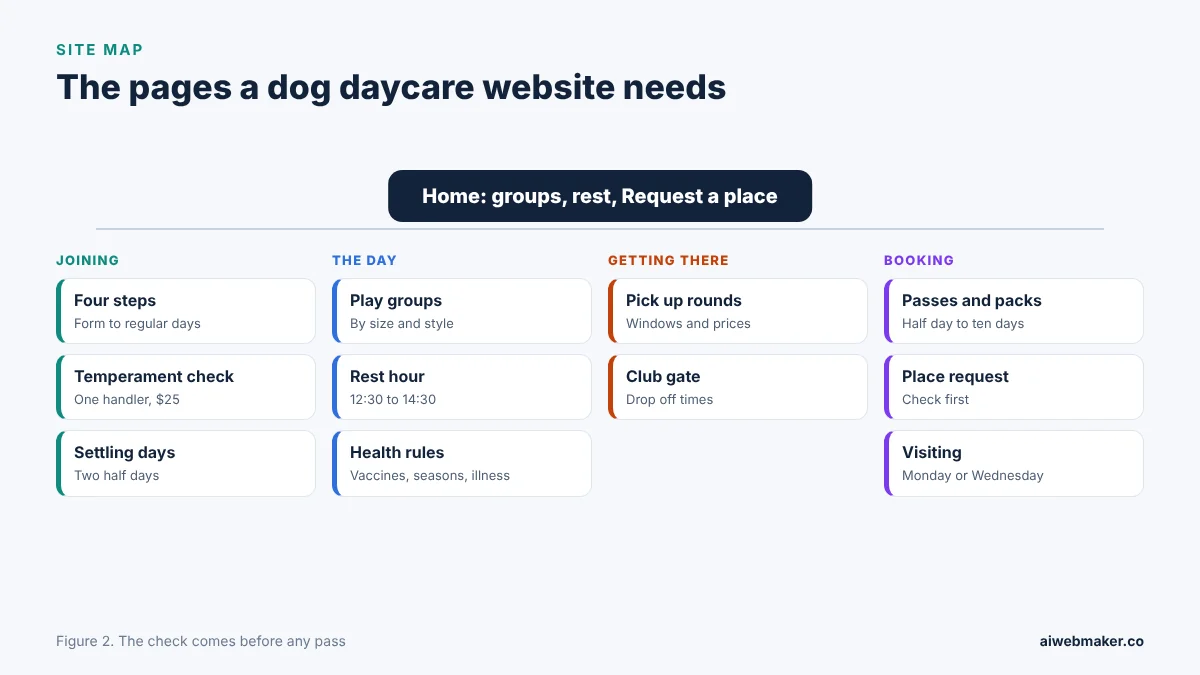
Joining, the day, getting there and the place request form the four branches of this plan, with the check placed ahead of any price. Pawsome Day Club, the sample daycare, opens on a promise of play all morning, a nap after lunch and home tired at six, with three facts: eight dogs at most for each handler, two hours of rest and four play groups. Its four joining steps run from the form to a $25 temperament check, two half days and regular days. The dog daycare website example with a temperament check before any pass then prices a half day at $24, a day pass at $36 and a ten day pack at $320, before describing the little and steady, big and bouncy, puppy, and senior and quiet groups. A rest section, three pick up rounds, health rules, photos, questions and a place request follow.
The temperament check: a $25 morning that protects the whole room
The temperament check is the most important page on a daycare site, because the calm of every group depends on the dogs it admits. The sample runs it on Tuesday and Thursday mornings with one handler throughout, introducing the new dog to a handler alone, then one calm dog, then a small group. Handlers watch whether the dog reads other dogs' signals, recovers after a fright and accepts a break when one is offered. Most dogs pass, some suit the quiet group better, and a few are happier at home or with a walker, which the club says kindly and plainly. A second check is possible after some training, and it is charged again because it costs a handler's whole morning.
| Stage | What the handler watches | What follows |
|---|---|---|
| Meets a handler alone | How the dog greets a stranger | A calm dog joins if all is well |
| Meets one calm dog | Reading signals, recovering from a fright | A small group if the pair settles |
| Joins a small group | Play style, breaks taken when offered | A group suggestion |
| A written note | Strengths and anything to watch | Shared with the owner |
| The outcome | Which group would suit, if any | Half days, the quiet group, or an honest no |
Half days, day passes and ten day packs: pricing a place in the yard
A daycare sells a fixed number of places in a room, so its prices have to fill the quiet weekdays as well as the busy ones. The sample's half day suits puppies and older dogs who tire quickly, while the day pass covers play in the morning and afternoon with rest in between. A ten day pack works out at $32 a day, must be used within three months and is paused when a vet signs the dog off, which rewards regular attendance without trapping anyone. Two half days count as one day of a pack, and a day cancelled by 18:00 the evening before is not charged. The club also points out that the same weekdays help most dogs settle, because they meet familiar friends.
| Pass | Sample price | Best suited to |
|---|---|---|
| Temperament check | $25, once | Every new dog, before any other pass |
| Half day | $24 | Puppies, older dogs, the first settling days |
| Day pass | $36 | Dogs who come now and then |
| Ten day pack | $320, used within three months | Dogs who come on set weekdays |
Handler ratios, group caps and a rest hour on the timetable
Ratios and group sizes are the numbers owners hold a daycare to, so they belong on the page in plain figures. The sample sets one handler for every eight dogs, caps any group at 12 and keeps at least two staff in the building, describing these as its own numbers set above the local minimum. Rules for dog daycare differ widely, and in England, for example, commercial daycare falls under local council animal activity licensing, while other countries and states set different requirements. Rest matters as much as play, since overtired dogs are the ones most likely to snap, so the sample moves every group to a rest room from 12:30 to 14:30. Adult dogs are not fed at lunch, and puppies or dogs on a vet's feeding plan eat apart from the group.
Pick up rounds and handovers at the door
Pick up turns a daycare from a place some owners can reach into a service the whole district can use, but only if the rounds are written precisely. The sample's table lists a north, an east and a town round, each with morning and evening windows and a price each way, plus the option of using the club gate. Every dog rides in its own crate, the order of stops changes so nobody spends long on board, and windows are confirmed by text the evening before. Dogs are handed over by a person at the door, never collected from gardens, and the club holds no house keys. Through the booking website builder for dog daycares that take place requests, owners ask for a check, a half day or a pass, and the club agrees, proposes a different date or explains honestly why it may not suit. Passes are paid at the gate or as the club arranges, and the price of every pass or pack reaches the club whole.
| Round | Morning pick up | Home again | Each way |
|---|---|---|---|
| North round | 07:15 to 08:30 | 17:15 to 18:30 | $7 |
| East round | 07:30 to 08:45 | 17:00 to 18:15 | $7 |
| Town round | 08:00 to 09:00 | 16:45 to 17:45 | $5 |
| Club gate | 07:30 to 09:30 | 16:30 to 18:30 | Included |
Vaccinations, illness and the note written after every scrape
Health rules work best as short separate lines, because owners skim them and argue about the ones they missed. The sample asks for core vaccinations, kennel cough vaccination as the dog's vet advises, current flea and worm treatment, the record shown before the check and a clear 24 hours after sickness or coughing. Females in season stay at home, and medicines are given only with written instructions. Countries differ on which vaccines count as core and when boosters fall due, so the club follows each dog's own vet record rather than a list of its own. A dog that seems unwell rests away from the group while the owner is called, and anything serious goes to the owner's vet or the nearest open clinic, with every scrape or nip written down and told to the owner at pick up.
Doggy daycare near me and puppy daycare: the searches that fill a yard
Owners search for daycare by the problem it solves and the area it covers. They type doggy daycare near me, puppy daycare, daycare with pick up or a quiet daycare for an older dog. Headings that name the groups, the rounds and the districts give those searches something exact to land on. A map listing with real hours, photos of the yard and the rest room, and the visiting times helps owners picture the place before they ring. Reviews that mention a slow, careful check or a dog sleeping soundly after a day there convince more owners than any claim of fun. Articles on settling a rescue, puppy socialisation or signs a dog is overtired bring readers long before they need a place.
The daycare's website bill, line by line
A daycare's website bill for the year is little more than hosting and a domain, and twelve dog care articles from AI credits total near $7.80 for the year. A club full of regulars keeps the cost lowest with one $119 payment each year. A newly opened yard still building its groups might choose $19 a month until the packs sell. Editing a pass price, a round or a group description is never billed. The $189 plan is shown in the table only as a reference beside the two routes.
| Item | Yearly | Monthly |
|---|---|---|
| Hosting the daycare club pages | $119 | $228 over twelve months |
| Domain | Depends on the ending | Depends on the ending |
| Higher plan, for comparison | $189 a year | Not needed |
| Twelve dog care articles at about $0.65 | About $7.80 | About $7.80 |
| Pass, round and group updates | No charge | No charge |
| Year before the domain | About $126.80 | About $235.80 |
No ratio, no rest and no word on the check: why owners keep looking
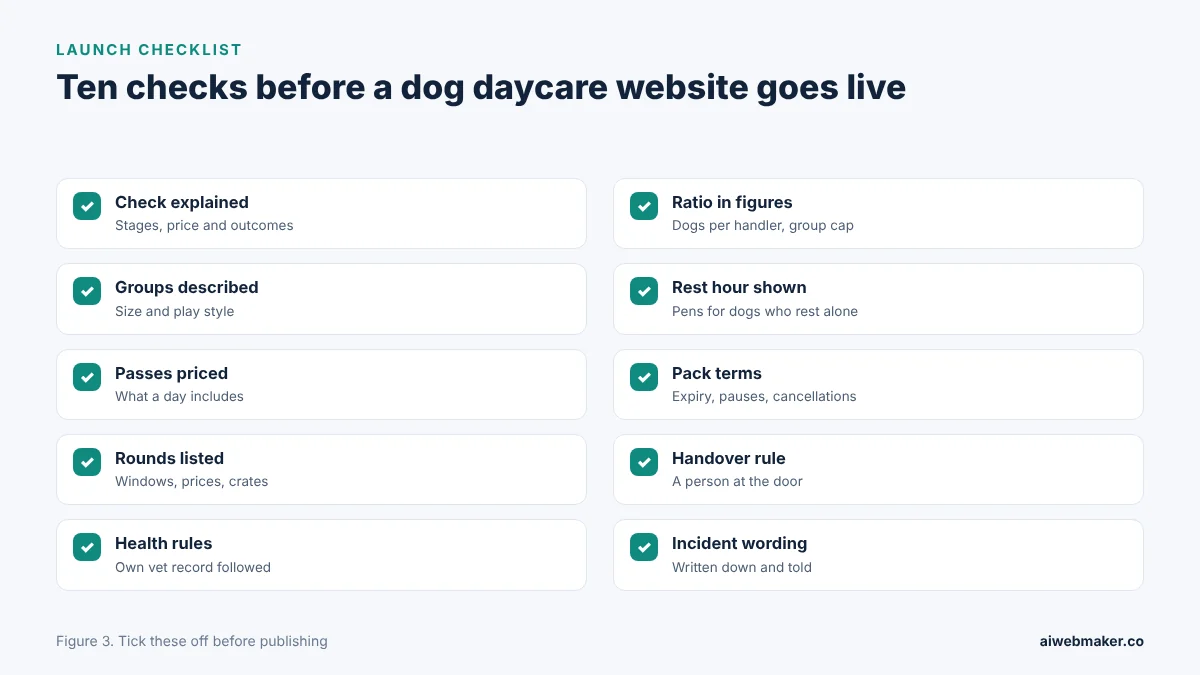
Owners keep looking when a daycare page shows a yard full of dogs but never says how many share it or who is watching. No mention of a temperament check suggests any dog is accepted, which worries the owners of gentle dogs most. A day described only as fun, with no rest hour, sounds exhausting to anyone with a puppy or a senior. Silence about illness and incidents leaves owners wondering what they would be told. The launch card shown below turns those doubts into ten lines a club can tick before opening its request form.
Frequently asked questions
What does a temperament check look for in a new dog?
A temperament check looks at how a dog meets a stranger, a calm dog and then a small group. Handlers watch whether the dog reads other dogs' signals, recovers after a fright and takes a break when offered. Most dogs pass, and the check mainly decides which group suits them. Some dogs are happier in a quiet group, and a few are better at home or with a walker. A club that explains this openly protects the dogs already in its care.
How many dogs should one handler supervise?
The right number depends on the dogs, the space and the rules where the daycare operates. Some places set a legal ratio, while others leave it to the business, so the page should state its own figure. The sample uses one handler for every eight dogs, with no group above 12 and at least two staff in the building. Owners can hold a club to numbers written down, which makes them worth publishing. A clear ratio also helps the daycare plan its rota honestly.
Can a dog that struggled at the first check try again?
Many daycares offer a second check after a few weeks of work at home or with a trainer. The sample allows it when it believes a second try would be fair to the dog. Each check uses a handler's whole morning, so it is usually charged again. Some dogs simply prefer people to other dogs, and a good daycare says so rather than forcing them in. An honest answer keeps both the dog and the group safe.
Who rings the owner when a dog is scraped or unwell at daycare?
Play can bring the odd scratch or nip even under close supervision, so the page should say how incidents are handled. Handlers step in early when games get rough and write down anything that happens. A dog that seems unwell rests away from the group while the owner is called. If something looks serious, the sample takes the dog to the owner's vet or the nearest open clinic and keeps trying the owner. Plain wording on this reassures owners more than a promise that nothing ever goes wrong.
One pack of ten days pays for a year of the club online
Ten days of daycare sold as one pack bring in well over the club's whole hosting year at $119. On monthly billing, $19 sits below the price of a single day pass, so one regular dog covers it many times over. Owners who trust the check and the ratios tend to book set weekdays for years, and they recommend the club in parks and vet waiting rooms. A clear check, honest numbers and a rest hour on the timetable do more for a daycare than photos of excited dogs. A yard that fills its quiet weekdays with settled regulars shows the pages are choosing dogs as carefully as the handlers do.
Build your website in Minutes and get the AI Tools that work
Start Building Your Website →