Mediator Website Cost and the First Meeting That Opens a Calmer Room
Mediators can host their website for $119 through the year, or in $19 monthly payments, with a domain picked separately. Inside: who seeks mediation, pages, confidentiality and safety, shared fees, the mediator's role, styles, first meeting requests, search and annual hosting.
- No coding required
- Live in minutes
- Blog, SEO and chatbot tools included
Mediators pay $119 to host their website through a whole year, or split it into $19 payments if income arrives session by session, and a domain is picked separately. The dispute pages, the fee table and the first meeting request are composed and checked on screen first, and that work never reaches an AI Web Maker invoice. One joint session or a pair of first meetings covers the year, so cost is not where a mediator's website struggles. Where it struggles is with people who arrive angry, frightened or exhausted, often unsure whether the other side will even agree to take part. A good site lowers the temperature, explains what mediation can and cannot do and makes booking a private first meeting feel safe. Covered here are who looks for a mediator, the pages needed, confidentiality and safety, shared fees, the mediator's role, styles of mediation, first meeting requests, search and the hosting sums.
This article is part of our complete guide: Website Builder for Law and Accounting Firms.
Who looks for a mediator, and what fears come with the dispute?
People look for a mediator when a disagreement has become too heavy to settle alone but they still have to deal with each other afterwards. Separating parents need arrangements for children and money, and wider families argue over the care of an older relative or an inheritance. Neighbours fall out over noise, boundaries, trees and parking. Colleagues and teams clash at work, and business partners or suppliers reach a point where a court case looks costly and slow. Each person fears being pressured, being judged or facing the other side unprepared. The mediator whose website calms those fears is usually the one who receives the first call.
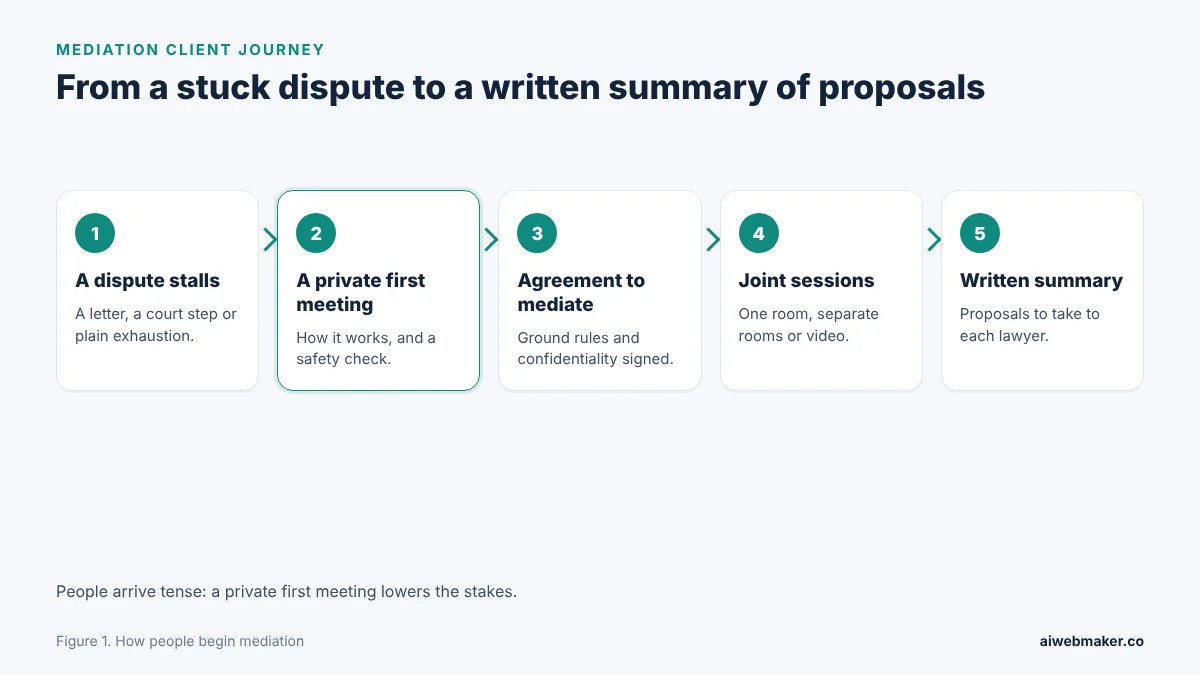
Moving from a dispute that has stalled to a written summary of proposals, the five steps show why the first meeting carries so much weight. The trigger is often a letter, a court requirement or simply exhaustion with arguing. The highlighted step is the private first meeting, where each person hears how mediation works and the mediator checks that it is safe and suitable. Only then does an agreement to mediate follow, with ground rules everyone signs. Joint sessions, in one room, in separate rooms or by video, lead to a written summary that each person can take to their own lawyer. A website that explains this sequence helps people agree to the first step without feeling trapped.
Which disputes and session pages does a mediation site need?
A mediation website should give each kind of dispute its own page or section, because separating parents, feuding neighbours and business partners use very different words. A how it works page should explain separate first meetings, the agreement to mediate, joint sessions and the written summary. A sessions page sets out fees and who pays them. A confidentiality and safety page explains where privacy ends and how risk is handled. A booking page for a first meeting, requested by each person separately, completes the set.
| Page | Who reads it | What it should state |
|---|---|---|
| Separation and parenting | Separating parents | Children's arrangements, decisions, holidays |
| Money after separation | Separating couples | Home, savings, pensions, full disclosure |
| Neighbours | Households side by side | Noise, boundaries, trees, parking |
| Workplace and business | Colleagues, partners, suppliers | Consent of all parties, day rates |
| How it works | Everyone | First meetings, ground rules, joint sessions, summary |
| Confidentiality and safety | Everyone, especially the anxious | Limits of privacy, screening, emergencies |
| Book a first meeting | Each person separately | Session, kind of dispute, day, rooms or video |
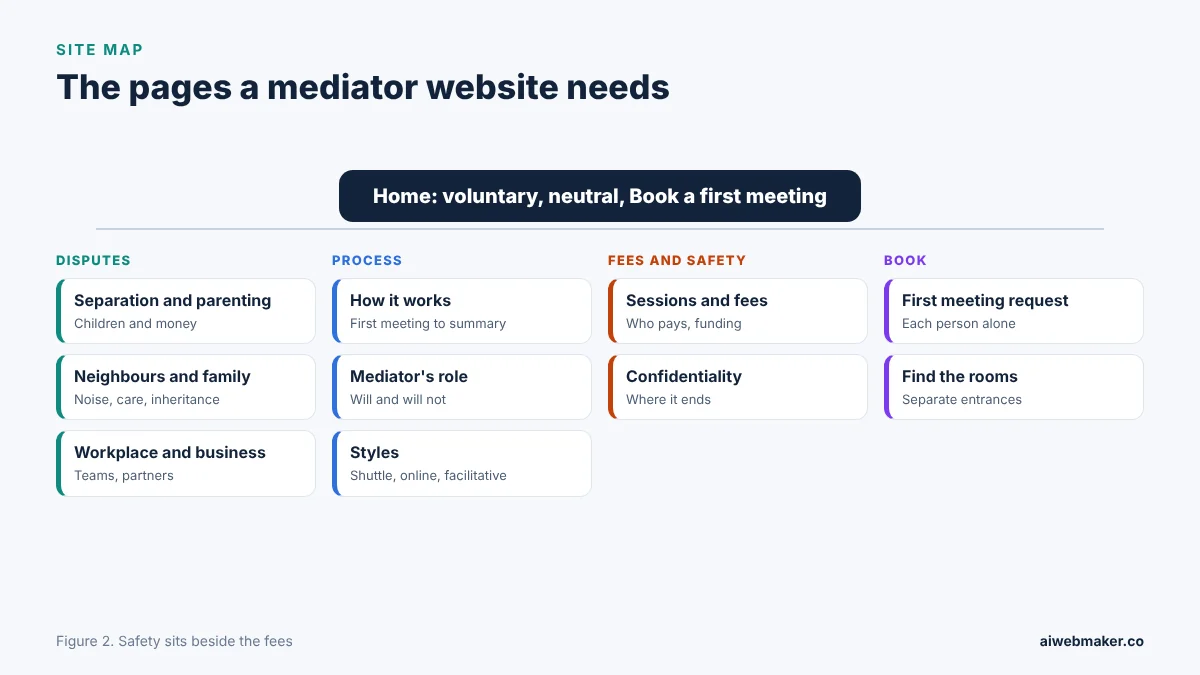
Laid across four branches, the mediation site separates what is mediated, how it works, what it costs and how to begin, so an anxious reader never has to guess. Common Ground Mediation, the invented service behind our mediator website example with separate first meetings, covers separation and parenting, money after separation, wider family, neighbours, workplace, and business and commercial disputes. Its process runs from a first meeting on your own through an agreement to mediate and joint sessions to a written summary. Sessions are listed as a first meeting per person, a shared joint session and a neighbour or workplace half day, with a note that public funding may apply in some countries. A section on voluntary, confidential and safe mediation sits beside a table of what a mediator will and will not do. The booking form asks for the session, the kind of dispute, a day and part of the day, rooms or video, and anything the mediator should know first.
Where does confidentiality end, and how is safety screened?
Confidentiality in mediation covers almost everything said in the room, but it has limits that the website must state plainly. A mediator must act if someone, especially a child, is at risk of serious harm, and the law in some places requires reporting in specific circumstances. Financial details disclosed for a settlement are usually shared openly so that proposals can be checked by lawyers. Safety screening at the first meeting, held privately with each person, is where a mediator asks about violence, threats or controlling behaviour. Where abuse is present, mediation may not be suitable, and the mediator should help the person find other routes, such as specialist support services or legal advice. Separate waiting areas, staggered arrivals, sessions in separate rooms and video from separate homes show that safety is designed in, and a line urging anyone in immediate danger to call the local emergency number belongs on every page.
How should mediation fees be shared and explained?
Mediation fees are usually charged per person for first meetings and shared between the parties for joint sessions, although the parties can agree a different split. A first meeting fee covers the private explanation and the suitability check. Joint sessions are often charged per session, while neighbour, workplace and commercial cases may be priced by the half day or day after a short call with each side. Some countries offer public funding, legal aid or voucher schemes for family mediation, and the rules vary widely, so the page should invite visitors to ask what applies where they live. Payment terms, such as paying before each session, should be stated beside the fees. Clear pricing removes one more source of tension from people who are already in conflict.
| Session | Who usually pays | What the page should state |
|---|---|---|
| First meeting | Each person for their own | Length, private check, no obligation to continue |
| Joint session | Shared, unless agreed otherwise | Length, breaks, note of progress |
| Neighbour or workplace half day | Shared or by an organisation | Hours, venue, written summary |
| Business mediation | Quoted per day | Preparation, venue, number of parties |
| Public funding | Varies by country | How to ask whether it applies |
What does a mediator do, and what is left to lawyers and courts?
A mediator manages the conversation, not the outcome, and visitors need to understand that difference before they agree to take part. The mediator keeps the process fair, makes sure each person is heard, helps find options and writes down the proposals reached. The mediator does not take sides, judge who is right, give legal advice to either party or impose an agreement. Lawyers advise each person separately and can turn proposals into a binding agreement or a court order where the law allows. Courts decide when agreement cannot be reached, and in some countries a court expects separating couples to consider mediation or attend an information meeting first. A table that sets out these roles helps visitors see where mediation fits.
| Role | Does | Does not |
|---|---|---|
| Mediator | Keeps the process fair, helps find options, records proposals | Takes sides, gives legal advice, decides |
| Each person | Shares information, proposes, decides | Is forced to agree or to continue |
| Each person's lawyer | Advises privately, drafts binding terms | Attends unless agreed |
| Court | Decides if agreement fails, approves orders | Runs the mediation |
Which styles of mediation suit which disputes?
Mediators use different styles, and explaining them helps visitors choose a service that fits their situation. Facilitative mediation, the most common style in many places, helps people reach their own solutions without the mediator giving opinions on the outcome. Evaluative mediation, more common in commercial disputes, may involve the mediator offering a view on the strengths of each side. Shuttle mediation keeps parties in separate rooms with the mediator moving between them, which suits high conflict or safety concerns. Child inclusive mediation, offered by specially trained mediators in some countries, gives children a chance to be heard without making them choose. A short guide to these styles shows visitors that the mediator can adapt to their dispute.
| Style | How it works | Often suits |
|---|---|---|
| Facilitative | Parties reach their own options | Families, neighbours, workplaces |
| Evaluative | Mediator may give a view on the issues | Commercial and contract disputes |
| Shuttle | Separate rooms, mediator moves between | High conflict or safety concerns |
| Child inclusive | Children heard by a trained mediator | Parenting arrangements, where offered |
| Online | Sessions by video from separate homes | Distance, safety or scheduling needs |
How should a first meeting be requested and confirmed online?
A first meeting request should let each person book separately, because mediation begins with private conversations rather than a shared appointment. The form can ask for the kind of session, the kind of dispute, a suitable day and part of the day, and whether the meeting should be in the rooms or by video. A clear statement that the other person will be contacted only with the requester's agreement reassures people who are not ready to involve them. Through the booking website builder for mediators and their first meetings, the visitor sends that request and the mediator confirms it, moves it to another time or explains why mediation may not suit. Fees are then paid straight to the mediator on the terms the service sets, and the platform keeps none of that money. A calm, private booking route makes it easier for a hesitant person to take the first step.
Which words do separating parents and feuding neighbours type?
People looking for mediation type the problem in their own words, such as family mediation near me, mediation for separating parents, neighbour dispute mediation or workplace mediator. Businesses search for commercial mediation or contract dispute mediation, often adding a city. Each dispute page should echo the visitor's phrasing in its title and first sentence. A map entry with opening hours, a note on step access and the website link helps people who prefer to meet in person. Reviews that mention feeling heard, calm sessions and fair handling carry particular weight, though mediators must protect confidentiality when inviting them. Guides to what happens at a first meeting, or to preparing for a joint session, find readers who have not yet made up their minds.
Counting a mediation service's hosting, domain and article credits
The recurring lines for a mediation service are few: hosting, the domain, and a dozen guidance articles from AI credits at about $7.80 in total. A busy practice keeps the bill lowest with annual payment. A mediator who has only just qualified may prefer monthly billing while referrals grow. Changing fees, sessions or dispute pages is never charged. For reference only, the $189 plan has its own row too.
| Item | Yearly | Monthly |
|---|---|---|
| Hosting the mediator pages | $119 | $228 over twelve months |
| Domain | Depends on the ending | Depends on the ending |
| Higher plan, for comparison | $189 a year | Not needed |
| Twelve mediation guidance articles at about $0.65 | About $7.80 | About $7.80 |
| Fee, session and dispute updates | No charge | No charge |
| Year before the domain | About $126.80 | About $235.80 |
What makes someone in a dispute close a mediator's page?
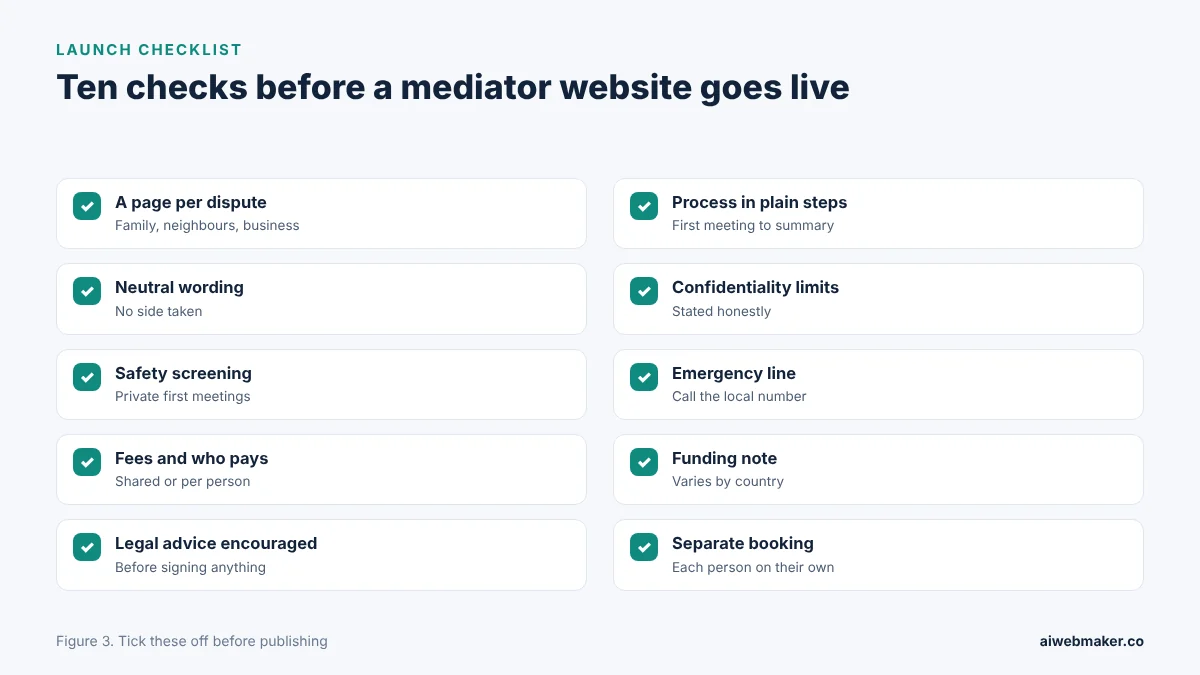
Someone in a dispute closes a mediator's page when it reads as if the mediator will take sides or tell them what to do. Missing information about safety and confidentiality frightens people who have experienced abuse or intimidation. No fees, or no word on who pays, adds money worries to an already tense situation. A booking form that seems to require both parties at once puts off anyone not ready to contact the other side. Legal jargon makes the process feel like a court case rather than a conversation. Ten launch checks, pictured next, settle each of these concerns before a page goes live.
Frequently asked questions
Is an agreement reached in mediation legally binding?
An agreement reached in mediation is usually not binding by itself, especially in family cases. The proposals are written into a summary that each person can take to their own lawyer. Lawyers can then turn them into a binding agreement or a court order where the law allows, and the process differs by country. Commercial mediations sometimes end with a signed settlement that is binding as a contract. The website should explain which applies to each kind of dispute.
Can mediation go ahead if the other person refuses?
Mediation is voluntary, so nobody can be made to attend. With the requester's agreement, the mediator can write to the other person and invite them to a first meeting of their own. Many people agree once they understand that the first meeting is private and carries no obligation. If the other person still declines, the mediator can explain other routes, such as legal advice. Stating this on the website helps visitors take the first step without waiting for the other side.
Is mediation suitable after domestic abuse?
Mediation is often not suitable where there has been domestic abuse, violence or controlling behaviour, and a careful mediator screens for this at a private first meeting. In some cases shuttle mediation in separate rooms may be considered, but only if it is safe and the person at risk wants it. The mediator should help anyone affected to find specialist support and legal advice. Anyone in immediate danger should call the local emergency number. A clear statement of this policy on the website protects people who may be at risk.
How long does family mediation tend to run before proposals are agreed?
The number of sessions depends on the issues, how far apart the parties are and how much financial information needs to be gathered. Arrangements for children may be agreed in a few joint sessions, while finances after separation often take longer. Neighbour disputes are frequently settled in a single half day. The mediator reviews progress after each session and checks that continuing is worthwhile. A realistic range on the website helps people plan time and cost.
How many first meetings pay for a mediator's year online?
A handful of first meetings, or a single joint session, brings in more than the $119 a mediator pays to keep its site online across the year. On monthly billing, the $19 is covered by a small part of one first meeting fee. Each person who books after reading a calm explanation of safety, fees and the process is a dispute that might otherwise have gone straight to court. Plain words about confidentiality, shared fees and the mediator's limits reassure people who arrive angry or afraid. Services that keep their sessions, fees and funding notes current become the name lawyers and advice workers suggest. First meeting requests from both sides of the same dispute show the site is building trust with everyone.
Build your website in Minutes and get the AI Tools that work
Start Building Your Website →