Fractional CFO Website Cost and the Retainer Days Founders Buy
A fractional finance director's proposal site runs for a full year on $119 of hosting, or month by month at $19, and a domain chosen to suit. Inside: founders and boards, pages, retainer days and sprints, the bookkeeper line, cash forecasts, fundraising, confidentiality, search and the budget.
- No coding required
- Live in minutes
- Blog, SEO and chatbot tools included
A part time finance director can publish a proposal site through AI Web Maker on hosting priced at $119 annually, or $19 per monthly cycle, leaving only the domain to buy. Drafting the retainer pages and rehearsing them in the preview costs the director nothing. One retainer day usually bills more than twelve months of hosting, which leaves the fee out of the argument. What gets in the way is that founders rarely know what a fractional CFO does, how the role differs from their accountant, or how a few days a month could be enough. They also hesitate to share cash figures with a stranger, so the site has to explain scope, fees and confidentiality before the first call. Covered next: founders and boards, pages, retainer days and sprints, the bookkeeper line, the thirteen week forecast, fundraising limits, confidentiality, search and the budget.
This article is part of our complete guide: Website Builder for Law and Accounting Firms.
Seed stage founders, owner managers and the investor who wants better numbers
Fractional finance help is usually bought at a moment of strain, when a company has outgrown its bookkeeper but cannot justify a full time finance director. A founder whose investors now expect a monthly board pack, an owner manager whose bank wants a forecast and a company weeks away from a cash shortfall all arrive with different urgency. Many are sent by an accountant, an investor or a lawyer, and they read the site to check that the referral makes sense. They look for experience in their sector, a clear picture of what two or four days a month buys and a fee they can put in a budget. A site that names these moments plainly turns a referral into a first call.
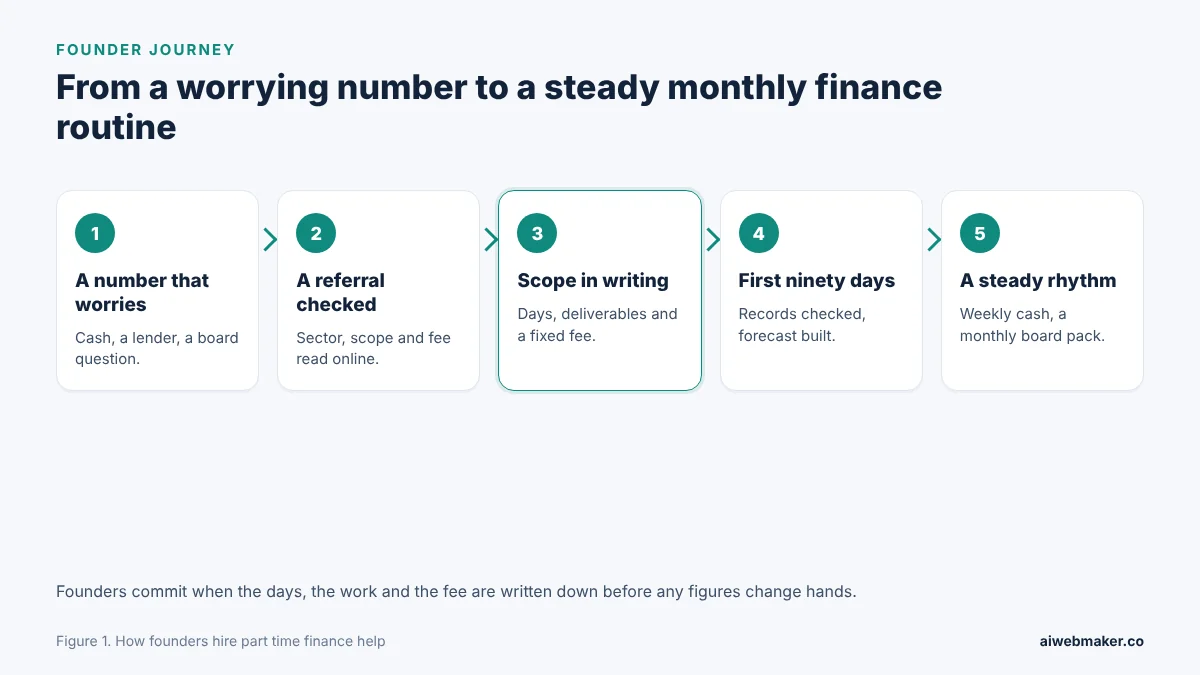
Scope in writing is the highlighted step, since founders who cannot picture a month of work will not sign a retainer. The trigger is nearly always a number that worries someone, whether a cash balance, a lender's request or a board member's question. A referral is then checked online for sector experience and a sense of the fee. Once a proposal sets out days, deliverables and price, the first ninety days turn untidy records into a forecast the company can trust. After that, a weekly cash update and a monthly board pack become the routine that keeps the retainer running.
Services, a sample month, retainers and the proposal request
A fractional finance director's site works as a long proposal that a founder can forward to a cofounder or an investor. Service pages explain cash flow, board reporting, fundraising preparation, budgets, pricing and finance team set up in plain terms. A sample month shows where two days actually go, which answers the question most founders are too polite to ask. Retainer and project pages carry the fees, notice periods and what is never charged, such as commission. A proposal request with a warning against sending bank details closes the route.
| Page | Founder's question | What it should show |
|---|---|---|
| Services | What will this person actually do? | Cash flow, board packs, fundraising, budgets, pricing |
| A sample month | Where do two days go? | The rhythm of weekly cash and monthly reporting |
| Retainers and projects | What will it cost, and for how long? | Days per month, sprints, notice, fixed fees |
| First ninety days | What happens after signing? | Records checked, forecast built, routine agreed |
| Fundraising | Will they raise the money for us? | Preparation only, no commission, no promises |
| Proposal request | How does this start? | Company size, timing, what is worrying the founder |
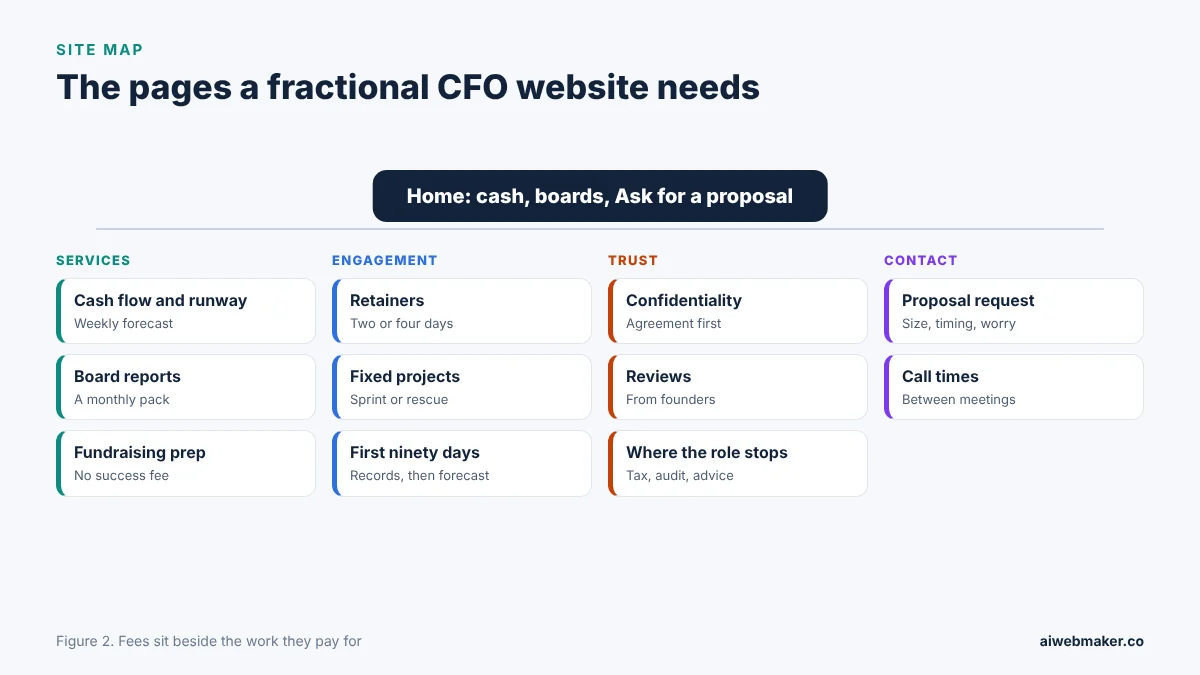
Money and method share the middle of this plan, because a founder judges the fee only after seeing the work behind it. The services group explains each kind of work, the engagement group sets out retainers and the first ninety days, and the trust group holds confidentiality, reviews and the limits of the role. Northstar Fractional Finance, our invented sample firm, lists Cash flow and runway, Board reports, Fundraising preparation, Budgets and forecasts, Pricing and margins and Finance team set up. Its fees come as Two days a month, Four days a month, a Fundraising sprint and a Cash rescue fortnight, followed by a board pack section, the first ninety days and a proposal request. The fractional CFO website example with retainer days and a proposal request places the fees before the fundraising section, so cost is never hidden behind ambition.
Two days, four days, a sprint or a rescue: how the fee is built
Fractional finance work is sold in days, and the site should show how days turn into a monthly fee before a founder has to ask. Retainers of two or four days a month suit companies that need a reporting rhythm, while fixed projects suit a single event such as a raise or a cash squeeze. A three month start followed by a rolling notice period gives the director time to repair the records without trapping the client. Extra days should be agreed in writing before they are worked, so no invoice carries a surprise. Fees marked as illustrative, then confirmed in a written proposal, keep the page honest without fixing every case in advance.
| Engagement | How it is priced | Suits | Watch for |
|---|---|---|---|
| Two days a month | Fixed monthly fee for set days | A company needing a steady routine | Extra days agreed in writing first |
| Four days a month | Larger fixed fee, same meetings | Faster growth, investor reporting | Days drifting into bookkeeping |
| Fundraising sprint | Fixed project fee over several weeks | A planned raise | Any hint of a success fee |
| Cash rescue fortnight | Fixed fee for short, intense work | Cash running short | Hard decisions still need the board |
| Day rate | Per day, agreed in advance | One off reviews | Scope left open ended |
Where the bookkeeper stops and the finance director starts
Founders often believe they already pay for finance help, so the site has to show what a fractional director adds that the existing team does not. The bookkeeper records transactions, and the external accountant usually prepares statutory accounts and tax returns, though the split varies by country and by firm. A fractional finance director looks forward rather than back, building the cash forecast, the budget and the board pack, and challenging prices and margins. Making that line explicit avoids the awkward moment when a founder asks why three people are studying the same numbers. It also reassures the existing accountant, who is often the person who made the referral.
| Task | Bookkeeper | External accountant | Fractional finance director |
|---|---|---|---|
| Recording transactions | Does it | Reviews at year end | Checks it is reliable |
| Statutory accounts and tax returns | Supplies the records | Usually prepares and files | Rarely, unless engaged for it |
| Thirteen week cash forecast | No | Sometimes | Builds it and updates it weekly |
| Monthly board pack | No | Rarely | Prepares and presents it |
| Pricing and margin analysis | No | Occasionally | Core work |
| Fundraising model and data room | No | Rarely | Prepares it with the founders |
The thirteen week cash forecast and the runway question
A rolling cash forecast, often thirteen weeks long and refreshed every week, is the piece of work founders remember long after an engagement ends. It shows week by week when money comes in, when payroll and suppliers go out and how many weeks of runway remain. The site can describe the method without promising outcomes: receipts based on how customers actually pay rather than invoice dates, costs matched to contracts and every assumption written beside the figure. Weekly updates turn the forecast from a document into a habit, which is why many retainers build them in. A calm description of this routine persuades a worried founder more than any slogan about growth.
Fundraising preparation without a success fee or a promise
Fundraising is where a fractional finance director's site must take the most care, both legally and in tone. Building a financial model, writing down its assumptions, filling a data room checklist and rehearsing hard investor questions are all legitimate preparation work. Introducing investors for a percentage of the money raised is different, because in some jurisdictions, the United States and the United Kingdom among them, deal related fees and arranging investments can fall under rules written for brokers and regulated advisers. Rules vary by country, so the common course is a fixed fee, no commission and a clear statement that the director gives no regulated investment advice. Nobody can promise that a round will close, and the page should say exactly that.
Confidentiality, bank access and the proposal request
Founders hesitate to share cash figures, payroll and investor terms with someone found online, so confidentiality belongs on the page above the request form. A confidentiality agreement signed before numbers change hands, read only access to accounting software where possible, and a rule against sending passwords through the website all reassure a careful founder. Data protection rules for financial and personal information vary by country, so the page can describe the practice without claiming a certification the director does not hold. The AI website builder for fractional finance directors and their proposal pages drafts the services, retainer and proposal pages once the director outlines the work, the days and the fees in a few lines. Each figure can then be corrected in the preview so the page and the director's written proposals never disagree.
Part time CFO, interim finance director and other phrases founders type
Founders type phrases such as fractional CFO, part time finance director, outsourced CFO for startups, cash flow forecast help or board reporting support, often with a sector or a city. Some search for the problem rather than the role, typing runway, investor reporting or how to prepare for a seed round. Service pages whose headings carry these phrases meet both kinds of search. A map listing matters less than for a shop, but a complete business profile with the city and a professional photo still helps when a founder checks a referral. Articles on reading a cash forecast, building a board pack or getting ready for due diligence reach founders months before they hire.
Indemnity cover, software and the website: what a year online adds
Professional indemnity insurance, accounting software licences and memberships cost a fractional finance director far more than a website does. Hosting through AI Web Maker is a $119 annual line, or $19 in each month for directors who would rather match costs to their first retainers, and the domain's price is set by the ending chosen. Twelve articles on cash forecasts, board packs and fundraising readiness, written with AI credits at roughly $0.65 apiece, total about $7.80. Changing retainer prices or adding a sector page adds nothing to the bill. Below, the $189 tier appears as a reference point and nothing more.
| Item | Yearly | Monthly |
|---|---|---|
| Hosting the finance director's pages | $119 | $228 over twelve months |
| Domain | Depends on the ending | Depends on the ending |
| Higher plan, for comparison | $189 a year | Not needed |
| Twelve cash and board pack articles at about $0.65 | About $7.80 | About $7.80 |
| Retainer and sector page updates | No charge | No charge |
| Year before the domain | About $126.80 | About $235.80 |
Vague scope, success fees and other reasons founders close the tab
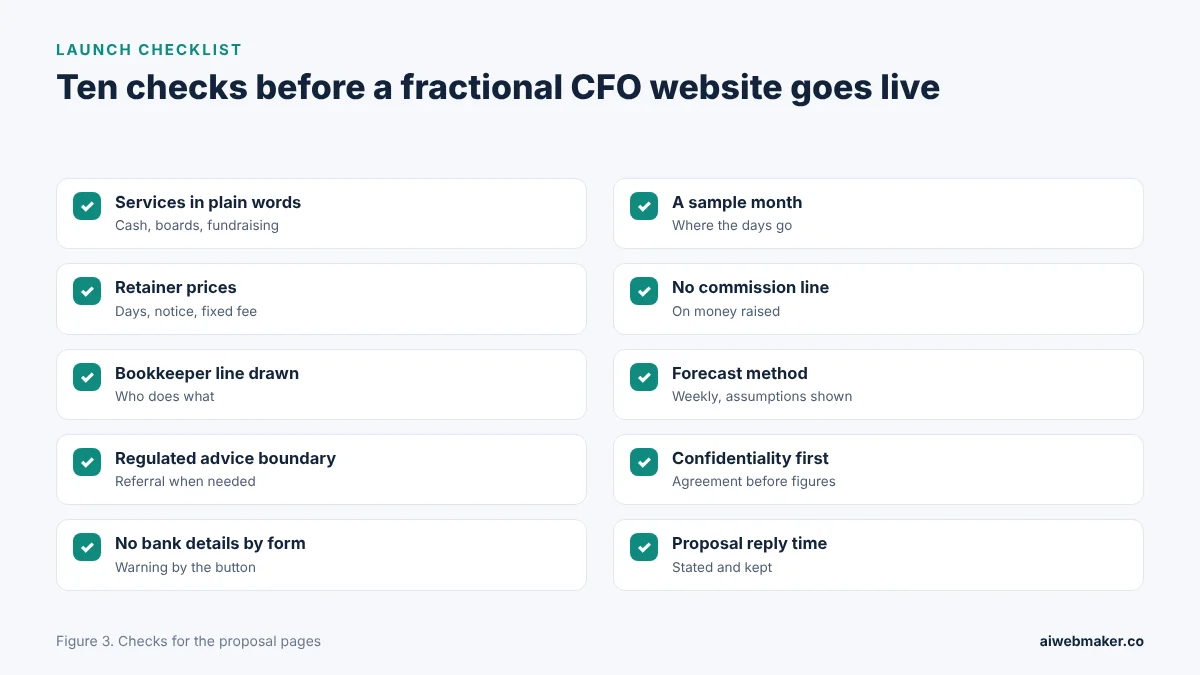
Founders abandon a fractional finance site the moment a month of work, or its price, stays a mystery. A promise to raise money, or a success fee on the amount raised, worries careful founders and their investors at once. Missing words on confidentiality make anyone hesitate before describing a cash problem. Talk of strategic value with no forecast, board pack or sample month behind it reads like a sales pitch. The ten fixes in the next image deal with each of these doubts in turn.
Frequently asked questions
How is a fractional CFO different from the company's accountant?
An accountant usually looks back, preparing statutory accounts and tax returns, while a fractional finance director looks forward at cash, budgets, pricing and investor reporting. The two roles overlap less than founders expect, and many fractional directors work alongside the existing accountant rather than replacing them. Some fractional directors are qualified accountants and some are not, and the rules on using particular professional titles vary by country. The site should say which qualifications the director holds and which tasks stay with the accountant. Clarity here stops a company paying twice for the same work.
Is advice from a fractional finance director regulated?
Most fractional finance work, such as forecasting, reporting and budgeting, is general business advice that is not regulated in itself. Investment advice, arranging investments and some kinds of debt broking need authorisation across much of the world, with the boundary drawn differently from one jurisdiction to another. A careful director states what falls outside the scope and refers founders to a regulated adviser or a lawyer when a question crosses the line. Professional bodies for accountants may also set their own rules for members who offer this work. A short note on the page shows founders that the director knows where the edges are.
When is a company ready for part time finance help?
Companies usually reach this point when decisions start depending on numbers nobody fully trusts. Common signs include investors asking for monthly reporting, a bank asking for a forecast, cash surprises at month end or a raise planned within the year. Very young companies with simple finances may only need a good bookkeeper and an accountant for now. The site can describe these signs honestly, including when the director would advise waiting. Turning away work that is not yet needed builds the reputation that brings it back later.
What happens when the company needs a full time finance director?
Outgrowing a fractional director is a good outcome, and the site can say so openly. Many retainers end with the director helping to write the job description, interview candidates and hand over the forecast, the board pack and the finance calendar. A notice period long enough for that handover protects the company from a gap in reporting. Some directors stay on as an adviser to the new hire for a short while. Planning the exit from the start shows founders that the arrangement serves the company rather than the retainer.
One retainer month against the hosting bill
A single retainer day, let alone a month, bills more than a fractional director's $119 hosting year. Even twelve monthly payments of $19 add up to well below one day of finance work. Each founder who arrives already understanding the days, the fee and the confidentiality rules shortens the sales conversation to one call. Referrals from accountants and investors convert more often when the site confirms what they promised. Proposals signed without a long argument over scope show the pages are carrying the explanation.
Build your website in Minutes and get the AI Tools that work
Start Building Your Website →