Business Law Website Cost, Priced Like the Contracts Founders Buy
For a business law firm, a year online comes to $119 in hosting, or twelve payments of $19, plus whatever its chosen domain costs. Inside: who hires, the pages, packages by stage, fee shapes, clauses, the brief, jurisdiction, search and the yearly sums.
- No coding required
- Live in minutes
- Blog, SEO and chatbot tools included
For a business law firm, a year online comes to $119 in hosting, or twelve payments of $19, plus whatever its chosen domain costs. Packages, document prices and the brief page can be drafted and redrafted in the preview, and AI Web Maker raises no bill while that happens. A single confidentiality agreement covers the year, so the hosting barely registers. What does register is that founders buy legal work the way they buy software or accounting, comparing scope, price and speed across several tabs before writing to anyone. A firm that hides its fees behind a call to discuss your needs loses those founders to a rival that shows them. This guide's ground runs from who hires and the pages they expect to packages by stage, fee shapes, clauses, the brief, jurisdiction, search and the yearly sums.
This article is part of our complete guide: Website Builder for Law and Accounting Firms.
Which founders and companies hire a commercial lawyer, and at what stage?
Commercial clients hire a business lawyer at predictable moments in a company's life, and each moment carries its own deadline. Founders setting up together need a share structure and an agreement on what happens if one of them leaves. A first funding round brings a term sheet, a shareholder agreement and new company rules, usually under pressure from investors keen to close. Growing companies need customer terms, supplier contracts and confidentiality agreements as their sales widen. Established firms often want a lawyer on call for contract reviews rather than a new hire. Each buyer compares scope, price and speed as with any supplier, so the site must answer all three quickly.
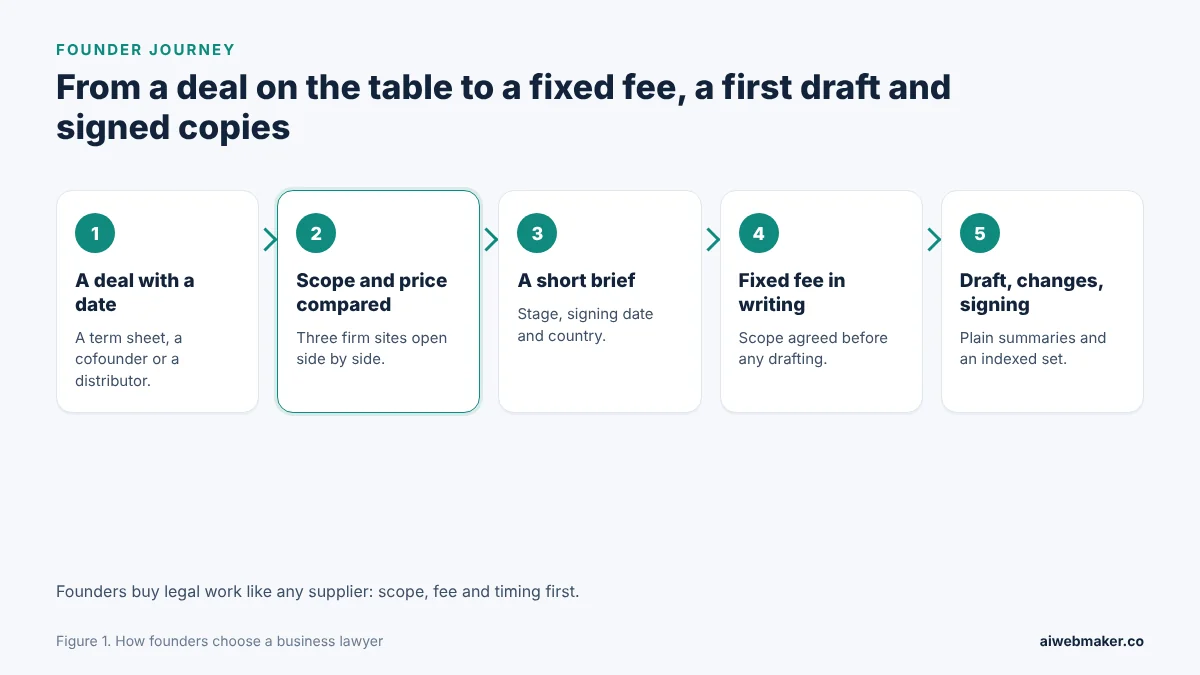
Of the five steps, the second carries the colour, because that is where a founder shortlists or drops a firm. Before it, a deal appears with a date attached, such as an investor's term sheet or a distributor wanting exclusivity. During it, the founder opens three or four firm websites and compares what each package includes, what it costs and how soon a first draft arrives. A brief follows only where all three are visible. The fixed fee in writing, the draft, the rounds of changes and the signing then decide whether the founder returns for the next round. A site that makes the second step easy tends to win the rest.
What does a business law site need to put in front of a founder?
A business law site works more like a supplier catalogue than a law firm brochure, because founders want to see exactly what they are buying. Packages by company stage come first, then a list of documents with starting prices, then the clauses founders worry about in plain words. A process page sets out the steps from brief to signature with timings attached. An about page names the lawyers, where they are qualified and which sectors they know. The brief page closes the set, asking enough to quote a fixed fee without requesting confidential detail too early.
| Page | What founders look for | What it should state |
|---|---|---|
| Packages | A bundle for their stage | Scope, fixed fee, what is excluded |
| Documents | One contract, priced | Starting price and what changes it |
| Key clauses | Plain explanations | What each clause decides |
| How we work | Speed and certainty | Timings, rounds of changes, signing |
| Lawyers | Who will draft | Qualifications and where they may advise |
| Brief | A fast quote | Deal type, stage, signing date, country |
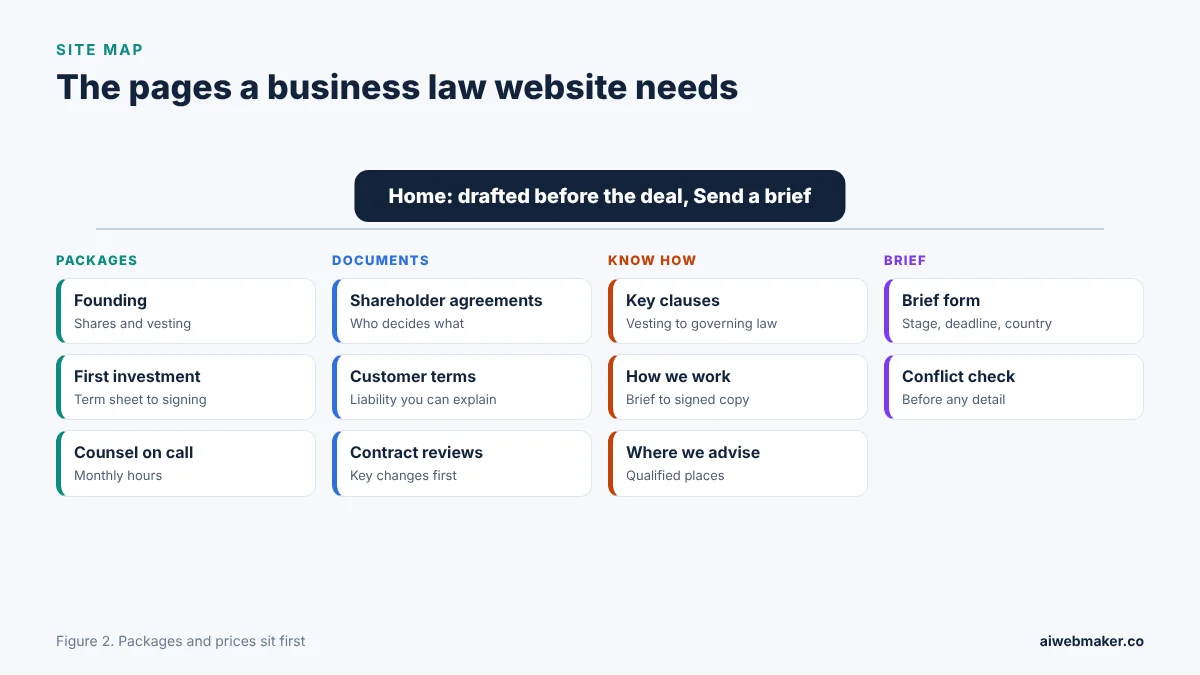
Packages, documents, know how and the brief form the four branches here, and each sits one click from the home page. Keystone Commercial Law, the made up practice in the business law website example with fixed fee packages for founders, opens with the promise of agreements drafted before the deal rather than after the dispute. Three packages follow, named Founding, First investment and Counsel on call, each with a written scope and a starting fee. Six document cards price shareholder agreements, customer terms, supplier and distribution contracts, confidentiality agreements, website terms with privacy notices, and contract reviews. A dark table explains vesting, drag along, tag along, deadlock, liability limits and governing law, each with a question worth asking. Five steps run from the brief to a signed copy, and the brief form asks for any signing deadline and the country where the company is registered. Founders reach a quote quickly because nothing on the page makes them hunt.
How should packages follow the stages of a company?
Packages work best when they follow moments founders already recognise, because few founders know which documents a stage requires. A founding package might combine a founders' agreement with vesting, the share structure and customer terms for the first sales. A first investment package typically covers a term sheet review, the shareholder agreement, updated company rules and a signing checklist. A retained arrangement suits companies with a steady flow of contracts, measured in hours each month with a promised turnaround. Each package should say what sits outside its scope and how extra work is quoted before it starts. Clear bundles let founders budget for legal work the way they budget for tools.
| Stage | Documents usually involved | Common fee shape |
|---|---|---|
| Before incorporation | Founders' agreement, share structure | Fixed package |
| First sales | Customer terms, website terms, privacy notice | Fixed per document |
| First funding round | Term sheet review, shareholder agreement, company rules | Fixed package with stated scope |
| Expansion | Supplier, distribution and agency contracts | Fixed or hourly by complexity |
| Steady trading | Contract reviews, board minutes | Monthly retainer of set hours |
| Sale or exit | Due diligence, sale agreement | Quoted after scoping |
Fixed fee, hourly rate or retainer: which suits commercial work?
Commercial work mixes predictable drafting with unpredictable negotiation, so most firms combine several fee shapes. Fixed fees suit documents with a known scope, such as a confidentiality agreement or a set of customer terms, and they remove the founder's fear of an open meter. Hourly rates suit negotiations where the other side's lawyer sets the pace, and a written estimate before each stage keeps them predictable. Retainers suit companies that want a lawyer on call, though the page must state the hours included and what happens to unused time. Stating how many rounds of changes each fee includes prevents the most common billing dispute of all. Whatever the mix, the founder should be able to price a typical year from the website alone.
| Fee shape | Suits | What to explain |
|---|---|---|
| Fixed fee | Standard documents, packages | Work outside scope is quoted first |
| Hourly with estimates | Negotiations, disputes | The other side affects the total |
| Monthly retainer | Steady contract flow | Hours included, unused time |
| Capped fee | Rounds with a clear timetable | What lifts the cap |
| Shares for fees | Rarely offered | Conflicts and local professional rules |
Which clauses do founders need decoded before signing?
Founders sign documents full of terms they have heard on podcasts but never seen explained, and a clause page turns that confusion into trust. Vesting decides how a founder earns shares over time, and the question to ask is what happens to unvested shares when someone leaves. Drag along and tag along rights decide whether a majority can force a sale and whether minority holders can join one on equal terms. Deadlock clauses matter for equal owners, who need a way forward that does not end the company. Liability caps and governing law decide how much either side can lose and where a dispute would be heard. Explained in a sentence each, with a note that effects vary by country, these clauses show a firm's thinking better than any biography.
How should a brief page get a founder to a fixed fee quickly?
A brief page should collect just enough to quote, because founders will not write an essay before knowing the price. Useful questions cover the kind of work needed, the company's stage, any signing deadline, the country of registration and a few lines about the deal. The deadline matters most, since a round closing on Friday changes the order of everything. The page should say that a conflict check comes before confidential detail and that no lawyer and client relationship exists until the firm confirms in writing. The AI website builder that drafts business law pages with packages and document prices produces the full page set once the firm describes its practice in a brief note, and each clause summary can be edited in the preview. A reply promise, such as a written scope within two working days, gives the founder a date to plan around.
Where does a commercial lawyer's authority to advise stop?
Company and contract law differ between countries, and so do the rules on who may advise, so a business law site must say where its lawyers are qualified. A founder in one country may sign with a distributor in another and choose a third country's law to govern the contract. Lawyers can usually advise only on the law of places where they are admitted, and the page should say when local counsel will be brought in. Privacy notices are a common example, since data protection law in the European Union differs from the rules in the United States and elsewhere. A clear statement of the firm's reach, with a note that bar and regulator rules vary, stops founders relying on advice that cannot travel. Honest limits make a firm look more expert, not less.
Which deal phrases do founders type before a round or a launch?
Founders search with the document or the deal already in mind. They type phrases such as shareholder agreement lawyer, term sheet review, startup lawyer, terms and conditions for an online shop or distribution agreement solicitor. Every document page can take its heading from those words and name the city or region served, while noting that video meetings reach other time zones. The map listing matters less than for walk in trades but should still carry the office address, hours and website link. Reviews that mention speed, fixed fees and plain explanations persuade other founders more than any award. Articles on vesting, what a term sheet usually covers or why a customer contract needs a liability cap reach readers months before their first round.
How much does a year online cost next to one contract review?
A business law site carries two standing costs, its hosting and its domain, and a monthly clause explainer drafted on AI credits adds only about $7.80 over the year. Firms with a stable book of retainers save by paying the hosting annually. A newly founded boutique might match its own cash flow with monthly billing instead. Adding a package, repricing a document or naming a new lawyer leaves the bill untouched. A yardstick row for the $189 tier sits beneath the two billing columns of this commercial firm's table.
| Item | Yearly | Monthly |
|---|---|---|
| Hosting the business law pages | $119 | $228 over twelve months |
| Domain | Depends on the ending | Depends on the ending |
| Higher plan, for comparison | $189 a year | Not needed |
| Twelve clause and contract articles at about $0.65 | About $7.80 | About $7.80 |
| Package, document and team updates | No charge | No charge |
| Year before the domain | About $126.80 | About $235.80 |
Why do founders close a commercial firm's tab and email a rival?
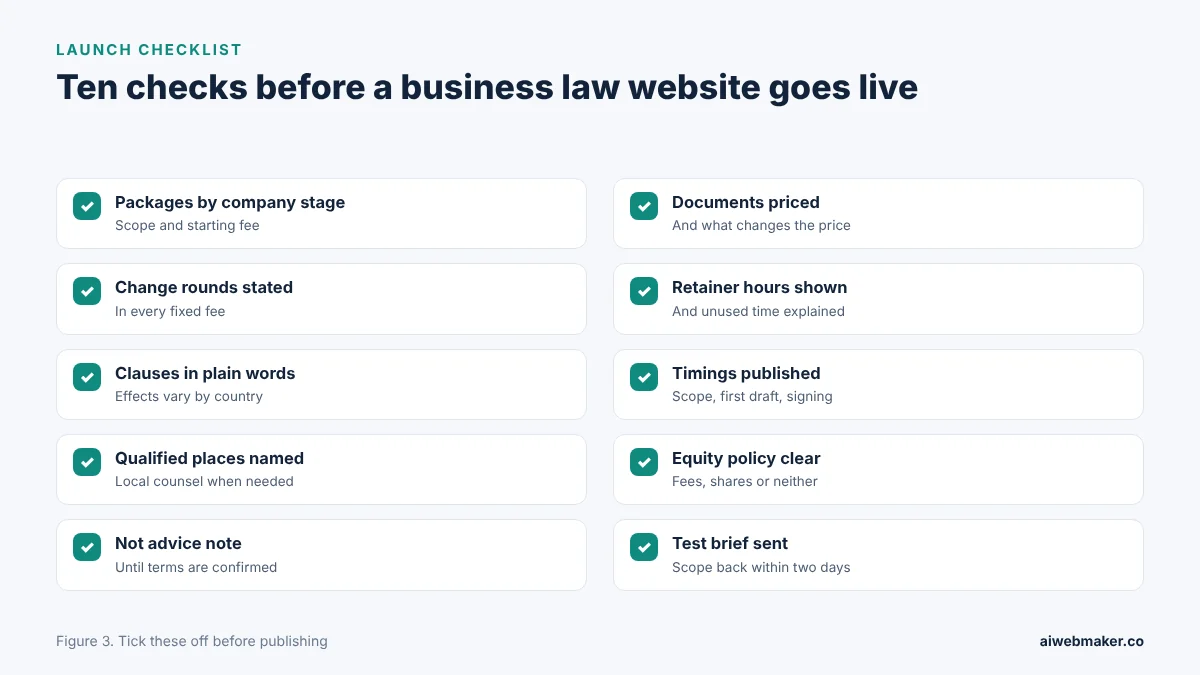
Founders abandon a commercial lawyer's site when it offers no prices at all, because an open meter is exactly what they fear. Pages that list practice areas in legal jargon, with no documents they recognise, make the firm feel built for large corporations. No timings leave a founder with a signing date unsure whether the firm can deliver. Silence on change rounds suggests that every comment will cost extra. No word on where the lawyers are qualified leaves cross border founders guessing. The drawing below turns each gap into one of ten launch checks.
Frequently asked questions
Does a two founder company need a shareholder agreement?
Many lawyers would say yes, because the best time to agree what happens if a founder leaves is while the relationship is good. Without an agreement, local company law fills the gaps, and its default rules rarely match what founders expect. Vesting, decision making, deadlock and what happens on a sale are the usual topics. The agreement need not be long, and a plain summary helps both founders remember what they signed. A firm's website can explain this in general terms while making clear that advice depends on the company's own facts.
Can a lawyer review a contract the other side drafted?
Yes, and contract reviews are among the most requested services for growing companies. The firm returns a marked up copy with the changes that matter most flagged first, so the client can decide where to push. A fixed fee for a review of a set length gives the client certainty. Turnaround matters, since sales teams often wait on the review before closing a deal. Stating the usual review time on the website helps founders plan their negotiations.
Is it normal for a startup lawyer to accept shares as payment?
Some firms in some countries accept a small stake or deferred fees from startups, but many do not, and professional rules usually impose conditions when they do. Those conditions often include fair terms, written consent and a recommendation that the client take independent advice. A stake can also create a conflict, since the lawyer's interest may differ from the founder's. Firms that charge only fixed fees or retainers can say so as a mark of independence. Whatever the policy, stating it plainly avoids awkward conversations later.
What happens when the deal changes halfway through drafting?
Deals change often, and a commercial firm should explain on its site how it handles work outside the agreed scope. A common approach is to pause, describe the extra work and quote a fee before continuing. That keeps the founder in control and avoids surprise invoices at signing. The number of change rounds included in each package sets the baseline. Clear rules on scope changes mark a firm that respects its clients' budgets.
Why one confidentiality agreement settles the hosting question
One confidentiality agreement or a short contract review typically bills above the $119 of hosting behind a business law site's whole year. Firms on the monthly plan cover $19 with a fraction of one hour of commercial advice. A founding package won from a founder who compared three websites can fund many years of hosting, and the investment round that follows is worth more again. Fixed fees in writing, clauses explained plainly and stated timings persuade founders who buy legal work like any other supplier. Firms that refresh their packages and articles see founders return at each new stage. Briefs arriving with the signing date and country already filled in show the pages are sorting serious deals from idle curiosity.
Build your website in Minutes and get the AI Tools that work
Start Building Your Website →