Window Cleaning Website Cost and a Round That Fills Street by Street
A window cleaning round can go online for $119 for the whole year, or a monthly $19, plus a domain. Inside: customers, cleans, methods, intervals, pricing, requests and round days, commercial glass, search and the yearly budget.
- No coding required
- Live in minutes
- Blog, SEO and chatbot tools included
A window cleaning round can be put online through AI Web Maker at $119 for the whole year, or at a monthly $19, and a domain completes the setup. Listing the cleans, naming the streets and setting out prices all happen in the preview, where nothing is billed. A few homes on a regular plan cover that yearly figure within the first couple of rounds. Crystal View Window Cleaning, a fictional firm, has its whole window cleaning service website built by AI Web Maker around the round, which makes it a useful reference while planning your own pages. The real challenge is density, because a round only pays when homes sit close together and each new customer is on a street the team already visits. Homeowners also want reassurance about ladders, access and what happens when it rains, since a stranger working outside upstairs windows is not a small thing. This article covers who hires a window cleaner, the cleans to list, cleaning methods, visit intervals, pricing, requests and round days, commercial glass, search and the yearly budget.
This article is part of our complete guide: Home Services Website Builder.
Upstairs windows, new movers and shopfronts: who hires a window cleaner
Window cleaning customers come from several groups, and each has its own reason to look for a regular cleaner. Many homeowners can manage the ground floor but not the upstairs windows, conservatory roof or glass above an extension. People who have just moved into a street often ask neighbours or search for whoever already cleans the houses nearby. Older residents value a reliable, familiar team who arrive on a predictable day. Sellers want gleaming glass for listing photographs, and landlords need windows cleaned between tenants. Shops, offices and restaurants want shopfronts kept spotless for customers, often weekly and before opening.
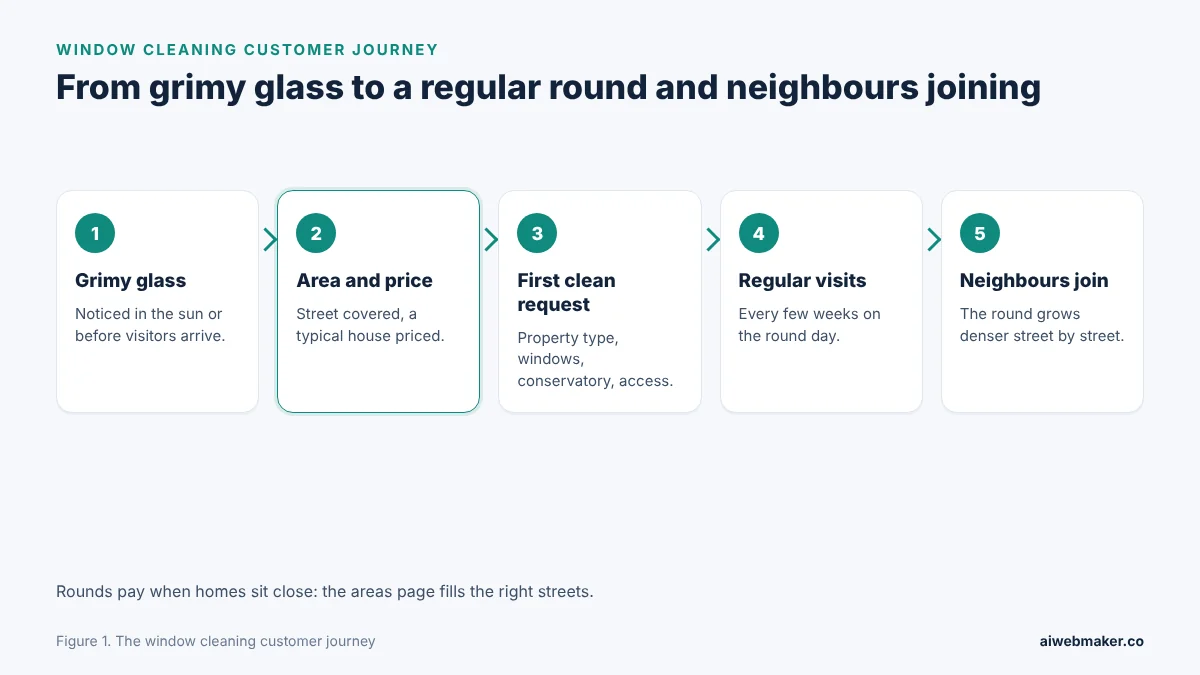
Grimy glass starts this journey, noticed when the sun hits the windows or when visitors are expected. The deciding moment follows straight away, as the homeowner checks whether the cleaner covers the street and what a typical house costs. A request for a first clean comes next, ideally with the property type, the number of windows and any conservatory or roof glass. Regular visits on a set interval then turn a one off clean into steady income. Neighbours who see the team at work often join the round, which is how good rounds grow denser. When the street names and a sample price are easy to find, the right homes join the round.
Homes, conservatories, frames and sills: the cleans to list
Each kind of clean deserves a line of its own, because a conservatory owner and a shop manager are looking for different things. Residential window cleaning is the heart of the round and should state what is included. Interior cleaning is usually arranged separately, since it needs someone home and takes longer. Conservatory and roof glass need different tools and often extra time. Frames and sills, along with extras such as gutter clearing or fascia cleaning where offered, can be priced as additions. A regular cleaning plan should sit prominently, because it turns one visit into years of work.
| Clean | Typical customer | What the page should state |
|---|---|---|
| Residential window cleaning | Homeowners and tenants | Outside glass, frames wiped or extra |
| Commercial window cleaning | Shops, offices, restaurants | Frequency, out of hours, insurance |
| Interior window cleaning | Homes and offices | Someone present, time needed |
| Conservatory and roof glass | Owners of glass roofs and extensions | Method, safety, price basis |
| Frames and sills | Homes with weathered frames | What is cleaned, how often |
| Regular cleaning plan | Customers wanting a fixed interval | Interval options, round days |
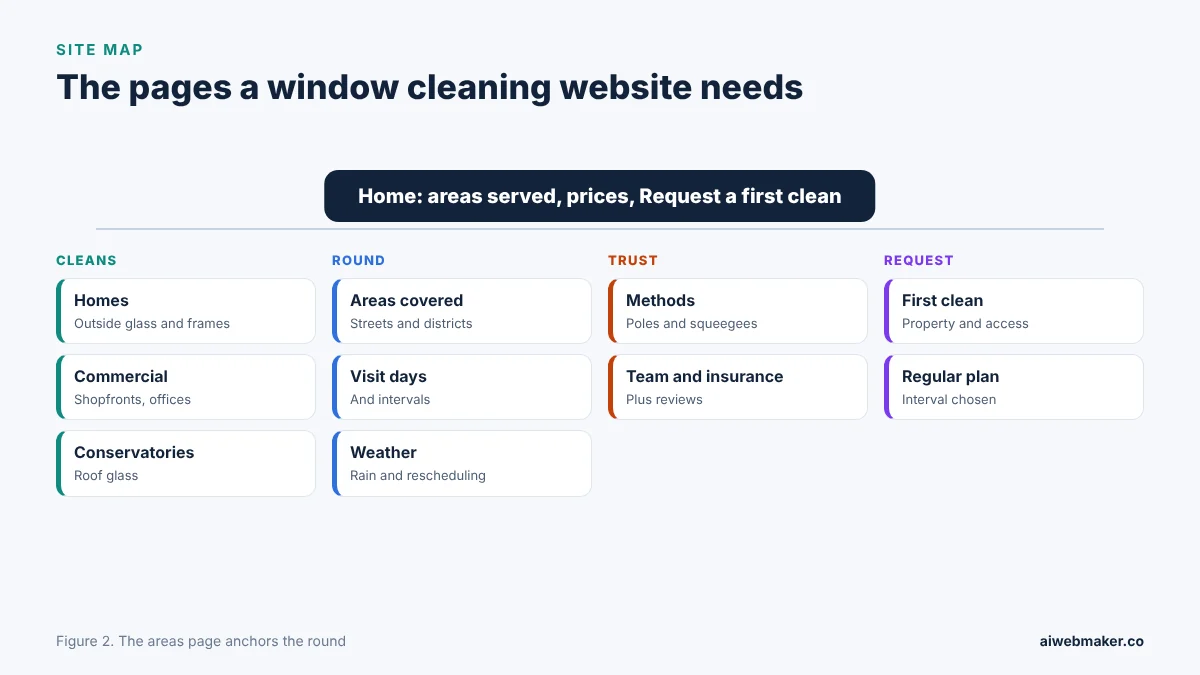
A window cleaning site divides into cleans, round details, trust and requests, and its home page should put the districts served and a request button in view at once. Clean pages cover homes, commercial glass, interiors and conservatories. Round pages explain areas covered, visit days and intervals. Trust pages introduce the team, the methods used, insurance and reviews, while the request page gathers property details. Crystal View Window Cleaning, the sample business, offers six bookable services, residential, commercial and interior window cleaning, conservatory and roof glass, frames and sills, and a regular cleaning plan, and its areas page explains where it is based, what happens on the edge of the area and how visit days work. The window cleaning website example with areas covered and visit days also explains how prices are worked out on its services page, and the whole site took 49 seconds.
Water fed poles, squeegees and ladders: how the glass gets clean
Customers increasingly ask how their windows are cleaned, and the answer affects both safety and the result. Water fed pole systems pump purified water up a long, lightweight pole to a brush, which scrubs the glass and frames and leaves them to dry clear without detergent. Because the operator stays on the ground, the method reduces ladder work on upper floors, which many safety authorities encourage. Traditional cleaning with an applicator and squeegee still gives an excellent finish, especially on interiors, leaded lights and shopfronts. Ladders remain useful in some places but need careful setup and stable ground. High rise buildings call for specialist access, such as platforms or rope access, which should be named only if the business is trained and equipped for it.
| Method | How it works | Where it suits | Points to note |
|---|---|---|---|
| Water fed pole | Purified water through a pole and brush | Most homes up to several floors | Frames cleaned too, operator stays on the ground |
| Traditional squeegee | Applicator, squeegee, cloth | Interiors, shopfronts, leaded lights | Excellent finish, may need ladders upstairs |
| Ladders | Traditional methods at height | Awkward spots and small jobs | Stable ground and careful setup |
| Specialist access | Platforms or rope access | Tall commercial buildings | Specific training and equipment |
Four weeks or eight: setting the interval and planning the round
The interval between visits shapes both the customer's satisfaction and the economics of the round, which is why the options deserve a plain explanation. Many residential customers choose a clean every four or eight weeks, depending on the setting and budget. Homes near busy roads, the coast or building sites get dirty faster and may need shorter intervals. Shopfronts and restaurants often want weekly or fortnightly visits, because grubby glass puts customers off. A fixed interval lets the cleaner group nearby homes onto the same day, which cuts driving and raises the number of houses cleaned per day. Recommending an interval, rather than leaving customers to guess, keeps them on the round for longer.
| Property | Interval often chosen | Why |
|---|---|---|
| Typical home | Every four to eight weeks | Balance of cost and clean glass |
| Home near a busy road or the coast | Every four weeks | Traffic film or salt builds up quickly |
| Conservatory roof | A few times a year | Moss, leaves and bird droppings |
| Shopfront | Weekly or fortnightly | First impression for customers |
| Office building | Monthly or by contract | Agreed with the facilities manager |
Size, access and the first clean: how window prices are worked out
Window cleaning prices make sense to customers when the website explains what drives them, rather than leaving a single figure to be argued over. Property size and the number of windows set the basic price, with detached houses usually costing more than flats or terraces. Access matters too, since extensions, conservatories, roof windows and glass above flat roofs take longer. A first clean is often priced higher than regular visits, because months of build up take more effort to remove. Frames, sills and interiors can be priced as additions, which keeps the basic price easy to understand. Clear pricing attracts the customers who stay for years rather than those who leave after one visit.
| Price factor | Why it changes the price |
|---|---|
| Property size | More windows, more time |
| Access | Extensions, conservatories, roof windows |
| First clean | Build up of dirt and stains |
| Frames and sills | Extra scrubbing and drying |
| Interior work | Someone home, careful indoor work |
Showers, side gates and round days: settling each new request
A request page for window cleaning should gather everything the team needs to fit a new home onto the right round day without a phone call. The homeowner can give the address, the property type, the number of windows, any conservatory or roof glass and how the side or back is reached. Through the booking website builder for window cleaners and exterior cleaning rounds, a homeowner submits those details, and the cleaner then slots the home onto the usual round day, suggests a different day or declines when the street is too far out, while payment stays between cleaner and customer with nothing kept by the platform. Weather deserves a line too, because light rain does not stop water fed pole cleaning, whereas storms, high winds and ice do. A note on whether customers need to be home, and how they will know the job is done, prevents worried calls. Requests that arrive with these details make every round day fuller and smoother.
Shopfronts, offices and high level glass
Commercial window cleaning needs its own page, because facility managers ask about schedules, insurance and safety paperwork that homeowners never mention. Shops and restaurants want cleans before opening, while offices may prefer evenings or weekends. Many commercial clients ask for proof of insurance, risk assessments and method statements before work begins. Rules on working at height differ between countries, and a business should follow the regulations and guidance that apply where it works. High level work beyond the reach of poles needs suitable equipment and trained staff, and it is better to refer it to a specialist than to stretch a ladder too far. A clear commercial page wins steady contracts that keep the round busy all year.
Searches by street and suburb: finding new homes for the round
Homeowners hunting for a cleaner search for window cleaner near me, conservatory roof cleaning or gutter and window cleaning, often with the street or district. An areas page that lists districts and streets by name gives search engines and visitors a clear match. Map entries showing the base, working hours and photos of the team at work catch many local searches. Cautious neighbours trust reviews praising punctual visits, care around plants and gates, and sparkling glass. Articles on how often to clean windows near the coast, how water fed poles work or caring for a conservatory roof answer questions homeowners search. Each of these signals helps fill the streets the round already serves.
A year online priced against a few homes on the round
A window cleaner's website bill is hosting and a domain, and seasonal advice articles written with credits cost cents each. Cleaners with a settled round spend least on yearly billing. A cleaner building a brand new round might lean on monthly billing while plans accumulate. Updating areas, visit days and prices is part of the hosting and adds nothing. The table compares the yearly and monthly routes, placing the $189 tier alongside solely as a reference.
| Item | Yearly | Monthly |
|---|---|---|
| Hosting the window cleaning pages | $119 | $228 over twelve months |
| Domain | Depends on the ending | Depends on the ending |
| Higher plan, for comparison | $189 a year | Not needed |
| Twelve glass care articles at about $0.65 | About $7.80 | About $7.80 |
| Areas, visit days and prices | No charge | No charge |
| Year before the domain | About $126.80 | About $235.80 |
No area list and no visit days: why homeowners look elsewhere
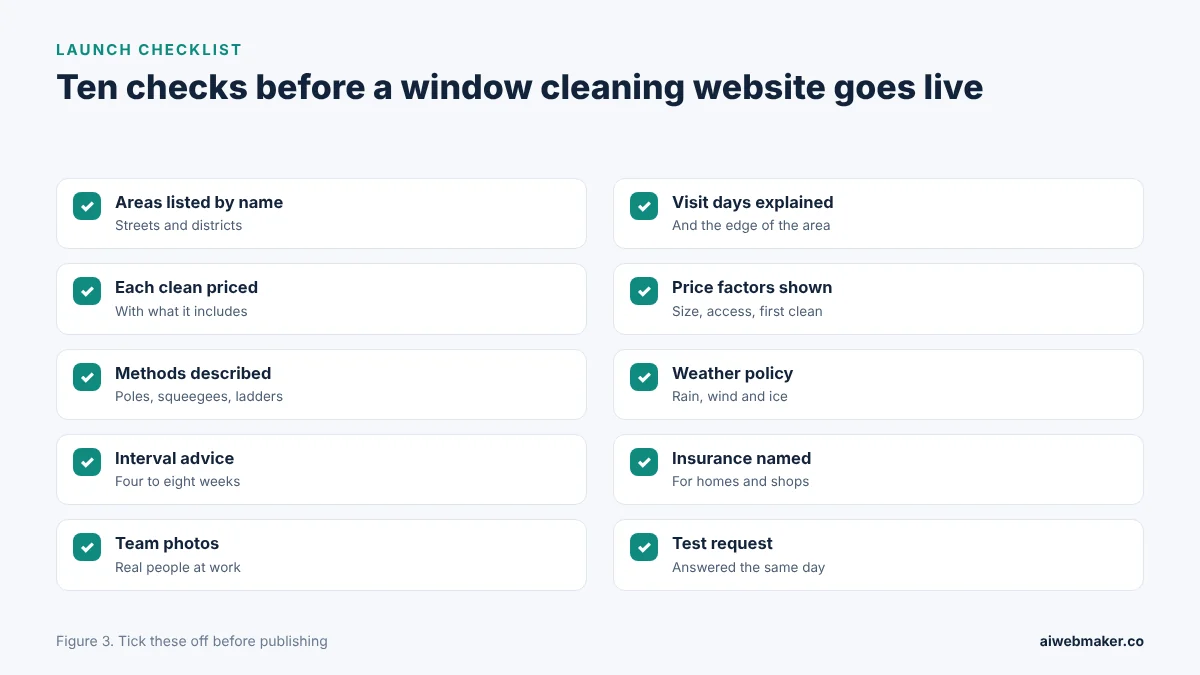
Homeowners leave a window cleaning site when they cannot tell whether their street is covered. A missing explanation of prices makes them suspect the figure will change at the door. Silence about ladders, methods and insurance worries anyone with tall windows or a conservatory. Photos of someone else's glass, rather than the team at work, make the business hard to trust. Request forms with no questions about the property force a phone call before any price can be given. The ten checks pictured here guard a new window cleaning site against each of those problems.
Frequently asked questions
Does someone need to be home for an outside clean?
Most outside cleans do not need anyone home, provided the team can reach the back and sides of the property safely. Customers can leave side gates unlocked and move plant pots or toys away from windows. Interior cleans, of course, need someone present to let the team in. A short note through the door or a text afterwards is a common way to confirm the visit happened. Clear arrangements let the round run smoothly while customers are at work.
Are windows cleaned in the rain?
Many window cleaners work in light rain, especially with water fed poles, because purified water leaves the glass clean and the rain itself is not usually the problem. Heavy rain, strong winds, thunderstorms and ice are different, since they make work unsafe or spoil the result. Traditional cleaning in wet weather can leave marks as the glass dries. The website should explain the cleaner's own approach and how rescheduled visits are handled. Clear expectations stop customers worrying when they see the team on a damp day.
Why is the first clean priced higher?
The first clean often costs more because glass and frames that have gone months without attention carry a build up of dirt, salt, moss or paint spots. Removing it takes more time and sometimes different tools. Once the windows are on a regular interval, each visit is quicker and the price settles. Explaining this on the website prevents surprise and shows that the regular price is fair. Customers who understand the reason rarely object to the first clean.
Can self cleaning glass be cleaned the usual way?
Self cleaning glass has a special coating that helps dirt break down and wash away, and it still benefits from occasional professional cleaning. Harsh chemicals, abrasive pads and some silicone products can damage the coating, so cleaners should follow the glass maker's guidance. Water fed poles with purified water are often well suited to this glass. The website can mention that the team asks about coatings before the first clean. Careful handling protects an expensive feature of the customer's windows.
A handful of homes on one street pay for the year
The $119 that keeps a window cleaning site online for a year is usually less than what a handful of homes on the round pay over a couple of visits. Billed monthly, the $19 is covered by a single house on most rounds. Every neighbour who joins after seeing the team on the street adds density the site helped build. A clear areas page, honest pricing and a plain explanation of methods win the trust a flyer through the door rarely earns. Cleaners who keep their visit days and photos current make it easy for new homes to join the right round. When requests start arriving from streets already on the round, the website is doing exactly the job it was built for.
Build your website in Minutes and get the AI Tools that work
Start Building Your Website →