Truck Repair Website Cost, Bay Requests and the Roadside Line
A truck repair workshop pays $119 a year for hosting, or $19 a month, with a domain added. Inside: who books bays, the pages to build, bay requests, warning signs, roadside safety, diagnostics, fleet accounts, search and costs.
- No coding required
- Live in minutes
- Blog, SEO and chatbot tools included
A truck and diesel workshop pays AI Web Maker a yearly $119 to keep its pages hosted, or $19 for each month it opts to pay singly, and the domain is extra. Writing the service pages, the warning signs table and the bay request in the preview brings no invoice, so the workshop checks everything on a phone first. One tractor unit service, or a single roadside call out, earns more than the year of hosting. The harder problem is downtime, because every hour a lorry stands in a yard costs its operator money and puts deliveries at risk. Fleet managers and owner drivers choose the workshop that gets them in quickly, explains faults plainly and answers the phone at night. What follows covers who books bays, the pages to build, bay requests, warning signs, roadside safety, diagnostics, fleet accounts, search and the hosting sums.
This article is part of our complete guide: Home Services Website Builder.
Who books a truck workshop, and what decides it?
Truck workshops serve a mix of owner drivers, fleet managers and businesses that run a few vans or lorries alongside their main trade. Owner drivers want a bay at a time that fits their loads, a fair price and a fitter who explains the fault in plain words. Fleet managers want vehicles back on the road quickly, one clear invoice and records they can show at inspections. Builders, farmers and delivery firms with a handful of vans care most about price and reliability. Everyone fears a breakdown at night on a busy road, so the roadside line weighs heavily in the choice. A workshop site that addresses downtime, clarity and emergencies wins most of this work.
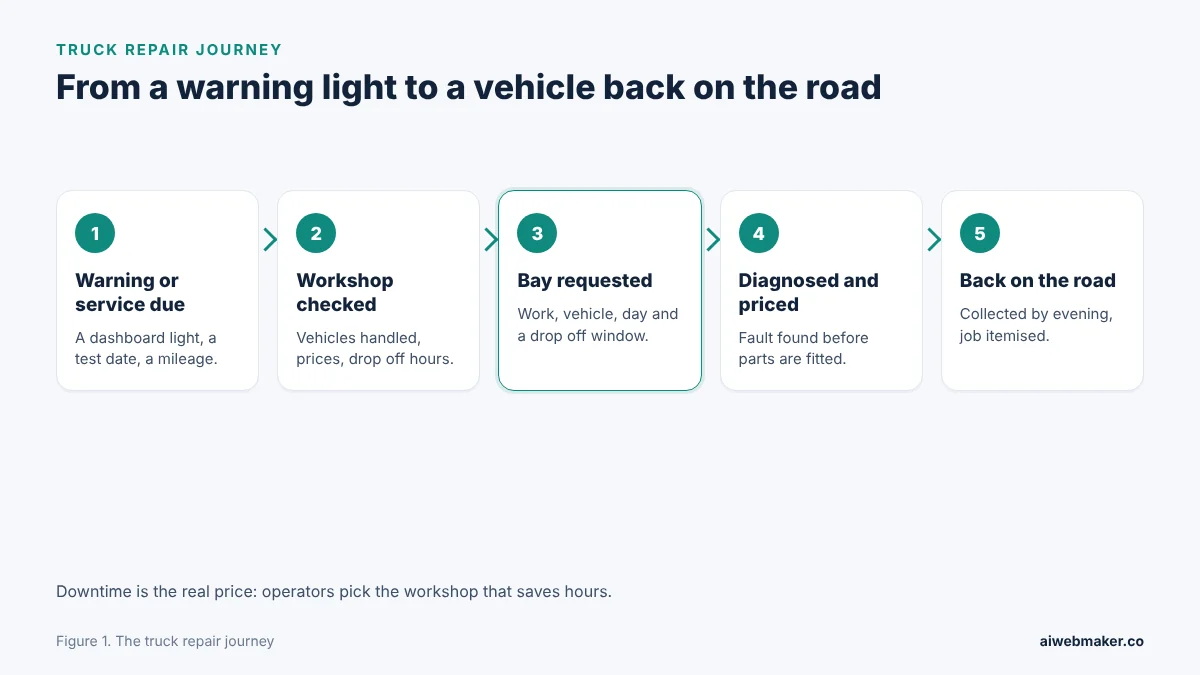
Starting with a dashboard warning or a service falling due, this journey ends with the vehicle collected and the job itemised on the invoice. The marked step is the bay request, because operators decide there whether the workshop can fit them in without wasting a day. Before it, drivers and fleet managers check which vehicles the workshop handles, the starting prices and the drop off hours. After it, diagnosis finds the fault before parts are fitted, and the price is agreed before work starts. The final step, a vehicle back on the road by the evening, is what keeps a fleet coming back. Every stage needs words on the website that promise only what the workshop can deliver.
Services, repairs, roadside: the pages a diesel workshop needs
A diesel workshop's website needs pages for scheduled work, repairs and emergencies, with the bay request reachable from all of them. The services page prices work by vehicle type, so a van owner and a fleet manager both see their numbers at once. The repairs page lists the faults the workshop handles, with starting prices where they make sense. A warning signs page helps drivers decide whether to stop or book in. The roadside page and the fleet page serve two very different audiences that both matter. With these pages in place, the site works as hard at night as the workshop does by day.
| Page | What the customer checks | What it should include |
|---|---|---|
| Services by vehicle | Price and time off the road | Van, rigid lorry, tractor unit, what each covers |
| Repairs | Whether this fault can be fixed | Diagnostics, brakes and air, clutch, electrical, filters, trailers |
| Warning signs | Whether it is safe to drive on | Symptom, likely cause, what to do |
| Roadside | Whether someone will come | Phone, safety steps, area, arrival estimates |
| Fleet accounts | Whether the workshop can handle a fleet | Approval, invoicing, drop off hours |
| Book a bay | How to get the vehicle in | Work, vehicle, day, drop off window |
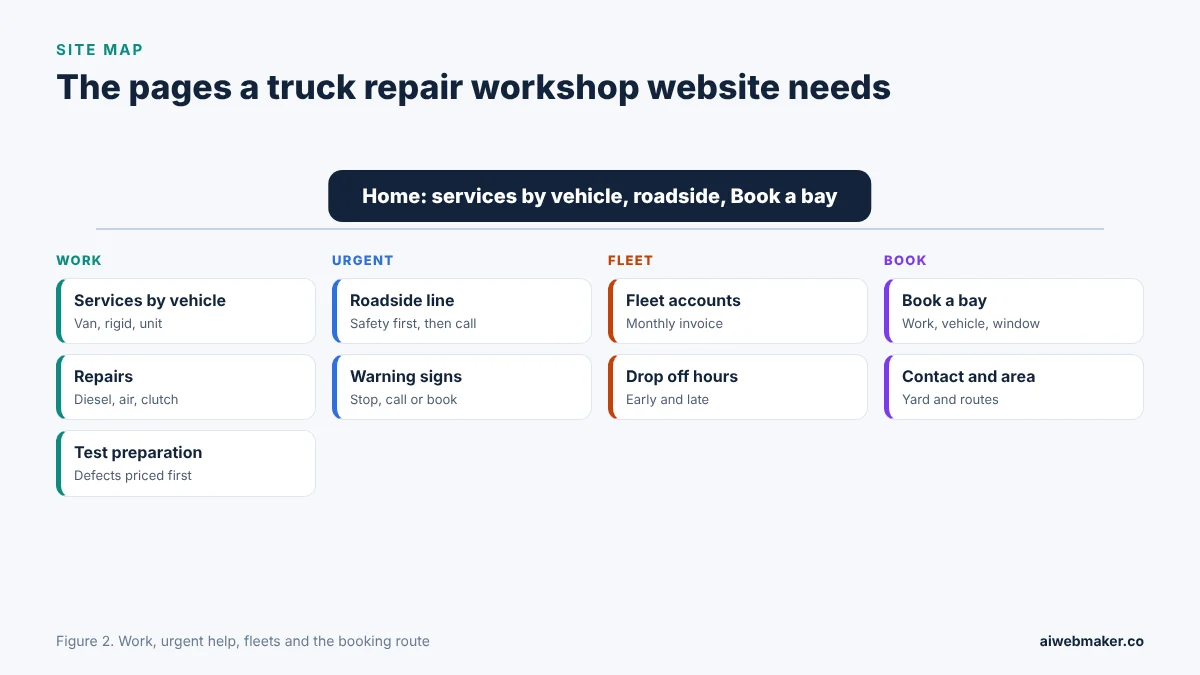
In this map the home page leads to four groups: scheduled and repair work, urgent help, fleet terms and the booking route. Work pages hold services by vehicle, repairs and test preparation, urgent pages hold the roadside line and the warning signs, fleet pages hold accounts and drop off hours, and booking pages hold the bay request and contact details. Our sample workshop, Haulmark Truck and Diesel, prices a van service, a rigid lorry service, a tractor unit service and test preparation. It also lists diesel engine diagnostics, brakes and air systems, clutch and gearbox work, electrical faults, particulate filter cleaning and trailer repairs. The truck repair website example with bay booking and a roadside line adds a warning signs table, fleet accounts, roadside steps, reviews, questions and a form for requesting a bay. That arrangement lets a stranded driver and a planning fleet manager each find their route in seconds.
Bay requests built around downtime
Downtime is the real price of truck repairs, so the booking route should be designed to get a vehicle in and out with the least time lost. A bay request should ask for the work needed, the vehicle type, the registration, the preferred day and a drop off window, plus whether the operator has a fleet account. Early and late drop off windows matter, because a lorry dropped at dawn can often be back on the road by evening. The booking website builder for truck workshops and their bay requests lets the operator send a request, which the workshop then accepts, moves to another slot or declines if it cannot fit the job in. Payment is arranged between the workshop and the customer, and no cut of it goes to the platform. Asking the right questions up front means each request arrives ready for a quick, honest answer.
| Request detail | Why the workshop needs it |
|---|---|
| Work needed | Bay, pit or lift, and the time to allow |
| Vehicle type | Van, rigid lorry, tractor unit, trailer or coach |
| Registration | Service history and parts lookup |
| Day and drop off window | Planning bays around shifts |
| Fleet account | Invoicing and agreed terms |
| Fault description | Diagnosis tools and parts to prepare |
Warning signs drivers should not ignore
A warning signs table helps drivers decide in seconds whether to stop, call or book in, and it shows that the workshop understands heavy vehicles. Low air pressure warnings can mean the brakes may apply on their own, so the driver should stop where it is safe and call. A sudden loss of power with an amber light often points to a blocked particulate filter or a sensor fault. White smoke with a sweet smell may mean coolant entering the cylinders, which can wreck an engine if the vehicle is driven on. Black smoke and a slipping clutch are less urgent but still need attention soon. The table below should be general guidance only, with drivers always deferring to the vehicle maker's handbook and their own judgement of safety.
| What the driver notices | Usual cause | What to do |
|---|---|---|
| Low air pressure warning | Air leak, compressor or governor fault | Stop where safe and call |
| Power cut, amber light on | Blocked particulate filter or sensor | Call before driving on |
| White smoke, sweet smell | Coolant reaching the cylinders | Stop and call |
| Black smoke pulling away | Injector, turbo or air intake fault | Book a diagnosis soon |
| Clutch slipping on hills | Worn clutch or leaking slave cylinder | Book in, keep loads light |
Roadside breakdowns: safety first, then the call
A roadside page must put safety ahead of everything else, because a broken down lorry on a busy road is dangerous for the driver and for passing traffic. The first instructions should be to switch on hazard lights, get everyone away from traffic and set out a warning triangle where the law requires one. If anyone is hurt or in danger, the driver should call the local emergency number before anything else. The roadside call itself should give the location, the load being carried and the warnings showing on the dashboard. Arrival times depend on distance and traffic, so the page should promise an estimate on the call rather than a fixed time. Calm, ordered instructions at that moment are what a driver remembers about a workshop.
Diesel diagnostics, particulate filters and air brakes
Modern diesel trucks rely on electronics, emissions equipment and air systems that need specialist tools, and the workshop's pages should prove it owns them. Diagnostics read live data, injector balance and compression readings, so the fault is found before any part is fitted. Particulate filters can block on vehicles that idle or run short journeys, and cleaning works best when the cause is found as well. Air brake systems need leak testing and careful checks of valves, chambers and compressors. Explaining these jobs plainly, with starting prices, shows owner drivers that the workshop will not guess at their expense. Technical honesty like this marks out a truck specialist from a general garage.
Fleet accounts and preparing vehicles for roadworthiness tests
Fleet accounts and test preparation bring steady, repeat work, so the website should explain both in terms a fleet manager can take to the finance team. Accounts are usually subject to approval, with terms set out in writing before the first job. A monthly itemised invoice, drop off from early morning and records for every vehicle make a fleet manager's life easier. Test preparation means inspecting the vehicle against the checklist the country uses and listing defects with prices. Test rules, intervals and fees vary by country, and the result is always given by the authority or an approved centre, never by the workshop. A page that makes these points clearly signals that the workshop understands compliance.
| Fleet need | What the page should say |
|---|---|
| Account terms | Approval process and written terms |
| Invoicing | One itemised invoice each month |
| Drop off hours | Early and late windows around shifts |
| Records | Service history kept for each vehicle |
| Test preparation | Inspection to the local checklist, defects priced |
How operators search for a truck workshop
Operators search with phrases such as truck repair near me, diesel mechanic, lorry service, particulate filter cleaning, air brake repair or mobile truck mechanic, often with a road or town. Service and repair pages that use these words, and name the vehicle types handled, match those searches directly. A map listing showing early and late opening hours, the roadside line and photos of the bays helps drivers decide in a hurry. Reviews from fleet managers and owner drivers that mention quick turnarounds and honest diagnosis carry real weight. Articles on warning lights, filter regeneration or preparing a vehicle for its test draw readers long before they need a bay. Over time, practical writing like this builds the workshop's name along the routes it serves.
A diesel workshop's site, priced for the year
A diesel workshop's website asks for hosting by the year or the month, plus a domain and a small credit spend on articles. Workshops with a full diary usually settle annually, while a new yard may prefer monthly payments while it wins its first fleets. Twelve articles on warning signs and maintenance come to around $7.80 in AI credits. New services, revised prices and extra vehicle types can be added at no charge. The table lays out annual and monthly billing, and the $189 tier sits in its own row so the figures can be weighed against it.
| Item | Yearly | Monthly |
|---|---|---|
| Hosting the workshop pages | $119 | $228 over twelve months |
| Domain | Depends on the ending | Depends on the ending |
| Higher plan, for comparison | $189 a year | Not needed |
| Twelve maintenance articles at about $0.65 | About $7.80 | About $7.80 |
| New services, prices and vehicle types | No charge | No charge |
| Year before the domain | About $126.80 | About $235.80 |
Why do operators skip a workshop's website?
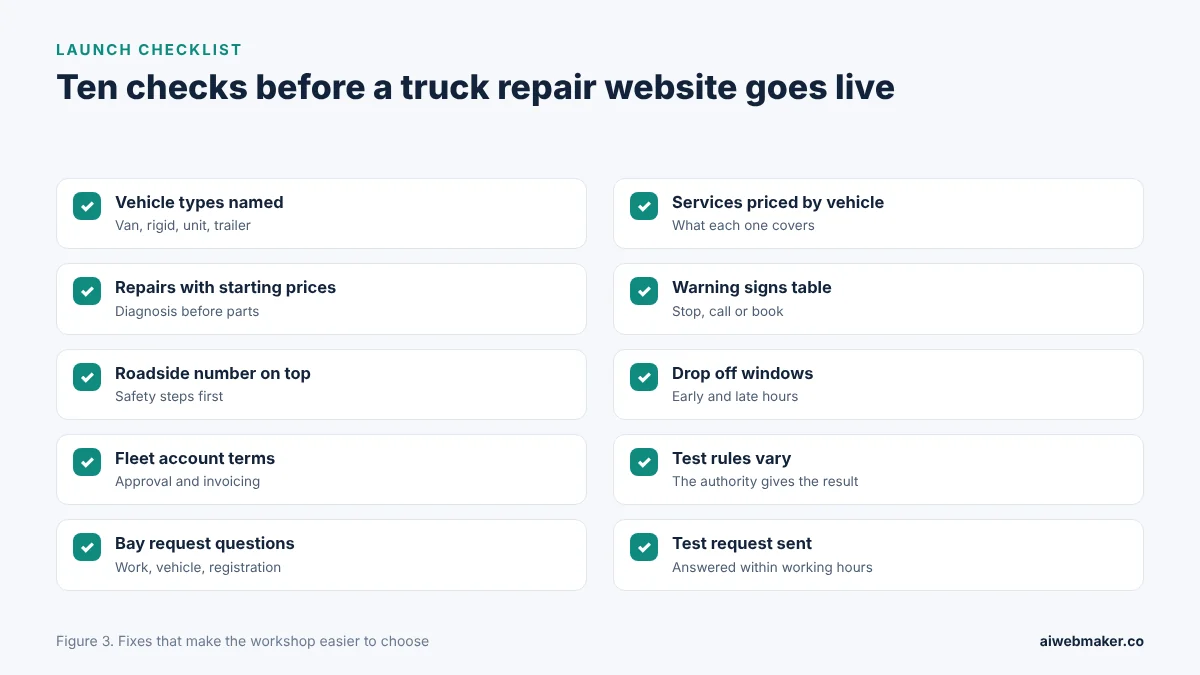
Operators skip a workshop's website when it does not say which vehicles it handles or whether it has the bays and lifts for a lorry. Missing drop off hours make it impossible to plan around shifts. A roadside number buried below the services loses the most urgent calls. No starting prices at all suggest the bill will be a surprise. A booking route that asks nothing about the vehicle or the fault leaves fleet managers doubting the workshop's organisation. The figure sets out ten fixes, and each one makes the workshop easier to choose.
Frequently asked questions
How quickly can a roadside fitter arrive?
How fast the van arrives depends on the distance, the traffic and how many call outs are running at once. A responsible workshop gives an estimate on the call rather than a promise it cannot keep. The website can describe the area the roadside van usually covers and how the estimate is worked out. Drivers should stay safe and away from traffic while they wait. Honest timing builds more trust than a bold claim that fails at night.
Can a workshop prepare a lorry for its roadworthiness test?
A workshop can inspect a lorry against the checklist the country uses, repair the defects it finds and take the vehicle to the test centre if asked. The test itself is carried out by the authority or an approved centre, which gives the result. Rules, intervals and fees for heavy vehicle tests vary from one country to another. The website should explain this division of roles clearly. Fleet managers appreciate a workshop that prepares vehicles thoroughly without promising a pass.
Why does a particulate filter keep blocking?
Particulate filters often block on vehicles that idle for long periods or make short trips, because the filter never gets hot enough to burn off the soot. Faulty sensors, injectors or turbo problems can also cause repeated blockages. Cleaning the filter without finding the cause usually means it blocks again. A good workshop diagnoses the root problem as well as cleaning or regenerating the filter. The website can explain this so operators understand the value of a proper diagnosis.
Are vans and tractor units booked the same way?
Vans and tractor units can use the same bay request, but the vehicle type changes the bay, the equipment and the time needed. A van service may take half a day, while a lorry or tractor unit often needs most of a day. The request should ask for the vehicle type so the workshop can plan correctly. Trailers can be booked alongside the tractor unit or on their own. Clear booking questions save time for both the operator and the workshop.
One tractor unit service and the hosting year is covered
A single tractor unit service usually brings a workshop more than its hosting and domain cost in a year. Paid monthly instead, one diagnosis or a short electrical repair outweighs the $19 several times. Every fleet that opens an account after reading the drop off hours and invoicing terms adds months of steady bay work. Clear prices by vehicle, honest warning signs and calm roadside steps persuade operators who cannot afford a wasted day. Bays filled before six in the morning by vehicles booked overnight show the site is pulling its weight.
Build your website in Minutes and get the AI Tools that work
Start Building Your Website →