Towing Company Website Cost for Roadside Calls and Planned Moves
A towing company's site carries one $119 hosting charge yearly, or a monthly $19 charge, and a domain. Inside: callers, services, trucks, roadside safety, tow bills, coverage, planned transport requests, search and the bill for a year.
- No coding required
- Live in minutes
- Blog, SEO and chatbot tools included
A towing company's website costs it a single $119 hosting charge each year on AI Web Maker, or a $19 charge each month instead, and the domain is a further small purchase. Every service, coverage area and phone number is laid out and checked in the preview before any bill appears. One motorway recovery or a couple of local tows bring in more than that yearly sum. Hookline Towing is an invented operator whose AI Web Maker towing company website design carries a breakdown from the hard shoulder to the repair yard, a good reference for what follows. The trickiest part is that towing serves two very different customers, a stranded driver who needs a phone number within seconds and a planned customer who wants to arrange a transport days ahead. Both are anxious about price, because towing has a reputation for surprise charges, and both want to know the truck is right for their vehicle. This article covers who calls a tow truck, the service pages, matching trucks to vehicles, roadside safety, tow bills, coverage, planned transport, search and the yearly budget.
This article is part of our complete guide: Home Services Website Builder.
Breakdowns, accidents and planned moves: who calls a tow truck
Towing customers fall into two camps, and the website has to serve the panicked caller and the careful planner on the same page. Drivers whose car has broken down on a busy road want to know whether the company covers their location and how soon a truck can arrive. People involved in an accident are shaken, may be dealing with police or insurers, and need calm, simple instructions. Planned customers include people moving a non runner to a garage, buyers collecting a car bought far away and owners of classic or low cars. Garages, dealers, auction houses and fleet operators book regular moves and value reliability over speed. A good towing site gives each group its route within a single screen.
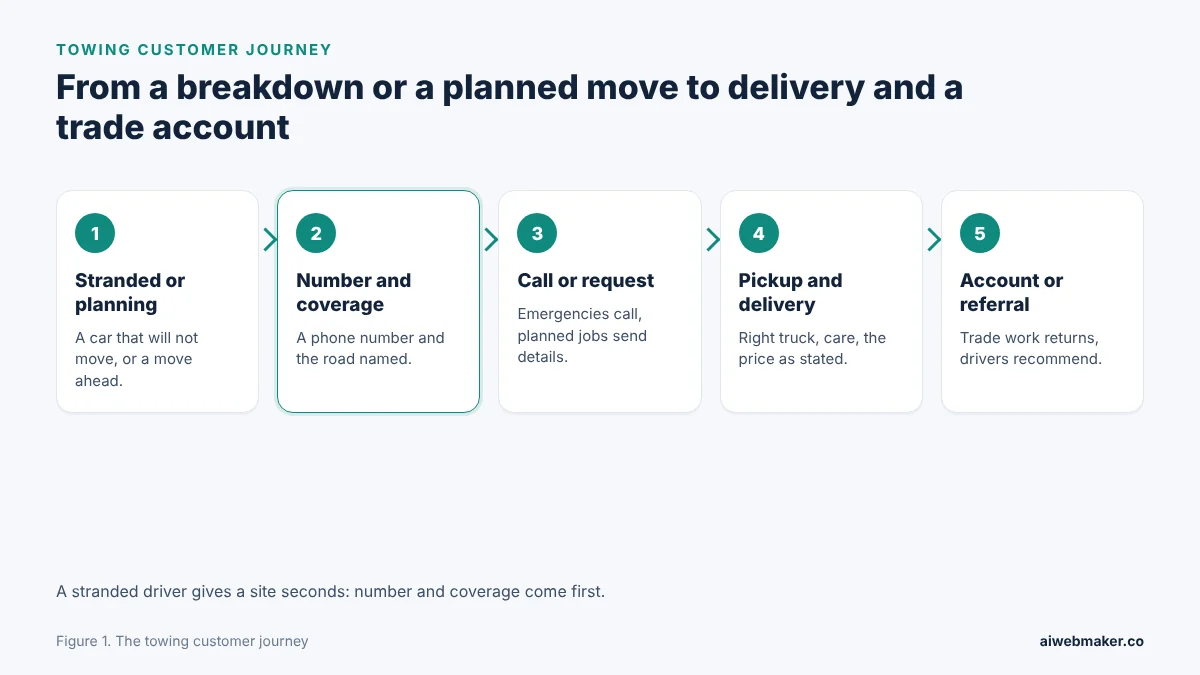
Two kinds of trigger start this journey, a car that will not move or a move that needs planning. The deciding moment comes straight after, when the driver looks for a phone number and checks that the company covers the road or town. Emergency customers call at once, while planned customers send a request with the vehicle, the pickup and the destination. Pickup and delivery follow, and the driver judges the company on arrival time, care with the vehicle and whether the price matched what was said. Satisfied trade customers often open a regular account, and private drivers recommend the company to friends. A site that wins the second step in seconds wins most of the jobs.
Breakdown towing to non runner collection: the service pages
Each towing service should have its own page or section, because a driver searching after an accident uses different words from a dealer arranging a transport. Breakdown towing covers vehicles that will not start or have failed on the road. Accident recovery involves damaged vehicles, debris and often police or insurer involvement. Vehicle recovery covers cars stuck in ditches, mud, snow or car parks, sometimes needing winching. Planned vehicle transport and non runner collection suit customers who can arrange a time in advance, and each page should state what the price includes.
| Service | Typical caller | What the page should state |
|---|---|---|
| Breakdown towing | Drivers stuck on the road | Phone number, coverage, response ranges |
| Accident recovery | Drivers after a collision | Calm steps, insurer involvement, storage |
| Vehicle recovery | Cars stuck in ditches, mud or snow | Winching, specialist equipment |
| Planned vehicle transport | Buyers, sellers, classic car owners | Request details, distances, price basis |
| Non runner collection | Owners of cars that will not move | Access needs, keys, destination |
| Trade and fleet moves | Garages, dealers, auction houses | Regular collections, invoicing |
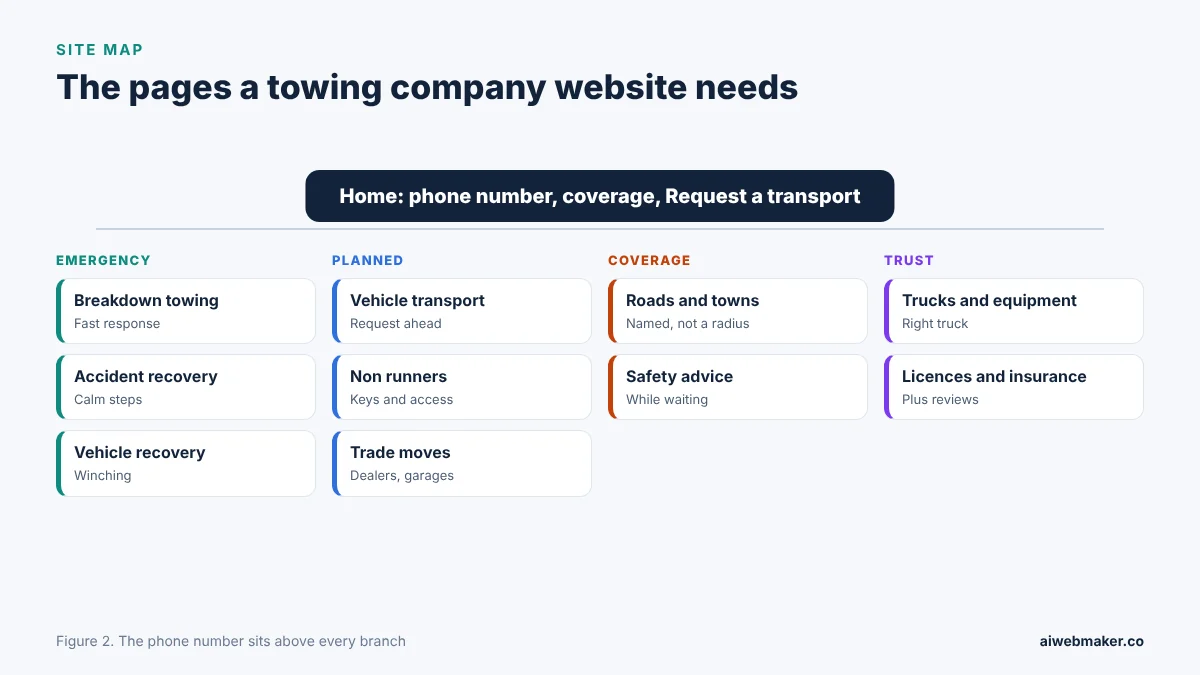
Urgent help sits at the top of a towing site, with the phone number visible on every screen and the services, coverage and trust pages arranged beneath it. Emergency pages cover breakdowns, accidents and recoveries. Planned pages cover transport, non runner collection and trade moves. Coverage pages name the roads and towns served, and trust pages hold equipment, licences, insurance and reviews. Hookline Towing, the sample company, greets broken down drivers with a headline on its home page and puts urgent call outs first on its contact page, while offering five bookable services: breakdown towing, accident recovery, vehicle recovery, planned vehicle transport and non runner collection, each with its own price. The towing company website example with a coverage area page and urgent call outs also includes an about page on equipment, licences and insurance, and it was built in 52 seconds.
Flatbeds, wheel lifts and low loaders: matching the truck to the vehicle
Drivers worry that the wrong truck will damage their car, so the site should explain which equipment the company uses and when. Flatbed trucks, also called rollbacks or car carriers, lift the whole vehicle onto a bed and suit most cars, including many that should not be towed on their wheels. Wheel lift trucks raise one axle and are quick for short tows and tight spaces. Low loaders and trucks with long, shallow ramps protect sports cars and lowered vehicles from scraped bumpers. Heavy recovery vehicles handle vans, lorries and buses, while motorcycle cradles keep bikes upright and secure. A short equipment table reassures owners that the company has thought about their particular vehicle.
| Truck or tool | Best for | Points to explain |
|---|---|---|
| Flatbed or rollback | Most cars, electric and four wheel drive vehicles | Vehicle travels fully off the ground |
| Wheel lift | Short tows, tight car parks | One axle on the road |
| Low loader | Sports cars, lowered and classic cars | Shallow ramp angle |
| Heavy recovery | Vans, lorries, coaches | Separate pricing and crews |
| Winch | Ditches, mud, snow, car parks | Controlled pulling to avoid damage |
| Motorcycle cradle | Motorbikes and scooters | Secure straps, upright transport |
Waiting at the roadside: safety advice for stranded drivers
A short safety section is one of the most useful things a towing website can offer, because people read it while standing beside a broken down car. The first advice is to get away from moving traffic if that can be done safely, ideally behind a barrier or well onto the verge, with hazard lights on. Drivers on fast roads should usually wait outside the vehicle and away from it, unless leaving the car would put them in greater danger. Rules on warning triangles and reflective vests differ between countries, so the page should follow the local road authority's guidance. Anyone injured, or anyone stopped in a dangerous position, should call the emergency number first and the towing company second. Calm, practical advice like this builds trust at the moment it matters most.
Hook up fees, mileage and storage: explaining a tow bill
Explaining how a tow bill is built is the best defence against the reputation for surprise charges that hangs over the trade. Most bills combine a hook up or call out fee with a charge for distance, measured in miles or kilometres. Winching, waiting time, extra crew and night or weekend call outs may add to the total. Storage at the yard is usually charged by the day, so owners and insurers should be told when charges begin. In some places, authorities set limits on fees for certain tows, such as those ordered by police or from private car parks, and a company should follow the rules where it works. A table of charges, with starting figures where possible, makes every quote easier to accept.
| Charge | When it applies | What to state |
|---|---|---|
| Hook up or call out | Every tow | The starting figure |
| Distance | Beyond any included distance | Rate per mile or kilometre |
| Winching or recovery | Vehicle stuck or off the road | How the time is charged |
| Out of hours | Nights, weekends, holidays | Any supplement |
| Waiting time | Delays at the scene | When the clock starts |
| Storage | Vehicle held at the yard | Daily rate and access hours |
Roads, towns and response times: building the coverage page
A coverage page saves time on both ends of the phone, since drivers inside the area call at once and those far outside it call someone closer. The page should name the main roads, ring roads and towns served, rather than a vague radius. Response times are best given as honest ranges that depend on traffic, weather and demand, never as fixed promises. The page can also explain what happens just outside the usual area, since many companies will still help for an agreed price. Listing the roads by name helps search engines show the page to drivers on those roads. Clear boundaries turn more calls into jobs and fewer into wasted conversations.
| Coverage detail | Why drivers need it |
|---|---|
| Main roads and junctions | Confirms help on a specific route |
| Towns and districts | Matches local searches |
| Response ranges | Sets honest expectations |
| Outside the usual area | Explains what is still possible |
| Yard location | Shows where a vehicle may be stored |
Planned transport and non runner collection by request
Planned jobs suit a written request, because the customer has time to give the details the driver needs and the company can plan its trucks. The request can ask for the vehicle make and model, whether it rolls and steers, where the keys will be, the pickup and drop off addresses and a preferred date. With the booking website builder for towing and vehicle transport companies, the customer sends that request, then the company confirms it, offers a different day or turns it down if every truck is busy, and the charge is settled with the customer directly, with no share kept by the platform. Emergency calls still go to the phone, which should stay at the top of every page. Planned work fills the hours between breakdowns and often pays well because it can be scheduled. A clear request route makes that work easy to win.
Tow truck near me: searches made from the hard shoulder
Drivers looking for help type phrases like tow truck near me, breakdown recovery, car towing, accident recovery or vehicle transport, often with a road name or town. A towing firm should echo those phrases in each matching service heading, and the coverage page should name the roads drivers are likely to type. A map listing with round the clock hours where true, a phone number and photos of the trucks captures many emergency searches. Reviews that mention fair prices, quick arrival and care with the car reassure anxious callers. Articles on what to do after a breakdown, how electric cars should be moved or what to check before buying a car from far away bring planned customers who book later. Steady, useful content keeps the company visible between emergencies.
Hosting costs measured in tows rather than months
Towing websites carry two fixed lines, hosting and a domain, and each roadside advice article written with credits is well under a dollar. A company with steady work pays least by choosing the annual plan. A new operator with one truck may prefer the monthly route while it builds trade accounts. Changing prices, coverage roads and truck photos is part of the hosting. Each billing route has its own column below, while the $189 tier is shown to compare against.
| Item | Yearly | Monthly |
|---|---|---|
| Hosting the towing pages | $119 | $228 over twelve months |
| Domain | Depends on the ending | Depends on the ending |
| Higher plan, for comparison | $189 a year | Not needed |
| Twelve roadside advice articles at about $0.65 | About $7.80 | About $7.80 |
| Prices, coverage and photos | No charge | No charge |
| Year before the domain | About $126.80 | About $235.80 |
No phone number on screen: why stranded drivers go back to search
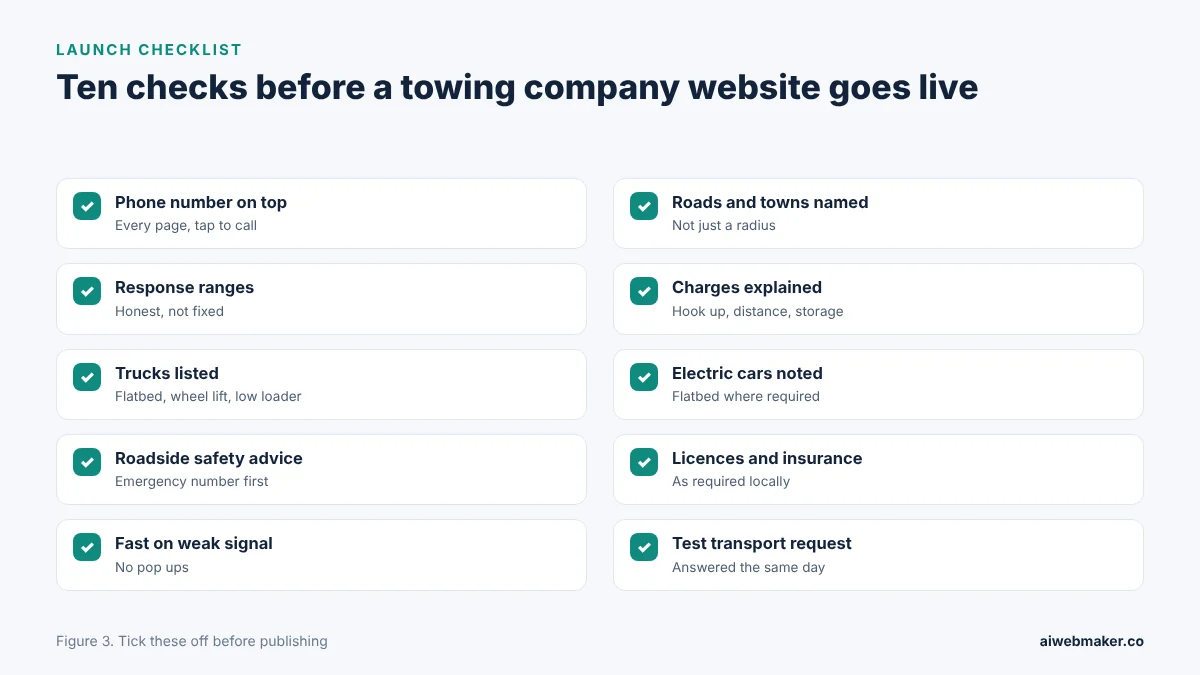
Stranded drivers leave a towing site within seconds when the phone number is not visible on the first screen. Coverage described only as a radius leaves them unsure whether the truck will come to their road. No mention of prices suggests the bill will be a surprise, which is the fear the trade most needs to answer. Missing equipment details worry owners of electric, low or valuable cars. Slow pages and pop ups are a particular problem for someone on a weak signal at the roadside. Working through the ten checks pictured here protects a towing site against each of those losses.
Frequently asked questions
Can an electric car be towed with its wheels on the ground?
Many electric cars should not be towed with the driving wheels on the ground, because turning wheels can damage the motor or generate unwanted current. Manufacturers usually recommend a flatbed, and the owner's manual gives the exact guidance. Some four wheel drive and automatic vehicles have similar restrictions. A towing company should state that it uses flatbeds for these vehicles where required. Clear information here reassures owners of newer cars and avoids expensive mistakes.
How long will the truck take to arrive?
Arrival time depends on the distance, traffic, weather and how many calls the company is handling. A towing company can give a typical range for its main area and an estimate when the driver calls. Promising a fixed time on the website is risky, since roads can close and demand can spike. Drivers in danger should call the emergency number and stay somewhere safe while they wait. Honest ranges build more trust than promises that are broken on a busy night.
Will insurance pay for the tow?
Whether insurance pays depends on the driver's policy, any roadside cover they hold and the circumstances of the breakdown or accident. Some policies include towing, while others reimburse costs only after a claim. The driver should contact the insurer or roadside provider to check before or soon after the tow, where possible. The towing company can explain how it works with insurers and what paperwork it provides. Clear answers prevent disputes when the bill arrives.
What happens to a car left in storage?
A car left in storage stays at the yard until the owner or insurer collects it or arranges a move, and daily storage charges usually apply. The website should state the yard address, access hours and what identification is needed to collect a vehicle. Owners should remove valuables when it is safe to do so, or ask the company how personal items are handled. Storage rules, including how long a vehicle may be held, can vary by place. Clear terms help owners act quickly and keep charges down.
A single motorway recovery and the hosting year is covered
The $119 that runs the towing site for a full year is typically less than a single motorway recovery earns. Billed monthly instead, the $19 disappears inside one short local tow. Every trade account opened after a dealer read the planned transport page adds months of steady work. A visible phone number, an honest coverage page and a plain explanation of charges win the trust that the trade's reputation makes hard to earn. Companies that keep their road list and truck photos current stay easy to find on the worst night of someone's week. When drivers start calling with the coverage page already open on their phone, the website has repaid its year.
Build your website in Minutes and get the AI Tools that work
Start Building Your Website →