Professional Organizer Website Cost and Session Requests That Calm
A professional organiser pays $119 to stay hosted through the year, or $19 in monthly portions, plus a web address. Inside: clients, pages, session pricing, tone and privacy, donations and storage, signposting, requests, search and the budget.
- No coding required
- Live in minutes
- Blog, SEO and chatbot tools included
A professional organiser keeps a site running on AI Web Maker with $119 per twelve months, or $19 in monthly portions, and adds a web address whose ending fixes its price. Session cards, room pages and the promises section can be written, reread and rearranged in the preview, without a line appearing on any AI Web Maker invoice. Even one half day of sorting usually outearns a full hosting year. What makes this trade hard is emotional rather than technical, because many people feel embarrassed about the state of a room and hesitate for months before asking a stranger in. A site that sounds kind, explains exactly what happens and promises that every decision stays with the client turns that hesitation into a request. Covered below are the clients, the pages, session pricing, tone and privacy, donations and storage, when to signpost other help, requests, search and a yearly budget.
This article is part of our complete guide: Home Services Website Builder.
Overwhelmed, moving or downsizing: who books a professional organiser
People who book an organiser are usually at a turning point, and the website has to meet them there. Busy parents feel the house has slipped out of control and want a calm system for toys, kitchens and paperwork. Someone moving home wants help packing with a plan and unpacking so the new place works from the first week. Older adults downsizing, or their adult children helping from a distance, face decades of belongings and difficult choices. People working from home want an office that lets them concentrate. Each of them wants reassurance that they will not be judged, pressured or rushed.
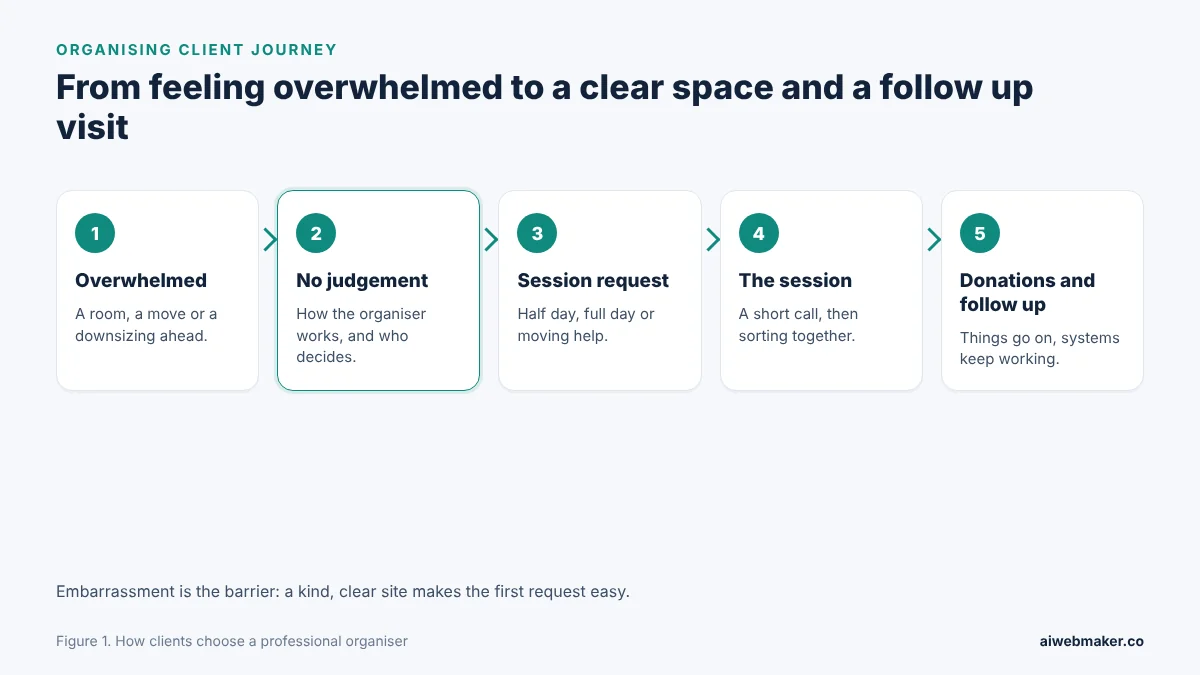
Overwhelm starts this journey, and the moment of trust in the middle decides whether a request is ever sent. A client first admits that a room, or a whole house, is beyond them. The highlighted step is reading how the organiser works, because clients need to know they will not be shamed or made to throw things away. Choosing a session and sending a request follows, then a short call to agree priorities. The session itself, and the donations run and follow up afterwards, decide whether the client books again and tells friends. A site that answers the trust question openly carries visitors through the rest with much less anxiety.
Sessions, rooms and promises: the pages an organiser's site needs
An organiser's website needs pages that answer practical questions and emotional ones in equal measure. Session pages explain half days, full days, moving help and follow ups with prices. Room pages describe wardrobes, kitchens, children's rooms, home offices, garages and downsizing in the client's own terms. A page on how a session works and a list of promises address the fear of judgement. Photos of finished spaces and a clear request route complete the set.
| Page or section | What the client asks | What it should explain |
|---|---|---|
| Sessions and prices | How long, and what does it cost? | Half and full days, what is included |
| How a session works | What happens on the day? | Call, plan, sorting, putting away |
| Rooms and spaces | Can they help with this room? | Wardrobes, kitchens, offices, garages |
| Moving and downsizing | Can they help with a move? | Packing plans, unpacking, letting go |
| Promises | Will they judge or pressure me? | Decisions stay with the client |
| Donations and storage | What happens to what leaves? | Donations, recycling, storage at cost |
| Request a session | Where does a client begin? | Session type, day, a short note |
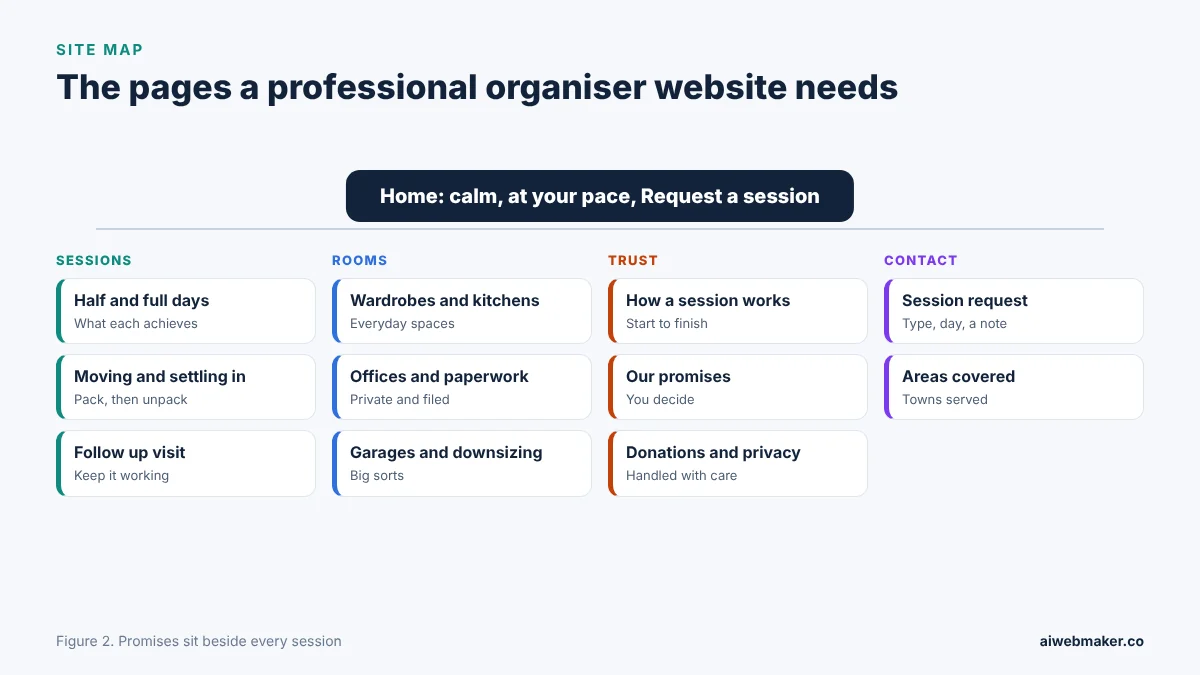
Pictured as a tree, the site has four branches: sessions, rooms, trust and contact. Session pages hold half and full days, moving and settling in, and follow up visits. Room pages cover wardrobes, kitchens and pantries, children's rooms, home offices and paperwork, garages, lofts and sheds, and downsizing. Our example business, Tidy Theory Organising, lists a half day session, a full day session, moving and settling in and a follow up visit on its price cards, then explains how a session works from start to finish. Room cards, a five step route from request to clear space, a set of promises and a gallery of finished spaces follow. The professional organizer website example with session requests and room pages ends with questions people ask before a session and a request form.
Half days, full days and packages: pricing an organiser's time
Clients find it hard to judge how much time a room needs, so the pricing page should describe what a session usually achieves rather than just the hours. A half day often suits one wardrobe, a pantry or a small office, while a full day can tackle a kitchen or a bedroom with storage. Moving help is usually priced by the day or as a package covering packing and unpacking. Follow up visits keep systems working once the first push is over. Storage products, if the client wants any, should be charged at cost and only with agreement, and the page can say that baskets and boxes already in the house are reused first. Clear pricing removes one more reason for a nervous client to put off asking.
| Session | Often suits | What the price should state |
|---|---|---|
| Half day | One wardrobe, pantry or small office | Hours, number of organisers |
| Full day | A kitchen, bedroom or playroom | Breaks, number of organisers |
| Moving and settling in | Packing before and unpacking after | Days included, packing materials |
| Follow up visit | Keeping a system working | Length, how soon after the first |
| Travel and parking | Clients further away | Any charge beyond a set area |
| Storage products | Shelving, boxes, labels | At cost, only with agreement |
A tone that never judges, and privacy inside the home
Embarrassment is the biggest barrier an organiser faces, so every sentence on the site should sound calm, practical and kind. Words like mess, junk or hoard can make a visitor close the page, while phrases such as a room that has got away from you feel easier to accept. The site should promise that the client makes every decision and that nothing leaves the house without their agreement. Privacy matters too, because organisers handle letters, bank statements, medicines and family keepsakes. Photos of a client's home should only be taken and shared with written consent, and addresses or faces should never appear. A clear privacy promise lets clients invite an organiser in without worry.
Donations, disposal and storage bought only with agreement
What happens to the things a client lets go is a question every organiser hears, and a short table answers it before the first visit. Good quality clothes, books and household items can go to charity shops, though each one accepts different goods. Electrical items, paint and batteries need proper recycling, and rules on waste differ between countries and councils. Bulky items may need a licensed waste carrier, depending on local law. Documents with personal details should be shredded or securely destroyed rather than recycled loose. Explaining this process shows the client that letting go will be handled with care.
| What leaves the house | Where it usually goes | What to tell the client |
|---|---|---|
| Clothes, books, toys in good condition | Charity shops or donation points | Which ones accept what |
| Electrical items and batteries | Recycling points | Local rules apply |
| Paint and chemicals | Special collection | Never in household bins |
| Bulky furniture | Collection or a licensed carrier | Any charge in advance |
| Personal documents | Shredding or secure destruction | Kept private throughout |
| Sentimental items | Kept, stored or passed to family | Never discarded without agreement |
When decluttering needs more than a professional organiser
Some homes need more than an organiser, and a responsible website says so gently. Severe difficulty letting go of possessions can be part of a recognised mental health condition, and in those cases an organiser works best alongside a doctor or therapist. Homes where clutter blocks exits, stairs or heaters may pose a fire risk, and the local fire service in some countries offers safety visits. Bereavement can make sorting a loved one's belongings very painful, and grief support services may help alongside practical sorting. Organisers are not therapists, and the website should avoid any language suggesting they treat anxiety or depression. Kind signposting protects clients and keeps the organiser within the limits of the role.
Session requests and how the booking builder handles them
A session request should be quick to send, because a hesitant client may lose courage halfway through a long form. On the booking builder, the client sends a request for the session they want, and the organiser decides what happens next. The organiser may agree the day, move it to a better date or decline it, and the client pays the organiser directly, while the platform keeps no slice of the fee. The booking website builder that lets organisers accept session requests sits that request next to the session and room pages, and drafting or previewing them costs the organiser nothing. A note promising a short call before the session reassures clients that nobody will simply arrive and start sorting. A warm reply confirming the day gives the working relationship a gentle start.
Phrases people type when the house has got away from them
People search for professional organiser near me, decluttering service, wardrobe organising, home organisation, help with downsizing or move management, usually with their town. American readers type organizer while British and Australian readers type organiser, so both spellings can sit naturally on one site. Each room and session page benefits from carrying its own phrase near the top. A map listing with the area served, photos of finished spaces taken with consent and accurate contact hours brings local enquiries. Reviews describing kindness, patience and lasting systems matter more than any before and after picture. Articles on preparing for a session, keeping a wardrobe in order or sorting paperwork give readers a gentle first step.
Twelve months of an organiser's website, line by line
An organiser's recurring website costs are hosting and the domain, with a dozen articles drafted on AI credits at about $7.80 for the year. Organisers with regular clients pay least through the $119 yearly plan. Someone starting out can spread it at $19 each month while bookings grow. Updating prices, rooms or photos brings no extra cost. Two payment columns follow, and the $189 tier joins them only to show the contrast.
| Item | Yearly | Monthly |
|---|---|---|
| Hosting the organising pages | $119 | $228 over twelve months |
| Domain | Depends on the ending | Depends on the ending |
| Higher plan, for comparison | $189 a year | Not needed |
| Twelve decluttering articles at about $0.65 | About $7.80 | About $7.80 |
| Session, room and photo updates | No charge | No charge |
| Year before the domain | About $126.80 | About $235.80 |
Wording that frightens off a client who is already embarrassed
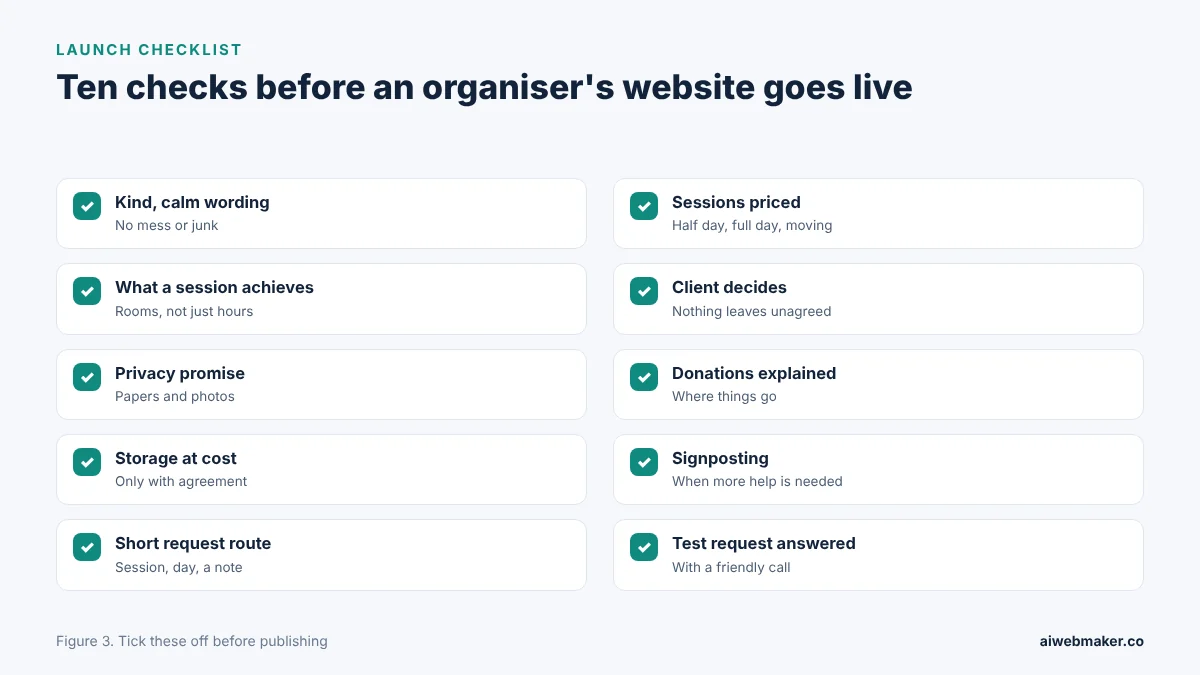
Nervous clients close an organiser's page quickly when the words sound judgemental or the photos look like a showroom they could never match. Missing prices make the service feel expensive and vague. No mention of who decides what goes raises the fear of being pushed to throw things away. Silence about privacy worries anyone with personal paperwork or family keepsakes. A long, demanding request form loses people who were already hesitant. The next picture pairs those gaps with ten simple fixes.
Frequently asked questions
Does the house need tidying before the first visit?
Clients never need to tidy before an organiser arrives, and saying so on the site lifts a common worry. Organisers need to see how a space is really used to design a system that lasts. Tidying beforehand can hide the problems the session is meant to solve. Clients can be asked to think about their priorities, such as the room that causes most stress. Reassurance on this point removes one more reason to delay booking.
Who decides what stays and what goes?
The client decides what stays and what goes, and the organiser's role is to guide, suggest and make the choices easier. Items are usually sorted into groups, such as keep, donate, recycle and undecided, so nothing is rushed. An organiser may ask questions that help a client think, but never pushes. Undecided items can be set aside for a later visit. Making this promise visible on the website is one of the most effective ways to win trust.
Are photos of a client's home ever shared?
Photos of a client's home should only be shared with clear written consent, and many organisers never share them at all. When photos are used, they should show the space without faces, names, addresses or personal documents. Clients should be able to say no without any effect on the service. The website can state this policy in a sentence beside the gallery. Respecting privacy is central to an organiser's reputation.
Can an organiser help an older parent downsize from a distance?
An organiser can help an older parent downsize while adult children live far away, but the parent's wishes should lead every decision. A call with the family beforehand agrees priorities, how decisions will be shared and what happens to items going to relatives. The organiser can arrange donations, sales and removals while keeping the family informed. Sensitivity matters, because downsizing often comes with grief or health changes. Clear communication keeps everyone involved and respected.
Half days needed to cover the organiser's hosting
One half day session normally covers the $119 that keeps a professional organiser's pages online for twelve months. Paid monthly, $19 is a small part of an hour's fee. Every client who returns for another room, and every friend they recommend, adds work the site helped arrange. A kind tone, clear prices and visible promises about decisions and privacy persuade hesitant clients far more than glossy photos. Organisers who keep their room pages and gallery current show a practice that is busy and trusted. Requests that arrive with a note saying the visitor finally felt ready show the pages are speaking to the right people.
Build your website in Minutes and get the AI Tools that work
Start Building Your Website →