Pressure Washing Website Cost and the Soft Wash Pages That Sell
Exterior cleaners need $119 for a year of site hosting, or can spread it at $19 per month over the busy spring, with the domain paid for separately. Covered: who books, surface pages, pressure versus soft washing, pricing, booking requests, runoff and safety, seasons, search and the annual cost.
- No coding required
- Live in minutes
- Blog, SEO and chatbot tools included
Exterior cleaners pay $119 to AI Web Maker for twelve months online, or a monthly $19 if cash is tight before the spring rush, with the domain priced separately. Setting up the surface pages and reading them through inside the preview brings no charge from AI Web Maker, so prices and photos can be matched to the real business first. One roof clean, or a pair of driveways, normally pays that yearly fee in full. Blue Jet Exterior Cleaning, a made up firm, has a complete pressure washing business website from AI Web Maker that pairs each surface with its proof, a handy reference for the pages below. The real challenge for this trade is that customers often think the job is simply blasting dirt away, while the expert knows that the wrong pressure on the wrong surface can strip render, crack tiles or scar decking. A pressure washing website has to sell the dramatic before and after result while showing that the method is chosen with care. What follows covers who books a clean, the surface pages, methods, pricing, booking requests, runoff and safety, seasons, search and the yearly sum.
This article is part of our complete guide: Home Services Website Builder.
Homeowners, landlords and shopfronts: who books a clean?
Exterior cleaning attracts a few distinct customers, and each looks for something different on the website. Homeowners usually notice a green patio, a black streaked roof or a slippery path, and they want to see the result before they commit. People selling a house often book a quick round of cleans before photos and viewings. Landlords and property managers want reliable cleaning across several properties, while shops, restaurants and offices want entrances and forecourts cleaned outside trading hours. Some customers also care about how cleaning affects plants, pets and nearby drains. A website that serves each group, with clear prices per surface and photos of real results, turns quick browsing into booked cleans.
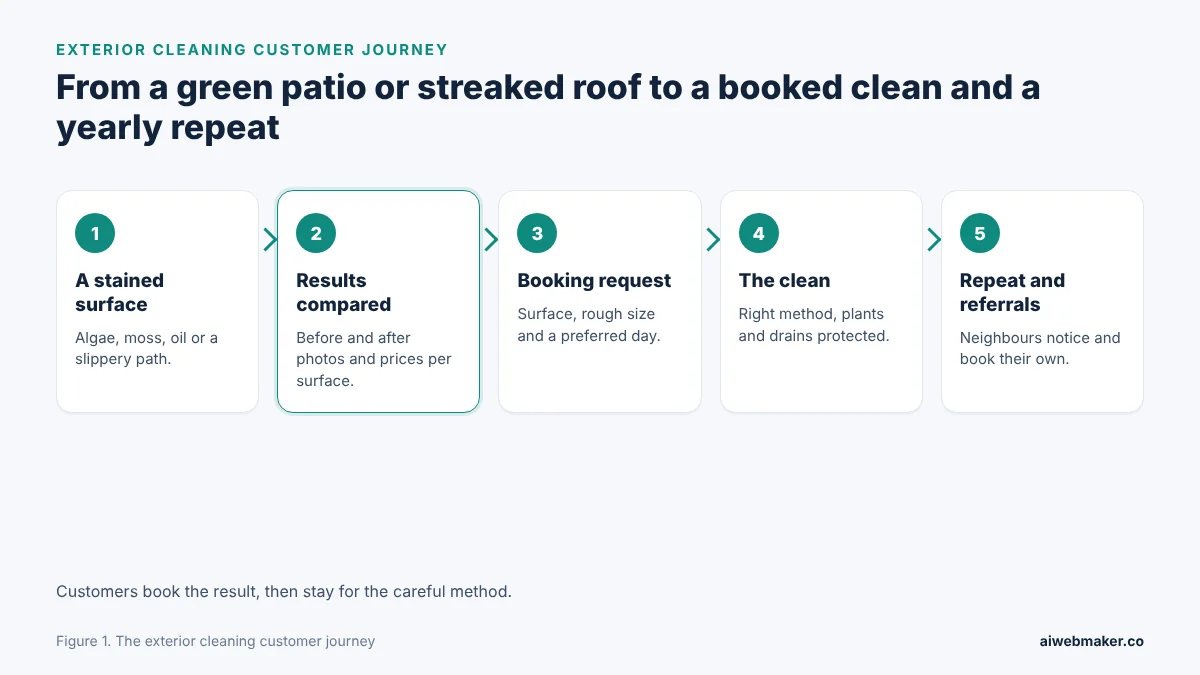
Before and after photos carry the second stage of this journey, and that stage decides whether a customer trusts the firm with a surface they care about. A customer first notices algae, moss or grime and starts searching for help. The comparison then rests on real results, on clear prices for each surface and on signs that the firm uses the right method. A booking request follows, naming the surface and a preferred day. The clean itself, and how tidily the property is left, decides whether the customer returns next year and recommends the firm to neighbours. A pressure washing website should make every stage visible and short.
One page per surface, from driveways to cladding
Customers search by the surface that bothers them, so every surface deserves its own page on a pressure washing site. Driveways and patios are the bread and butter of the trade, often followed by fresh jointing sand and sealing on block paving. Roofs need a gentle, specialist approach and attract higher value work. Gutters and fascias, windows, conservatories and cladding each bring their own questions about method and access. Decking and fences need care, because timber can be scarred by too much pressure. The table below shows what each surface page should explain.
| Surface | Method usually used | What the page should say |
|---|---|---|
| Driveways and patios | Pressure washing with a rotary cleaner | Sanding and sealing options, drying time |
| Roofs | Soft washing and moss removal by hand | Why high pressure is avoided on roofs |
| Gutters and fascias | Clearing and low pressure washing | Access equipment, downpipe checks |
| Windows and conservatories | Low pressure and purified water | Frames, seals and glass protected |
| Cladding and render | Soft washing with a cleaning solution | Suitable products, plants protected |
| Decking and fences | Low pressure and timber treatments | Grain protected, oiling or staining after |
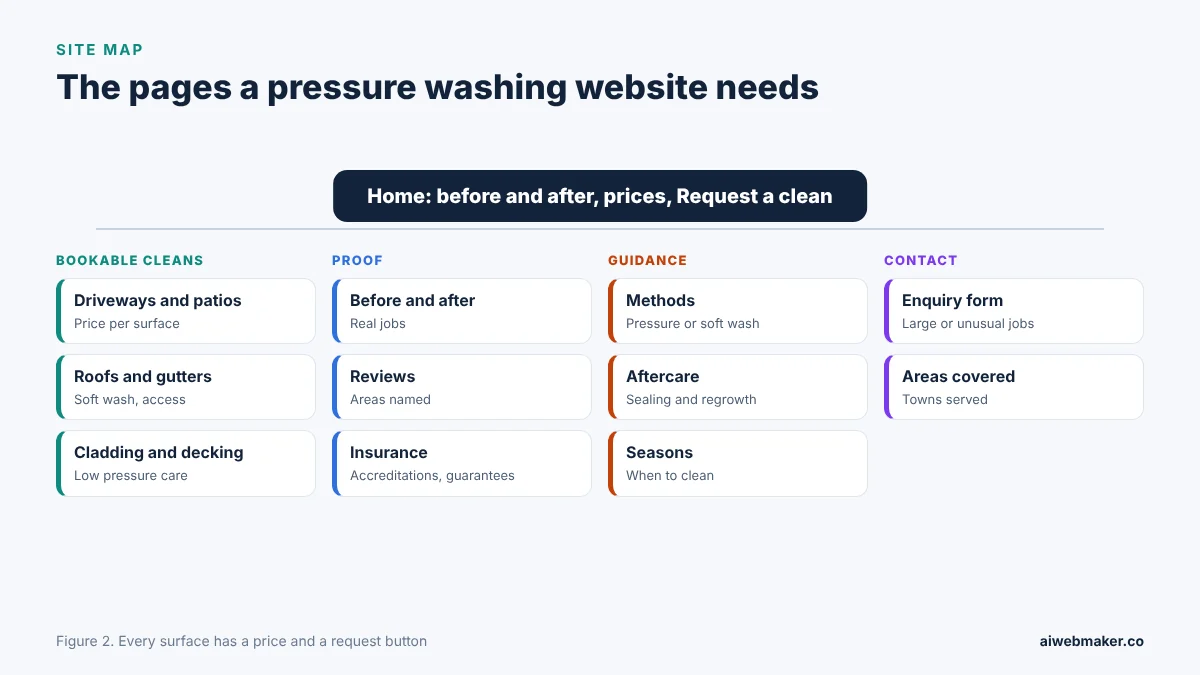
Built around the bookable cleans, an exterior cleaning site groups its pages into services, proof, guidance and contact. The services group lists each surface with its starting price and a request button. Proof pages carry before and after pictures, reviews, insurance and accreditations. Guidance pages explain methods, sealing, aftercare and seasonal timing. Our sample firm, Blue Jet Exterior Cleaning, offers six bookable services covering driveways and patios, roofs, gutters and fascias, windows, conservatories and cladding, and decking and fences, with a price beside each clean, from gutter and fascia cleaning to roof cleaning. Its work page leads with before and after pictures, then comments marked as example reviews and a note on where the firm works, while the about page explains its cleaning approach and lists insurance, accreditations and guarantees, and an enquiry form on the home and contact pages handles larger jobs; the pressure washing website example with six bookable surface cleans was built in 63 seconds.
High pressure or soft wash: matching the method to the surface
The most important expertise in exterior cleaning is choosing the method for each surface, and the website should explain it in plain words. High pressure washing suits hard, durable surfaces such as concrete, stone and well laid block paving. Soft washing uses low pressure with a cleaning solution, often based on sodium hypochlorite, to kill algae and lichen on roofs, render and cladding without forcing water under tiles or into joints. Hot water washing helps with oil, grease and chewing gum on forecourts. Timber needs low pressure and a careful technique to avoid raising the grain. A table of methods, with honest notes on risk, shows customers the firm knows its craft.
| Method | How it works | Suits | Risk if misused |
|---|---|---|---|
| High pressure | Strong jet of cold water | Concrete, stone, block paving | Etching, joint damage, splashback |
| Soft washing | Low pressure with a cleaning solution | Roofs, render, cladding | Plant damage if not rinsed and protected |
| Hot water washing | Heated water at moderate pressure | Oil, grease, gum on forecourts | Burns and surface damage if careless |
| Low pressure rinse | Gentle flow, often with brushes | Timber, windows, conservatories | Little risk when done properly |
Pricing by area, by job or by package
Pressure washing is usually priced by area, by job or as a package, and a website that states its method makes quotes easier to compare. Pricing by area, measured in square metres or square feet, suits driveways, patios and commercial forecourts. Fixed job prices work for standard tasks such as clearing the gutters on a typical house. Packages, such as a driveway with a matching patio, encourage customers to add a second surface. Extras like sealing, fresh jointing sand, moss treatment or difficult access deserve their own line. Starting prices beside each surface, with the factors that move them, attract customers who are ready to book.
| Pricing approach | Suits | What the page should state |
|---|---|---|
| Per square metre or foot | Driveways, patios, forecourts | How area is measured, minimum charge |
| Fixed job price | Gutters, conservatories, small patios | What a standard job includes |
| Package | Driveway with patio, house front | Which surfaces combine and the saving |
| Extras | Sealing, sanding, treatments | Priced separately, with drying times |
From request button to a date in the diary
A booking request should take a customer less than a minute, with the surface, rough size and a preferred day as the main details. Customers can be asked to note access, the nearest outside tap and any plants or cars in the way, and to keep a photo or two handy should the firm want one. Once the request arrives, the firm reviews it and confirms the day, suggests a different one or turns it down if the job is outside its area. Money for the clean changes hands directly between customer and firm, with no commission kept by the platform. The AI booking website builder for exterior cleaning firms with bookable surfaces puts the surface pages and request route together once the owner describes the cleaning work. A clear request route turns weekend browsing into a full diary for the week ahead.
Runoff, chemicals and safety around the property
Cleaning water and solutions have to go somewhere, so a careful firm explains how it protects drains, plants and people. In many places it is not acceptable to let dirty water or cleaning chemicals run into surface water drains, and rules on wastewater vary between countries and local authorities. Soft washing solutions can harm plants and lawns unless they are protected, wetted and rinsed, and the website should say how the firm handles that. Vents, electrical sockets and door seals need covering before washing nearby walls. Work at height on roofs and gutters calls for proper access equipment, and children and pets should be kept indoors while cleaning is under way. A firm that states these precautions earns the trust of customers who care about their whole property.
Seasons, weather and repeat cleans
Exterior cleaning is strongly seasonal, and the website can turn that pattern into steady bookings rather than a few frantic weeks. Demand usually peaks in spring and before holidays, when homeowners want their property looking its best. Moss and algae grow fastest in damp, shaded spots, so roofs and north facing walls often need attention after wet seasons. Sealing a driveway needs dry weather before and after, while frost can damage freshly washed surfaces in cold climates. Reminding past customers that most driveways and patios benefit from a clean every year or two brings repeat work in quiet months. Planning around the seasons keeps the diary fuller from one year to the next.
How driveway and roof cleaning searches are worded
People looking for exterior cleaning type phrases such as pressure washing near me, driveway cleaning, roof moss removal, patio cleaning or soft washing, often with their town or district. A page for each surface, headed with the phrase people use, gives search engines a clear match for each request. The map listing should show striking before and after photos, the areas covered and a link to the booking page. Reviews that mention a careful crew, protected plants and a result that lasted outweigh any amount of vague praise. Articles on caring for block paving or why roofs should not be pressure washed bring in homeowners who are still deciding. A firm that teaches as well as cleans becomes the one people remember when the patio turns green again.
The exterior cleaner's annual website arithmetic
Two amounts recur for an exterior cleaner's website, namely hosting and a domain name, and every article written with AI credits adds about $0.65. Firms with a busy spring diary spend least by choosing the yearly bill. A new operator still building up equipment may prefer monthly payments until the first season is finished. Changing prices, adding surfaces or posting new photos does not change what the firm pays. Here are both payment routes for exterior cleaners, with the $189 tier placed alongside for scale.
| Item | Yearly | Monthly |
|---|---|---|
| Hosting the exterior cleaning pages | $119 | $228 over twelve months |
| Domain | Depends on the ending | Depends on the ending |
| Higher plan, for comparison | $189 a year | Not needed |
| Twelve surface care articles at about $0.65 | About $7.80 | About $7.80 |
| Surfaces, prices and photo updates | No charge | No charge |
| Year before the domain | About $126.80 | About $235.80 |
What makes a homeowner doubt an exterior cleaner
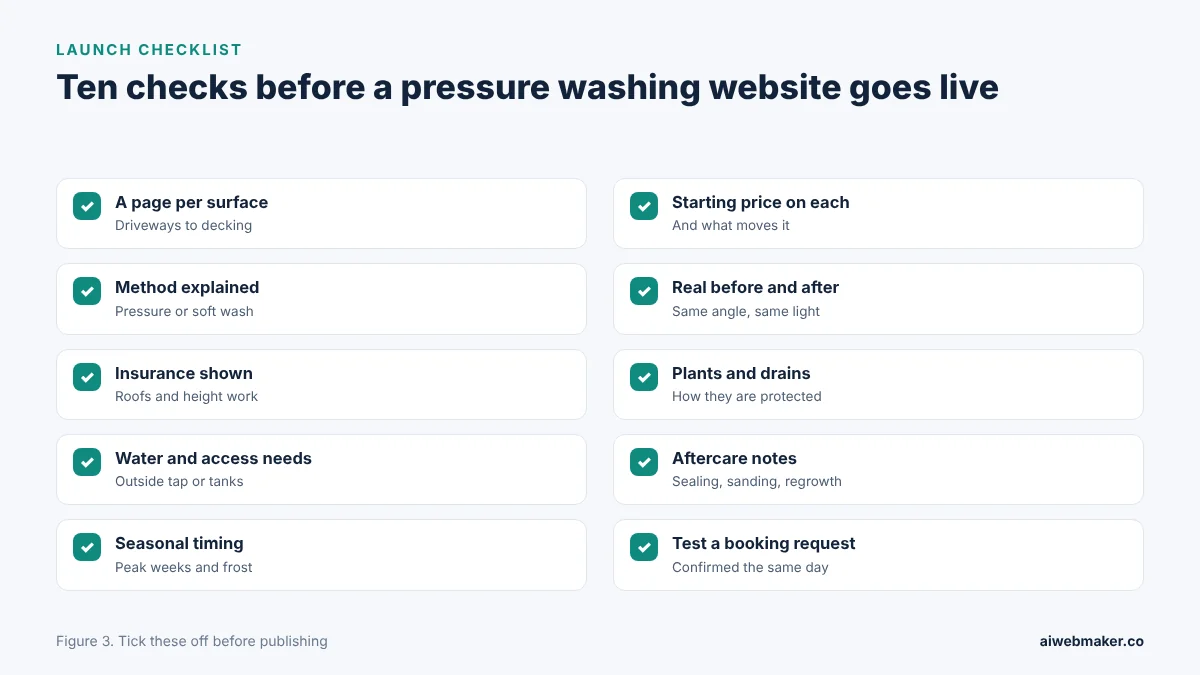
A homeowner doubts an exterior cleaner when the website shows no before and after photos from real jobs. A site with no prices at all, not even starting figures, makes the firm look either costly or evasive. No mention of soft washing for roofs and render suggests the crew will blast every surface the same way. Silence on insurance worries anyone with a fragile roof or an expensive driveway. No word on protecting plants and drains loses customers who care about the garden as much as the patio. The ten points in the exterior cleaning checklist that follows answer every one of those worries before launch.
Frequently asked questions
Will pressure washing damage block paving or render?
Pressure washing can damage block paving joints, soft stone and render if the pressure or technique is wrong, which is why method matters more than power. Block paving often loses jointing sand during cleaning, so fresh sand is usually brushed in afterwards. Render and painted surfaces are generally better suited to soft washing. Older or fragile materials may need a test patch first. A firm that explains these risks honestly earns more trust than one that promises perfect results.
How often should a roof or driveway be cleaned?
Most driveways and patios benefit from a clean every year or two, depending on shade, traffic and the local climate. Roofs need cleaning less often, but moss and algae can return within a few years in damp areas. Treatments that slow regrowth can lengthen the gap between cleans. Customers in shaded or wooded spots may need more frequent visits than those in open sunny areas. A short guide on the website helps customers plan repeat cleans sensibly.
Does the cleaner need water and power from the house?
Many exterior cleaners use an outside tap at the property, while others carry water tanks and their own power. The website should say what the firm needs, so customers can check before booking. Customers without an outside tap should mention it in their request. Commercial sites may have specific rules about connecting to supplies. Clear requirements prevent wasted trips and delayed starts.
Why does a clean driveway sometimes turn green again quickly?
A driveway can turn green again quickly when algae spores remain in joints and pores, especially in shade and damp weather. Pressure alone removes visible growth but may leave spores behind. A follow up biocide treatment, where local rules allow it, slows regrowth considerably. Sealing block paving after cleaning can also help keep it cleaner for longer. Explaining aftercare on the website sets realistic expectations and invites repeat work.
Two driveways and the year is covered
A pair of driveway cleans, or one roof, generally outweighs the $119 an exterior cleaning firm spends to keep its site online for the year. On the monthly plan, $19 is a modest share of a single gutter clear. Every customer who adds a patio or path after seeing the surface prices raises the value of the visit with no extra travel. Real before and after photos, honest notes on method and a quick booking request answer what cautious homeowners want to know. Firms that photograph every job keep their gallery as fresh as the surfaces they clean. A diary that fills each spring with repeat customers shows the site pulling in the right work.
Build your website in Minutes and get the AI Tools that work
Start Building Your Website →