Phone Repair Website Cost, Pages and Pricing: A Repair Bench Guide
A phone repair website on AI Web Maker costs $119 a year to keep live, or $19 a month, plus a domain. This guide covers the pages a repair shop needs, how to list repairs by model and fault, how part quality and warranties should be explained, how repair slots are requested, and what the first year really costs.
- No coding required
- Live in minutes
- Blog, SEO and chatbot tools included
Hosting a phone repair website costs $119 for twelve months, or $19 in any month a bench pays as it goes, and the domain is registered beside it. On AI Web Maker, building the site and testing every page in the preview carries no charge, so an owner can see the finished repair list before paying anything. That price covers hosting for a site with repair pages by device and fault, prices, a warranty and data privacy page, opening hours and a repair booking form. For a sense of how those parts hang together, the sample phone repair shop website shows an imaginary repair counter on AI Web Maker, with online repair booking already in place. The harder question is not the hosting bill but what the website must do for a customer holding a cracked phone. Someone in that position wants their exact model, a price, a turnaround time and a slot, and they want all four within a minute. This guide sets out the pages, the price list, the booking flow, the trust signals and the first year budget that make a repair website earn its keep.
The advice here comes from the way repair customers actually decide, which is quickly, on a phone or a borrowed laptop, and usually while comparing two or three shops. Each section explains one part of the site, what it should contain and why it changes the number of bookings. Tables give the page plan, a sample repair list, the first year costs, a launch timeline and an upkeep calendar. Diagrams show the customer journey, the site map and a final checklist. Owners who already run a repair bench can use the checklists directly, while those planning a new shop can read the guide as a blueprint. Either way, the goal is a website that turns urgent searches into booked repairs.
What does a phone repair website cost at a glance?
Put simply, a repair bench pays a small and predictable sum each year, and the table below lists every line an owner will meet. Hosting is the only fixed charge, chosen as a single yearly payment or as monthly billing. Domain prices depend on the ending a shop picks, so that line carries no fixed figure here. Writing help for blog articles is optional and costs only cents per article. Everything else, from adding new models to changing prices, is done by the owner inside the editor without any further fee.
| Item | What it costs | Notes |
|---|---|---|
| Building and previewing the site | No charge | Every repair page can be checked before paying |
| Hosting on yearly billing | $119 a year | The lowest yearly route |
| Hosting on monthly billing | $19 a month | $228 over twelve months, with no long commitment |
| Higher plan | $189 a year | Listed above the standard plan for comparison |
| Domain | Varies by ending | About 400 endings to choose from, renewed yearly |
| Article writing credits | About $0.65 per article | Optional, for repair tips and guides |
| Changing prices, models and photos | No extra fee | Done by the owner in the editor |
What do customers need from a phone repair website?
Repair customers need four answers in order: whether the shop fixes their model, the price, the turnaround and the earliest drop off time. A customer with a shattered screen often searches from a second device, so the site must load quickly and show the repair list without making them dig. Someone whose battery is fading is less urgent but more price sensitive, and they compare several shops before booking. A customer with water damage is anxious about data, so they look for honest language about what can and cannot be saved. Business customers with several company phones want to know whether the shop handles bulk repairs and invoices. A good repair website serves all of these visitors from the same clear structure.
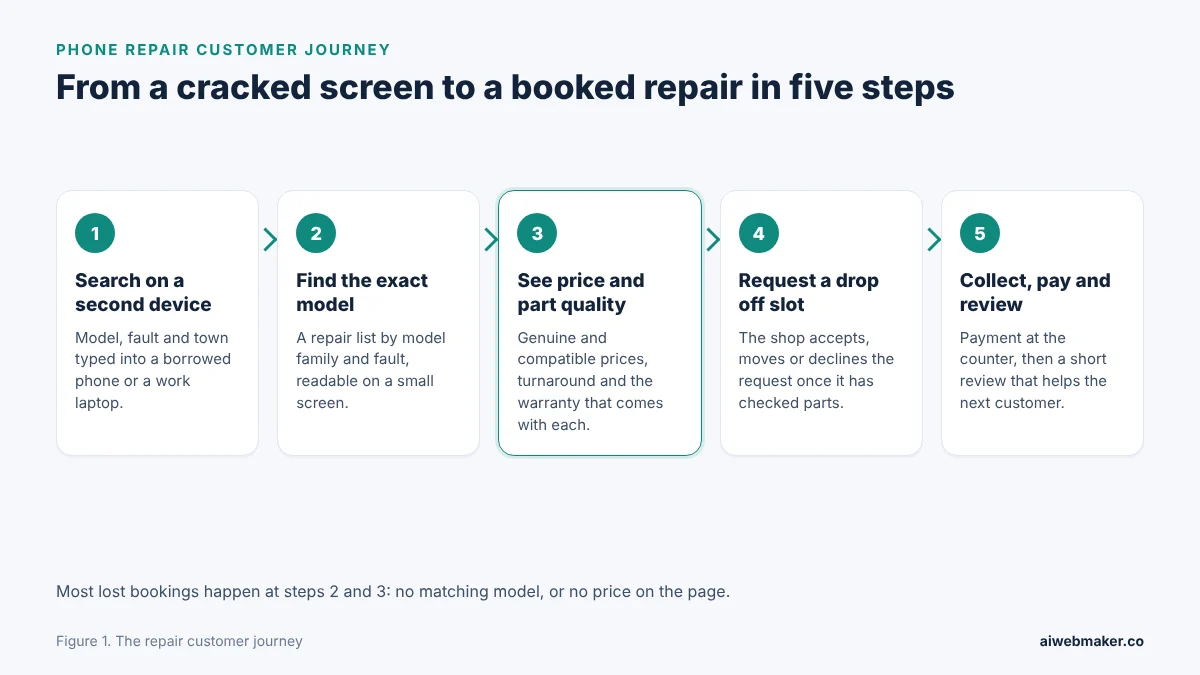
The journey above shows why every step matters. A visitor who cannot find their model leaves at the second step, and a visitor who finds a model but no price leaves at the third. The booking step is where most shops lose people, because they ask customers to phone during working hours instead of letting them request a slot at any time. After the repair, a short follow up asking for a review feeds the next customer's decision. Each of these steps has a page or a feature behind it, which the next section maps out.
Which pages should a phone repair website have?
A phone repair website needs a small set of focused pages, each answering one question a customer brings to the shop. The home page introduces the shop, its location and its most common repairs, with a clear button to book. Repair pages organised by device family hold the real substance, because that is where customers find their model and price. A warranty and data privacy page carries the trust that persuades someone to hand over a phone full of personal photos. The remaining pages, such as mail in repairs, reviews and contact, remove the last doubts before a booking.
| Page | Purpose | What it must include |
|---|---|---|
| Home | First impression and quick routes | Most common repairs, opening hours, location, a booking button |
| Phone repairs | The main catalogue | Repairs by model family and fault, with prices and turnaround |
| Tablet and other devices | Keeps the phone list clean | Tablets, smart watches or laptops if the bench handles them |
| Book a repair | The request form | Repair type, preferred drop off time, contact details |
| Warranty and data privacy | Trust before handover | Warranty length, exclusions, how personal data is protected |
| Mail in repairs | Reach beyond the street | Packing advice, tracking, return delivery and timings |
| About the bench | Human proof | Technicians, experience, tools and parts policy |
| Reviews | Social proof | Customer reviews shared with permission |
| Contact and hours | Practical details | Address, map, phone, walk in hours, parking |
| Repair tips | Search traffic and goodwill | Short articles on batteries, screen protection and backups |
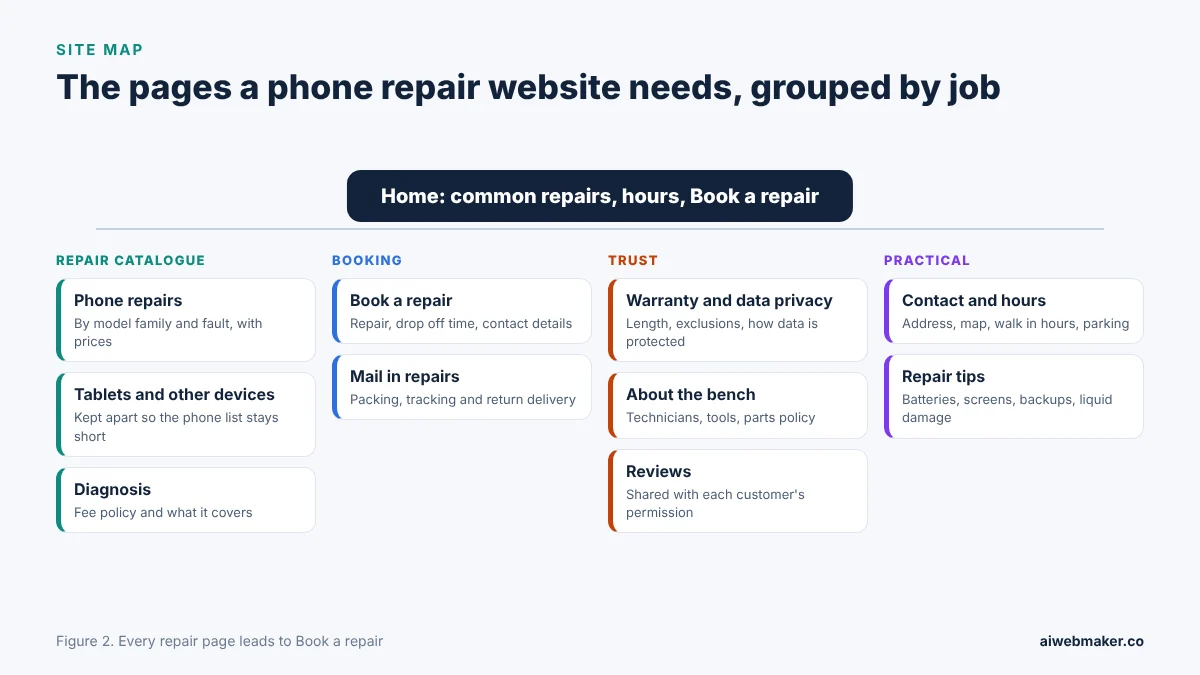
The site map shows how the pages connect, with every repair page leading to the booking form and every trust page sitting one click away from it. Keeping the structure shallow matters on a phone, where each extra tap loses visitors. Owners who repair only phones can merge the tablet page into the main catalogue until demand grows. Shops with a strong mail in trade can promote that page in the main menu instead of the footer. The structure is a starting point that each bench can shape around its own strengths.
How should repairs be listed and priced by model and fault?
Repairs should be listed by model family and fault, so a customer scanning the page finds a line that matches their phone and problem exactly. A heading for each family, such as recent iPhone models or Samsung Galaxy series, keeps a long list readable. Under each heading, separate lines for screen replacement, battery replacement, charging port repair, rear glass and camera faults cover most enquiries. Each line should state the price, the usual turnaround and the part quality being used. A line called diagnosis for anything else catches the customers whose fault does not fit a neat category.
| Repair line | What the line should state | Why it matters |
|---|---|---|
| Screen replacement | Price by model, part quality, same day or next day | The most searched repair, often urgent |
| Battery replacement | Price, battery health check, time on the bench | Planned repair, customers compare prices |
| Charging port repair | Price, cleaning versus replacement | Many ports only need cleaning, which builds trust |
| Rear glass | Price, whether the frame is involved | Prices vary widely between models |
| Camera or lens | Front or rear, price by model | Customers rarely know which part failed |
| Liquid damage | Diagnosis first, no promise of recovery | Sets honest expectations on data |
| Diagnosis | The fee policy, credited against the repair if chosen | Lowers the risk of walking in |
Part quality deserves its own sentence on every price line, because it is the main reason two shops quote different prices for the same repair. Many benches offer a genuine or original part at one price and a compatible part at a lower price, and customers deserve to choose knowingly. Stating which parts carry which warranty removes the suspicion that a low price hides a poor screen. If refurbished parts are used, the page should say so plainly. Customers who understand the difference rarely argue at collection, and they come back because they felt informed rather than sold to.
How does booking a repair slot work on the website?
On an AI Web Maker booking site, each repair becomes a service with its own price and length, and the customer requests a time to drop the device off. A customer selects the repair, proposes a drop off time and submits the request along with a phone number and email. The shop then accepts the request, moves it to another time or declines it, for example when a part for that model is out of stock. Nothing is confirmed until the shop accepts, so the bench never ends up with three screens booked into the same half hour. Payment is taken by the shop in its own way when the repair is collected, and the platform takes no share of any booking.
Repair services are set up for the shop by the booking website builder phone and tablet repair shops use for repair slots, and every line stays editable. Setting realistic lengths for each service matters, because a battery swap and a board level repair should not occupy the same slot. Walk in customers remain welcome, and the booking page can say which hours stay open for them. Owners who check new requests at fixed times each day, such as before opening and after lunch, keep response times short without living on their phone. Fast confirmations are often the deciding factor between two shops with similar prices.
Why do warranties and data privacy decide where customers go?
Warranties and data privacy decide the choice because customers are handing a stranger a device that holds their photos, messages, banking apps and passwords. A clear privacy section explains that the shop only accesses the device when testing requires it, that customers should back up before drop off, and that no personal data is copied or kept. Advice on removing a memory card or signing out of accounts where possible shows care beyond the repair itself. If a passcode is needed for testing, the page can explain why and how it is handled. This kind of plain language reassures careful customers far more than a badge or a slogan.
The warranty section should state its length for each kind of repair, what it covers and what it excludes. Most benches exclude new physical damage and liquid damage after the repair, and saying so upfront prevents arguments later. Parts and labour can carry different terms, and genuine and compatible parts may carry different warranties. A short note on what happens if a fault returns, such as bringing the device back with the receipt for inspection, completes the picture. The wider right to repair debate, summarised in the Federal Trade Commission's business guidance on its Nixing the Fix report about repair restrictions, has made customers more aware that independent repair is a legitimate choice. A confident warranty page is how an independent bench answers that choice.
How should photos, reviews and the bench itself be shown?
Photos of the real bench, the tools and the technicians show customers that the shop is a workshop and not a counter that sends phones elsewhere. A clean, well lit photo of a technician at work, with a microscope or a heat station in view, signals skill in a way that stock images cannot. Before and after shots of a cracked screen replaced are simple to take and very persuasive. Short introductions to each technician, with years of experience and the kinds of repairs they enjoy, put names to the faces. Reviews from customers, shared with their permission, belong near the booking button where doubts are strongest. Real images and real voices are the cheapest trust a repair shop can buy.
How does a phone repair website get found in search?
A phone repair website gets found when titles, headings and opening lines use the words customers type: model, fault and town. A page or a clear section for the most popular models helps searches like screen replacement for a specific phone land on the right line. A complete Google Business Profile, with the same name, address and hours as the website, links the shop to map searches. Reviews collected after each repair help both the profile and the website. Repair tip articles, such as how to tell when a battery is failing, attract visitors who are not ready to book yet but remember the shop later. Steady, specific content beats any single trick.
Repair tips also give the shop a voice that rivals with bare price lists lack. An article on protecting a new screen, or on what to do in the first minutes after a phone falls in water, earns links and shares from customers. Each article can end with the matching repair and the booking button, so readers have a next step. AI Web Maker's writing credits cost about $0.65 per article draft, which makes a monthly tip affordable for any bench. Owners should still read and adjust each article so the advice matches their own policies. Consistency over a year matters more than volume in a single month.
What does the first year really cost?
The first year costs the hosting fee, the domain and any optional article credits, and the table below compares the two billing routes for a typical shop. The yearly route suits an established shop that knows it will keep the site, while the monthly route suits a new bench that wants to test demand first. Neither route charges for adding models, changing prices or uploading photos. The domain price depends on the ending, so it is shown as a separate line. A shop that writes one tip article a month adds only a few dollars to the year.
| Cost line | Yearly billing | Monthly billing |
|---|---|---|
| Hosting | $119 | $228 (12 × $19) |
| Domain | Price of the chosen ending | Price of the chosen ending |
| Twelve tip articles at about $0.65 each | About $7.80 | About $7.80 |
| Edits, new models, price changes | Included | Included |
| First year total before the domain | About $126.80 | About $235.80 |
Set against the shop's own takings, the comparison is simple. A single screen replacement at most shops brings in more than the yearly hosting fee, so the site pays for itself with its first booked repair. On the monthly route, one battery swap typically covers several months of hosting. The real return comes from repeat customers and referrals, because a customer who had a smooth repair tends to come back for the next device in the household. A website that books two or three extra repairs a week changes the economics of a small bench.
How long does it take to launch a phone repair website?
A repair website can be live within a few days, and most of that time goes into gathering prices and photos rather than building pages. The builder drafts the structure from a short description of the shop in minutes, which leaves the owner to refine the repair list and policies. Prices by model are the slowest part, because they depend on current parts costs from suppliers. Photos of the bench and the team can be taken in a single quiet hour. The timeline below is a realistic plan for a shop owner working around normal opening hours.
| Step | What happens | Time needed |
|---|---|---|
| Describe the shop | Name, location, devices repaired, opening hours | 10 minutes |
| Review the draft | Check pages, menu and booking services | 30 minutes |
| Build the repair list | Models, faults, prices, part quality, turnaround | 2 to 4 hours |
| Write the policies | Warranty, data privacy, diagnosis fee, mail in terms | 1 hour |
| Add photos | Bench, technicians, before and after repairs | 1 hour |
| Test a booking | Send a request from a phone and confirm it | 15 minutes |
| Go live | Choose billing, connect the domain, publish | 15 minutes |
What upkeep does the website need each month?
The upkeep is light but regular, and the shops that win online are the ones that keep prices and models current. Parts prices change, new phone models arrive every year, and an out of date price list damages trust faster than having no list at all. Booking requests need a reply within hours, not days, because a customer with a broken phone will book elsewhere. A short monthly article keeps the site active in search. The calendar below spreads these jobs across the year so none of them becomes a burden.
| Task | How often | Time needed |
|---|---|---|
| Reply to booking requests | Daily, at set times | 10 minutes |
| Check prices against parts costs | Monthly | 30 minutes |
| Add new models as they launch | When released | 20 minutes per model |
| Publish a repair tip article | Monthly | 30 minutes |
| Add new before and after photos | Monthly | 15 minutes |
| Review warranty and privacy pages | Yearly | 30 minutes |
| Renew the domain | Yearly | 5 minutes |
Which mistakes cost phone repair shops the most bookings?
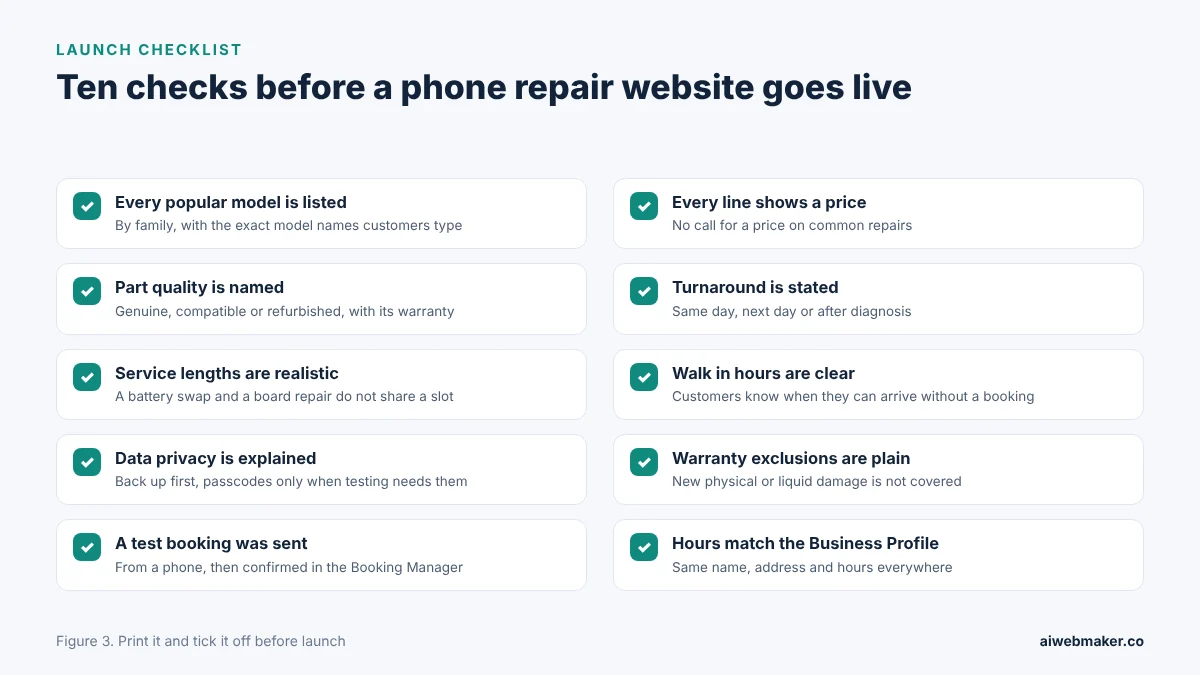
The costliest mistake is hiding prices behind a phone number, because customers comparing shops at night simply move on to the one that shows a figure. The second is listing a single price per repair without saying which part quality it buys, which invites disputes and poor reviews. Ignoring data privacy is a quieter mistake, yet it keeps careful customers away without the owner ever knowing. Slow replies to booking requests waste the effort of every other page. Out of date model lists tell visitors that the shop is not keeping up with new phones. Each of these is easy to fix once the owner knows to look for it.
Frequently asked questions
Should a repair shop show genuine and compatible part prices separately?
Showing both prices side by side is the clearest approach, because it lets customers choose between cost and longevity with their eyes open. A short line explaining the difference, such as brightness, touch response or battery capacity, helps them decide. Each option should state its own warranty so the trade off is honest. Shops that only use one grade of part can say so and explain why. Transparency on parts is one of the strongest trust signals a bench can give.
Does every phone model need its own page?
Every model does not need a full page, but the most popular models deserve a clear section or line that names them exactly. A family heading with lines for each recent model keeps the catalogue readable and still matches specific searches. Older or rare models can be covered by a line inviting customers to ask for a quote. As a shop sees which models bring the most enquiries, it can give those their own page. Growing the catalogue from real demand avoids building pages nobody visits.
How should liquid damage be explained on the website?
Liquid damage should be explained as a diagnosis first, with no promise that the device or its data can be recovered. The page can describe what the shop does, such as opening the device, cleaning corrosion and testing components. A clear diagnosis fee policy, and whether it is credited against a repair, removes the fear of paying for nothing. Advice on what customers should do immediately, such as switching the phone off and not charging it, adds value. Honest expectations protect the shop's reputation when recovery is not possible.
Can customers pay for a repair through the website?
Repair bookings on the website are requests for a slot rather than payments, and the shop takes payment in its own way when the device is collected. This suits most repair benches, because the final price can change after the device is opened and inspected. The booking page can explain accepted payment methods so customers arrive prepared. Mail in customers can be told how and when payment is arranged before the device is returned. Keeping payment at collection also avoids refunds when a repair turns out to be uneconomic.
How many repairs does it take for the website to pay off?
One screen replacement typically earns a shop more than the $119 a year that hosting costs, so the website is in profit from its first booked repair. On monthly billing, a single battery swap usually covers several months of the $19 fee. Every repair after that is income the website helped bring through the door. Owners who want to compare their pages with how locksmiths, electricians and other service trades present themselves can browse the home services website builder for repair shops and trades section. The shops that gain most are those that keep their price list current and answer requests quickly. A bench busy with booked repairs, and customers who return for the next device, is the result worth building toward.
Build your website in Minutes and get the AI Tools that work
Start Building Your Website →