EV Mechanic Website Cost, With the Battery Report Read Line by Line
Hosting an EV workshop's pages costs $119 across the year, while a garage paying monthly sees $19 per bill, and the domain is priced by ending. Inside: drivers, pages, high voltage safety, the battery report, wear items, prices, warranties, search and the yearly sums.
- No coding required
- Live in minutes
- Blog, SEO and chatbot tools included
For an electric car workshop, the website asks $119 per hosting year, or $19 for any single month of bay bookings, while the domain ending carries its own price. Drafting the pages, rewording the battery table and trying out the bay request in preview are steps AI Web Maker does not invoice. One EV service on a single morning brings in more than the whole hosting year. The harder job is persuading drivers who were told that electric cars need almost no servicing, and who suspect a general garage will not understand theirs, to book a bay at all. Ahead come the drivers, the pages, high voltage safety, the battery report, the parts that still wear, prices and bay requests, warranties, search and the yearly budget.
This article is part of our complete guide: Home Services Website Builder.
Warning lights, winter range and a first service: who looks for an EV specialist
Drivers who look for an EV specialist usually arrive with a specific worry rather than a routine reminder. Some have watched their range shrink through a cold winter and wonder whether the battery is ageing. Others own a car that has left the dealer's service plan and are unsure whether an independent workshop can look after it. Buyers of used electric cars want an independent reading of the battery before or soon after they pay. Fleet and taxi drivers covering long distances count tyre wear in weeks, and they book wherever the car comes back quickest. Each group reads the website for the same two proofs: trained hands on the high voltage system and a battery report written in plain words.
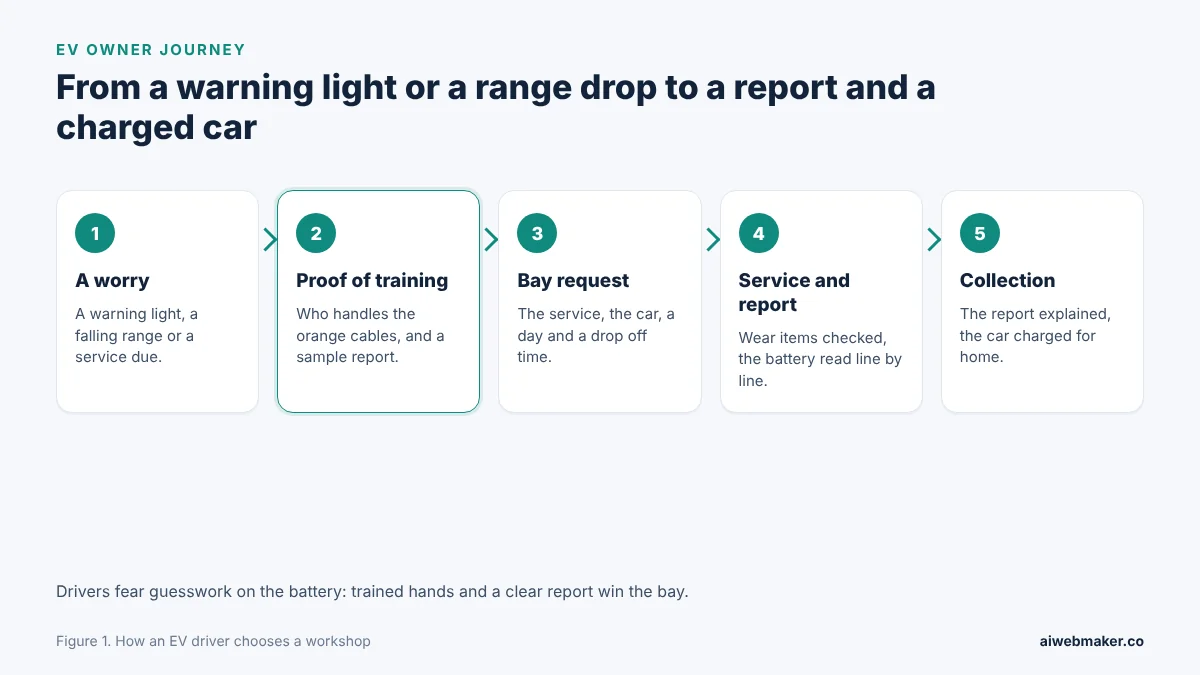
Doubt fills the opening pair of steps in this path, and the workshop wins or loses the driver there. The first step is the trigger, such as a warning that flickered twice, a service reminder or a range figure that keeps falling. The highlighted step is where the driver reads who handles the orange cables and sees what a battery report actually contains, the two answers that separate a specialist from a guessing garage. The final steps cover the bay request, the service and a collection where the report is explained and the car leaves with at least the charge it arrived with. A driver who understands the report on the way out is the one who books again next year and recommends the bays to other owners.
From orange cables to the bay diary: the pages an electric car workshop publishes
An EV workshop's pages should answer the two fears in order, safety first and the battery second, before any list of prices. A high voltage page states who isolates the battery and which jobs are done with the system powered down. Service pages are written around what an electric car still wears out, which corrects the belief that there is nothing to maintain. Prices for the common visits sit close to the top, with a line saying that parts are agreed before fitting. A short list of the cars taken in, and those sent to other specialists, saves wasted requests and keeps the bay diary useful.
| Page | What the driver wants to know | What it should state |
|---|---|---|
| High voltage safety | Who touches the battery | Training held, isolation procedure, jobs done powered down |
| Battery report | What each figure means | Every line explained, no lifespan promises |
| Prices | The bill before the visit | Battery check, EV service, hybrid service, parts agreed first |
| Cars taken in | Whether this car fits | Types of EV and hybrid, and what is referred elsewhere |
| Workshop and chargers | Where to leave the car | Address, hours, chargers for cars awaiting collection |
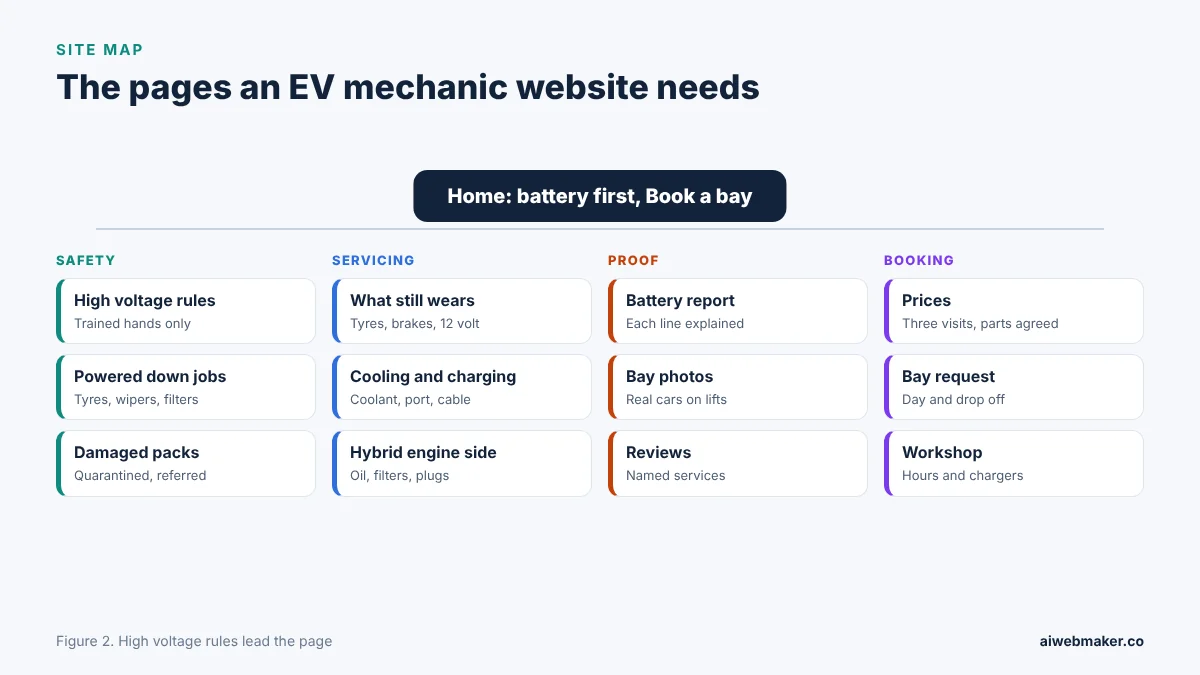
Four groups hold the workshop's pages in this plan: safety, servicing, proof and booking, with the high voltage group placed first on purpose. Servicing covers the wear items and the hybrid engine side, while proof gathers the battery report, photos from the bays and reviews. Volt Garage EV Specialists, the sample business, opens on a battery chart beside promises of trained high voltage technicians, a 90 minute standard service and a report at every visit. The EV mechanic website example with a battery report explained line by line then sets out its safety rules, six wear items from tyres for heavier cars to the charge port and cable, a table decoding the report, and three priced visits: a battery health check at $85, an EV service at $195 and a hybrid service at $245. A gallery, reviews, questions and a bay booking form close the page.
Orange cables stay in trained hands: writing the high voltage page
The high voltage page is where an EV workshop proves it deserves the car, so it should be specific rather than dramatic. Battery packs and their orange cables carry enough voltage to cause serious injury or death, and drivers know it. The page should say that only technicians trained for high voltage systems isolate the battery, work near those cables or remove high voltage parts, following a written isolation procedure each time. Training schemes differ between countries, and in Britain or America, for example, recognised hybrid and electric vehicle qualifications sit alongside makers' own courses. Naming the schemes the team actually holds, rather than borrowing another country's terms, is what makes the page believable.
| Job | Who carries it out | State of the car |
|---|---|---|
| Tyres, wipers, cabin filter | Any trained technician | Powered down, high voltage untouched |
| Battery isolation | High voltage trained technician only | Isolated under a written procedure |
| Removing high voltage parts | High voltage trained technician only | Isolated and recorded on the job card |
| Crash damaged battery | Not opened in the bay | Quarantined and referred to a specialist |
Selling the battery health report as a product in its own right
The battery report is the product that sets an EV specialist apart, because no general garage can offer the same reassurance with a petrol checklist. A report that explains each figure in plain words, and says when further tests would make sense, turns that anxiety into a booking. It can be sold alone, as the sample does at $85, and included in every full service as a reason to return. Buyers of used electric cars are a natural audience, since an independent reading gives them evidence that a seller's word cannot. The page must still admit that a report describes the battery on the day it is read and that nobody can predict exactly how long a battery will last.
| Report line | What it tells the driver | When more tests may be suggested |
|---|---|---|
| State of health | Usable capacity now, against the battery when new | A sudden drop between two visits |
| Cell balance | How evenly the cells hold their charge | One group of cells drifting from the rest |
| Cooling circuit | Coolant level, pump and fan | Low coolant or a stored pump fault |
| Charging habits | How often rapid charging is used, and to what level | Never, since it is a habit rather than a fault |
| Insulation test | Whether high voltage parts stay isolated from the body | Any reading outside the maker's limits |
Tyres, seized brakes and the 12 volt battery: what an EV still wears out
Many drivers believe an electric car needs almost no maintenance, and the service pages should correct that gently, part by part. Electric cars are heavy and deliver strong torque from a standstill, so tyres tend to wear faster and need load rated replacements. Regenerative braking does much of the stopping, which leaves discs to corrode and calipers to stick through lack of use rather than wear. The small 12 volt battery wakes the car's computers and locks, and when it fails nothing starts, however full the main pack is. Cooling circuits for the battery and cabin, the heat pump, the charge port and the driver's own cable all need inspection too. Hybrids add the engine side, with oil, filters and plugs on the maker's schedule, so their page lists both halves of the car.
Three visits priced, parts agreed first and a charged car at collection
Most EV workshop visits fall into a few kinds, and pricing exactly those kinds lets drivers compare a specialist with a general garage on equal terms. The sample prices three: a battery health check, an EV service that includes the report, and a hybrid service that adds the engine side, each showing how long the car stays on the lift. Parts such as tyres, pads and coolant should be priced and agreed before fitting, which removes the fear of an inflated bill. Cars waiting for collection can be plugged into the workshop's chargers, a small courtesy that answers a very electric worry. With the booking website builder for EV workshops that take bay requests, a driver sends a request for a service and a day, and the workshop takes it, moves it to a better day or turns it down. The garage and the driver settle the bill between themselves when the keys are handed back, and no share of the EV service fee goes to the platform.
Battery warranties, pack repairs and the jobs to send elsewhere
Drivers often ask whether using an independent workshop will affect the maker's warranty, and the page should answer carefully rather than confidently. Many makers cover the high voltage battery under a warranty of its own, with terms that differ from the rest of the car. Rules on independent servicing during a warranty vary by country, so the safest wording tells drivers to read their own terms and offers to follow the maker's schedule and suitable parts. Pack repairs need the same honesty, since some modules can be replaced on certain cars while larger repairs belong with a specialist battery repairer. Electric motorbikes, scooters and large commercial vehicles may also belong elsewhere, and a workshop that names its limits earns trust for the jobs it keeps.
EV service near me, battery check, hybrid service: the searches behind the bookings
Drivers searching for EV servicing type plain phrases such as electric car service, EV battery health check, hybrid service or tyres for an electric car, often with a district added. A map listing that shows real bay hours, the chargers by the door and photos of cars on the lifts reassures drivers who have never visited. Reviews that mention a battery report explained in person, or brakes released after months of little use, persuade the next owner more than any certificate logo. Short articles on why range falls in winter, why EV brakes rust or how to read a battery report bring in owners long before anything goes wrong. Steady writing of this kind turns an unfamiliar workshop into the name local EV owners pass around.
Hosting, credits and a domain on an EV workshop's yearly bill
Hosting and the domain make up nearly all of an EV workshop's website year, and twelve battery care articles from AI credits barely reach $7.80. A garage with steady bookings keeps the total lowest by settling $119 for the full year. A workshop that has only just opened its bays may prefer paying $19 as each month comes round. Adding a wear item, changing a price or rewriting the battery table carries no extra charge. Beside both routes, the $189 tier is listed simply so the two can be compared with it.
| Item | Yearly | Monthly |
|---|---|---|
| Hosting the EV workshop pages | $119 | $228 over twelve months |
| Domain | Depends on the ending | Depends on the ending |
| Higher plan, for comparison | $189 a year | Not needed |
| Twelve battery care articles at about $0.65 | About $7.80 | About $7.80 |
| Price, service and report updates | No charge | No charge |
| Year before the domain | About $126.80 | About $235.80 |
No word on high voltage training and no sample report: why drivers try another garage
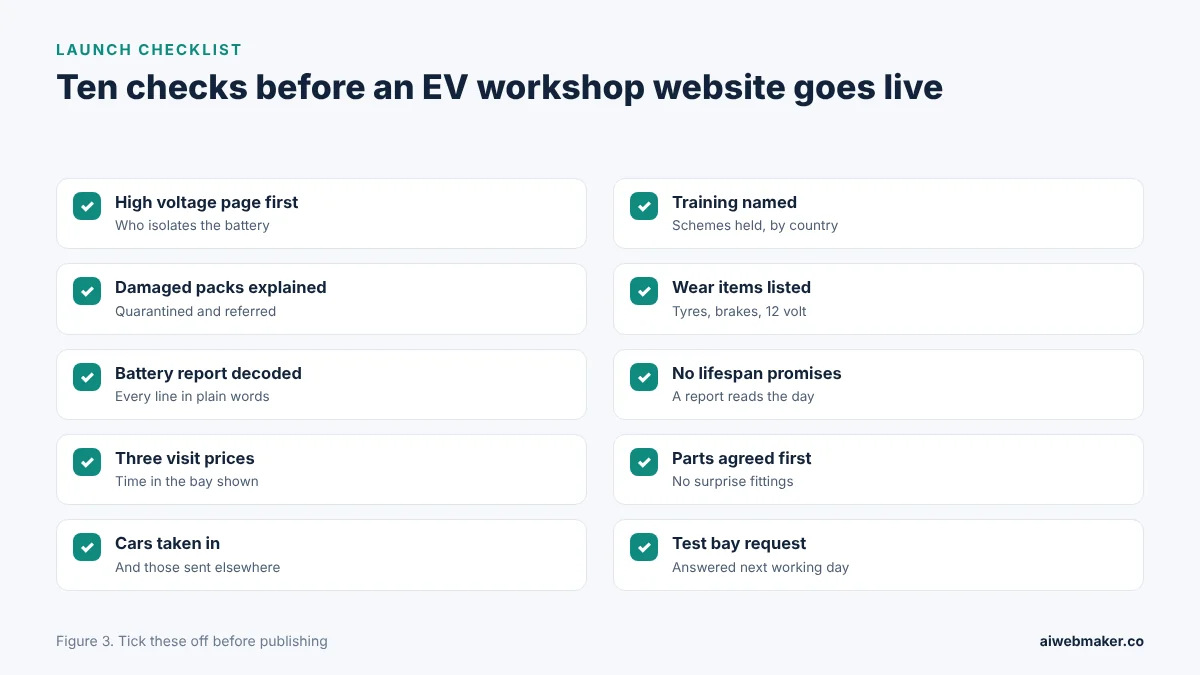
Drivers try another garage when the page says nothing about who works on the high voltage system, because silence there suggests guesswork. A petrol service checklist with the word electric pasted on top tells them the workshop does not know what an EV wears out. No explanation of the battery report leaves the main worry untouched. Hidden prices and no promise that parts are agreed first raise the fear of a large bill for a car that supposedly needs little. Those gaps each have a cure on the launch card below, which an EV workshop can tick off before its first bay request.
Frequently asked questions
Does an electric car still need a yearly service?
Most electric cars still need regular servicing, though with fewer parts than a petrol or diesel car. Tyres, brakes, suspension, cabin filters, coolant and the 12 volt battery all wear or age, and the high voltage system benefits from regular checks. The maker's schedule sets the intervals, which vary between models and countries. A yearly visit that includes a battery report is a sensible habit for many drivers, even when the schedule asks for less. A workshop page that explains this gently wins bookings from owners who assumed they could skip the garage.
Can a battery report predict how many years the battery will last?
A battery report describes the pack's condition on the day it is read, not the date it will wear out. It can show usable capacity against the battery when new, how evenly the cells hold their charge and whether the cooling circuit works properly. Comparing reports from several visits shows a trend, which is more useful than any single figure. Nobody can promise an exact lifespan, because driving, charging and climate all play a part. A workshop that says this plainly is more believable than one that promises years.
Will an independent EV workshop affect the maker's warranty?
It depends on the country and on the wording of the warranty itself, so drivers should read theirs before booking. In many places, servicing by an independent garage is allowed when the maker's schedule and suitable parts are followed, but this is not universal. The battery often carries a separate warranty with conditions of its own. A good workshop records every job and part on the invoice, which helps if a claim is ever made. The page should invite drivers to ask before booking whenever they are unsure.
What should a driver bring when dropping off an electric car?
Drivers should bring the charging cable that lives in the boot, so the workshop can inspect it along with the charge port. The locking wheel nut key matters as much as on any car, because tyre work stops without it. A reasonable state of charge, such as the 20 percent the sample asks for, lets the car be moved and tested on the day. Any warnings, noises or changes in range are worth writing down beforehand, however vaguely. Those notes often shorten the time a technician spends finding the fault.
A battery check and one service, and the workshop's hosting year is paid
A single EV service earns the workshop more than the $119 its pages cost to host for twelve months. Paying monthly instead, one tyre fitted or one 12 volt battery test clears the $19 comfortably. Drivers who book a yearly service after reading the battery page tend to return, and many mention the workshop at the charging point. Plain safety rules, an explained battery report and parts agreed before fitting persuade drivers in ways a general garage struggles to match. A driver who arrives already knowing what the report will show is proof that the pages are doing their job.
Build your website in Minutes and get the AI Tools that work
Start Building Your Website →